Standard observer — where it appears
Named by 99 essays across 9 fields — each of them below, with the objects they name alongside it.

Seventeen observers in 1931
The standard observer that governs every colour specification in industrial use is an average over seventeen young British men, measured with equipment from the 1920s. It is known to be wrong in the blue, the correction has existed since 1951, and it has never been adopted.

Three numbers
A spectrum has as many degrees of freedom as anyone cares to give it. The eye reports three. Everything colour science can do, and every way it fails, follows from that one collapse.

Matching is not appearance
CIE XYZ predicts when two lights will look the same under identical viewing conditions. It was never a model of how anything looks, and most of the confusion in applied colour comes from using it as one.

The eye that has no colour
Rods outnumber cones twenty to one, work alone below a hundredth of a candela, and are absent from the centre of gaze. Between dusk and a lit room both systems run at once, and neither standard curve describes what is happening.

Whose eyes
The standard observer is an average over seventeen people, and no reader is it. What that costs was small when displays were broad and grows every time the primaries get narrower.

What a lamp cannot give back
Six hundred and eighty-three lumens per watt is not a measurement of anything. It is the definition of the candela, it is a ceiling no white light can approach, and the distance between a lamp and that ceiling is mostly the price of being able to see what colour things are.
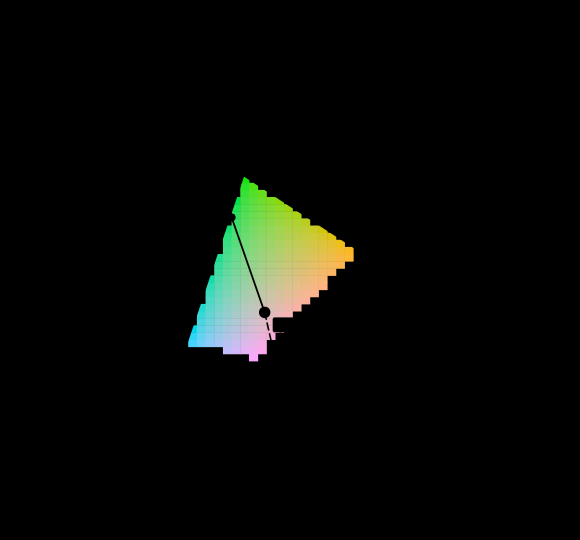
Not every colour has a wavelength
The question every reader arrives with is which wavelength a colour is. For close to a third of the directions on the chromaticity diagram the honest answer is that there is none, and the construction colorimetry offers instead is a statement about a diagram rather than about light.

Nothing is in focus at both ends
The eye carries about two dioptres of chromatic aberration across the visible band, which is a strong reading prescription. Whatever it is focused on, most of the spectrum is landing somewhere other than the retina — and the cone class that gets the worst of it is the one the retina bothered least to sample.

The mosaic is not the observer
The ratio of long-wavelength to medium-wavelength cones varies between ordinary people by a factor of sixteen. Those people make the same colour matches, to twelve decimal places, and that single fact is the reason a standard observer can exist at all.

The algorithms that guess the light
What reaches a sensor is an illuminant multiplied by a reflectance, and no arithmetic separates a product into its factors. Every white-balance algorithm therefore works by assuming something about the world — and the interesting content of each is not its formula but the assumption, because a scene can violate it.
Two degrees or ten
This site names the observer on every figure it draws, which was supposed to be the point. Measuring what it had actually done found two hundred and four figures naming the same observer, three naming the other, and sixty-two of sixty-four generators printing a string that had never once varied.
A patch is not a scene
A paint chip is the wrong size, on the wrong background, at the wrong luminance, in the wrong surround. Every one of those is a term in an appearance model, and the model says how much each of them moves the answer — which is the difference between a caution and a prediction.
Six numbers make a space
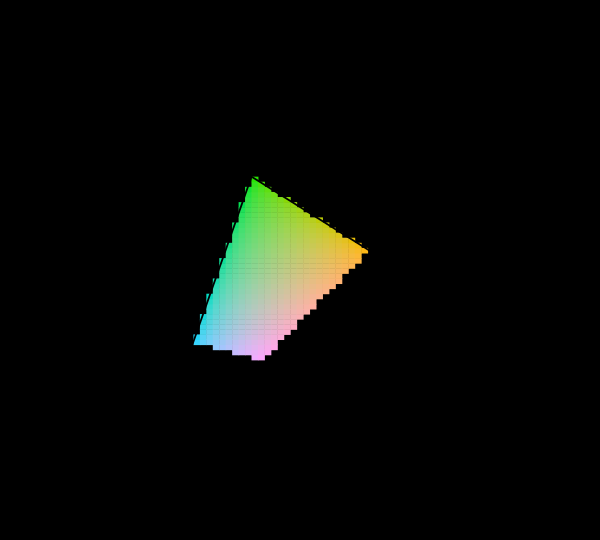
An RGB colour space is eight numbers — three primary chromaticities, a white point, and a transfer function — and everything else about it is derived. Deriving it rather than copying the matrix is the difference between having a colour space and having a table somebody else computed.

The sun is not one illuminant
Daylight is not a blackbody and is not one spectrum. It is a one-parameter family reconstructed from three measured basis functions, its chromaticities lie on a curve that is near the Planckian locus and not on it, and the difference is the reason a colour temperature needs a second number beside it.

A bounce is a multiplication
Colorimetry multiplies an illuminant by a reflectance once and integrates. A surface in a room is lit by every other surface the lamp reached first, so the spectrum arriving at the eye has been multiplied several times — and the second multiplication is where the whole apparatus of matching starts to come apart.
Two paints that stop matching
A metameric match is an identity between three integrals that are linear in reflectance. A second bounce carries reflectance squared, and no linear identity survives being squared — so two paints certified identical on a flat chart come apart in a corner, by an amount the geometry decides and the colorimetry cannot express.

A shadow has its own illuminant
Outdoors there are two lights, not one. The direct beam is a radiator reddened by the atmosphere; the sky is precisely the power that reddening removed. A shadow is lit by the second alone, so shadowed ground and sunlit ground sit under illuminants 21 units of ΔE apart — before any surface, any eye or any opinion is involved.

The highlight is the lamp
Light reflected at the surface of a glossy material never entered it, so it never met a pigment. Fresnel's reflectance varies by 5.5% across the visible band and the paint underneath varies by a factor of twenty — which makes a highlight the one region of a photograph that reports what the light was rather than what the object is.

Rendering in three numbers
Almost every renderer ever shipped bounces red, green and blue rather than a spectrum. The error that costs is exactly zero at the first product and grows at every one after it — because three numbers cannot carry a product they were never given the factors of, and each bounce is another product.

What a white wall costs
A closed room returns 1/(1−ρ) times the light that entered it, computed band by band — so a paint that is five percent off neutral becomes a strongly coloured illuminant once the room has finished bouncing. The gain amplifies the tint along with the brightness, and the last few percent of albedo cost far more than the first.

A corner is not a wall
A form factor is the fraction of everything leaving one surface that arrives at another, and it is the only place geometry enters the colour of a room. It is also the one number here with a published closed form to check against — and the check turned out to converge at two different rates for two cases that look identical.
The room is the illuminant
Colour bleeding is usually described as an aesthetic phenomenon of rendered images. It is better described as a measurement. In a room with one lamp, five of six surfaces emit nothing at all, so their light is entirely a product of other surfaces' reflectances — and the bleeding saturates rather than running away, for a reason worth deriving.

Paint is not a filter
Stacking two filters multiplies their transmittances. Stirring two pigments together does not multiply their reflectances, because a mixture is one scattering layer rather than two in series — light meets whichever particle is nearest. Treating the two as the same operation is a 15-unit error, and which way it errs turns out to depend on whether the comparison holds the amount of pigment fixed.

Why blue and yellow make green
The oldest fact in colour, and the usual explanations are wrong. It is not because green sits between blue and yellow, and it is not a fact about the eye at all — it is that the only band both pigments return is their overlap, and the overlap of a blue and a yellow reflectance is green. Computed, the mixing path bows away from the straight line by a measurable amount.

The colour is in the thickness
Transmittance is exponential in path length and the observer is linear, so doubling the depth of an absorbing medium squares the transmittance rather than halving the colour. A translucent object therefore has no one colour — its thin edge and its thick middle are different spectra of the same substance, and the hue moves between them.

A colour that moves with the viewer
A thin film has no pigment in it. Its reflectance spectrum is an interference condition containing a path length and an angle, so tilting the sample moves every maximum to a shorter wavelength and changes the colour by 40 units of ΔE. A pigment's spectrum contains neither, and cannot do this at all — which is the cleanest separation between the two kinds of colour there is, and it is geometric rather than chemical.

No surface can be that colourful
There is a hard bound on object colour that no pigment will ever move, and it follows from a reflectance being at most 1. Its boundary is generated by two numbers, it shrinks by a factor of eleven from dark to light — and measured against it properly, sRGB reaches 40% of what a surface could be at mid lightness while Rec. 2020 reaches 106%.
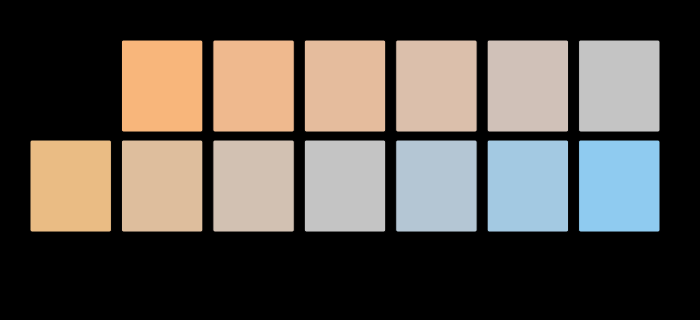
A scene has no white point
White balance is one transform applied to a whole image, and a scene lit by two lamps has no single answer for that transform to be. The failure is structural rather than a matter of a better estimator — and every colour-managed workflow in existence takes exactly one white point as an input, with no field in which to say there were two.

Gloss changes the measurement
The same sample measured with the specular component included and excluded returns two different numbers, and both are correct answers to different questions. Colour is one of four appearance attributes and the only one most instruments report — so a specification that names a colour has silently named a geometry too, and usually does not say which.

A camera is a fourth observer
The 1931 functions, the 1964 functions and a person's own cones are three sets of three curves that collapse a spectrum onto three numbers. A camera is a fourth, built from silicon and dye rather than from pigment and neural wiring, and it agrees with none of them.

Luther said when it would work
There is an exact condition under which a fixed three-by-three matrix converts camera raw to XYZ correctly for every spectrum in existence. It was stated in 1927, it is a theorem rather than a guideline, and no camera ever built satisfies it.

The camera has its own metamers
Two surfaces a camera records as identical can be plainly different to a person, and two a person cannot tell apart can be recorded as different. Both pairs are constructed rather than found, from one projection, used for both.

The grid outside every figure
Every figure here is computed on 380 to 780 nanometres, which is exactly right for an eye and insufficient for a sensor. This field met the first subject the grid cannot hold, and the decision was not to widen it — because widening it honestly is impossible.

There is no D65 lamp
D65 is standardised by three numbers, and three numbers do not pin a spectrum. A source built to hit them exactly — matched to a part in a billion, with a third of the visible band nearly empty — separates pairs that D65 says are identical by up to eight and a half units of colour difference.

A cone absorbs its own light
A photopigment's absorbance is a property of a molecule; a cone's sensitivity is that molecule stacked in a column deep enough to absorb most of what arrives. The stacking broadens the curve by thirty-five nanometres, and two observers differing in nothing else disagree about a match that is exact for one of them.
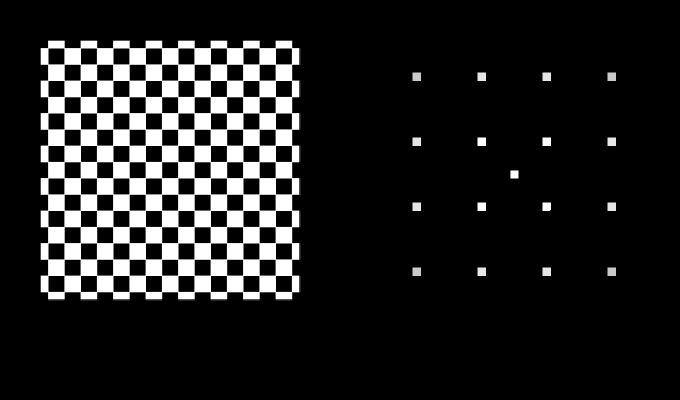
A pattern has a direction
Every spatial claim here is a claim about a frequency, and a frequency has no direction in it. Turning a printed screen forty-five degrees makes it exactly twice as quiet with nothing else changed — and the same rotation does nothing at all to a chromatic one.

Colour stops at the edge of sight
Cone density falls twenty-one-fold between the centre of gaze and ten degrees out, and the three channels give out at three different rates — so a colour difference in the periphery does not merely shrink, it turns. At the exact point of fixation there are no short-wavelength cones at all.

The eye has a shutter
An isoluminant flicker fuses at fifteen hertz and a luminance one at sixty, so a light whose colour changes forty times a second is a steady light of a colour it never emits. And the frequency at which flicker stops being visible is not a property of the eye — it moves twelve and a half hertz for every decade of light.

Which of two is worse
Two colour-difference formulae disagree about which of two pairs is the larger difference in thirteen per cent of comparisons overall — and in forty-three per cent of comparisons among pairs sitting near a tolerance of one unit, which is where every acceptance decision is actually made.
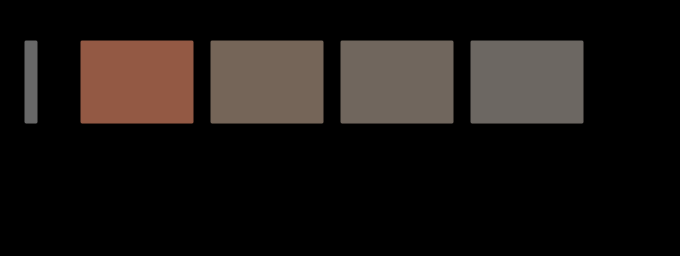
A difference has no place
A colour difference formula answers a question about two patches somebody is looking straight at. Move the same pair ten degrees into the periphery and a third of it is left — and it has turned twenty-four degrees of hue, because the three channels give out at three different rates.

The laws that make colour add up
Colorimetry is an integral, and an integral assumes matching is linear. Grassmann's four laws are exact for a linear observer, to floating point — and they fail at both ends of the light range, by two different mechanisms, leaving colorimetry an operating band of three and a bit decades that no standard states.

One match names the observer
A yellow at 589 nanometres set against a mixture of 545 and 670 is two equations in two unknowns. It has one solution for a normal observer, a solution somewhere else for an anomalous one, and no unique solution at all for a dichromat — whose two equations are one equation twice.

Nobody here has two eyes
One person's two eyes differ in macular pigment and lens density, so the same light produces two colours — a whole ΔE00 apart for an ordinary pair, seven for one replaced lens. Adaptation hides it exactly, which is why nobody notices and why nothing in colorimetry has a term for it.

A colour has a name
Every quantity here is a number, and the question a reader arrives with is what colour something is called. The eleven basic terms of English divide the space into territories that differ by a factor of five, the metric accounts for fifteen per cent of that, and one of the eleven focal colours cannot be shown on this page at all.

A catalogue is not a vocabulary
A colour order system is a regular lattice, because a person has to be able to find a page. Sorted by what its chips would be called, that lattice comes apart into piles differing by a factor of three — and a fifth of all one-step moves in it change the name.

Four primaries have a choice
Three primaries matching three numbers have one answer. Four have a family of them, every member exact to floating point for the observer they were solved for — and the members are not equally good for anybody else, so a display with a fourth primary has a setting that is robust to who is looking at it and a setting that is not.

A tolerance is a probability
A colorimeter reports one number and a specification compares it with another, and both are computed for an observer who does not exist. Handed to two hundred people, the same pair at ΔE00 1.0 is read from 0.8 to 3.7 — and which of those two ranges applies depends on something no specification records.

Three constants nobody quotes
CIEDE2000 is defined with three parametric factors in it, the CIE leaves them to the industry using the formula, and the two settings in ordinary use differ by a factor of two in one of them. Twenty-nine per cent of acceptance decisions change between the two — a larger disagreement than any between the formulae themselves.
There is no word for that colour
The naming model built this phase gives a saturated cyan the name green, calls part of a chromatic ring grey, and puts one of the eleven focal colours outside what a display can show. Each failure is a measurement rather than a disclaimer, and together they say what a vocabulary is that eleven points and a distance are not.
One person is two observers
The macular pigment is a yellow screen over the fovea and nowhere else, so a cone at the centre of gaze and a cone ten degrees away have different colour-matching functions in the same eye. A match made in the middle comes apart at the edge by six units — and fitting one filter to the gap between the CIE's two standard observers gives a density of 0.40 against a measured 0.35.

The index is one observer's opinion
A colour rendering index is printed to a tenth of a point and computed for a single set of colour-matching functions that no standard names as a choice. Scored by two hundred eyes instead, one lamp's spread is wider than the whole range the standard observer puts five lamps in — and two lamps the standard separates by four tenths of a point come out the other way round for every member of the population.

A fourth primary is a design
A display's fourth emitter is sold as more colour. Optimised instead against how far apart two hundred eyes are about its white — with the gamut held fixed so it cannot cheat — it buys agreement, and two and a half times closer together than three primaries reaching the same area, and the wavelengths it chooses are not the ones anybody would pick.

Fitted to an eye nobody has
A camera profile's residual against the observer it was fitted to is under a unit, and that is the number everybody quotes. Against a person drawn from a population it is 3.35 at the ninety-fifth percentile — and a camera with no spectral error whatever, reporting the standard observer's tristimulus values exactly, would carry 3.47. The camera is not the problem.

What no adaptation can remove
A change of light is exactly a 3×3 matrix on tristimulus values, and adaptation is a diagonal one. Putting every change of illumination this site models through that distinction sorts them by how much of themselves they leave behind, and the smallest residual in the census belongs to a filter inside the eye.

A gain needs a basis
Adaptation scales three signals, and which three is a choice. The basis in which a change from D65 to D50 is exactly diagonal can be computed in closed form from the two spectra, it beats every published transform on daylight by a factor of five, and it loses to all of them on a fluorescent tube.

A gamut has a population
Whether a display can reproduce a paint is a fact about somebody's cones, so the boundary of a gamut is not a curve but a band. On a laser projector, ten of twenty-eight boundary surfaces are ones the standard observer calls displayable and some real people cannot see — and the wider the gamut, the wider the band.

The tables do not stop together
This collection integrates from 380 to 780 nanometres, and decided once, in writing, that the range could not honestly be widened. The argument was correct at the long end and wrong at the short one — the CIE publishes the daylight basis from 300 nanometres, and publishes it from there for exactly the reason it matters.

The eye stops at the lens
Neither standard observer is tabulated below 360 nanometres, and the reason is not that the photopigments stop absorbing there. It is that the light never arrives — the cornea and the crystalline lens take it — so the short-wave limit of human colour vision is a piece of optics, it moves by a factor of twenty across a lifetime, and it can be surgically removed.

The eye weights where the light is not
A brightened sheet returns a quarter more light than arrives at 430 nanometres, and it is three tenths of one per cent brighter for it. The luminous efficiency function is 0.017 there against 1.0 in the middle of the band, so the whole effect lands in the blue-yellow axis — brighter than white is a colour claim wearing a brightness word.

The matches do not name the cones
Colour matching is the whole empirical basis of colorimetry, and it fixes the observer's three curves only up to a nonsingular 3×3 — nine numbers that no match, in any quantity, to any precision, can see. One particular choice of those nine is used throughout here, and it was made for a different purpose.

Which of these is a convention
Nine ordinary sentences from this collection, put through one test — do they mean the same thing after the observer's three curves are replaced by a nonsingular combination of themselves? Five survive and four do not, and none of the four is wrong, because each is a statement about a set of coordinates being read as a statement about an eye.

A width nobody varied
Five numbers say how much people differ from one another, and every conclusion drawn here about a population rests on them. Each was written down with the range the literature reports beside it, so that a result could be re-read at the pessimistic end. Nothing ever was.

Which measurement is worth making
Four things about an eye differ between people, and they have been ranked here by how much of the answers they carry since the population was built. Ranking them by how much doubt they carry gives a different order, and ranking them by which one takes a published claim closest to failing gives a third.

The observers differ by a unit's worth
The gap between the 1931 and 1964 standard observers is the one quantity in this collection's audit with no published number under it — nothing here reports it as a single figure over a stated set. It also has the second-largest dependence on which colour-difference formula is used, running from 1.60 to 3.55 across the menu.

The population rests on a template
Two hundred observers here are built from one formula fitted to microspectrophotometry in 2000. The obvious alternative — the tabulated cone fundamentals — is not available, and the reason is the finding. A tabulated fundamental has no peak wavelength to move, so the moment it is used the population collapses to a single observer.

A template is mostly its tail
Four pigment templates matched to the same width at the same peak, differing only in which side of the peak their half-maximum reaches further. Ordered by that one number, the observers they build are ordered by how far they sit from the standard one — and the two with the tail on the wrong side cost two and four times what either real nomogram costs.

The band below four hundred
The pigment template every observer here is built from carries a second, smaller absorption band in the ultraviolet, published at 0.26 of the main one. Dialling it from nothing to twice that moves the median observer monotonically away from the standard one, with no interior optimum — which is what a physical constant looks like when nothing downstream is pulling it anywhere.

The index is a choice too
Every colour in this collection is a sum over eighty-one numbers running from 380 to 780 nanometres in steps of five. That index is not a property of the eye, the light or the sample — it is a tabulation, and it holds three separable decisions that behave completely differently from one another.

A neutral has no grid
A perfectly flat reflectance computes to exactly the same colour on every wavelength grid, through every slit, at every origin, and for every observer — not nearly, but to the last bit of a floating-point number. The condition is an identity rather than a limit, and what makes it one is the white point.

Two ends and one is empty
Extending this collection's wavelength range down to 300 nanometres moves a red pigment under daylight by 0.502 ΔE₀₀. Extending it up to 830 moves the same colour by 0.00015. A fifth of a thermal source's power lies outside the range and almost none of its colour does, and confusing those two shares is how a range gets argued about instead of measured.

The reference had to be built
A five-nanometre error cannot be measured with five-nanometre data. Interpolating the tables and integrating finely measures the interpolator, not the grid — so the audit of this collection's index had to be run against an observer made of formulae, and the price of that is a residual of 1.42 ΔE₀₀ that every number in the section is read beside.

The third factor is a construction
Every figure in this collection names its observer, which was the whole point. None of them says what an observer is made of. Three curves are not a measurement of the eye; they are a projection of one, with a field size, an age, a macular density, three peak wavelengths and a luminance constraint inside them.

A neutral is everyone's colour
Two eyes differing by fifty years of lens yellowing, by a factor of three in macular pigment and by six nanometres of long-wavelength peak agree about a grey card to four parts in ten thousand billion. The agreement is an identity rather than a coincidence, and it says exactly what an observer disagreement is a disagreement about.

A gain is not an observer
Multiply one eye's three cone sensitivities by 1.6, 0.7 and 2.4 and it is not a different eye. The white-point division is that multiplication's inverse, so the two agree exactly — and most of what a cone optical density change does is that multiplication, which is why the largest number in the table of individual variation is the one that matters least.

Three curves for one space
Rotate a set of colour-matching functions by an arbitrary invertible matrix, undo the rotation at the end, and the computed colour is identical to eight parts in a thousand million million. An observer is a three-dimensional subspace, not a set of curves, and the literature keeps reopening a question that is a theorem.

The identity is in the eye's own coordinates
Two conditions in this round are exact — a gain on each cone is not a different observer, and three curves for one space are one observer. Imposed in a published cone space rather than the eye's own they leave 13.0 and 8.11 ΔE₀₀ standing. The identities belong to the physiology and every arithmetic in use works somewhere else.

The lens is worst under tungsten
An ageing lens costs 4.38 ΔE₀₀ under a tungsten lamp and 2.20 under a fluorescent tube. The pigment peaks cost 2.84 under a three-emitter LED and 1.87 under the same tube. Six departures across six lights do not form a single ordering, which is what a pairing looks like and what a dominant term would not.

A departure is straight in the excitations
Walk a sample a quarter of the way from the light towards its own reflectance and exactly a quarter of the observer disagreement remains — in cone excitations, to two parts in a hundred. In ΔE₀₀ the same quarter leaves 0.347 where proportionality wants 0.428, and the discrepancy belongs entirely to the unit.

The ranking is not stable
On a red pigment under daylight the six observer departures run from 2.38 down to 1.20 ΔE₀₀. Over forty-two surfaces two of them change places, the top two separate, and every one spans between a factor of ten and a factor of thirty-five. A chart of six bars is a chart of one example.

The grid hid the observer
On this collection's five-nanometre grid a three-laser projector's observer disagreement is exactly zero. On a quarter-nanometre grid it is 2.34 ΔE₀₀ and the largest in the table. The two audits of this round meet here, and the first one does not compound with the second — it removes it.

One wavelength is everyone's colour
A stimulus with a single wavelength in it produces the same relative cone excitations for every observer, exactly, whatever their age or field size. A display made of three such stimuli is where observers disagree most. Both statements are consequences of the same algebra, and the second is why laser projection has an observer problem.

A field size is two changes
The CIE publishes two standard observers and the difference between them is usually described as a field size. What actually differs is a macular pigment the light no longer passes through and a cone outer segment the light no longer travels the length of — two changes, in two places, with different signs and different sample dependence.

The observer has no age
Five of the six arguments in this round are spreads — a population differs about them and the mean is a reasonable summary. The lens is not. Everybody's lens yellows in the same direction at about the same rate, so a standard observer with no age is not an average over a population; it is a snapshot of one moment in every reader's life.

The rods are a fourth curve
Colorimetry has three numbers and a rod signal is a fourth. It cannot be absorbed by a gain, it cannot be removed by a white point, and adding a tenth of one to a three-curve observer costs 1.60 ΔE₀₀ — the narrowest distribution of the six departures, because an addition behaves quite differently from a filter.

The macular is a band, not a filter
The lens absorbs everything below 500 nanometres with a long tail; the macular pigment absorbs forty nanometres either side of 460 and nothing else. The two have similar sizes and completely different distributions, and the reason is that one is broad and one is narrow — which is what decides whether a sample is affected at all.

The peaks move the flanks
Shifting a cone's peak wavelength by three nanometres changes its sensitivity at its own maximum by almost nothing and on its flanks by several per cent, because a maximum is flat and a flank is steep. Every display primary sits on a flank, which is why a pigment polymorphism is worth 3.60 ΔE₀₀ under a laser projector.

An observer is a contract
Six departures, all above a delivery tolerance, none dominant, and no reader matching the standard on any of them. That would be a demolition if the standard observer were a description of an eye. It is not — it is an agreement about what a number means, and an agreement is not falsified by being unlike anybody.
A tolerance with an observer in it
A delivery tolerance is written in ΔE₀₀ against the 1931 observer, and six departures of that observer combine to about three of the same units on an ordinary saturated sample. A one-unit tolerance is being asked to contain a three-unit uncertainty that nothing in its budget mentions.
The instrument is one observer exactly
A spectrophotometer has no observer uncertainty. It computes through the 1931 tables to the last bit, reproducibly, forever — which is its whole value and is also why it cannot report the three colour differences of observer spread between itself and whoever is looking at the sample.

The chart was measured by an observer too
A camera profile is fitted so that the camera's numbers reproduce the chart's measured tristimulus values. Those values were computed through the 1931 observer, so the fit inherits every departure in this round — and the fit's own residual, at 0.19 ΔE₀₀ on the chart, is fifteen times smaller than the term it cannot see.
The census under another observer
This collection's largest computed result is an adaptation census — fourteen changes of light judged over a hundred and twenty-five constructed surfaces. Every number in it was computed through one observer, and the observer's own departures are between one and two and a half units on the same surfaces, which is the size of the effects the census reports.
The appearance model takes XYZ
CIECAM16 predicts how a colour looks, and its input is three tristimulus values computed through a standard observer. Everything this round measures happens before the model is called, so an appearance prediction inherits six observer departures and a choice of cone space before it begins.
Two observers and one metamer
An observer departure is invisible on a single sample compared with nothing. It becomes a disagreement the moment two spectra are being asked to match, because a match is an identity between three integrals and a different observer takes different integrals. Everything in this round is a statement about pairs wearing a single sample's clothes.

A sensor has no lens
A camera is a fourth observer and it is the only one with none of the six arguments this round measured. It does not age, it has no macular pigment, its response does not broaden with density and its peaks do not vary — so it is perfectly reproducible and is not any of the observers it is fitted to reproduce.

Two yellow filters cancel on a slope
An older lens and a denser macular pigment both take blue out of the light, and read before adaptation they move a colour in nearly the same direction, eight degrees apart. Once each eye has adapted to its own white they point a median 156 degrees apart on smooth reflectances and together cost less than the lens alone. On surfaces with a narrow absorption band they still sit 26 degrees apart and add. What decides it is the width of the surface's own features.

A soft proof is exact for one reader
A display can be driven to match a printed patch exactly for the standard observer — three equations, three unknowns, agreement to fourteen decimal places. Two hundred observers drawn from a realistic population see the same screen and print a median of 2.1 colour differences apart on an OLED panel and 5.4 apart at the ninety-fifth percentile. On a laser projector the ninety-fifth percentile is 7.5. The patch that fails worst is unprinted paper, and in the chain's own unit the ninety-fifth percentile reader's stage is larger than every one of the four stages a delivery chain is budgeted for.

A proof cannot be tuned for readers who disagree
A soft proof matched exactly for the standard observer is five colour differences wrong for one reader in twenty. Giving up that exactness to tune the display's three drives for a population instead moves the ninety-fifth percentile reader by 4 to 14 per cent even when the tuning is done on the very readers it is scored against — because what readers see is mostly each other's disagreement, and three drives act on every reader at once.

The metamerism index has two corrections
The index for a metameric pair is defined for a pair that matches exactly under the reference light, and no real pair does. The standard's remedy is to correct the sample first, and it names two corrections — scale the tristimulus values, or add the difference. On six pairs matched to one colour difference, the two answers differ by a tenth to four tenths of an index unit; at two, by a whole one.

A name moves with the reader
Three earlier essays have moved a colour's name by changing the distance function, the room and the space. All three held the observer fixed. Handed the same light from the same display, sixty observers rename between 3.5 and 13.1 per cent of the gamut against the standard observer, a quarter of its colours have a dissenter in twenty, and the narrower the display's primaries the worse it gets.
Named alongside it
The objects these essays reach for when they reach for this one.
Individual variationObserver metamerismSpecificationCone fundamentalsMetamerismReflectanceColour-matching functionsΔEMacular pigmentIlluminantChromaticityPrimaries