Depth

Series

A field says what an essay is about. A series follows one idea essay by essay — from the question that introduces it to the one that assumes all the others.

Two identical grey patches on different surrounds. Both inner squares are #818181. The one on the dark field looks lighter. The values are checked to be equal before the figure is drawn, so the claim is a fact about the drawing rather than a promise.

Appearance

  1. 1 These two patches are identical
  2. 2 Brightness is inferred from edges
  3. 2 Constancy is the default
  4. 3 A viewing condition is an argument
  5. 3 Four ways to move a white point
  6. +48 more
53 essays · brain
A spectrum, weighted three ways, and the three numbers left over. The illuminant D65 above; below, the same spectrum multiplied by each matching function. The area under each product is one coordinate of XYZ. Everything else about the spectrum — its shape, its structure, all its remaining degrees of freedom — is discarded here.

Cones

  1. 1 Three numbers
  2. 2 Two spectra, one colour
  3. 2 Why colour is exactly three-dimensional
  4. 2 The eye that has no colour
  5. 3 Three cones, two axes
  6. +48 more
53 essays · eye
Three colour-difference formulae, disagreeing. ΔE76, ΔE94 and ΔE2000 for the same 9 pairs of colours. The largest disagreement between ΔE76 and ΔE2000 here is 26.6 units — larger than the threshold usually quoted for a just-noticeable difference, so the choice of formula can decide whether two colours count as matching.

Metric

  1. 1 How far apart are two colours
  2. 2 MacAdam measured it
  3. 2 The midpoint is not half
  4. 3 A threshold is not a unit
  5. 3 A tolerance is a shape
  6. +48 more
53 essays · difference
A camera's spectral sensitivities, after the infrared-cut filter. Silicon quantum efficiency times the colour-filter dye times the infrared-cut filter, per channel, on a grid running to 1100 nm rather than to 780. With the filter removed, 68 per cent of the area under the three curves lies beyond the visible band, and all three curves are the same curve out there.

Capture

  1. 1 A camera is a fourth observer
  2. 1 Raw is not a picture
  3. 2 Silicon sees past the visible
  4. 2 The filter that makes colour possible
  5. 2 Luther said when it would work
  6. +47 more
52 essays · imaging
A halftone tint, its four regions, and what they average to. At 40% and 30% coverage the sheet is a mosaic of 4 fully-inked regions, not a mixture of anything. Their areas are the product of the coverages — Demichel's rule, which holds because the screens are rotated to make it hold — and the patch's reflectance is the area-weighted average of theirs, raised to the Yule–Nielsen exponent n = 1.8. Averaging the regions' CIELAB coordinates instead, which is what mixing means to almost everybody, lands ΔE00 = 0.76 away.

Delivery

  1. 1 A halftone is not a mixture
  2. 1 A profile is a table
  3. 2 A dot is larger than it was asked to be
  4. 2 Neither gamut contains the other
  5. 2 The paper is the white point
  6. +47 more
52 essays · applied
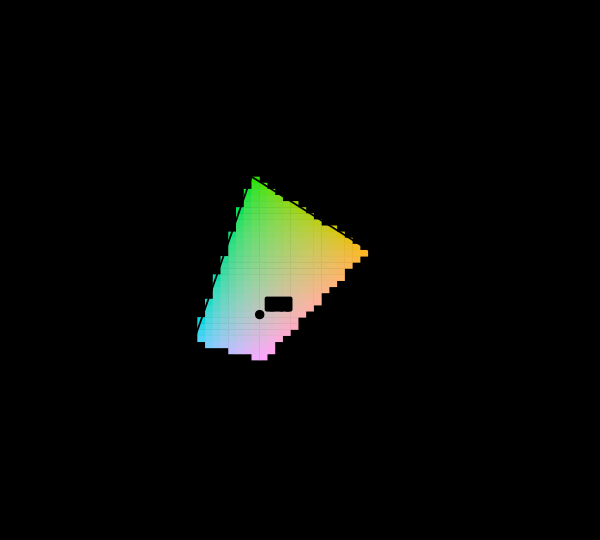
The CIE 1931 chromaticity diagram with its unreachable region marked. The spectral locus encloses every chromaticity a human eye can see. Cells inside the sRGB triangle are drawn in their own colour; the 85 per cent outside it are hatched, because no value this display accepts is the colour belonging there.

Gamut

  1. 1 Most of this diagram cannot be shown
  2. 2 Matching is not appearance
  3. 2 What a gamut costs
  4. 2 A hex code is not a colour
  5. 3 The diagram was replaced in 1976
  6. +47 more
52 essays · matching
A spectrum after 2 bounces off the same surface. The lamp's spectrum at the top, then the same spectrum multiplied by a reflectance peaking at 530 nm once for each bounce. Interreflection is elementwise multiplication, so light that reaches the eye by the long way round carries ρ raised to the number of surfaces it met. Each row's swatch is drawn at fixed luminance so only the chromaticity changes, and the distance from the D65 white point, printed at the right, rises from 0.000 to 0.235. The spectrum narrows every time, which is why a room painted in one colour is more saturated in its corners than on its walls.

Scene

  1. 1 A bounce is a multiplication
  2. 2 Two paints that stop matching
  3. 2 A shadow has its own illuminant
  4. 2 The highlight is the lamp
  5. 3 Rendering in three numbers
  6. +47 more
52 essays · scene
Four standard illuminants, and how little they have in common. Spectral power distributions for A, D50, D65, E, on one scale. Illuminant A rises steeply toward the red; the daylight illuminants carry the atmosphere's absorption structure; E is flat by definition. All four are ordinarily called white.

Light

  1. 1 A spectrum is not a colour
  2. 2 Blackbody and the colour of temperature
  3. 2 The illuminant is half the answer
  4. 3 A lamp is not a blackbody
  5. 3 Some paper is brighter than white
  6. +46 more
51 essays · light
The CIE 1931 colour-matching functions. The three functions that turn a spectrum into three numbers. They are all positive, which is why XYZ exists — the RGB functions they were derived from are not. ȳ is by construction the luminous efficiency function, which is why luminance comes out of Y.

Limits

  1. 1 Seventeen observers in 1931
  2. 2 Simulating what cannot be simulated
  3. 2 The display is an unknown
  4. 3 Whose eyes
  5. 3 How bright is white
  6. +46 more
51 essays · limits

All essays