Series

Scene — the series

52 essays on one idea, from the one that introduces it to the one that assumes the rest.
  1. A spectrum after 2 bounces off the same surface. The lamp's spectrum at the top, then the same spectrum multiplied by a reflectance peaking at 530 nm once for each bounce. Interreflection is elementwise multiplication, so light that reaches the eye by the long way round carries ρ raised to the number of surfaces it met. Each row's swatch is drawn at fixed luminance so only the chromaticity changes, and the distance from the D65 white point, printed at the right, rises from 0.000 to 0.235. The spectrum narrows every time, which is why a room painted in one colour is more saturated in its corners than on its walls.

    A bounce is a multiplication

    Colorimetry multiplies an illuminant by a reflectance once and integrates. A surface in a room is lit by every other surface the lamp reached first, so the spectrum arriving at the eye has been multiplied several times — and the second multiplication is where the whole apparatus of matching starts to come apart.

    part 1 · scene
  2. A metameric match that a corner breaks. Two reflectances with identical XYZ under D65 — metamers, matching to ΔE00 = 5.4e-14, which is the numerical floor rather than an approximation. On a flat wall the light meets one of them once and the two patches are the same colour. In a corner, a fraction 0.200 of what leaves the surface returns to it, so part of what reaches the eye carries ρ twice — and the match fails by ΔE00 = 1.53. A metameric match is an identity between three integrals that are linear in ρ, and there is nothing linear left after a second bounce. The geometry, not the light and not the paint, is what breaks it.

    Two paints that stop matching

    A metameric match is an identity between three integrals that are linear in reflectance. A second bounce carries reflectance squared, and no linear identity survives being squared — so two paints certified identical on a flat chart come apart in a corner, by an amount the geometry decides and the colorimetry cannot express.

    part 2 · scene
  3. The two components of daylight, computed from one radiator and one scattering law. A 5800 K radiator through the atmosphere at air mass 1. The direct beam is the radiator times e^{−τm}; the sky is what that extinction removed, so the two are complements and neither needs its own model. The sky is steeply blue because τ ∝ λ⁻⁴, and a surface in shadow is lit by that component alone. Open ground and shadowed ground therefore sit under two illuminants differing by ΔE00 = 21.4 — which is why a photograph of snow has blue shadows and why no single white balance fixes both halves of it.

    A shadow has its own illuminant

    Outdoors there are two lights, not one. The direct beam is a radiator reddened by the atmosphere; the sky is precisely the power that reddening removed. A shadow is lit by the second alone, so shadowed ground and sunlit ground sit under illuminants 21 units of ΔE apart — before any surface, any eye or any opinion is involved.

    part 2 · scene
  4. A glossy surface returns two spectra, and only one of them is the paint. The dichromatic reflection model, computed rather than assumed. Light that enters a dielectric binder, scatters off pigment and comes back carries the reflectance — the body component, ΔE00 = 33.7 from the lamp. Light reflected at the interface never entered, so it carries the lamp's spectrum with only Fresnel's slight dispersion on it: ΔE00 = 1.06. The interface term is computed from Fresnel's equations on a Cauchy index at 55°, so its near-neutrality is a result here rather than an assumption. This is why a highlight is the one region of a photograph that tells a white balancer what the light was, and why removing highlights removes the evidence.

    The highlight is the lamp

    Light reflected at the surface of a glossy material never entered it, so it never met a pigment. Fresnel's reflectance varies by 5.5% across the visible band and the paint underneath varies by a factor of twenty — which makes a highlight the one region of a photograph that reports what the light was rather than what the object is.

    part 2 · scene
  5. How far three channels drift from eighty-one, per bounce. One room, one geometry, one reduction to three channels, and the only thing changing is how many bounces of the Neumann series are kept. At one bounce the two agree to 2.5e-13 — the only reflectance in that path is the floor's, which is flat, and a flat reflectance is one of the few three numbers carry exactly. Every bounce after it multiplies another non-flat reflectance into the spectrum, and three numbers cannot carry a product they were never given the factors of. The curve levels off at ΔE00 = 2.38 because the light has run out, not because the disagreement has.

    Rendering in three numbers

    Almost every renderer ever shipped bounces red, green and blue rather than a spectrum. The error that costs is exactly zero at the first product and grows at every one after it — because three numbers cannot carry a product they were never given the factors of, and each bounce is another product.

    part 3 · scene
  6. The interreflection gain of a room, band by band. A closed cavity of reflectance ρ returns 1/(1 − ρ) times the light that entered it, and because that is computed per band it amplifies the wall's colour along with its brightness. The wall here is only 5% off neutral — a paint anybody would call white — and at albedo 0.9 the room's white point has moved by ΔE00 = 50.7 against the lamp it was lit with. The gain is a geometric series, so the last few percent of albedo cost far more than the first: 1.64× at ρ = 0.4 against 8.41× at ρ = 0.9.

    What a white wall costs

    A closed room returns 1/(1−ρ) times the light that entered it, computed band by band — so a paint that is five percent off neutral becomes a strongly coloured illuminant once the room has finished bouncing. The gain amplifies the tint along with the brightness, and the last few percent of albedo cost far more than the first.

    part 3 · scene
  7. The form-factor matrix of the box. F_ij is the fraction of everything leaving face i that arrives at face j. The diagonal is zero because a flat face sees none of itself; each row sums to exactly 1 because the cavity is closed; and A_i F_ij = A_j F_ji, which is reciprocity and is checked to 10⁻⁹. For a cube the opposite face takes 19.98% and each of the four adjacent faces 20.00%, and the near-equality of those two numbers is a coincidence of the cube rather than a rule.

    A corner is not a wall

    A form factor is the fraction of everything leaving one surface that arrives at another, and it is the only place geometry enters the colour of a room. It is also the one number here with a published closed form to check against — and the check turned out to converge at two different rates for two cases that look identical.

    part 3 · scene
  8. Every face of the solved room. The red room after the transport is solved in all 81 bands. Only the ceiling emits; the other five faces are lit entirely by what the ceiling and each other send them, so their colour is the lamp multiplied by every reflectance along every path that reached them. The ceiling itself comes out 1.05× brighter than it emits, because a closed room returns light to its own source. The two chromaticities under each swatch are the spectral solve and the three-channel one, and the faces furthest from the lamp — the ones the light reached by the most bounces — are where they disagree most.

    The room is the illuminant

    Colour bleeding is usually described as an aesthetic phenomenon of rendered images. It is better described as a measurement. In a room with one lamp, five of six surfaces emit nothing at all, so their light is entirely a product of other surfaces' reflectances — and the bleeding saturates rather than running away, for a reason worth deriving.

    part 3 · scene
  9. Mixing two paints and stacking two filters are different operations. The same two reflectances combined two ways. Stacking them as filters multiplies the transmittances, which is right for gels in front of a lamp and wrong for pigment stirred into pigment: a stirred mixture is one scattering layer, not two in series, and light meets whichever particle is nearest rather than passing through both. Kubelka–Munk handles it by moving to K/S = (1 − R)²/2R, in which absorption and scattering add by concentration, and inverting afterwards. The two answers differ by ΔE00 = 15.0, and the filter model is the darker of the two because it charges every photon for both pigments.

    Paint is not a filter

    Stacking two filters multiplies their transmittances. Stirring two pigments together does not multiply their reflectances, because a mixture is one scattering layer rather than two in series — light meets whichever particle is nearest. Treating the two as the same operation is a 15-unit error, and which way it errs turns out to depend on whether the comparison holds the amount of pigment fixed.

    part 4 · scene
  10. Why blue and yellow make green. 7 mixtures between a blue and a yellow pigment, mixed in Kubelka–Munk — K/S summed by concentration and inverted back to reflectance — and plotted against the straight line joining the two endpoints. The path bows towards green by 0.099 in chromaticity, and the reason is in the spectra rather than in the eye: the blue reflects below about 520 nm and the yellow above about 500, so the only band both return is the overlap between them. Mixing lights adds spectra and lands on the chord; mixing pigments intersects them and does not.

    Why blue and yellow make green

    The oldest fact in colour, and the usual explanations are wrong. It is not because green sits between blue and yellow, and it is not a fact about the eye at all — it is that the only band both pigments return is their overlap, and the overlap of a blue and a yellow reflectance is green. Computed, the mixing path bows away from the straight line by a measurable amount.

    part 4 · scene
  11. The same medium at six path lengths. Beer's law at 6 depths of one absorbing medium. The absorption coefficient is a single spectrum and the only thing changing is how far the light travelled, yet the patches differ in hue by 7.8° as well as in lightness — because absorption is exponential in depth and the observer is linear, so the bands that survive at d = 8 are not a scaled copy of the ones that survive at d = 0.25. Path length belongs to the geometry, not to the substance, which is why this sits in a field about scenes.

    The colour is in the thickness

    Transmittance is exponential in path length and the observer is linear, so doubling the depth of an absorbing medium squares the transmittance rather than halving the colour. A translucent object therefore has no one colour — its thin edge and its thick middle are different spectra of the same substance, and the hue moves between them.

    part 4 · scene
  12. One film, five viewing angles. The same 340 nm film seen from 5 directions. Nothing about the object has changed — not the light, not the material, not the thickness — and the colour swings by ΔE00 = 42. A pigment's spectrum contains no path length and no angle, so it cannot do this; a film's contains both. This is the clean separation between structural and pigmentary colour, and it is geometric rather than chemical.

    A colour that moves with the viewer

    A thin film has no pigment in it. Its reflectance spectrum is an interference condition containing a path length and an angle, so tilting the sample moves every maximum to a shorter wavelength and changes the colour by 40 units of ΔE. A pigment's spectrum contains neither, and cannot do this at all — which is the cleanest separation between the two kinds of colour there is, and it is geometric rather than chemical.

    part 4 · scene
  13. What no surface can be more colourful than. The MacAdam limits at 4 lightnesses under D65, each computed by sweeping two-transition reflectances over the whole band and keeping those that land at the target luminance factor. This is a physical bound rather than a gamut: a reflectance above 1 is a surface that emits, so no pigment anybody invents will ever put an object colour outside these curves. The boundary shrinks steeply as the surface lightens, from 0.310 at Y = 0.1 to 0.028 at Y = 0.9 — a very light surface has almost no room to be colourful, and that is physics rather than pigment chemistry. Drawn against it is sRGB at the same luminance factor rather than as a primary triangle, because a triangle is what a display can reach at some luminance and the bound is what a surface can reach at one; matched properly, sRGB covers 36% at Y = 0.1, 40% at Y = 0.3, 40% at Y = 0.6, 21% at Y = 0.9. The faint triangle is the familiar figure, kept only to show how much it misleads.

    No surface can be that colourful

    There is a hard bound on object colour that no pigment will ever move, and it follows from a reflectance being at most 1. Its boundary is generated by two numbers, it shrinks by a factor of eleven from dark to light — and measured against it properly, sRGB reaches 40% of what a surface could be at mid lightness while Rec. 2020 reaches 106%.

    part 5 · scene
  14. One white balance across a scene lit by two lamps. A neutral surface of albedo 0.6 under 7 mixtures of A and D65, corrected by one diagonal transform chosen for the middle of the run — which is what a camera does when it estimates a single illuminant. The middle patch comes out neutral to ΔE00 = 0.00 and both ends do not: 19.8 at the A end and 16.9 at the D65 one. The failure is structural rather than a matter of a better estimator: white balance is one transform for the whole image, and a scene with two lamps in it has no single answer for that transform to be. Every patch here is the same surface.

    A scene has no white point

    White balance is one transform applied to a whole image, and a scene lit by two lamps has no single answer for that transform to be. The failure is structural rather than a matter of a better estimator — and every colour-managed workflow in existence takes exactly one white point as an input, with no field in which to say there were two.

    part 5 · scene
  15. A glossy surface returns two spectra, and only one of them is the paint. The dichromatic reflection model, computed rather than assumed. Light that enters a dielectric binder, scatters off pigment and comes back carries the reflectance — the body component, ΔE00 = 33.7 from the lamp. Light reflected at the interface never entered, so it carries the lamp's spectrum with only Fresnel's slight dispersion on it: ΔE00 = 1.14. The interface term is computed from Fresnel's equations on a Cauchy index at 45°, so its near-neutrality is a result here rather than an assumption. This is why a highlight is the one region of a photograph that tells a white balancer what the light was, and why removing highlights removes the evidence.

    Gloss changes the measurement

    The same sample measured with the specular component included and excluded returns two different numbers, and both are correct answers to different questions. Colour is one of four appearance attributes and the only one most instruments report — so a specification that names a colour has silently named a geometry too, and usually does not say which.

    part 5 · scene
  16. A corner moves the spectrum and the viewing condition at once. A coloured patch in a corner of coloured walls, against how enclosed the corner is. The top curve is what a colorimeter set up at the door reports: light that has bounced carries the surrounding reflectance again, so the patch is lit by something the room is not. The middle curve is what is left once the patch is read against the corner's own white — most of it goes, because a corner is a change of illuminant and that is what chromatic adaptation is for. The bottom curve is the other thing a corner is: a brighter place, 1.76 times the light, which moves the appearance through the Hunt effect with the white point held still and cannot be adapted away at all.

    A corner moves both terms

    The interreflection essays compute what a corner does to a spectrum, which is one of the two things a corner does. It is also a brighter place with a differently coloured background — a viewing condition, not a stimulus — and adaptation removes most of the first and none of the second. At an enclosure of six tenths that is 63 per cent of seven units gone and a further unit arriving from the extra light alone.

    part 6 · scene
  17. What a sheet of glass takes out of the band a brightener eats. The transmittance of four glazings across the short-wave band, with the brightener's own absorption shaded underneath. The overlap between a curve and the shading is what the sheet behind that glass has to work with. Ordinary window glass stops below about 310 nanometres and leaves most of the band; laminated glass has a plastic interlayer that was put there to hold the sheet together in a crash and happens to absorb almost to 380; a filter sold to protect a print removes the band entirely. The curves are logistic edges at stated wavelengths rather than measurements of particular products.

    The window is part of the light

    A viewing condition here has always been a spectrum and a geometry. For anything fluorescent it needs a third thing — the transmittance of whatever the daylight came through — because ordinary window glass, a laminated windscreen and a museum filter remove three quite different parts of the band a brightener eats, and the sheet is a different colour behind each.

    part 6 · scene
  18. The same wall, applied once and applied twice. A room lit by light that has bounced off its own walls is a change of illumination like any other, and a corner is the same change applied twice. Squaring a reflectance sharpens it, a sharper change of light is further from being a gain, and the residual an adapted observer is left with therefore grows faster than the change does: the second bounce is 1.33 times the change and 1.96 times the residual. This is the adaptation half of what a corner does to a metameric match.

    The same wall applied twice

    A bounce off a painted wall is a change of illumination, and adaptation handles it about as well as it handles a change of colour temperature. A corner applies the same reflectance twice, which sharpens it — and leaves an adapted observer with 1.96 times as much for a change only 1.33 times as large.

    part 7 · scene
  19. A sample with two reflectance curves, and neither below one. The apparent reflectance of an optically brightened sample, measured under D65 and A. It exceeds 1 — the shaded band — which no reflector can do: more light leaves at these wavelengths than arrives at them, because the sample absorbs in the violet and re-emits in the blue. And the two curves differ, so the sample has no single reflectance to store. The effect drawn here is a floor: most of the excitation band lies below 380 nm, outside the range computed here.

    A surface that is not a multiplication

    Every argument here about what light does to a surface begins by multiplying two spectra together. A surface with a brightener in it takes light at one wavelength and returns it at another, so it is a full operator rather than a diagonal one — and it does not have a reflectance at all.

    part 7 · scene
  20. Two sheets with the same reflectance and two different colours. A brightened sheet and a dyed one built to match it under an instrument with no ultraviolet. Under that instrument the pair agrees to ΔE00 0.00, which is a rounding and is true by construction — the dyed sheet's reflectance is the curve the brightened one measured. Under an instrument that includes the ultraviolet they are 7.1 apart, and under daylight 10.6. This is not ordinary metamerism: the two sheets do not differ in reflectance anywhere the eye can see, so no change of light puts them back together and no adaptation removes the difference. One of them is a curve and the other is an operator.

    Two sheets that match until the window

    Ordinary metamerism is two reflectances that agree under one light and not another, and it can always be undone by putting the first light back. A dyed sheet and a brightened one have the same reflectance everywhere an eye can see, agree exactly under any lamp with no ultraviolet, and separate by ten units under daylight — and no change of light puts them back together.

    part 8 · scene
  21. How short of determining the light a photograph is, as the scene grows. Each cell is the number of unknowns left over after every equation the image supplies: three sensors, a three-dimensional illuminant, and reflectances confined to a linear model of the dimension on the left. At one and two dimensions more surfaces close the gap. At three the gap never closes, because each further surface adds three equations and three unknowns; at four it widens. The count is arithmetic and has no algorithm in it.

    An image does not determine the light

    A photograph of a scene under one illuminant gives three numbers per surface and asks for the illuminant plus three numbers per surface. The count closes only if reflectances lie in a two-dimensional model, and no number of surfaces helps — at three dimensions the alternative scenes can be written down, and they reproduce every sensor response exactly.

    part 9 · scene
  22. A room applies its wall a different number of times at each wavelength. The mean number of bounces the surviving light has made, wavelength by wavelength, in a closed room whose walls are the green paint the adaptation census uses. It runs from 0.33 in the band the wall absorbs to 5.67 in the band it reflects — a factor of 17.00 — because the light that survives many bounces is the light the wall was reflecting all along. The census has one bounce and two bounces as separate rows and a search treats the count as a free integer; a room has neither, and what it has is bounded by the walls reflecting less than everything.

    A room bounds its own bounces

    The adaptation census has one bounce and two bounces as separate rows, and a search over the family treats the count as a free integer it always takes to the largest value offered. A room offers no integer at all — it applies a geometric mixture of every number of bounces, and that mixture is bounded by the walls reflecting less than everything.

    part 9 · scene
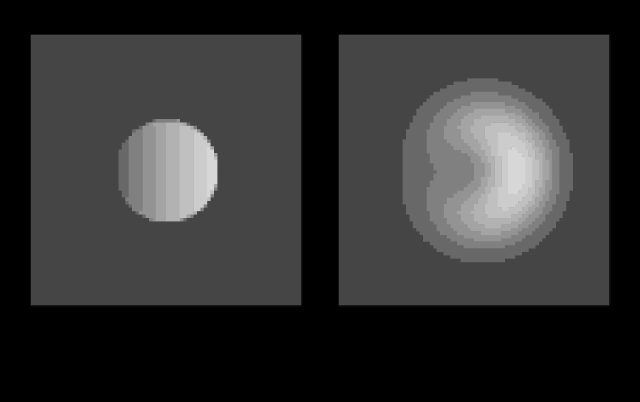
  23. The same border signal, filled in with a boundary and without one. Two fields, each 6 degrees across. The signal is injected along a ring just inside a contour and varies around it, brightest on one side and dimmest on the other. On the left the signal diffuses and the contour is impermeable: the interior settles to 1.000 against a border mean of 1.000, which is the mean-value property of a harmonic function arriving as a prediction about appearance. On the right the same signal is handed to a Gaussian pool of 0.5°, which has no notion of inside: it reaches 0.040 at the centre, because a kernel weights the near rim more than the far one and a filled region does not.

    A pool with an edge

    A Gaussian pool says how much of a stabilised image survives and can say nothing about what the remainder looks like, because a Gaussian has no edge. Give the pool a boundary and the interior of a faded region takes the average of its own border — exactly, by the mean value theorem, arriving as a prediction about appearance.

    part 10 · scene
  24. A gap in the wall and a gap in the drive are not the same gap. What the centre of a region settles to under three conditions. With the contour closed it reaches its border's value exactly. Open a 16% hole in the barrier and leave the border signal unbroken and it still reaches it, to 1e-8 — a ring of driven cells encloses the centre whatever the wall outside it is doing, so nothing can escape. Break the signal too and it falls to 0.960. All of what a gap costs is the piece of border that stopped driving, and none of it is the hole.

    A gap in the drive, not in the wall

    Break the contour around a region and leave its border signal unbroken, and the interior does not move by one part in a million — a ring of driven cells encloses a centre whatever the wall outside it is doing. Break the signal too and the shortfall goes as the square of what is missing. All of what a gap costs is the piece of border that stopped driving.

    part 10 · scene
  25. The three worst walls, drawn as the reflectances they are. Three reflectance curves, one per bound: the wall each search settled on. All three are dark over most of the spectrum with a single band near the short-wavelength end — the arithmetic bound's is 10 nanometres wide, the physical one's 40, and a paint somebody sells the same. None of them is a saturated colour: their excitation purities are 0.18, 0.52, 0.52 against a ceiling of 0.6, which is why the purity constraint never bites. What breaks an adapted observer is a wall that takes most of the light away, not one that is a strong colour.

    The darkest wall anybody sells

    Asked which property of a paint decides the worst change of light a room can produce, anybody would answer how saturated it is allowed to be. A ceiling on saturation never comes near binding, because the worst wall is dark rather than colourful — and the constraint that does bind is one nobody would nominate.

    part 10 · scene
  26. The worst case is wherever the box stops. Four horizontal tracks, one per parameter of a painted wall. Each track spans the range an ordinary paint is allowed to occupy, with a second, wider range drawn behind it, and two markers show where the search for the worst change of light came to rest under each. Under the narrower box the answer sits on the wall in centre and width; under the wider one, in centre, width, base. The residual rises monotonically towards a narrower notch at a shorter wavelength on a darker wall, so there is no interior maximum to find. The worst change of light is 21.3 ΔE00 under one box and 28.4 under the other, and the census's own worst row is 3.37.

    The worst case is where the box stops

    The worst change of light this collection quotes is two bounces off a green wall, and it is the worst of fourteen changes somebody wrote down. Searching the family those fourteen were drawn from reaches six times further — and does not stop, because the residual rises monotonically towards a narrower notch on a darker wall. There is no worst case in this family, and the number anybody quotes for one is a number about their own constraint.

    part 11 · scene
  27. What one change of light costs, surface by surface — daylight to tungsten. A rising curve of 125 points, one per surface in the test set, sorted from the surface this change of light costs least to the one it costs most, with the published mean drawn across it as a horizontal line. The published residual for daylight to tungsten is 1.635 ΔE₀₀. The curve runs from 4.4e-14 — 5 of the surfaces are flat greys, on which an adapted observer's gain is exactly right and the residual is exactly zero — to 3.058, which is 1.87 times the mean. The mean line crosses the curve about two thirds of the way along, so most surfaces cost less than the published number and a minority cost a great deal more. This is what a single published residual is a summary of.

    A mean has a set under it

    Every adaptation number this collection publishes is an average over a hundred and twenty-five surfaces that were written down once, in one file, with no argument for how many there should be or how saturated. The average runs from exactly zero to twice itself across them, and the set has never been varied.

    part 11 · scene
  28. What a fourth reflectance dimension costs the theorem that a change of light is a matrix. Four rising curves on axes of the fourth dimension's amplitude, left to right, against what is left of daylight to tungsten after the exact 3×3 change-of-light matrix has been applied, in ΔE₀₀. All four begin at exactly zero: on the three-dimensional family the matrix is solved rather than fitted and there is no remainder at all, which is the theorem this collection's adaptation argument is built on. Adding a fourth reflectance dimension breaks it, and how badly depends far more on the fourth function's shape than on its size — at five per cent amplitude the four shapes cost 0.329, 0.572, 0.063, 0.124 ΔE₀₀ respectively, a factor of 9.1 between the dearest and the cheapest. For scale, the smallest von Kries residual anywhere in the census is 0.26 ΔE₀₀, so the cheapest of the four is a quarter of it and the dearest is twice it.

    A theorem about a family

    A change of light acts on the test surfaces used here as an exact 3×3 matrix with no residual whatsoever, and the whole adaptation argument is built on that being exact. It is exact because the surfaces span exactly three dimensions, and they span exactly three dimensions because three basis functions were written down.

    part 12 · scene
  29. Every worst surface sits on a number somebody typed. The region the test surfaces are drawn from, in its own two modulation coordinates: a square of allowed depths with a diamond inscribed in it, the diamond being the requirement that the two depths sum to no more than 0.7. The 14 marked points are the worst surface for each change of light in the adaptation census, found by search over the whole region. Every one of them lies exactly on the diamond, and every one is also at the brightest level the region allows — both declared constraints active, on all 14 rows, with no interior maximum anywhere. That is the opposite of what bounding the wall gave: there the worst case turned over at a band width of six nanometres because a narrow band returns too little light, which is physics. Here the worst case is a reading of two numbers. The one constraint that is about the world — a paint's excitation purity may not exceed 0.6 — is slack everywhere: the most saturated surface the region admits reaches 0.459.

    Every worst surface sits on a declaration

    Bounding the wall in a painted room produced a real worst case — the residual turns over at a band six nanometres wide because a narrower band returns too little light. Bounding the surfaces the residual is averaged over produces nothing of the kind, because all fourteen answers sit exactly on two numbers somebody typed and the one constraint that comes from the world never binds at all.

    part 12 · scene
  30. What an observer is left with, by how much it is allowed to know about the room. Six ways of discounting a change of light, averaged over the fourteen changes in the adaptation census and 125 test surfaces each. The bar is what each leaves behind, on a logarithmic axis because the models span two orders of magnitude. The second line under each name is the count that matters: how many numbers about this room the model has to be given. Doing nothing leaves 15.7 ΔE₀₀. A single gain read off the two whites' luminances leaves 15.3. A matrix fitted across half the census and then applied everywhere, knowing nothing about the room at all, leaves 12.5. The published von Kries gain, which is told the white and nothing else, leaves 1.312 — and bolting a fixed correction onto it, at no cost in scene information, leaves 1.368, which is very slightly worse. The exact matrix leaves nothing and is not on the chart: its nine numbers are the change of light, which is the quantity being discounted.

    Three numbers the scene supplies

    An adaptation model's parameters are not all the same kind of thing. Some are numbers an observer must estimate from the room it is standing in; others could have been settled once by evolution. Counting them separately turns the diagonal gain from a crude approximation into the only model of the set that gets a large answer from information the observer can actually have.

    part 12 · scene
  31. How much light comes back at each distance from where it went in. The diffuse reflectance kernel of 3 materials at 550 nanometres, computed from the dipole approximation to the diffusion equation. Both axes are logarithmic. The horizontal axis is the distance from the point the light entered, in millimetres; the vertical is how much comes back out per unit area there. Each curve's own diffusion length is marked with a tick. Coated paper returns almost everything within a fifth of a millimetre; marble is still returning light at ten. The reflectance the model wants is the whole of each curve, integrated over the plane, and what an instrument reads is only the part inside its aperture.

    A surface has a kernel

    Light that enters a translucent material does not come back where it went in. It scatters some thousands of times and leaves a few millimetres away, so what the surface has is not a reflectance but a function of distance — and the reflectance the model wants is that function's integral over the whole plane, which no instrument ever collects.

    part 12 · scene
  32. Where a sample's colour goes as the aperture closes. The a and b of three translucent materials as the measuring aperture narrows from forty millimetres to one. Each track starts at the open circle, which is the colour the model says the sample has, and ends at the filled one. The axes cross at the neutral point. pale marble passes through neutral at a radius of 5.32 millimetres and comes out on the other side; candle wax passes through neutral at a radius of 7.07 millimetres and comes out on the other side; skin passes through neutral at a radius of 0.76 millimetres and comes out on the other side. Nothing about the sample changed: the aperture is a filter with a colour of its own, and the colour is decided by how the sample scatters rather than by what it absorbs.

    The hue the hole decides

    A piece of pale marble measured through a wide aperture is faintly yellow. Measured through a narrow one it is faintly blue, and between the two there is an aperture at which it is exactly neutral. Nothing about the stone changes; the aperture is a filter with a colour, and what decides that colour is the size of the particles rather than the pigment between them.

    part 12 · scene
  33. Five fields, by how much light arrives from each elevation. The radiance arriving at a surface from each direction in one vertical plane, for five ways of lighting it. The vertical axis is logarithmic, spanning the three decades between a sun and the sky around it. The number beside each name is the share of the light that would have to be moved to make the field uniform: zero for the overcast sky, 0.93 for a lamp on a stand. A uniform field is the condition under which a reading is the sample's own reflectance, and the only place it exists is inside an instrument.

    A room is not a sphere

    An integrating sphere reads a surface's own reflectance exactly, and the exactness is a theorem rather than good engineering — under a hemisphere of constant radiance, reciprocity makes the reading the sample's directional-hemispherical reflectance whatever the surface is. Every room fails that condition, and a viewing booth and a window get the sign of the error wrong in opposite directions.

    part 12 · scene
  34. What the interface does to a reflectance, and the straight line it is taken for. The Saunderson relation between the reflectance inside a pigment layer and the reflectance an instrument reads off it, for a boundary of refractive index 1.50. The curve is the real map; the dashed line joins its two endpoints, which is the straight relation an additive pedestal assumes. They are 0.216 of a reflectance unit apart at their widest, which is 5 times the pedestal itself. The curvature comes from the k₂ term — light reflected back down into the layer from underneath the boundary — which is 0.60 where the outward reflection is 0.04.

    A mixture in the variable nobody named

    Kubelka–Munk works because absorption and scattering add over a mixture and reflectance does not. What adds is the absorption of the pigment layer, and what an instrument reports is that layer seen through an interface — related by a Möbius function rather than by a constant. Mixing in the reported variable instead of the internal one costs between three and eight ΔE₀₀, and no source this collection quotes says which variable its curves are in.

    part 12 · scene
  35. How much of the residual a partial correction removes. Between the diagonal gain and the exact matrix there is a line: apply the correction that would make a row exact, but only a fraction of it. The horizontal axis is that fraction and the vertical is the share of the row's residual it removes, for all fourteen census rows. The straight diagonal is where a correction worth exactly its fraction would fall, and in the published unit every curve lies on it to within 2.2 percentage points. The lower band of curves is the same interpolation measured in CAM16-UCS, which departs by up to 17 points — because its distance is a power of the Euclidean one and a power is not homogeneous along a ray, where every ordinary norm is. The straight line is therefore a property of the ruler rather than of the correction, and the exception is what says so.

    A partial correction is worth its fraction

    Between a diagonal gain and the exact matrix there is a line, and a bounded observer's natural hope is that the first part of it is worth a disproportionate share. It is not. On all fourteen changes of light, at every setting, the share of the residual removed matches the share of the correction applied to within 2.2 percentage points — which closes the last way the gap could have been cheap.

    part 13 · scene
  36. A correction an observer could have been born with, fitted on half the census and tested on the other. The same six models, each scored twice: on the seven census rows the fixed matrices were fitted to, and on the seven they were not. The split alternates by position so both halves contain daylight changes and discharge lamps. The upper bar is in sample and the lower is out, on a logarithmic axis. For the four models with nothing fitted the two bars differ only because the halves are different questions. For the two fitted ones the gap is the finding, and it is largest where it matters least: bolting a fixed correction onto the von Kries gain takes it from 1.2724 to 1.2592 on the rows it was fitted to, and from 1.3511 to 1.3679 — worse — on the rows it was not. There is no correction to the diagonal that an observer could arrive with.

    A model is a claim about what can be known

    The exact answer to chromatic adaptation is nine numbers, and the nine numbers are the change of light itself. A model whose parameters are quantities the observer cannot obtain is not a worse model of the same thing — it is a model of something else, and counting parameters without asking where they come from hides the difference.

    part 13 · scene
  37. What the Lambertian assumption costs a room, against how rough its walls are. The horizontal axis is the roughness of the two coloured walls; the right-hand end is nearly matt, which is what a radiosity calculation assumes. One line is the distance in ΔE₀₀ between the floor's colour and what radiosity gives for the same room — 4.89 at an eggshell finish, falling to 0.97 at the matt end. The other is the chroma of the bounce, which falls as the walls get glossier: what an interface returns is a Fresnel reflection and carries no pigment, so the fraction of the return that goes into the lobe is a fraction that arrives at the floor white. The lobe is taken out of the body term rather than added beside it, which is what a real finish does.

    The solver had no slot for gloss

    Every scene result in this collection is computed by radiosity, and radiosity is not an approximation that could be made more accurate. Its unknown is one number per surface, and a surface that returns light differently in different directions does not have one. A missing slot cannot be wrong by a small amount.

    part 13 · scene
  38. The directional solver reduces to the radiosity solver exactly. A solver with a new unknown in it is worth nothing until it reproduces the one it replaces. Setting every wall's bidirectional distribution to ρ/π collapses all thirty ordered-pair radiances onto their patch's radiosity divided by π, and the answer agrees with this collection's existing radiosity solution to 9.8e-16 relative — the floating-point floor. That is the check that makes every other number in this family a statement about lobes rather than about a new piece of arithmetic, and it is the reason the reduction is drawn rather than mentioned.

    Thirty unknowns instead of six

    A directional transport solver is worth nothing until it reproduces the one it replaces. Setting every wall's bidirectional distribution to ρ over π collapses thirty ordered-pair radiances onto six radiosities and reproduces this collection's existing answer to 9.8 × 10⁻¹⁶ relative — which is the only reason anything else it says can be believed.

    part 14 · scene
  39. What the floor receives, matt walls against walls of roughness 0.2. The spectral radiance leaving the floor towards the front of the room, computed twice. The matt curve peaks at 530 nanometres, where the walls' pigment is. The glossy curve is higher everywhere and higher by relatively more away from that peak, because the extra light is a Fresnel return and a Fresnel return has the lamp's spectrum rather than the paint's. That difference in shape is the desaturation, drawn before it is reduced to a number, and it is the reason the two lines cannot be brought together by any exposure change.

    A lobe takes colour out of a bounce

    A gloss wall sends more light to the floor and less colour. The extra light is a Fresnel reflection at the interface, it carries the lamp's spectrum rather than the paint's, and it arrives at the next surface white — so a green room in satin paint is less green than the same room in flat paint by nearly a colour difference of chroma.

    part 14 · scene
  40. Where the viewer stands, at a wall roughness of 0.2. The chroma of the light the floor sends towards each of the five other faces of the room, at one roughness. The spread is 2.00 ΔE₀₀ between the extremes. A radiosity solution assigns one radiosity to the floor and therefore cannot have a spread at all — the whole width of this chart is a quantity the method has no slot for, rather than one it approximates badly. The two side walls see the most because they are where the coloured light comes from, and the direction the lobe favours is the direction it came from.

    The floor is a different colour from the door

    With a lobe on the walls the floor sends chroma 18.76 towards the front of the room and 20.94 towards the side walls, a spread of two colour differences. A radiosity solution assigns the floor one number, so the whole of that spread is a quantity the method has no slot for rather than one it estimates badly.

    part 14 · scene
  41. Two ways of putting a lobe on a wall, and the sign they disagree about. The chroma of the floor's return against the wall's roughness, computed twice. In one the interface's return is taken out of the body term — light reflected at the boundary never reaches the pigment, which is what a real finish does. In the other it is added beside the body term, which is what a microfacet model does if nobody couples the two. The first says a gloss wall makes the room less coloured and the second says more, and the gap at the glossiest end is 2.87 units of chroma. Neither is a numerical error; the difference is a modelling decision that is usually made by omission.

    Two ways to put a lobe on a wall

    Take the interface's return out of the body term and a gloss wall makes the room less colourful. Add it beside the body term and the same wall makes the room more colourful. Same solver, same room, one line of energy accounting, and the two answers differ by nearly three units of chroma at the glossy end.

    part 15 · scene
  42. The lobe's share of what leaves a surface of body reflectance 0.5. For light arriving at 45°, the fraction of what leaves the surface that is the interface's Fresnel return rather than the pigment's. It runs from about 9.1 per cent at an eggshell finish down to 4.2 at a matt one. That is a small share, and it is the whole of the effect: a tenth of the return arriving white is enough to move the room's colour by units of ΔE₀₀, because the bounce is what a room's colour is made of and every bounce is multiplied by the next.

    A tenth of the return arriving white

    Nine per cent of what leaves a satin wall is a Fresnel reflection carrying no pigment. That nine per cent moves the room's colour by 4.89 ΔE₀₀ and its chroma by five per cent, because an interreflection multiplies and a small contribution with a different spectrum compounds into a large one.

    part 15 · scene
  43. What the Lambertian assumption costs a room, against how rough its walls are. The horizontal axis is the roughness of the two coloured walls; the right-hand end is nearly matt, which is what a radiosity calculation assumes. One line is the distance in ΔE₀₀ between the floor's colour and what radiosity gives for the same room — 4.89 at an eggshell finish, falling to 0.97 at the matt end. The other is the chroma of the bounce, which falls as the walls get glossier: what an interface returns is a Fresnel reflection and carries no pigment, so the fraction of the return that goes into the lobe is a fraction that arrives at the floor white. The lobe is taken out of the body term rather than added beside it, which is what a real finish does.

    Every scene in this collection was matt

    The green wall, the corner, the bounce series and the metamer separation are all computed on Lambertian surfaces, because the solver that produced them requires it. Each would move by between one and five colour differences on an ordinary satin finish, and none of those essays says what finish it means.

    part 15 · scene
  44. The room's reflected light and its colour, against how glossy the walls are. Four changes against the matt room as the coloured walls are made glossier, from roughness 0.8 on the left to 0.15 on the right. The room's reflected light rises by up to 19 per cent and its chroma falls by up to 9.1 per cent. The walls' own outgoing chroma falls fastest, by 14.6 per cent, and the floor's follows the room's. A lobe does not move colour from one face to another: the room as a whole has less of it.

    A gloss finish takes colour out of the whole room

    A gloss wall makes the floor's return less colourful seen from the front of a room and more colourful seen from the coloured walls, which leaves open whether the lobe removes colour or only moves it. A ledger of every flux between the room's faces answers it. At an eggshell finish the room's reflected light gains 16 per cent in quantity and loses 8.3 per cent of its chroma, and the loss is nearly the same for blue, green and orange walls while the walls' own losses range from 13 to 25 per cent. Only the painted walls receive light as colourful as before.

    part 16 · scene
  45. A gloss finish's loss of colour, read by the light and by a viewer in the room. Four changes against the matt room as the coloured walls are made glossier, from roughness 0.8 to 0.15: the chroma of the room's reflected light as a colorimeter reads it; the mean chroma of the six faces as CIECAM16 sees them adapted to the lamp and adapted to the room's own average light; and how far the faces sit from that average in the model's uniform space. At roughness 0.2 the light loses 8.3 per cent, the faces 8.6 per cent to the lamp-adapted viewer and 13.9 to the room-adapted one, and the spread 11.0 per cent against 11.2 read against the lamp.

    A gloss room looks less colourful than it measures

    A gloss finish takes 8.3 per cent of the chroma out of a green room's reflected light, and a viewer adapted to the room should discount a loss that affects everything alike. The appearance model says the opposite. Adaptation removes the colour the whole room shares, leaves the colour that differs from face to face, and the finish takes as large a share of that as of anything — so to a viewer standing in the room the faces lose 13.9 per cent of their chroma, not 8.6.

    part 17 · scene
  46. The glossiest finish the solver can report, against what it costs to report it. Six quadratures, each with the roughness at which its answer stops being stable, on logarithmic axes. The line is a fit and its slope is -0.350: the reachable roughness falls as the cost to the power of about a third, so reaching a finish twice as glossy costs about 7 times the work. The solver used here sits at 108 directions and reports down to a roughness of 0.145, which is where its own note put the boundary by inspection.

    The boundary belongs to the quadrature

    The directional solver stops at a roughness of about 0.15, and below that its answers are not imprecise but unphysical. The boundary is where the lobe stops being resolved by the sampling, so it belongs to the discretisation rather than to the room — and moving it is a purchase. Measured across six quadratures the reachable roughness falls as the cost to the power of a third, so a finish twice as glossy costs seven times the work and a polished varnish costs two hundred and thirty-six times.

    part 18 · scene
  47. A satin finish pulls each room towards the lamp's white — a 3000 K radiator. Six rooms lit by a 3000 K radiator, on the ab plane of an instrument referenced to daylight, whose own white is the cross at the centre. Each open circle is a matt room and the arrow runs to the same room with satin walls. The filled diamond is the lamp's own white on that plane. Every arrow points within 9.2 degrees of the diamond and covers between 8.1 and 11.5 per cent of the distance to it. Whether the daylight instrument then reads more chroma or less depends only on whether the room was nearer the cross than the diamond is.

    A finish adds colour only to a daylight meter

    Measured against daylight's white, a satin finish under six lamps and six wall colours takes anything from −6 to 42 per cent of a room's colour, and one room reads as more colourful glossy than matt. Measured against the white of the lamp each room is actually lit by, the same thirty-six rooms lose between 7.7 and 12.9 per cent and none gains. The whole spread was the lamp's own colour, and the finish does one simple thing to every room: it pulls the room's colour a tenth of the way towards the lamp's white.

    part 18 · scene
  48. Thirty-six rooms as a viewer adapted to each would see them. Each cell is one room at a satin finish: wall colour down, lamp across. The large number is the share of the faces' chroma a viewer adapted to the room's own light loses, read through CIECAM16; the small number under it is what the room's light loses against the lamp's white. The viewer loses between 12.8 and 30.9 per cent, always more than the light, and the rows differ far more than the columns: a deep red room loses about twice what a green one does under every lamp.

    What an adapted viewer loses is set by the wall

    A satin finish takes about a tenth of a room's colour, measured on the room's light against its lamp's white. Read through an appearance model by a viewer adapted to the room, the same thirty-six rooms lose between 12.8 and 30.9 per cent — 1.4 to 2.4 times as much — and the wall colour decides the multiplier: a deep red room loses twice what a green one does, under every lamp. A test on the bare wall predicts it. Add a little of the lamp's white to the wall's own colour and ask the model what that costs: the answer orders the thirty-six multipliers at 0.95.

    part 19 · scene
  49. The share a finish takes falls with how much light the wall returns. Seventy-two rooms under daylight, each with a different paint on two opposite walls — six hues, four band widths, three peak reflectances — at a satin finish. Across is the wall's luminance factor, the share of the lamp's light it returns; up is the share of the room's chroma the finish takes. The losses fall with the luminance factor at a rank correlation of −0.89, from 15.5 per cent on the darkest walls to 2.5 on the palest. The two ringed paints make rooms of the same matt chroma and lose 14.7 and 2.5 per cent.

    A dark wall pays for a finish

    A satin finish takes about a tenth of a room's colour, and the tenth varies. The natural explanation is that a weak colour loses a larger share of itself to the white light a glossy surface adds. Over seventy-two paints under one lamp that explanation orders nothing: the loss runs from 2.5 to 15.5 per cent, it follows how much light the wall returns at a rank correlation of −0.89, and it follows how colourful the wall is at −0.04. Two rooms equally colourful matt lose shares nearly six times apart, and the one that loses more is the darker.

    part 19 · scene
  50. What survives holding the lightness still. For each of five groups of rooms sorted by how much light the wall returns, the rank correlation of the finish's share with three properties of the paint, taken with the wall's luminance factor held. The wall's chroma runs from -0.90 among the darkest walls to 0.81 among the palest, crossing zero in the middle — the reversal. The band's width, which was the predicted mechanism, never leaves the range -0.15 to 0.22, and the census already contains four families whose bands are all the same width.

    The finish adds the room's own colour

    Among dark walls a more saturated paint loses a smaller share of its colour to a gloss finish, and among pale walls a larger one. The mechanism proposed for that reversal was spectral concentration — a narrow tall band — and the census that found it already contained four families of paints whose bands are all the same width. Holding lightness still, the band's width orders the losses at a rank correlation of 0.01. What does order them is that the light a finish adds has already bounced off the walls.

    part 20 · scene
  51. Where chroma stops protecting a wall, in five rooms. The seventy-two paints in each of five rooms, sorted by how much light the wall returns and read in overlapping windows of eighteen: the rank correlation of the share of colour a satin finish takes with the wall's chroma, lightness held. Below zero a more saturated paint loses less; above, more. The dots are where each room's curve crosses: cube at 0.36, corridor at 0.37, low room at 0.38, one wall open at 0.29, two walls open at 0.24. Solid lines are closed rooms of three shapes; dashed are the cube with one and two walls opened.

    An open room hands over sooner

    A gloss finish takes the least colour from a saturated dark wall and the most from a saturated pale one, and in a closed cube the sign changes at a wall returning about a third of the light. The prediction was that a less enclosed room would move that point up the lightness scale and that a room with a window would have no pale end. Opening one wall moves it down, from a luminance factor of 0.36 to 0.29, and opening a second to 0.24; stretching the room into a corridor or flattening it nudges it slightly up. The ambient does whiten, as predicted. A whiter ambient does not delay the colour term — it weakens it, so the other term takes over sooner.

    part 21 · scene
  52. The lamp's white, six walls and the light arriving at each. On the 1976 chromaticity diagram, in the closed cube under daylight: the lamp's white (centre), six saturated walls with bands centred from 450 to 650 nm (open circles), and the light arriving at each wall from the rest of the room, lamp included (filled). Each ambient lies on the line from the white to its wall, a fraction of the way along it: 450 nm 10 per cent, 490 nm 12 per cent, 530 nm 19 per cent, 570 nm 19 per cent, 610 nm 13 per cent, 650 nm 5 per cent.

    A probe at the wall prices the finish

    The light arriving at a painted wall from the rest of its room is what a gloss finish hands back, and a small probe held against the wall reads it. It lies on the line from the lamp's white to the wall's own colour, a fraction of the way along, and the fraction is set by how much light the wall returns, not by how colourful it is — as predicted. It is not the fixed fraction the prediction said: it runs from 2 to 46 per cent across seventy-two paints in one room. That variation is what makes it useful. Read in the matt room, it orders what a satin finish would cost more tightly than the paint's own lightness does, in every room tried.

    part 21 · scene

All series