A mixture in the variable nobody named
Assumes Paint is not a filter, A room is not a sphere and Why blue and yellow make green.
Mixing paint correctly requires working in a variable where the ingredients add. This collection has known which variable that is from the beginning, and has been computing it from the wrong end of an interface ever since.

The variable a mixing law leaves out has a name in the other half of this machinery, and a curve.

The claim
The reflectance an instrument reports is a Möbius function of the reflectance inside the pigment layer, and Kubelka–Munk is additive in the second.
- Two constants describe the boundary.
k₁ ≈ 0.04is what reflects on the way in and never meets a pigment;k₂ ≈ 0.60is what reflects back down into the layer from underneath. - The larger of the two is the one nobody draws. A pedestal model has
k₁in it and nok₂at all. - The map is not a straight line. It departs from the line through its own endpoints by 0.216 of a reflectance unit, which is 5.4 times the pedestal.
- Mixing in the reported variable costs 3.35 to 7.86 ΔE₀₀ at ordinary concentrations, always in the same direction.
- And which variable a published reflectance is in is never stated, so the error is not a mistake anybody made but a convention nobody wrote down.
What Saunderson’s relation says
Light arriving at a painted surface meets a boundary between air and binder before it meets any pigment. About four per cent turns straight round — that is Fresnel’s term, and it is the pedestal this collection has already measured. The remaining ninety-six per cent goes into the layer, does whatever the pigment does, and arrives back at the boundary from underneath.
Coming from underneath is a different problem. Light inside a denser medium meeting a boundary at a shallow angle is totally internally reflected, and light inside a scattering layer arrives at every angle at once. Averaged over a diffuse internal distribution, about sixty per cent of it is turned back into the layer to try again.
Saunderson wrote the consequence down in 1942:
R = k₁ + (1 − k₁)(1 − k₂) Rᵢ / (1 − k₂ Rᵢ)
with Rᵢ the reflectance of the pigment layer itself. The denominator is the geometric series of light bouncing between the pigment and the underside of the boundary, and it is what makes the relation a Möbius function — a ratio of two linear functions — rather than a sum.
Both constants come from the same refractive index and the same Fresnel arithmetic, and k₂ is the same number the dipole model needs to place its virtual source. Two departures in this round share a constant, and it is not a coincidence: it is what the boundary does, seen from the two sides.
How far it is from a straight line
The temptation is to treat the whole boundary as an addition — measured reflectance is internal reflectance plus a few per cent — and that is what this collection’s instrument-geometry machinery does, correctly, for the part of the boundary it models.
Measured against the straight line joining its own endpoints, the Möbius map is out by 0.216 of a reflectance unit at its worst, at an internal reflectance of 0.61. The pedestal itself is 0.040. So the curvature is 5.4 times the term that gets modelled.
The shape of the departure matters as much as the size. The map is concave: it compresses the top of the range and leaves the bottom nearly alone. An internal reflectance of 0.8 reads as 0.63; one of 0.5 reads as 0.31; one of 0.05 reads as 0.06. A dark sample is barely moved and a light one is moved a great deal, which is the opposite of the pedestal’s behaviour, where a dark sample is the one that suffers.
That opposition is worth holding onto, because the two effects live at the same boundary and are usually described in the same breath. The outward reflection is an addition and hurts dark samples; the inward reflection is a compression and hurts light ones.

What mixing in the wrong variable costs
Kubelka–Munk’s entire claim is that K/S = (1 − R)² / 2R is additive over a mixture. That claim is about the pigment layer. It is not about what an instrument reports, because the interface is not part of the mixture — two paints stirred together have one interface between them, not two.
So the correct operation is: remove the interface from each ingredient, form K/S, add by concentration, invert, put the interface back. The operation this collection has been performing is: form K/S from whatever curve was to hand, add, invert.
At a blue and a yellow paint in equal parts the two answers are 3.35 ΔE₀₀ apart. At four parts blue to one yellow, 6.93. At one to four, 7.86. In every case the internal-variable mixture is the more chromatic — 70.9 against 60.4 in chroma at equal parts — and darker, 55.2 against 57.4 in lightness.
The direction is the same every time and it has a cause. The unwrap expands the top of the reflectance range, so the ingredient curves become more contrasty before they are mixed; K/S is nonlinear, so a more contrasty input gives a more contrasty output; and the rewrap compresses the result less than it expanded the inputs, because the mixture sits lower in the range than either ingredient did.
Why the correction is invisible in a single sample
A reasonable objection: if the difference between the two variables is as large as 0.216 of a reflectance unit, why has nobody tripped over it?
Because on a single sample it is absorbed by whatever comes next. A curve is measured, converted to tristimulus, and reported; the interface is inside all three steps and inside the calibration that produced the curve, so the number is self-consistent. Nothing anywhere asks which variable it is in, and nothing needs to, because the whole chain is in the same one.
The moment two curves are combined the question becomes unavoidable, and only then. Mixing is the obvious case. So is a bounce off a coloured wall, which multiplies two reflectances and is correct in neither variable strictly — the light really does cross two interfaces there, so the right operation has the boundary terms in it twice. So is a Neugebauer calculation of a halftone’s colour, which adds the primaries by area.
This is the ordinary way a convention stays hidden. It is not that anybody chose badly; it is that the choice never had to be made until an operation appeared that could tell the two apart, and by then there were twenty years of curves with no flag on them.
Two boundaries, one number
The clearest demonstration that the interface is not part of the mixture is a counting argument, and it takes one sentence.
Stack two coloured gels in front of a lamp and there are four air-to-medium boundaries; stir two pigments together and there is one. Any model that treats mixing as stacking has therefore got the boundary count wrong by three, and its error will be largest where the boundary matters most, which is at high reflectance.
That is a second reason — quite separate from the scattering argument — why treating a mixture as two filters in series gives an answer that is always too dark. The filter model puts interfaces where there are none and each of them removes light.
It also says something about what the unwrap is doing. Removing the interface from each ingredient before mixing is not a correction applied twice; it is the removal of a boundary that only exists once in the answer. The rewrap puts back the single boundary the mixture really has.
What a formulation system does
Industrial colour matching solves the inverse of this problem — given a target colour, find concentrations — and it has applied the Saunderson correction as a matter of course since the 1950s.
The reason is not fastidiousness. A formulation system iterates: guess concentrations, predict the colour, compare with the target, adjust. If the prediction is systematically biased the iteration converges to a recipe that is systematically wrong, and the bias here is worth several ΔE₀₀, which is far more than the tolerance such a system is asked to hit.
So the practical knowledge exists, in the industry that has to make the recipes work, and it is expressed as a step in a procedure rather than as a property of a published curve. What this collection adds is the size of the ambiguity for anybody working from published numbers instead — and the observation that a curve without a stated convention is an input nobody declared, which is the shape of defect this collection keeps finding in its own foundations.
It would be convenient to call this an error in the collection’s paint figures, and it is not one, because there was never a stated convention to violate.
A reflectance curve arrives from a measurement or from a construction. If it is measured with a sphere and the specular port open, it has k₁ in it. If it is measured at 45°/0°, it does not. If it comes out of a Kubelka–Munk calculation, it is internal. If it is a constructed curve — which is what most of this collection’s pigments are, built from a stated band shape — it is neither, because nothing about its construction says whether an interface has been passed.
The convention is therefore missing rather than wrong, and the size of the gap is what the audit contributes: a curve with no convention attached carries an ambiguity of up to eight ΔE₀₀ the moment it enters a mixture. That is the same shape of finding as the unit a difference is quoted in — a choice made by importing a function, invisible until something downstream is sensitive to it.
What was computed, and how
The two paints are this collection’s own constructed reflectances, a band at 470 nanometres and one at 580, at three concentration ratios.
Each is unwrapped with Saunderson’s inverse — which exists in closed form, and which refuses rather than returning a value when the measured reflectance is below the interface’s own floor, because there is no internal reflectance that would produce it. The K/S of each is formed, added by concentration, inverted, and rewrapped. The comparison mixture takes the same K/S route without the two boundary steps.
The constants are computed rather than quoted: k₁ from the Fresnel formula at normal incidence for a refractive index of 1.5, and k₂ from the Egan–Hilgeman polynomial for the diffuse internal reflectance at the same index. The second is the same call the diffusion kernel makes, asserted equal rather than arranged to be.
The gate that guards this requires the internal-variable mixture to be more chromatic at every concentration tested. A result that held at one ratio and reversed at another would be a numerical accident rather than a mechanism, and the assertion is written so that such an accident stops the build.
The worst point belongs to k₂ alone
The curvature is quoted as 0.216 at an internal reflectance of 0.61, and both numbers come out of the relation in closed form.
Differentiating the departure from the chord gives a maximum at
Rᵢ* = (1 − √(1 − k₂)) / k₂
which at k₂ = 0.60 is 0.61257 — the essay’s 0.61 — and the departure there is
(1 − k₁)(1 − √(1 − k₂))² / k₂, which is 0.21614.
The location depends only on k₂. The outward reflection scales the departure and cannot move it: k₁ appears as a multiplier and nowhere else. So the map is concave and worst near 0.6 is a statement about the inward reflection alone, and it would sit at the same place for a coating with no outward Fresnel term at all.
That sharpens the essay’s own contrast between the two halves of the boundary. The outward reflection sets how large the curvature is and the inward one sets where it is, and since k₂ is the constant nobody models, the entire shape of the correction belongs to the term nobody draws.
The ratio checks too: 0.21614 over 0.040 is 5.40, and it is a function of the refractive index alone — both constants come from the same n, so the factor of five and a half is a property of a binder-and-air boundary rather than of any paint.
Two thirds of the mixing error is chroma
The equal-parts case is given as two pairs of coordinates and a difference, and putting them through the difference formula says what kind of error it is.
The two mixtures differ by 10.5 in chroma and 2.2 in lightness. At a mean chroma of 65.6 the formula’s chroma weighting is 3.95 and its lightness weighting 1.08, so the two terms are 2.66 and 2.04 — and their quadrature is 3.35, the quoted figure, with nothing left over for hue.
So the mixing error is 63 per cent chroma and 37 per cent lightness by squared contribution, and zero hue. That is what the mechanism predicts: both mixtures are the same two pigments in the same proportion, so they lie on the same hue line and differ only in how far along the K/S path they land.
A hue-preserving error is the hardest kind to notice on a single sample and the easiest to notice in a series, which is why a formulation system iterating towards a target trips over it and a person looking at one chip does not. The bias moves the recipe along a line the eye reads as more or less of the same colour, which is exactly the direction an operator would attribute to the mix rather than to the arithmetic.
The error is worst where the mixture is least mixed
The three ratios are quoted in the order 1:1, 4:1, 1:4 — 3.35, 6.93 and 7.86 — and the ordering is the opposite of the intuitive one.
Equal parts is the smallest of the three, by a factor of 2.35 against the worst. A mixture in which one ingredient dominates is where the two variables disagree most, not the balanced one.
That follows from where the curvature lives. The Möbius map departs most from a straight line at an internal reflectance near 0.61 and hardly at all near zero; a lopsided mixture is close to its dominant ingredient and therefore sits high in the reflectance range, while a balanced mixture of two pigments absorbing in different bands sits low — subtractive mixture takes an intersection, and an intersection is darker than either part.
So the mixture’s own darkening protects it from the correction. The very operation whose result is being computed pushes the answer into the part of the range where the two variables nearly agree, and the cases where they disagree most are the ones a formulator would call a tint rather than a mixture.
That is worth knowing for where to look. A dark mixed colour is nearly safe and a pale tint is not, which is the reverse of the pedestal’s exposure and the same reversal the essay draws between the boundary’s two halves — stated once more, at the level of the recipes rather than of the curves.
Where the model stops
Three limits, and the second is the one that would move the numbers most.
k₂ is a single number. The real internal reflectance depends on how the light inside is distributed in angle, which depends on how strongly the layer scatters. A weakly-scattering layer sends light back at shallower angles and loses more of it to total internal reflection.
The two paints are constructions. Their reflectances are Gaussian bands rather than measurements of real pigments, and the size of the mixing error depends on where in the reflectance range the ingredients sit — which is exactly what the Möbius map’s curvature is a function of. Real pigments at real concentrations would give different numbers with the same sign.
And the layer is opaque. A thin coat over a substrate has a second boundary, and then the correction is two nested Möbius maps rather than one.
The generalisation
The transferable point is about which variable a model’s additivity lives in, and it generalises well beyond paint.
Almost every useful model in colour has a variable in which something adds: light adds in radiance, density adds in the logarithm, pigment adds in K/S, and adaptation is diagonal in a cone-like basis. In each case the additivity is the whole content of the model, and in each case the variable that adds is not the variable anybody measures or publishes.
The failure mode is always the same: a transformation between the two is either forgotten or assumed to be a constant offset. Here it is a Möbius function; in a halftone it is the Yule–Nielsen exponent; in adaptation it is the basis the gain is diagonal in. And the diagnostic is always available: ask what the model’s additivity claim is a claim about, and check whether the numbers being added are in that variable.

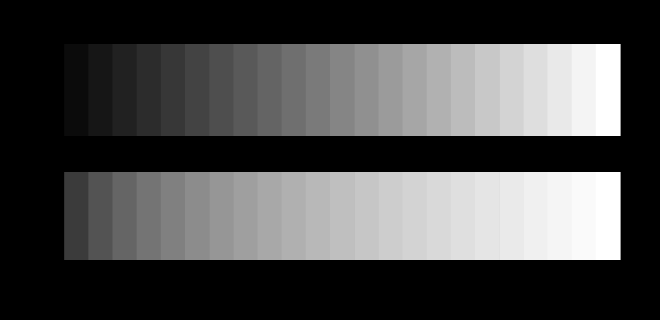
Two more views of the same boundary say what the unnamed variable does to a single surface before any mixing happens.


Who found it, and when
Saunderson published the relation in 1942, in the Journal of the Optical Society of America, and he was working on pigmented plastics — the same industry that supplies the hardest cases for the aperture. The correction has been standard in industrial colour matching ever since, and every serious formulation system applies it.
What is not standard is stating which variable a published curve is in. A colour matching system knows, because it applies the correction itself and controls both ends. A published reflectance in a paper or a database does not carry the information, and the two conventions differ by an amount that matters as soon as anybody mixes.
The measurement community’s answer has been to specify the geometry instead, which fixes k₁ and says nothing about k₂ — a reasonable division of labour, since k₂ is a property of the sample rather than of the instrument, and therefore not something a measurement standard can settle.
Where the ladder goes next
The immediate work is a convention rather than an experiment: every reflectance in this collection could carry a flag saying which side of the boundary it is on, and the mixing code could refuse a curve that does not. That is a day’s work and it would make the ambiguity impossible rather than merely measured.
The larger question is whether k₂ can be recovered from measurements instead of assumed. It appears in the denominator of the Möbius map, so its effect is largest on light samples, and a series of tints of one pigment ought to constrain it — the same shape of inversion as recovering a Yule–Nielsen exponent from a tone scale, and with the same risk that the fit absorbs everything else that was wrong.
Where this goes next
 Paint is not a filter
Stacking two filters multiplies their transmittances. Stirring two pigments together does not multiply their reflectances, because a mixture is one scattering layer rather than two in series — light meets whichever particle is nearest. Treating the two as the same operation is a 15-unit error, and which way it errs turns out to depend on whether the comparison holds the amount of pigment fixed.
Paint is not a filter
Stacking two filters multiplies their transmittances. Stirring two pigments together does not multiply their reflectances, because a mixture is one scattering layer rather than two in series — light meets whichever particle is nearest. Treating the two as the same operation is a 15-unit error, and which way it errs turns out to depend on whether the comparison holds the amount of pigment fixed.
 Why blue and yellow make green
The oldest fact in colour, and the usual explanations are wrong. It is not because green sits between blue and yellow, and it is not a fact about the eye at all — it is that the only band both pigments return is their overlap, and the overlap of a blue and a yellow reflectance is green. Computed, the mixing path bows away from the straight line by a measurable amount.
Why blue and yellow make green
The oldest fact in colour, and the usual explanations are wrong. It is not because green sits between blue and yellow, and it is not a fact about the eye at all — it is that the only band both pigments return is their overlap, and the overlap of a blue and a yellow reflectance is green. Computed, the mixing path bows away from the straight line by a measurable amount.
 A room is not a sphere
An integrating sphere reads a surface's own reflectance exactly, and the exactness is a theorem rather than good engineering — under a hemisphere of constant radiance, reciprocity makes the reading the sample's directional-hemispherical reflectance whatever the surface is. Every room fails that condition, and a viewing booth and a window get the sign of the error wrong in opposite directions.
A room is not a sphere
An integrating sphere reads a surface's own reflectance exactly, and the exactness is a theorem rather than good engineering — under a hemisphere of constant radiance, reciprocity makes the reading the sample's directional-hemispherical reflectance whatever the surface is. Every room fails that condition, and a viewing booth and a window get the sign of the error wrong in opposite directions.
What this makes readable
Essays that name this one as a prerequisite.
Named alongside this one
Essays reaching for the same objects. Nobody chose these; they are what the index of named objects makes visible.
- A tenth of the return arriving white fresnel · measuring geometry · modelling assumption · specular
- Every scene in this collection was matt declared input · modelling assumption · specular
- The floor is a different colour from the door measuring geometry · modelling assumption · specular
- The highlight is the lamp fresnel · refractive index · specular
- A dark wall pays for a finish fresnel · specular
- A finish adds colour only to a daylight meter fresnel · specular
What links here
Every essay whose body links to this one.
The objects this essay names
Each one links to every other essay that touches it.
ConventionDeclared inputFresnelKubelka munkMeasuring geometryModelling assumptionRefractive indexSaunderson correctionSpecularSubtractive mixture