The thread: The instrument is the reader
 What the brain does
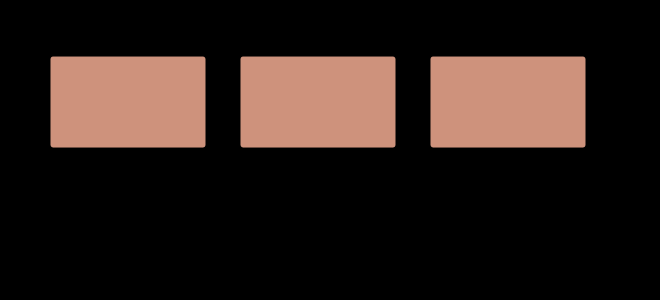
These two patches are identical
It is the most repeated and least checkable sentence in visual perception, because the whole point is that it does not look true. Every instance here is computed, and checked before the figure is drawn.
 What the brain does
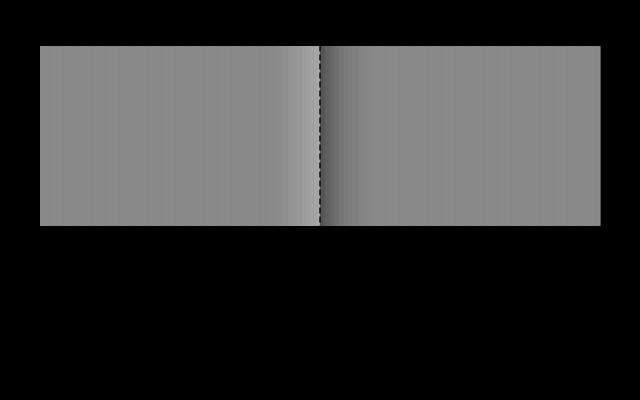
Brightness is inferred from edges
The Cornsweet effect makes two identical regions look different by altering nothing except a narrow band at the boundary between them. Cover the boundary and the difference vanishes, which says the visual system is reconstructing surfaces rather than reading off intensities.
 What the brain does
Constancy is the default
A sheet of paper looks white in daylight and white under a tungsten lamp, although the light reaching the eye differs enormously. The visual system is solving one equation with two unknowns, and it solves it by assumption.
 Where the model breaks
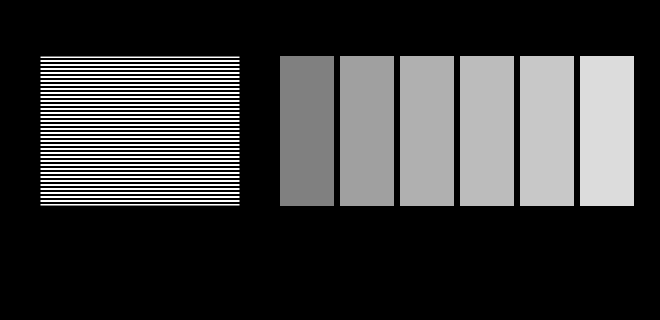
The display is an unknown
This site is displayed on the very apparatus it is about, and it knows almost nothing about that apparatus. Two figures here stop assuming and ask instead — a probe for the transfer function and a probe for the gamut.
 Difference and uniformity
The midpoint is not half
Code 128 sits halfway along the sRGB scale and carries about a fifth of white's luminance. Half the luminance is code 188. Almost every gradient, blur and resize on the web gets this wrong, and the errors are visible once known.
 What the brain does
A viewing condition is an argument
An appearance model takes a stimulus and a situation. The second argument is not a refinement of the first — it is the content of the claim, and a model that returns an appearance from a colour alone has assumed a room without saying which.
 What the eye does
The eye that has no colour
Rods outnumber cones twenty to one, work alone below a hundredth of a candela, and are absent from the centre of gaze. Between dusk and a lit room both systems run at once, and neither standard curve describes what is happening.
 Where the model breaks
Whose eyes
The standard observer is an average over seventeen people, and no reader is it. What that costs was small when displays were broad and grows every time the primaries get narrower.
 Where the model breaks
How bright is white
An sRGB value says a pixel is some fraction of whatever the display can manage. A PQ value says it is two hundred candelas. The change is the largest in display encoding since gamma, and what it removed was the honest admission that nobody knew.
 Matching and measuring
What the instrument reports
A spectrophotometer sees a sample through a slit of finite width, at a finite number of wavelengths. What it writes down is the truth convolved with its own bandpass, and nothing in the file says which values were measured and which were invented.
 What the eye does
Nothing is in focus at both ends
The eye carries about two dioptres of chromatic aberration across the visible band, which is a strong reading prescription. Whatever it is focused on, most of the spectrum is landing somewhere other than the retina — and the cone class that gets the worst of it is the one the retina bothered least to sample.
 What the brain does
The algorithms that guess the light
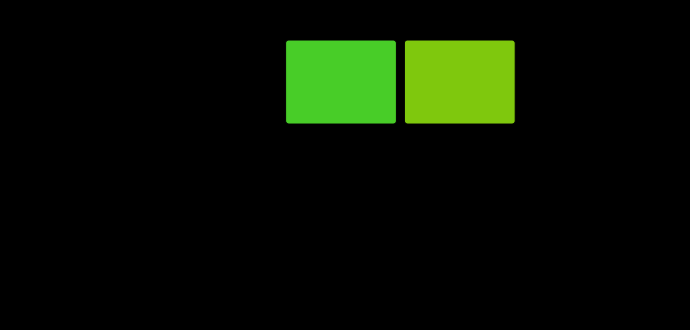
What reaches a sensor is an illuminant multiplied by a reflectance, and no arithmetic separates a product into its factors. Every white-balance algorithm therefore works by assuming something about the world — and the interesting content of each is not its formula but the assumption, because a scene can violate it.
Where the model breaks
Two degrees or ten
This site names the observer on every figure it draws, which was supposed to be the point. Measuring what it had actually done found two hundred and four figures naming the same observer, three naming the other, and sixty-two of sixty-four generators printing a string that had never once varied.
 Difference and uniformity
Where the formula is not smooth
A colour difference formula is a distance, and a distance ought to vary gently. CIEDE2000's does not everywhere — it carries a hue-rotation term with a hard edge in it, and the discontinuity sits where a great many industrial samples live.
 What a scene does
The highlight is the lamp
Light reflected at the surface of a glossy material never entered it, so it never met a pigment. Fresnel's reflectance varies by 5.5% across the visible band and the paint underneath varies by a factor of twenty — which makes a highlight the one region of a photograph that reports what the light was rather than what the object is.
 What a scene does
A scene has no white point
White balance is one transform applied to a whole image, and a scene lit by two lamps has no single answer for that transform to be. The failure is structural rather than a matter of a better estimator — and every colour-managed workflow in existence takes exactly one white point as an input, with no field in which to say there were two.
 What a scene does
Gloss changes the measurement
The same sample measured with the specular component included and excluded returns two different numbers, and both are correct answers to different questions. Colour is one of four appearance attributes and the only one most instruments report — so a specification that names a colour has silently named a geometry too, and usually does not say which.
 What a camera does
A camera is a fourth observer
The 1931 functions, the 1964 functions and a person's own cones are three sets of three curves that collapse a spectrum onto three numbers. A camera is a fourth, built from silicon and dye rather than from pigment and neural wiring, and it agrees with none of them.
 What a camera does
Raw is not a picture
A raw file is three integrals per site and a list of decisions nobody has taken yet. Every one of those decisions has a defensible answer and none of them has a correct one, which is why two converters open the same file and disagree.
 What a camera does
Silicon sees past the visible
A sensor's response ends at 1107 nanometres because that is the band gap, and the colour-filter dyes have stopped absorbing three hundred nanometres before it. So all three channels measure the same thing over the last third of the range, and every published sensitivity plot is drawn after the component that hides it.
 What a camera does
The filter that makes colour possible
An infrared-cut filter is not a refinement on a colour camera. Removing it collapses the separation between the three channels by a factor of nearly nine under tungsten, and the component that keeps colour photography working is the one nobody photographs.
 What a camera does
Most things are pale in the infrared
A spectrophotometer stops at 780 nanometres and a black cotton shirt reflecting five per cent of visible light reflects more than half the near infrared. The measurement everybody has and the quantity a camera integrates are different quantities, and nothing in the first says so.
 What a camera does
Luther said when it would work
There is an exact condition under which a fixed three-by-three matrix converts camera raw to XYZ correctly for every spectrum in existence. It was stated in 1927, it is a theorem rather than a guideline, and no camera ever built satisfies it.
 What a camera does
A camera profile is a fit
Since no matrix is exact, the one a manufacturer ships is a least-squares compromise over a set of surfaces somebody chose. Fitted on desaturated patches it is excellent on desaturated patches — and the sample set is a hidden argument to every camera profile in existence.
258 essays on this thread, page 1 of 11 · all threads · all essays