The thread: The instrument is the reader — page 2
 What a camera does
No matrix is right everywhere
The best three-by-three this sensor admits, fitted and tested on the same twenty-four surfaces, leaves a worst case of ΔE00 2.85. A control sensor built to satisfy Luther's condition reaches ten to the minus seven under the identical computation, which is what makes the first number a measurement.
 What a camera does
A grey edge arrives coloured
A sensor site measures one channel and the other two are interpolated from neighbours that sat somewhere else. Across a black-and-white step that reconstruction gives an achromatic scene a chroma of 144 per cent of its own local mean, and nothing in the scene or the sensor was coloured.
 What a camera does
The highlight is the white balance
Every estimator a camera uses is an assumption about the scene wearing the costume of a measurement. The specular component of a glossy surface is not — it carries the illuminant to within a third of a degree on a scene where averaging is fifty times worse, and it does so without knowing what colour the paint underneath is.
 What a camera does
Correcting colour costs noise
The matrix that turns a sensor's raw into XYZ has large off-diagonal terms of both signs, because that is what correcting a sensor which fails Luther's condition requires. Differences of large numbers are where noise grows, and the full correction amplifies photon noise by 1.66 times.
 What a camera does
A blown highlight turns
An exposure that clips nothing changes no hue at all. Once one channel reaches the ceiling the recorded hue rotates by as much as sixty-seven degrees, with nothing in the scene having changed colour — and every response a converter can make to that is an invention.
 What a camera does
The grid outside every figure
Every figure here is computed on 380 to 780 nanometres, which is exactly right for an eye and insufficient for a sensor. This field met the first subject the grid cannot hold, and the decision was not to widen it — because widening it honestly is impossible.
 What a camera does
A photograph is not a measurement
A photograph is a measurement made by an instrument whose kernel nobody published, under an illuminant nobody recorded, corrected by a matrix fitted to somebody else's surfaces, with two thirds of every pixel invented. It supports relative claims well and absolute ones badly, and it is used for the second.
 What it takes to deliver it
A halftone is not a mixture
Forty per cent cyan and thirty per cent magenta are not stirred together anywhere. They are laid down as dots, and the sheet is a mosaic of four fully-inked regions in proportions the two coverages fix — which is why the colour is an area average of four spectra rather than a blend of two, and why it lands nowhere near where mixing would put it.
 What it takes to deliver it
A dot is larger than it was asked to be
Two quite different things make a printed midtone darker than its coverage says — ink spreading under pressure, and light scattering sideways inside the paper. Both bend the tone curve the same way and neither touches its ends, so the measurement every press is characterised by cannot say which happened. A patch that nobody measures can.
 What it takes to deliver it
A profile is a table
An ICC profile does not contain a model of the device it describes. It contains a lattice of patches that were printed and measured, and everything between them is interpolation — which is exactly zero at every patch, so a profile checked against its own target reports perfection for ever.
 What it takes to deliver it
The lamp in the shop decides
Two packages printed to the same specification, verified under the same standard illuminant and passed, can differ by nearly seven colour differences on a shelf under a tungsten lamp. Nothing went wrong at either press. The specification named one light, the separations that satisfy it are metamers of one another, and the shop chose the second light.
 What it takes to deliver it
The screen is not the room
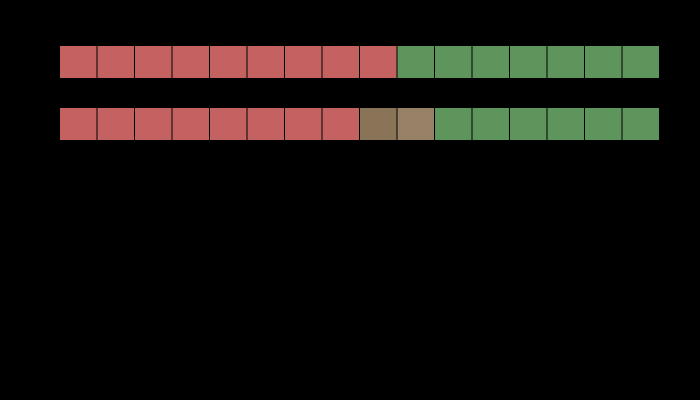
A thousand-to-one display in an ordinary office is a hundred-and-thirty-seven-to-one display, and the signal value that means black comes out at the lightness of a dark grey card. Nothing is wrong with the panel. Light falls on the screen and comes back off it, and the two per cent it returns is added to every pixel — most of all to the ones with nothing else in them.
 What it takes to deliver it
Colour thrown away on purpose
Every video format in use discards three quarters of its colour information and keeps all of its luminance, because the eye resolves fine colour detail badly. On an edge that carries luminance the loss is exactly zero. On an edge of nearly equal luminance it is a colour difference of forty-three, and the two edges are the same edge to the codec.
 What light is
There is no D65 lamp
D65 is standardised by three numbers, and three numbers do not pin a spectrum. A source built to hit them exactly — matched to a part in a billion, with a third of the visible band nearly empty — separates pairs that D65 says are identical by up to eight and a half units of colour difference.
 What the eye does
How fine a colour edge can be
The eye resolves a lightness pattern to about fifty cycles per degree and a red–green one to twelve. Every colour difference here is quoted as though a patch had no size, and the same difference is plainly visible at one scale and gone at another.
 What the eye does
Colour goes first in the dark
A cone reports a count, and a count carries the square root of itself as noise. Counting the photons says where colour vision stops — a chromatic difference runs out four hundred times sooner than a lightness difference of the same size — and says just as clearly that in daylight the eye is nowhere near that limit.
 Matching and measuring
Five nanometres is a choice
Every integral here is taken in five-nanometre steps, and the interval has never had to be defended. Coarsening it to twenty costs daylight two hundredths of a colour difference and a fluorescent tube six and a half — and which way of coarsening is used decides a further factor of six.
 Difference and uniformity
A difference has no size
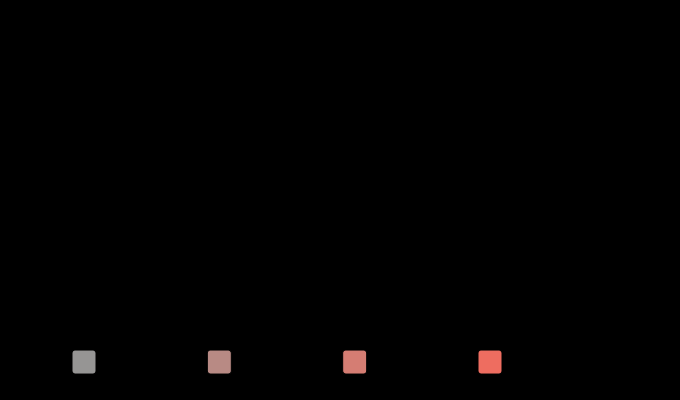
A colour difference formula answers a question about two large patches seen side by side. Applied to a pattern, it reports fourteen units where the eye is left with less than one — and the ratio depends on nothing but how finely the difference is spread.
 What the brain does
Brightness is not luminance
Photometry is additive because the CIE defined it that way. Brightness is not, and a saturated colour looks as bright as a neutral of one and a half times its luminance — an effect this site's appearance model moves by two per cent, in a direction that depends on the hue.
 Where the model breaks
Banding is not a bit depth
Eight bits bands at thirty times threshold in the shadows and at under three at mid grey, on the same ramp with the same encoding. What decides is where in the tone scale the gradient sits, how sharp each step's edge is, and how far away the reader is — and a bit count contains none of the three.
 Where the model breaks
The model has no clock
An appearance model takes a stimulus and a situation and returns what it looks like. It does not take a time, and adaptation is not instantaneous — half a second after the light changes a judgement is three and a half CAM16-UCS units from the settled one, and a minute later it is still 1.3.
 What the eye does
A pattern has a direction
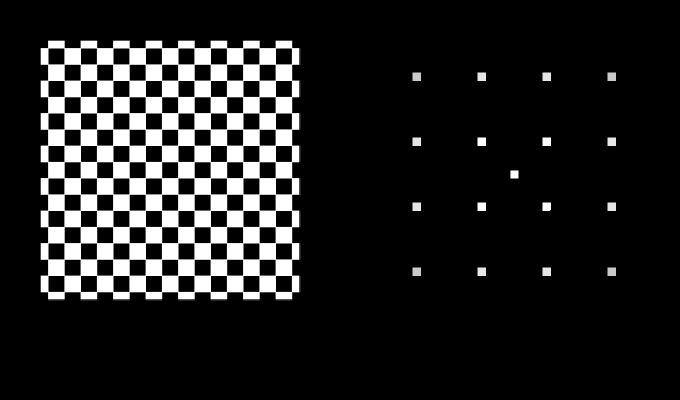
Every spatial claim here is a claim about a frequency, and a frequency has no direction in it. Turning a printed screen forty-five degrees makes it exactly twice as quiet with nothing else changed — and the same rotation does nothing at all to a chromatic one.
 What the eye does
Colour stops at the edge of sight
Cone density falls twenty-one-fold between the centre of gaze and ten degrees out, and the three channels give out at three different rates — so a colour difference in the periphery does not merely shrink, it turns. At the exact point of fixation there are no short-wavelength cones at all.
 What the eye does
The eye has a shutter
An isoluminant flicker fuses at fifteen hertz and a luminance one at sixty, so a light whose colour changes forty times a second is a steady light of a colour it never emits. And the frequency at which flicker stops being visible is not a property of the eye — it moves twelve and a half hertz for every decade of light.
258 essays on this thread, page 2 of 11 · all threads · all essays