Theme

The thread: Identical, and checked
"These two patches are the same colour" is the most repeated and least checkable sentence in perception, because the whole point is that it does not look true. Every instance here is checked by computation.
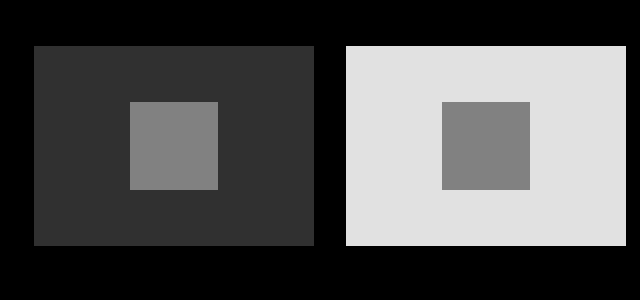
Two identical grey patches on different surrounds. Both inner squares are #818181. The one on the dark field looks lighter. The values are checked to be equal before the figure is drawn, so the claim is a fact about the drawing rather than a promise. What the brain does

These two patches are identical

It is the most repeated and least checkable sentence in visual perception, because the whole point is that it does not look true. Every instance here is computed, and checked before the figure is drawn.
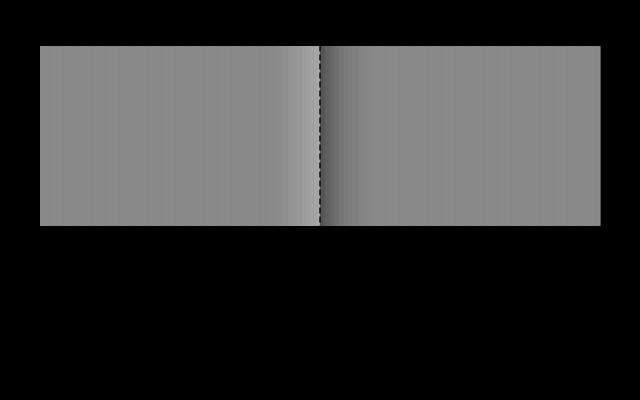
The Cornsweet edge, with its luminance profile. The two plateaux are both #898989 and are flat to exactly — the profile below shows that everything which differs lies within a narrow band at the boundary. Cover the centre line and the two halves become obviously identical. What the brain does

Brightness is inferred from edges

The Cornsweet effect makes two identical regions look different by altering nothing except a narrow band at the boundary between them. Cover the boundary and the difference vanishes, which says the visual system is reconstructing surfaces rather than reading off intensities.

Two identical grey patches on different surrounds. Both inner squares are #868686. The one on the dark field looks lighter. The values are checked to be equal before the figure is drawn, so the claim is a fact about the drawing rather than a promise. Matching and measuring

Matching is not appearance

CIE XYZ predicts when two lights will look the same under identical viewing conditions. It was never a model of how anything looks, and most of the confusion in applied colour comes from using it as one.

Threshold and suprathreshold contours, normalised to the same size. At five of MacAdam's centres: the measured just-noticeable-difference ellipse in grey and the ΔE2000 = 1 contour in gold, each scaled to the same mean radius so that only shape and orientation are being compared. A scale change preserves orientation exactly, so any rotation between the pair settles the question. They differ by 24° on average and by 70° at worst, and the ratio between their sizes varies 4.8-fold across the diagram — so no single factor turns one into the other. Difference and uniformity

A threshold is not a unit

MacAdam measured the smallest difference anyone could detect. ΔE2000 was fitted to how far apart plainly different colours look. The two are quoted interchangeably, and the contours they produce are not even the same shape.
A metameric match that a corner breaks. Two reflectances with identical XYZ under D65 — metamers, matching to ΔE00 = 5.4e-14, which is the numerical floor rather than an approximation. On a flat wall the light meets one of them once and the two patches are the same colour. In a corner, a fraction 0.200 of what leaves the surface returns to it, so part of what reaches the eye carries ρ twice — and the match fails by ΔE00 = 1.53. A metameric match is an identity between three integrals that are linear in ρ, and there is nothing linear left after a second bounce. The geometry, not the light and not the paint, is what breaks it. What a scene does

Two paints that stop matching

A metameric match is an identity between three integrals that are linear in reflectance. A second bounce carries reflectance squared, and no linear identity survives being squared — so two paints certified identical on a flat chart come apart in a corner, by an amount the geometry decides and the colorimetry cannot express.

The form-factor matrix of the box. F_ij is the fraction of everything leaving face i that arrives at face j. The diagonal is zero because a flat face sees none of itself; each row sums to exactly 1 because the cavity is closed; and A_i F_ij = A_j F_ji, which is reciprocity and is checked to 10⁻⁹. For a cube the opposite face takes 19.98% and each of the four adjacent faces 20.00%, and the near-equality of those two numbers is a coincidence of the cube rather than a rule. What a scene does

A corner is not a wall

A form factor is the fraction of everything leaving one surface that arrives at another, and it is the only place geometry enters the colour of a room. It is also the one number here with a published closed form to check against — and the check turned out to converge at two different rates for two cases that look identical.

One film, five viewing angles. The same 340 nm film seen from 5 directions. Nothing about the object has changed — not the light, not the material, not the thickness — and the colour swings by ΔE00 = 42. A pigment's spectrum contains no path length and no angle, so it cannot do this; a film's contains both. This is the clean separation between structural and pigmentary colour, and it is geometric rather than chemical. What a scene does

A colour that moves with the viewer

A thin film has no pigment in it. Its reflectance spectrum is an interference condition containing a path length and an angle, so tilting the sample moves every maximum to a shorter wavelength and changes the colour by 40 units of ΔE. A pigment's spectrum contains neither, and cannot do this at all — which is the cleanest separation between the two kinds of colour there is, and it is geometric rather than chemical.
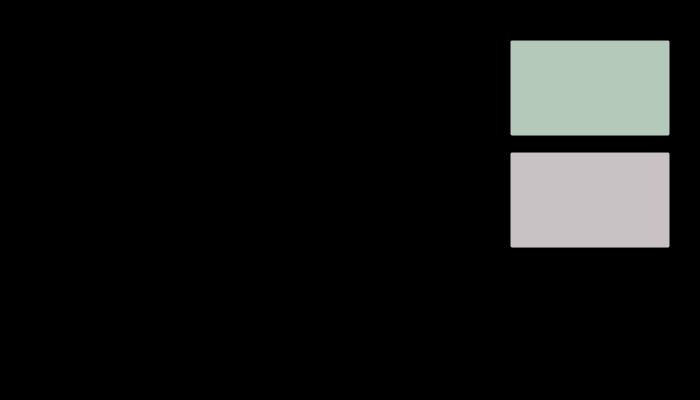
Two reflectances the camera records as identical. Constructed by projecting onto the null space of the sensor's own sensitivities, so the two raw triples agree to 0.0000 per cent. To the eye they are ΔE00 15.33 apart, which the swatches show. What a camera does

The camera has its own metamers

Two surfaces a camera records as identical can be plainly different to a person, and two a person cannot tell apart can be recorded as different. Both pairs are constructed rather than found, from one projection, used for both.

A grey edge, reconstructed from a Bayer row, arrives coloured. Above: an achromatic step through 24 sensor sites, with green sampled on the even ones and red on the odd. Interpolating each channel separately reconstructs them from data taken on either side of the edge, so their ratio moves. Below: the resulting chroma, peaking at 144 per cent of the local mean, and 112 per cent once colour differences are interpolated instead. What a camera does

A grey edge arrives coloured

A sensor site measures one channel and the other two are interpolated from neighbours that sat somewhere else. Across a black-and-white step that reconstruction gives an achromatic scene a chroma of 144 per cent of its own local mean, and nothing in the scene or the sensor was coloured.

How often two colour-difference formulae disagree about which pair is worse. Pairs of colours sampled in CIELAB, compared two at a time. A rank inversion is a case where one formula calls pair A worse and the other calls pair B worse; no monotone rescaling of either can remove one. The left bar of each group is the rate over the whole space and the right bar is the rate among pairs sitting near a tolerance of ΔE 1, where the decision is actually made — and it is between 35 and 44 per cent, against a coin flip at fifty. Difference and uniformity

Which of two is worse

Two colour-difference formulae disagree about which of two pairs is the larger difference in thirteen per cent of comparisons overall — and in forty-three per cent of comparisons among pairs sitting near a tolerance of one unit, which is where every acceptance decision is actually made.
An afterimage, as the local pool coming back to equilibrium. The local pool has adapted to the patch and the global pool has not, so the gain change is exactly the local share of a full von Kries change — which is why afterimage's free strength parameter is not free here. The dwell is 20 seconds. The swatches are the predicted appearance of the test surface at four moments. They are predictions of hue and direction; there is no response compression in this model, so the chroma is a ceiling rather than an estimate. What the brain does

A gain has a time constant

An afterimage and the clock on chromatic adaptation were built in different files from what the last phase said was one mechanism. Joining them removes a free parameter, reproduces both, and predicts a third thing — that two people in one room, at one moment, looking at one patch, do not agree about its colour.

What a dither mask is worth, read as components, in two dimensions. Five luminance ramps, each quantised to 8 bits with and without a high-passed mask of the same power. The bars are the most visible single sinusoidal component of the error, as a multiple of the contrast that component needs to be seen: above the line at one it is visible. The mask lowers it by 20–22×, on every ramp — which the one-dimensional model on this site says it does not, and that disagreement is the finding. Where the model breaks

Every threshold was measured with a grating

An earlier essay here claimed that the model cannot explain why dither works, and named two missing pieces. One of them was real and worth thirteen times the guess; the other was not needed. The piece nobody named was the detector — and reading the same model two ways changes the answer by a factor of fifty.

How large a step changes the name, across the ab plane at L* 60. At each point, the smallest ΔE00 step in any direction after which the probability of two people using the same word has halved. It runs from 4.8 to 33.8 units across this one plane, in eight quantised levels: the palest cells are where a name is finest — a short step changes it — and the strongest are the middles of large territories, where a colour can move twenty units and keep its word. The ragged edge is the sRGB boundary at this lightness rather than a property of the vocabulary. The boundary softness is a stated parameter of the model, and the map barely moves when it is changed fourfold, because what sets this quantity is how far apart the centroids are. What the brain does

A name is not a threshold

Two colours have to move about ten times a just-noticeable difference apart before people stop calling them the same thing, and how far varies threefold across one plane of the space. A tolerance and a word are answering different questions, and nothing in colorimetry converts between them.

Coming back from a bleach, against the clock already measured. A 94 per cent bleach, and the pigment returning at its own time constant of 120 seconds. The lower curve is the site's slow neural adaptation constant, 60 seconds, started from the same place — it is finished while the chemistry is barely half done. Regeneration does not speed up because the light went away: the rate constant is the same one it always was, which is why the recovery is slow while the bleaching was fast. What the eye does

The slowest clock is chemical

An earlier essay here joined the afterimage to the adaptation clock and named what was still missing — a third gain, upstream of both, in the pigment itself. It is twice as slow as anything measured before it, it leaves a coloured after-tint from a white field, and at steady state it cancels exactly, which is why nobody has ever needed to model it.

Every filtered claim in these essays, read at a point and read as components. Each row is a comparison one of the essays makes. The bar is the ratio between the two readings — how many times larger the component answer is than the point answer, or the reverse — on a logarithmic scale. 5 of 7 disagree by more than half again, and 4 disagree about the direction of the effect rather than merely its size. The three marked as noisy are the ones with a noise field on one side of the comparison, and they are the three largest. Where the model breaks

The list nobody made

The last phase found that reading a filtered signal at a point asks a question its thresholds were never fitted to, made it a standing rule, and admitted that nobody had gone back through the site to see which claims it touched. Here is the list. Every claim with noise on one side of it moves — and so do two that have no noise in them at all, which the rule said would not.

Dimmed to a fiftieth, three ways. Switching a lamp on and off faster than anyone can see scales the spectrum and changes nothing else, so its colour temperature is a horizontal line and its chromaticity moves by 7.3e-14 ΔE00 — exactly, to floating point. Reducing the drive current moves the die's peak and cools the junction, which moves the mixture: ΔE00 3.5 across the range. A filament has no spectrum of its own to move; it is a blackbody at whatever temperature the power leaves it at, and it falls 1672 K. Three methods, one instruction, three colours. What light is

Three ways to dim a lamp

"Dimmed to ten per cent" names three different colours. Switching the lamp on and off faster than anybody can see changes the chromaticity by nothing at all — exactly, to floating point. Reducing the current moves it a few units. Reducing the power to a filament moves it eighteen hundred kelvin down the Planckian locus, and stays on the locus exactly the whole way.

A tolerance of one unit, re-measured under every light in the census. Every one of the 23 pairs behind this figure is at exactly ΔE00 1.000 under D65 by construction. Each bar is what those same pairs measure under another light, after the observer has adapted to it: the line is the median and the bar spans the pairs. A tolerance is written as a property of a pair and it is not one — the light multiplies both members, and the difference between two products is not the product of the difference. The widest row is a lens at twenty against a lens at seventy, spanning 0.81 to 1.57. Difference and uniformity

One unit in another room

Twenty-three pairs built at exactly ΔE00 1.000 under D65, re-measured under every change of light this site models with the observer adapted to each, come out anywhere between 0.64 and 1.57. A tolerance is written as a property of a pair and it is a property of a pair and a room.

Two sheets with the same reflectance and two different colours. A brightened sheet and a dyed one built to match it under an instrument with no ultraviolet. Under that instrument the pair agrees to ΔE00 0.00, which is a rounding and is true by construction — the dyed sheet's reflectance is the curve the brightened one measured. Under an instrument that includes the ultraviolet they are 7.1 apart, and under daylight 10.6. This is not ordinary metamerism: the two sheets do not differ in reflectance anywhere the eye can see, so no change of light puts them back together and no adaptation removes the difference. One of them is a curve and the other is an operator. What a scene does

Two sheets that match until the window

Ordinary metamerism is two reflectances that agree under one light and not another, and it can always be undone by putting the first light back. A dyed sheet and a brightened one have the same reflectance everywhere an eye can see, agree exactly under any lamp with no ultraviolet, and separate by ten units under daylight — and no change of light puts them back together.

Outside the set of colours a reflecting surface can be. How far each stock sits from the boundary of the object-colour solid, as a fraction of the bound. The line at zero is the boundary: a perfect diffuser sits exactly on it, and every reflectance ever made sits to its left. The pale marker is the sheet measured with the ultraviolet excluded and the dark one with it included. Two of the six cross the line — they are brighter, in a direction that can be written down, than any reflecting surface of their colour could be. This is a proof rather than a hull: for each sample a direction is found in which the largest value any reflectance can reach is computed exactly, and the sample exceeds it. Where the model breaks

A white that is not a reflectance

The object-colour solid is the hardest boundary in colorimetry — the set of tristimulus values any reflecting surface can produce, with no assumption about pigments in it at all. A coated press stock under a measurement standard's own lamp sits 1.5 per cent outside it, and a heavily brightened one 4.0, and with the ultraviolet removed both come back inside.

Where a dichromat's confusions converge. Every pair of colours a protanope cannot tell apart lies on one of these lines, and all the lines meet at a single point — at (0.7465, 0.2535) for this class. The point is the chromaticity of the missing cone's own response direction, which is why it need not lie inside the diagram or correspond to any light at all. Two of the three do not. The three points between them carry six numbers, and six is two thirds of what the matching data leave undetermined. What the eye does

A confusion point is a missing pigment

The nine numbers colour matching leaves free are fixed by three points on a chromaticity diagram, each of them the place where everything one class of dichromat cannot tell apart converges. Two of the three lie outside the diagram entirely, which is not a defect — a direction in tristimulus space need not correspond to a light.

Four cameras that all satisfy the Luther condition exactly. Four sensors whose sensitivities are linear combinations of the colour-matching functions — the theoretical ideal, satisfying the condition to machine precision, each with an adaptation basis that does not move when the light does. They differ only in which linear combination, which the condition does not constrain, and they leave 2.46, 0.97, 1.65, 2.37 ΔE00 after a white balance. The best of them reaches 0.974, which is the best any basis at all achieves. Being a perfect colorimeter costs nothing in adaptation; what costs is the mixing matrix, and the control measured here carries one nobody chose. What a camera does

The condition chooses no axes

It has long been said here that a sensor satisfying the Luther condition exactly adapts worse than a silicon one, and offered a reason — that its channels are the matching functions, and a gain on those is the oldest mistake in the subject. The measurement was of one sensor. The condition leaves the axes entirely free.
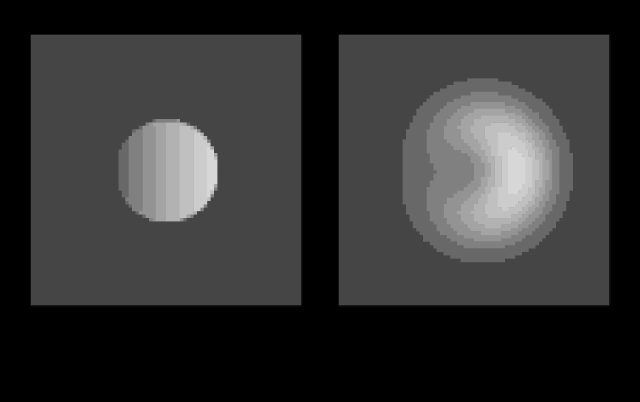
The same border signal, filled in with a boundary and without one. Two fields, each 6 degrees across. The signal is injected along a ring just inside a contour and varies around it, brightest on one side and dimmest on the other. On the left the signal diffuses and the contour is impermeable: the interior settles to 1.000 against a border mean of 1.000, which is the mean-value property of a harmonic function arriving as a prediction about appearance. On the right the same signal is handed to a Gaussian pool of 0.5°, which has no notion of inside: it reaches 0.040 at the centre, because a kernel weights the near rim more than the far one and a filled region does not. What a scene does

A pool with an edge

A Gaussian pool says how much of a stabilised image survives and can say nothing about what the remainder looks like, because a Gaussian has no edge. Give the pool a boundary and the interior of a faded region takes the average of its own border — exactly, by the mean value theorem, arriving as a prediction about appearance.

A gap in the wall and a gap in the drive are not the same gap. What the centre of a region settles to under three conditions. With the contour closed it reaches its border's value exactly. Open a 16% hole in the barrier and leave the border signal unbroken and it still reaches it, to 1e-8 — a ring of driven cells encloses the centre whatever the wall outside it is doing, so nothing can escape. Break the signal too and it falls to 0.960. All of what a gap costs is the piece of border that stopped driving, and none of it is the hole. What a scene does

A gap in the drive, not in the wall

Break the contour around a region and leave its border signal unbroken, and the interior does not move by one part in a million — a ring of driven cells encloses a centre whatever the wall outside it is doing. Break the signal too and the shortfall goes as the square of what is missing. All of what a gap costs is the piece of border that stopped driving.

The minimum sits in a notch the width of the answer's reciprocal. The distance from the centre to the boundary, all the way round one MacAdam ellipse mapped into a lightness–chroma space built on the CIE RGB primaries. The curve has two broad maxima and two very narrow minima: the dip is about 2.5 degrees wide at a third above its floor, because the width of the minimum of an ellipse's radius is the reciprocal of its axis ratio, and this ratio is 41. Forty-eight sample points, marked, are spaced 7.5 degrees apart, so none of them lands in either notch and the smallest one found is 2.2 times the true minimum. The ratio comes out 18.59 where it is 40.76. Difference and uniformity

An ellipse is not a ring of points

For eleven rounds of argument the distortion a colour space does to MacAdam's ellipses by mapping forty-eight points round each one and dividing the longest radius by the shortest. The minimum sits in a notch whose width is the reciprocal of the answer, so the method was accurate wherever the answer was small and short by a factor of two where it was large.

44 essays on this thread, page 1 of 2 · all threads · all essays