The thread: Matching is not appearance
 Difference and uniformity
How far apart are two colours
ΔE is meant to be a distance with the property that the same number means the same perceived difference everywhere. Three successive formulae have tried, they disagree with each other by more than a just-noticeable difference, and the disagreement decides real matching questions.
 Where the model breaks
Seventeen observers in 1931
The standard observer that governs every colour specification in industrial use is an average over seventeen young British men, measured with equipment from the 1920s. It is known to be wrong in the blue, the correction has existed since 1951, and it has never been adopted.
 What the brain does
These two patches are identical
It is the most repeated and least checkable sentence in visual perception, because the whole point is that it does not look true. Every instance here is computed, and checked before the figure is drawn.
 Matching and measuring
Matching is not appearance
CIE XYZ predicts when two lights will look the same under identical viewing conditions. It was never a model of how anything looks, and most of the confusion in applied colour comes from using it as one.
 Where the model breaks
Simulating what cannot be simulated
A colour-blindness simulation cannot show what anybody sees. What it can show is which discriminations survive, and that is a narrower claim, a checkable one, and the only one worth making.
 What the brain does
Constancy is the default
A sheet of paper looks white in daylight and white under a tungsten lamp, although the light reaching the eye differs enormously. The visual system is solving one equation with two unknowns, and it solves it by assumption.
 What light is
The illuminant is half the answer
An object has a reflectance, not a colour. The colour appears when a specified light falls on it, which is why two surfaces can match in a shop and clash outside, and why every serious matching standard names the light.
 Matching and measuring
A hex code is not a colour
Six hexadecimal digits identify three numbers. Turning three numbers into a colour needs a colour space, a transfer function, a white point and a display, and leaving any of them unstated is the everyday version of every confusion in colour management.
 What the brain does
A viewing condition is an argument
An appearance model takes a stimulus and a situation. The second argument is not a refinement of the first — it is the content of the claim, and a model that returns an appearance from a colour alone has assumed a room without saying which.
 What the brain does
Brighter looks more colourful
Colourfulness rises with light level and the model predicts it. Apparent contrast is supposed to rise too, and the model does not — which turns out to be right, because the thing that actually carries contrast is the surround.
 What the brain does
Why there are four unique hues
Observers agree that four hues are elementary and that no colour is reddish green. Nothing in the three receptors predicts either fact, and the axes of every standard colour space miss the four by tens of degrees.
 What the eye does
The mosaic is not the observer
The ratio of long-wavelength to medium-wavelength cones varies between ordinary people by a factor of sixteen. Those people make the same colour matches, to twelve decimal places, and that single fact is the reason a standard observer can exist at all.
 What the brain does
A patch is not a scene
A paint chip is the wrong size, on the wrong background, at the wrong luminance, in the wrong surround. Every one of those is a term in an appearance model, and the model says how much each of them moves the answer — which is the difference between a caution and a prediction.
 What a scene does
Two paints that stop matching
A metameric match is an identity between three integrals that are linear in reflectance. A second bounce carries reflectance squared, and no linear identity survives being squared — so two paints certified identical on a flat chart come apart in a corner, by an amount the geometry decides and the colorimetry cannot express.
 What a scene does
Gloss changes the measurement
The same sample measured with the specular component included and excluded returns two different numbers, and both are correct answers to different questions. Colour is one of four appearance attributes and the only one most instruments report — so a specification that names a colour has silently named a geometry too, and usually does not say which.
 What a camera does
Most things are pale in the infrared
A spectrophotometer stops at 780 nanometres and a black cotton shirt reflecting five per cent of visible light reflects more than half the near infrared. The measurement everybody has and the quantity a camera integrates are different quantities, and nothing in the first says so.
 What a camera does
Luther said when it would work
There is an exact condition under which a fixed three-by-three matrix converts camera raw to XYZ correctly for every spectrum in existence. It was stated in 1927, it is a theorem rather than a guideline, and no camera ever built satisfies it.
 What a camera does
The camera has its own metamers
Two surfaces a camera records as identical can be plainly different to a person, and two a person cannot tell apart can be recorded as different. Both pairs are constructed rather than found, from one projection, used for both.
 What a camera does
The highlight is the white balance
Every estimator a camera uses is an assumption about the scene wearing the costume of a measurement. The specular component of a glossy surface is not — it carries the illuminant to within a third of a degree on a scene where averaging is fifty times worse, and it does so without knowing what colour the paint underneath is.
 What a camera does
The grid outside every figure
Every figure here is computed on 380 to 780 nanometres, which is exactly right for an eye and insufficient for a sensor. This field met the first subject the grid cannot hold, and the decision was not to widen it — because widening it honestly is impossible.
 What a camera does
A photograph is not a measurement
A photograph is a measurement made by an instrument whose kernel nobody published, under an illuminant nobody recorded, corrected by a matrix fitted to somebody else's surfaces, with two thirds of every pixel invented. It supports relative claims well and absolute ones badly, and it is used for the second.
 What it takes to deliver it
The paper is the white point
A printed colour is reported against the sheet it sits on rather than against the light in the room, and the choice is a switch in every colour engine. Flipped one way, the same separation on coated stock and on newsprint is a 3.04 colour difference; flipped the other, it is 0.13 — and the two answers are about different questions.
 What it takes to deliver it
The separation is not unique
A four-ink press has one more control than a colour has numbers, so most colours can be printed several ways. The alternatives agree to a hundredth of a colour difference under the light the match was made in — and they are metamers of one another, so under a tungsten lamp the same eleven separations of one colour spread by nearly seven.
 What it takes to deliver it
No mapping preserves everything
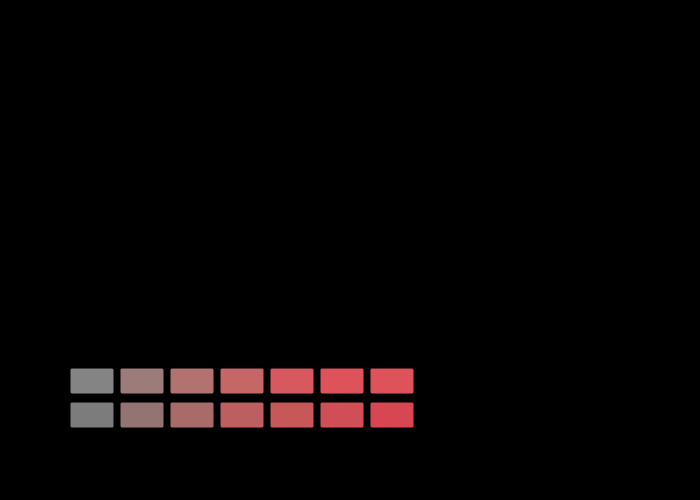
More than half the sRGB solid is outside a press's gamut, so something has to be done with it, and there are two things that can be done. One leaves every reproducible colour exactly where it was and delivers a gradient as a flat area. The other keeps the gradient and moves every colour that needed no help by about three.
136 essays on this thread, page 1 of 6 · all threads · all essays