Theme

The thread: Matching is not appearance — page 2
CIE XYZ predicts when two lights will match under identical viewing conditions. It was never a model of how anything looks, and most of the confusion in applied colour comes from using it as one.
What separates the separations, and under which light. 11 separations of a single colour, differing only in how much of it is carried by black rather than by the three chromatic inks. Under D50 they agree to ΔE00 = 0.00 — the solver was asked for that and delivered it. Under illuminant A they spread to 6.75. They are metamers of one another, and the whole family is invisible to any instrument reading a single illuminant. What it takes to deliver it

The lamp in the shop decides

Two packages printed to the same specification, verified under the same standard illuminant and passed, can differ by nearly seven colour differences on a shelf under a tungsten lamp. Nothing went wrong at either press. The specification named one light, the separations that satisfy it are metamers of one another, and the shop chose the second light.
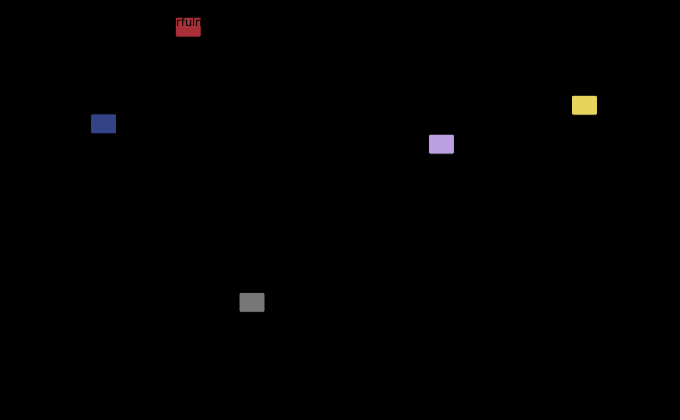
Lightness against colourfulness, in a booth and on a screen. Each arrow is one colour, from what the model predicts under a print in a 2000 lux booth to what it predicts under a display in a dim room. Every arrow points the same way, which is the content: a dimmer surround lowers predicted lightness and colourfulness together, so a proof does not merely differ from the print, it differs in a direction — and that is why proofing standards specify the room and not only the numbers. What it takes to deliver it

The proof is a different object

A soft proof can be made colorimetrically exact and still not match the print, because the print is in a booth at two thousand lux with an average surround and the screen is in a dim room at a fifth of the luminance. The appearance model puts four CAM16-UCS units between them, with no change of stimulus anywhere — larger than the error any rendering intent is arguing about.

Mixtures of 2700 K and 6500 K, on the diagram colour temperature is defined on. Both sources are Planckian radiators, so both sit exactly on the locus. Every mixture of them lies on the straight line between them, because mixing is addition and chromaticity is a projection of it — and the locus is curved, so the line is a chord. The equal mixture sits -0.0064 off the locus at a correlated colour temperature of 3953 K: a light that is measurably pink, specified by a number that says nothing about it. What light is

Two lamps do not average

Light adds, band by band, and every number a lamp is sold by is a projection of the sum rather than a sum of the projections. Two radiators sitting exactly on the Planckian locus mix into a light that is measurably pink; two poor lamps mix into a better one than either.

The L cone's sensitivity at three axial pigment densities. Each curve is normalised to its own peak, so the only difference visible is shape. Raising the density from 0.1 to 0.9 widens the curve from 113.6 to 145.9 nm at half height while the peak stays within 5 nm of where it was. That is Beer–Lambert saturating: at the peak the pigment already absorbs nearly everything, so more of it can only catch more light in the wings. What the eye does

A cone absorbs its own light

A photopigment's absorbance is a property of a molecule; a cone's sensitivity is that molecule stacked in a column deep enough to absorb most of what arrives. The stacking broadens the curve by thirty-five nanometres, and two observers differing in nothing else disagree about a match that is exact for one of them.
The worst triple found, under ΔE2000. Three colours, plotted on the a–b plane of CIELAB. Going from a to c directly is 123.645; going via b is 60.528, which is 51.0 per cent shorter. A distance cannot behave that way, and this one is the formula every colour tolerance in industry is written in. The colours are far apart, which is where the violation is largest; the same search confined to tolerance scale finds a smaller one that has not gone away. Difference and uniformity

A difference is not a distance

Two earlier essays here said that CIEDE2000 violates the triangle inequality and left it at that. Searching for the violation finds a detour half the length of the direct route, a smaller one inside a five-unit ball, and a second defect nobody mentions — ΔE94 is not even symmetric.
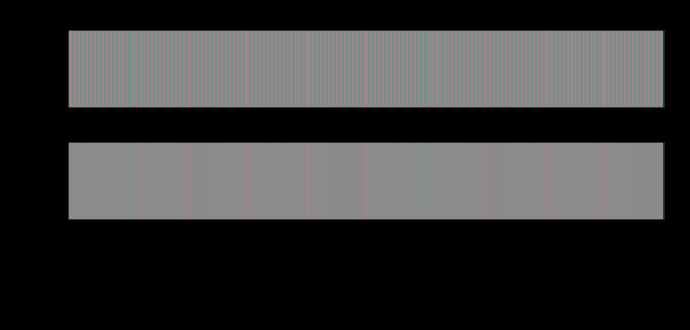
A chromatic line screen at 10.0 cycles per degree. The upper strip is the pattern as delivered and the lower one is the same pattern after each opponent channel has been low-passed at its own cutoff. Against a flat field of the same mean, the delivered pattern differs by up to ΔE00 14.22 and the filtered one by 7.77 — a ratio of 1.8. Every number quoted elsewhere for a difference of this kind is the first one. Difference and uniformity

A difference has no size

A colour difference formula answers a question about two large patches seen side by side. Applied to a pattern, it reports fourteen units where the eye is left with less than one — and the ratio depends on nothing but how finely the difference is spread.
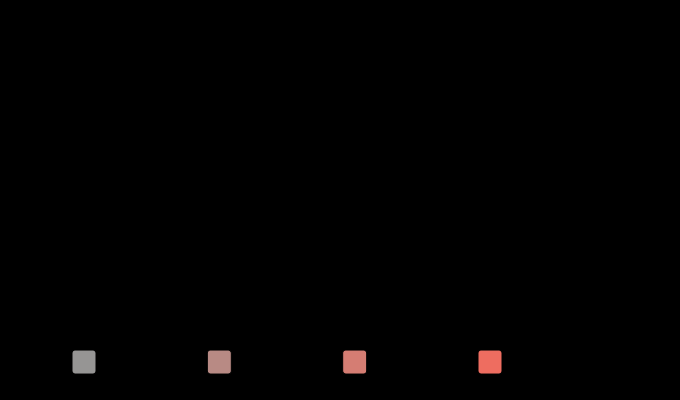
Brightness against chroma, at exactly constant luminance. Seven stimuli of identical luminance and rising chroma at hue 25. The model's brightness moves by 2.2 per cent across the whole sweep, and at some hues it moves the other way. The Helmholtz–Kohlrausch effect — measured repeatedly, by several methods — is that a saturated colour looks as bright as a neutral of 1.3 to 2 times its luminance, shown as the band. The gap is the model's, and nothing here closes it: the term that would is not in CIECAM16 and is not invented for the occasion. What the brain does

Brightness is not luminance

Photometry is additive because the CIE defined it that way. Brightness is not, and a saturated colour looks as bright as a neutral of one and a half times its luminance — an effect this site's appearance model moves by two per cent, in a direction that depends on the hue.
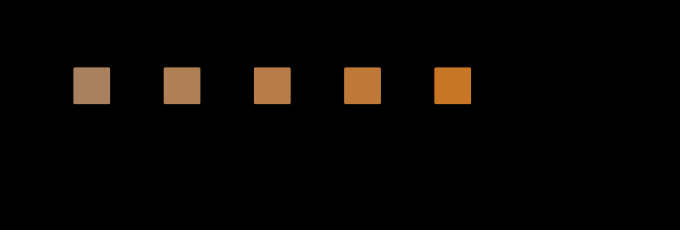
One light, seven rooms. The same stimulus — fixed in XYZ, unchanged throughout — shown against whites from 12 to 800 candelas per square metre. Its lightness falls from 152 to 16 and its brightness rises, because one of those is a ratio to the white and the other is not. Brown is the low-lightness end: a colour that exists only when something brighter is present, which is why no lamp is brown and no star is. What the brain does

There is no brown light

Brown is dark orange, dark is a ratio to a white, and a light in a dark room has no white to be dark against. The same stimulus, unchanged in XYZ, runs from lightness 152 to lightness 16 as the surround is raised — and only the bottom of that range has a name.

One adapting colour, two answers. The left patch is what was stared at. The middle is the afterimage the cone-gain arithmetic predicts at 15 per cent adaptation; the right is the inverted code values. They are 22.1 ΔE00 apart. The gains that produced the middle patch are 0.95, 1.06, 1.69 on the long, medium and short cone classes — the reciprocal of what each class had been receiving, taken 15 per cent of the way. What the brain does

An afterimage is an adaptation

The demonstration everybody gives is an inverted image, which is a statement about a file format. Running the receptoral arithmetic instead puts the afterimage of a saturated red sixty degrees of hue away from the inverse — and outside what any display can show.

A 8-bit ramp from 0.0008 to 0.006 of white, 12° wide. The top strip is the ramp as delivered: 16 distinct levels, each a step of one code value. Below it is the quantisation error as a Weber contrast against the local luminance, filtered by the luminance sensitivity function. The largest response is 8.51 per cent contrast against a threshold of 0.3, which is 28.4 times over — and it occurs at 0.09 per cent of white, at the dark end, because a code step is a Weber contrast and the same step is a larger fraction of less light. Where the model breaks

Banding is not a bit depth

Eight bits bands at thirty times threshold in the shadows and at under three at mid grey, on the same ramp with the same encoding. What decides is where in the tone scale the gradient sits, how sharp each step's edge is, and how far away the reader is — and a bit count contains none of the three.

The colourfulness the sRGB cube reaches, against the light in the room. The display is the same display throughout and the signal is the same signal. What moves is the adapting luminance, which enters the appearance model and nothing else. The furthest colourfulness the cube reaches falls from 131 to 57, a factor of 2.29. A gamut in CIELAB cannot show this at all, because CIELAB has no light level in it — which is why every gamut percentage in circulation is quoted without one. Where the model breaks

The gamut shrinks in the dark

Every gamut number here is a property of a device and of nothing else, which is why the same display has the same gamut in a studio and in a cinema. It does not. Turn the room down four decades and the solid loses a fifth of its reach and two thirds of its volume, with the signal unchanged.

How far a judgement is from the settled one, second by second. The light changed from one white to another at t = 0 and nothing else moved. The model has one degree of adaptation and no clock, so the distance plotted is what a clock adds: 3.6 CAM16-UCS units half a second in, still 1.3 after a minute, and 0.11 after five. Every appearance number on this site is the value at the right-hand end. Where the model breaks

The model has no clock

An appearance model takes a stimulus and a situation and returns what it looks like. It does not take a time, and adaptation is not instantaneous — half a second after the light changes a judgement is three and a half CAM16-UCS units from the settled one, and a minute later it is still 1.3.
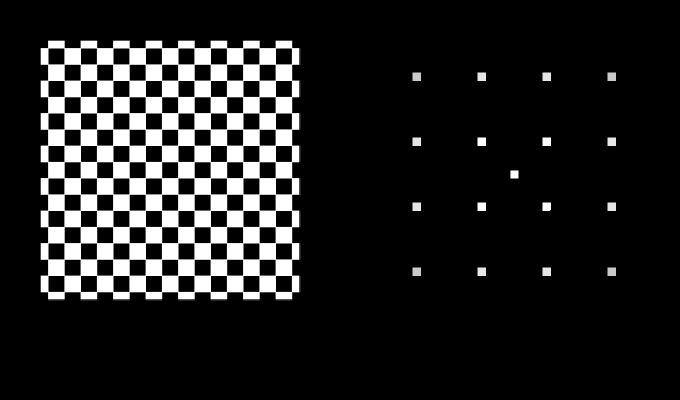
A screen at 45°, 8 c/°, and where its energy sits. Left, the pattern. Right, its power in the frequency plane with the zero frequency at the centre and the edges at the sampling limit of 23 cycles per degree, on a logarithmic scale over five decades. The closed curves are the visual system's own sensitivity at 5, 25, 60 per cent of its peak; they are not circles, because sensitivity is lower on the diagonals than on the cardinal axes by a factor of 2.0 at high frequency. Energy inside a curve is seen; energy outside it is not, whatever its size. What the eye does

A pattern has a direction

Every spatial claim here is a claim about a frequency, and a frequency has no direction in it. Turning a printed screen forty-five degrees makes it exactly twice as quiet with nothing else changed — and the same rotation does nothing at all to a chromatic one.

Temporal sensitivity, and where each channel gives out. Modulation frequency in hertz against relative sensitivity. The luminance channel is band-pass, peaking at 8 hertz and running out at 60; an isoluminant modulation is low-pass and runs out at 15, which is 4.0 times sooner. Both cutoffs are at the same criterion of 5 per cent of that channel's own peak, so the ratio between them is a ratio between two measurements rather than between two conventions. What the eye does

The eye has a shutter

An isoluminant flicker fuses at fifteen hertz and a luminance one at sixty, so a light whose colour changes forty times a second is a steady light of a colour it never emits. And the frequency at which flicker stops being visible is not a property of the eye — it moves twelve and a half hertz for every decade of light.

A 100 hertz drive, and whether anybody sees it. 3 cycles of a 100 hertz drive at 100 per cent modulation. The number beside each is how far above the threshold for seen flicker its loudest harmonic sits: above one and a stationary observer sees the flutter, below it and only something moving does. Fusion is at 60 Hz at 100 cd/m², and moves 12.5 Hz for every decade of light. What light is

A lamp has a waveform

A lamp modulating a thousand times a second is a hundred times past the frequency at which flicker fuses, and it is plainly visible — as a dotted trail, during any glance across the room. The reason is not a new measurement; it is the spatial contrast sensitivity function, arriving from an unfamiliar direction.

Colour temperature, and the number nobody quotes beside it. The Planckian locus in the 1960 UCS diagram — the only diagram on which correlated colour temperature is well defined — with four sources and the perpendicular from each to its nearest point. The temperature is where the foot of the perpendicular lands; Duv is how long the perpendicular is. halophosphate sits 0.0246 off the locus at 4513 K, which is a visible green cast that its colour temperature does not mention. What light is

White is a region

A lamp is not sold as a chromaticity. It is sold as 4000 K, and what that means is that its chromaticity fell inside a quadrangle — which two lamps can occupy at opposite corners, eleven ΔE00 apart. In a room with either of them, the same twelve surfaces differ by one unit.
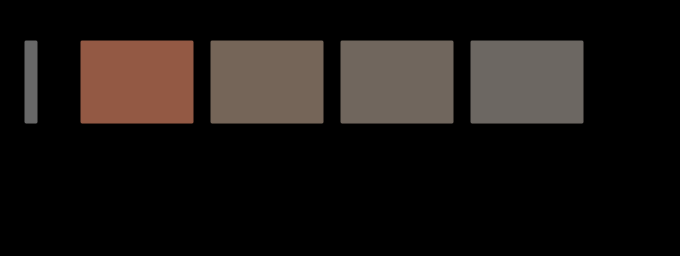
One colour difference, at four places in the visual field. The same pair of colours — ΔE00 22.0 at the fovea — with each of its three components divided by that channel's own threshold scaling at the stated eccentricity. What is left at 20° is 4.4, and its hue has turned by 26 degrees, because the red–green part is divided by more than the blue–yellow part. The swatches are the predicted colours, drawn where a reader will look straight at them; the figure states a prediction it cannot stage. Difference and uniformity

A difference has no place

A colour difference formula answers a question about two patches somebody is looking straight at. Move the same pair ten degrees into the periphery and a third of it is left — and it has turned twenty-four degrees of hue, because the three channels give out at three different rates.

Grassmann's four laws, exact — and the two things that break them. For a linear observer every one of the four is exact and the residual is floating point, which is the control that makes the two failures below measurements rather than artefacts. Rods break a cone-metameric match by 23 per cent of a rod excitation at dusk; bleaching breaks it by 0.59 per cent of a cone excitation in the sun. Both are stated as fractions of a receptor's own response, so they can be put on one scale. Matching and measuring

The laws that make colour add up

Colorimetry is an integral, and an integral assumes matching is linear. Grassmann's four laws are exact for a linear observer, to floating point — and they fail at both ends of the light range, by two different mechanisms, leaving colorimetry an operating band of three and a bit decades that no standard states.
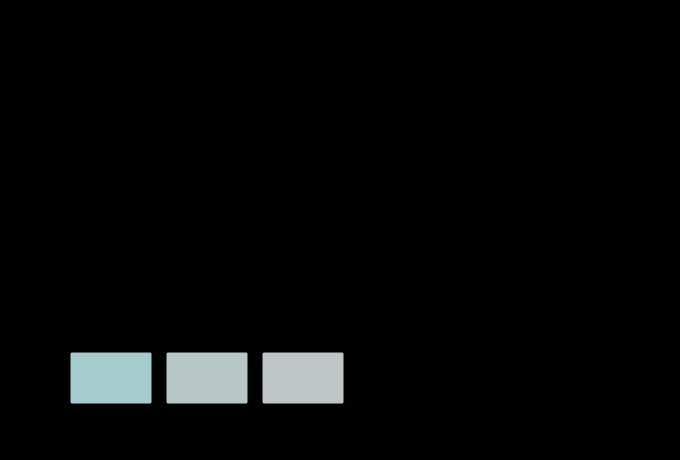
An afterimage, as the local pool coming back to equilibrium. The local pool has adapted to the patch and the global pool has not, so the gain change is exactly the local share of a full von Kries change — which is why afterimage's free strength parameter is not free here. The dwell is 20 seconds. The swatches are the predicted appearance of the test surface at four moments. They are predictions of hue and direction; there is no response compression in this model, so the chroma is a ceiling rather than an estimate. What the brain does

A gain has a time constant

An afterimage and the clock on chromatic adaptation were built in different files from what the last phase said was one mechanism. Joining them removes a free parameter, reproduces both, and predicts a third thing — that two people in one room, at one moment, looking at one patch, do not agree about its colour.

The eye's own drift, and what it does to every spatial frequency. A pattern of f cycles per degree, drifting across the retina at 0.5 degrees a second, arrives at each receptor at f × 0.5 hertz. The curve is the temporal sensitivity at that rate, against the pattern's spatial frequency. Every frequency the eye can resolve stays above a quarter of the temporal peak, and the band of drift speeds for which that holds is 0.02–0.71 degrees a second — with the measured drift inside it. Faster and the finest detail is carried past 60 hertz, where there is no sensitivity at all. What the brain does

The eye is never still

A perfectly stabilised retinal image disappears within seconds. What keeps the world there is a drift of about half a degree a second between the microsaccades — fast enough to keep the finest detail modulating and slow enough not to carry it past fusion, in a band whose upper edge is at 0.71 degrees a second.

How much colour a display delivers, against how bright the room is. The appearance solid of the whole code cube, with the room's reflected light added to every code value and the surround ratio computed from the room's own white against the display's. A 300 cd/m² panel delivers most at 200 lux, and the curve falls on both sides: darker costs the surround, brighter costs the black. At the 32 lux the softproofing standards specify, the solid is 89 per cent of its best — which is not a criticism of the standard, since it is written for matching a screen to a print viewing booth rather than for delivering the most colour. Where the model breaks

A display in a room is a smaller display

Two results here turn the room's light in opposite directions and neither knows about the other. A room has one light level and does both at once — so there is a brightness at which a display delivers the most colour, it is not at either end, and it scales with the panel.
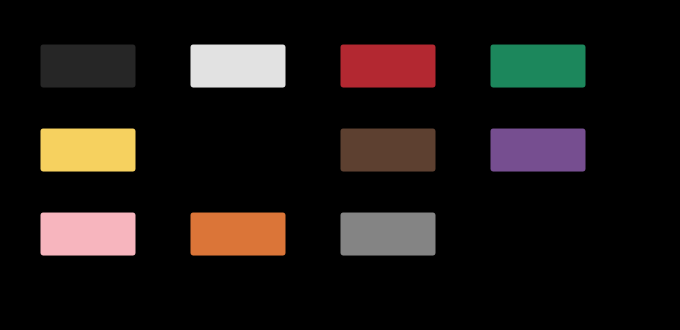
The eleven basic colour terms, at their quoted centroids. Each patch is the CIELAB centroid quoted for that term, converted to a stimulus and drawn — except blue, whose focal colour is outside the sRGB gamut and is therefore hatched rather than clipped, which is the rule for an unreachable colour everywhere else and applies here too. The centroids are rounded to 5 units in each coordinate, and moving them by that much either way leaves the same term outside. What the brain does

A colour has a name

Every quantity here is a number, and the question a reader arrives with is what colour something is called. The eleven basic terms of English divide the space into territories that differ by a factor of five, the metric accounts for fifteen per cent of that, and one of the eleven focal colours cannot be shown on this page at all.

How large a step changes the name, across the ab plane at L* 60. At each point, the smallest ΔE00 step in any direction after which the probability of two people using the same word has halved. It runs from 4.8 to 33.8 units across this one plane, in eight quantised levels: the palest cells are where a name is finest — a short step changes it — and the strongest are the middles of large territories, where a colour can move twenty units and keep its word. The ragged edge is the sRGB boundary at this lightness rather than a property of the vocabulary. The boundary softness is a stated parameter of the model, and the map barely moves when it is changed fourfold, because what sets this quantity is how far apart the centroids are. What the brain does

A name is not a threshold

Two colours have to move about ten times a just-noticeable difference apart before people stop calling them the same thing, and how far varies threefold across one plane of the space. A tolerance and a word are answering different questions, and nothing in colorimetry converts between them.

A colour-order system's chips, sorted by what they would be called. A regular lattice in lightness, chroma and hue — the idealisation of a swatch book, and regular by construction because a person has to be able to find a page. Named, it comes apart: 1320 chips inside the gamut divide into 198 for grey and 66 for blue. And 22 per cent of one-step moves in the lattice change the name, so a page of a swatch book is not a page of a vocabulary. Matching and measuring

A catalogue is not a vocabulary

A colour order system is a regular lattice, because a person has to be able to find a page. Sorted by what its chips would be called, that lattice comes apart into piles differing by a factor of three — and a fifth of all one-step moves in it change the name.

136 essays on this thread, page 2 of 6 · all threads · all essays