A display in a room is a smaller display
Assumes The gamut shrinks in the dark and The screen is not the room.
This site has two essays about a display and a room. One turns the light down and finds the appearance solid losing most of its volume, because the model’s chromatic gain falls with the adapting luminance and a dark surround compresses the lightness scale. The other turns it up and finds the black rising, because light falls on the screen and comes back off it.
Both are right. Neither is an answer, because a room has one light level and does both things at once.
The claim
There is a room brightness at which a stated display delivers the most colour, it is neither dark nor bright, and it moves with the panel.
For an ordinary 300 cd/m² desktop panel with a 1,000:1 native contrast and two per cent screen reflectance:
| room | appearance volume | surround ratio | contrast in the room |
|---|---|---|---|
| 0.1 lux — a dark room | 217.8k | 0.00 | 998:1 |
| 20 | 221.0k | 0.02 | 702:1 |
| 100 | 235.6k | 0.11 | 321:1 |
| 200 | 250.3k | 0.21 | 191:1 |
| 500 | 230.2k | 0.52 | 87:1 |
| 3,000 | 149.5k | 2.99 | 16:1 |
| 10,000 — outdoors | 73.6k | 8.75 | 6:1 |
The optimum is at two hundred lux, which is an ordinary living room. The dark room delivers 87 per cent of it and daylight delivers 29 per cent, and the panel is the same panel throughout.
And the optimum scales with the peak:
| panel | best room | share of best at 32 lux |
|---|---|---|
| 100 cd/m² | 80 lux | 94.9% |
| 300 | 200 | 89.1% |
| 600 | 500 | 89.6% |
| 1,600 | 1,200 | 88.7% |
The rule that falls out is clean: a room’s white wants to be about a fifth of the display’s. For a 300 cd/m² screen that is 60 candelas a square metre off a matte white surface, which is a little under two hundred lux.
The rule in the unit a light meter reads
The fifth-of-the-white rule is stated in a ratio of luminances, which is the quantity the model uses and the one nobody can measure without a photometer and a white card. Converting it into the unit a room is actually specified in makes it usable and slightly sharper.
A matte white surface under lux returns candelas a square metre, so a surround ratio against a panel of peak needs . Reading the four optima back through that:
| panel | best room | the room’s white | surround ratio | lux per cd/m² |
|---|---|---|---|---|
| 100 cd/m² | 80 lux | 25.5 | 0.255 | 0.80 |
| 300 | 200 | 63.7 | 0.212 | 0.67 |
| 600 | 500 | 159.2 | 0.265 | 0.83 |
| 1,600 | 1,200 | 382.0 | 0.239 | 0.75 |
The right-hand column is a constant, and it is very nearly three quarters.
— the best room illuminance, in lux, is about three quarters of the display’s peak luminance in candelas a square metre. It predicts 75, 225, 450 and 1,200 against the 80, 200, 500 and 1,200 the sweep found, which is inside the grid the sweep steps on.
That is the version worth carrying out of this essay, because both of its quantities are on a datasheet or a light meter. A 300 cd/m² monitor wants about 220 lux; a 1,600 cd/m² television wants about 1,200. Nothing has to be converted, and the awkward that makes a room’s illuminance and a surface’s luminance different quantities has been absorbed into the constant.
And the underlying ratio is nearer a quarter than a fifth. The four optima sit at surround ratios of 0.212 to 0.265, averaging 0.243, all of them at or above the standard’s average threshold of 0.2 rather than on it. The spread is within one step of the sweep’s own grid, so this does not establish a ratio of 0.24 over a ratio of 0.20 — what it does establish is that the optimum is not below the threshold on any panel, which is what the surround-driven explanation requires and is the part that could have failed.
Why the dark room’s penalty stops growing
The last column of the panel table has a shape that the sections above pass over, and it is the one a reader in a standards-compliant room would want.
| panel | surround ratio at 32 lux | how far from dark towards average | share of the best kept |
|---|---|---|---|
| 100 cd/m² | 0.102 | 46% | 94.9% |
| 300 | 0.034 | 8% | 89.1% |
| 600 | 0.017 | 0% | 89.6% |
| 1,600 | 0.006 | 0% | 88.7% |
The penalty saturates. A brighter panel wants a proportionally brighter room, so one might expect the fixed 32-lux ceiling to hurt a 1,600 cd/m² television far more than a 300 cd/m² monitor — it is a hundred and eighty times too dark for the first and eleven times too dark for the second. It costs them 11.3 and 10.9 per cent respectively, which is the same number.
The reason is that the surround has a floor. Once the room’s white falls below a fiftieth of the display’s the surround is dark, and it stays dark however much further the light is turned down — the exponent has bottomed out and there is nothing left to lose. The third column reads that off directly: the 600 and 1,600 candela panels are at the floor outright, and the 300 is eight per cent of the way off it, which is close enough to the floor to pay the same price.
The one that pays less is the dim panel, and by the same reading forwards: at 32 lux a 100 cd/m² screen is nearly halfway from dark to average, so half of the surround’s range is still ahead of it. A laptop in a standards-compliant room is closer to its own optimum than a television is — not because the room suits it, but because the room is not dark enough, relative to it, for the penalty to be complete.
Which gives the standard’s 32 lux a shape it is not usually read as having. It is not a level chosen against any panel; it is a level far enough below every panel in professional use to put all of them on the surround’s floor, where the penalty is fixed at about eleven per cent and stops depending on the display at all. That is arguably the right property for a standard to have — a fixed, known, panel-independent cost — and it is not the property the number was chosen for.
The two mechanisms, and which wins where
Both are already on the site and the join is what is new.
Downward: the surround. CIECAM16’s surround parameter is set by the ratio of the room’s white luminance to the display’s — dark below about a fiftieth, average above a fifth, dim between. The parameter that changes most is the exponent on lightness, from 0.525 in the dark to 0.69 at average, and it compresses the whole scale. A cinema’s picture looks flat when the lights come up for exactly this reason, run backwards — and it is why a proof in a booth and a proof on a screen are different objects before anybody compares their colours.
So going from a dark room to a lit one enlarges the solid, by raising the exponent. That is the rising left half of the curve.
Upward: the flare. Light falling on the screen returns two per cent of it diffusely, and that addition goes to every code value equally — which is nothing to a bright one and everything to a dark one. A 1,000:1 panel is 191:1 at two hundred lux and 6:1 outdoors, and the solid loses its bottom — which is where a black that is not black comes from in a different medium.
That is the falling right half.
The crossover is where the surround stops helping. The surround parameter is at its maximum once the room’s white reaches a fifth of the display’s, and past that only the flare acts. So the optimum is at exactly the ratio that makes the surround average, which is a property of the standard’s tabulation as much as of the eye — and is worth saying rather than presenting as a discovery about vision.
What this says about the standards
The softproofing standards specify a dark room: thirty-two lux or less for critical display viewing. The arithmetic here says that costs about eleven per cent of the delivered solid against the optimum.
That is not a criticism of the standard, and saying why matters. The standard is written for matching a screen to a print in a booth, and its job is to keep flare off the screen so that the two objects can be compared. Delivering the most colour is a different objective, and a specification written for one is not wrong about the other — it is silent about it.
What is worth noticing is that nobody states which objective a room is set up for. A colour-critical workstation and a room where somebody grades a film for a living room have different answers, and both are usually set up by the same rule — the same shape of omission as a specification that names a gamut and not a light level.
And the eleven per cent has a shape. What the dark room loses is not spread evenly through the solid: the surround exponent compresses lightness, so what goes is the mid-tone separation rather than the saturated corners. A dark room loses tonal range and keeps chroma; a bright room loses the shadows and keeps everything else.


The reading a viewer can act on
The result is unusually actionable for something on this site, so it is worth writing out plainly.
A dark room is not the best room for watching anything. The common advice — turn the lights off — optimises for contrast ratio, which is one number about the two ends of the scale, and costs eleven to thirteen per cent of the delivered solid on every panel measured here. What it costs is mid-tone separation, because the surround’s exponent acts on lightness.
A bias light is the whole of the fix. A dim source behind the screen, throwing its light on the wall rather than the screen, raises the surround ratio without adding flare — which is exactly the arrangement this arithmetic wants, since the two mechanisms have different geometries. The recommendation exists in the video-calibration trade and is usually justified by eye strain; this says what it is worth in gamut.
And a brighter panel wants a brighter room, in proportion. The rule scales: a fifth of the display’s white, off a matte surface. A television at 1,600 candelas a square metre wants twelve hundred lux, which is brighter than almost anybody watches at — so the delivered gamut of a bright panel in an ordinary room is further from its own optimum than a dim panel’s is.
None of this changes the numbers on the box. Peak luminance, contrast ratio and gamut coverage are all measured in the dark, which is the one condition none of them is best in.
What was computed, and how
The cube is mapped through the room before the model sees it. Every code value is decoded, scaled between the panel’s black and its peak, and the room’s flare added — so what reaches the appearance model is what reaches the eye. The signal is unchanged throughout; only its delivered luminance moves.
The flare is the same line as the site’s own. Ambient illuminance times screen reflectance over π, which is the luminance a Lambertian surface returns. It is restated in the volume file rather than imported, because the file it lives in imports the largest module on the site and has nothing to do with a display — and colourcheck asserts the two agree to 10⁻¹² so the two copies cannot drift.
The surround is interpolated rather than rounded. CIE 159 permits interpolating the three constants linearly in the surround ratio, and this file does, because the quantity being looked for sits between two of the tabulated boxes. viewingConditions was extended to accept an interpolated surround — validated as hard as a name is, since a surround with a missing constant is a viewing condition with a silent zero in it.
And the adapting luminance is the standard’s own recommendation: a fifth of the device white, which already carries the flare. That is why the optimum is driven by the surround rather than by the Hunt effect — the eye is adapted to the screen, and the room enters through the surround ratio rather than through the adaptation.
The volume is the same tetrahedral decomposition the site’s other gamut volumes use, mapped into CAM16-UCS rather than CIELAB, at sixteen steps a side.
Where the model stops
The optimum sits on a boundary of the standard’s own tabulation. The surround ratio’s average threshold is 0.2 and the optimum is at 0.21, which means the model stops improving exactly where the standard stops describing. A surround model that continued smoothly past average would move the optimum, and this one is honest about where its knee comes from.
The observer is adapted to the screen and nothing else. A reader at a desk is adapted to a mixture of the screen and the room, and the mixture depends on how much of the field the screen fills. That share is not in the computation and moving it moves the whole curve up or down without much moving its peak.
The flare is diffuse and uniform. A real screen has a specular component, a window reflected in it is not uniform, and a matte finish trades a mirror for a haze. Two per cent is a plausible diffuse reflectance for a matte panel and nothing here models a glossy one.
And there is no viewer position. The delivered gamut varies across the visual field as well as across the room, and the corner of a large screen is twenty degrees out.

The generalisation
The sentence worth carrying: a gamut is not a property of a device.
The site has now removed three things from a display’s gamut that a specification treats as fixed. The triangle is a shadow — the chromaticity diagram’s area is not the solid’s volume. The gamut shrinks in the dark — the solid depends on the adapting level. And now the delivered solid depends on the room in two opposing ways, with an optimum in between.
What is left that is a device property is the code cube and the primaries. Everything downstream of that is a statement about a room and an observer, and every number on a display’s box is downstream.
The surprising connection is with the fifth ink. A press buys gamut by adding a colorant, at a cost in ink, plates and registration; a display buys delivered gamut by changing the room, at no cost at all beyond a lamp and a dimmer. The second is free and nobody sells it, because a display is specified as an object and a room is not part of the object.


Who found it, and when
The surround’s effect on perceived contrast is Bartleson and Breneman’s, from the 1960s, and it is why cinema, television and print have three different reference gammas. The three-box tabulation in CIECAM and its predecessors is a summary of that work.
Screen flare is older than screens, in the sense that veiling glare was a photographic and projection problem long before it was a display one, and the arithmetic is the same.
Putting the two together appears not to have been done as a single quantity, and the reason is administrative rather than scientific: the surround belongs to appearance modelling and the flare belongs to display engineering, and the two are specified by different documents written by different committees for different readers.
What has not changed is the specification. A display carries a peak luminance, a contrast ratio and a gamut coverage, all measured in a dark room, and no statement at all about the room it delivers the most in.
What the pictures cannot show
They cannot change the reader’s room. Every figure here is a curve on a screen in whatever light the reader is sitting in, which is one point on the curve and is not marked.
And the volumes cannot be drawn. A CAM16-UCS solid is a three-dimensional object and the quantity plotted is its volume — a single number per room brightness, which is what a curve can carry and a picture of a solid cannot.
Where the ladder goes next
The nearest unfinished piece is the adaptation share. The observer here is adapted entirely to the screen, and a real observer at a desk is adapted to a mixture whose weight depends on how much of the visual field the screen fills. Making that an argument would let the same sweep answer a question nobody has asked: how large should a screen be, for a stated room?
The second is the surround past average. The optimum sits exactly where the standard’s tabulation stops, so the model cannot distinguish the eye stops benefiting from the table stops describing. Measuring the surround effect above a ratio of a fifth would settle it, and would move a number this essay currently reports with a caveat attached.
Where this goes next
 The gamut shrinks in the dark
Every gamut number here is a property of a device and of nothing else, which is why the same display has the same gamut in a studio and in a cinema. It does not. Turn the room down four decades and the solid loses a fifth of its reach and two thirds of its volume, with the signal unchanged.
The gamut shrinks in the dark
Every gamut number here is a property of a device and of nothing else, which is why the same display has the same gamut in a studio and in a cinema. It does not. Turn the room down four decades and the solid loses a fifth of its reach and two thirds of its volume, with the signal unchanged.
 The screen is not the room
A thousand-to-one display in an ordinary office is a hundred-and-thirty-seven-to-one display, and the signal value that means black comes out at the lightness of a dark grey card. Nothing is wrong with the panel. Light falls on the screen and comes back off it, and the two per cent it returns is added to every pixel — most of all to the ones with nothing else in them.
The screen is not the room
A thousand-to-one display in an ordinary office is a hundred-and-thirty-seven-to-one display, and the signal value that means black comes out at the lightness of a dark grey card. Nothing is wrong with the panel. Light falls on the screen and comes back off it, and the two per cent it returns is added to every pixel — most of all to the ones with nothing else in them.
 What a gamut costs
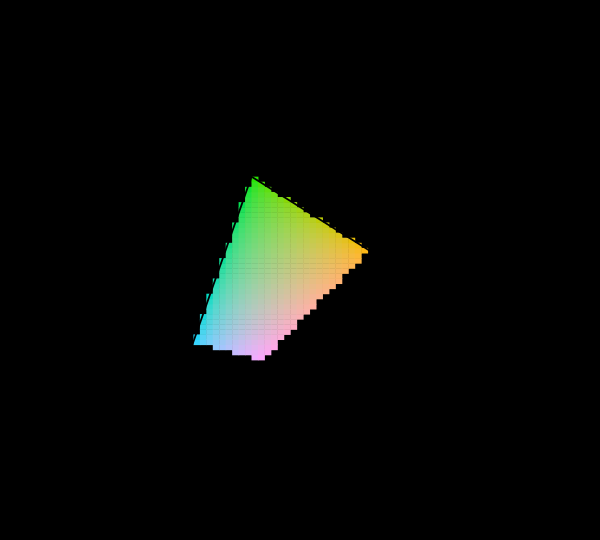
Three primaries reach a triangle and the visible region is not a triangle, so something has to give. Widening the primaries helps, has a price in precision and compatibility, and runs into a limit that is geometric rather than technological.
What a gamut costs
Three primaries reach a triangle and the visible region is not a triangle, so something has to give. Widening the primaries helps, has a price in precision and compatibility, and runs into a limit that is geometric rather than technological.
Named alongside this one
Essays reaching for the same objects. Nobody chose these; they are what the index of named objects makes visible.
- A gain has a time constant adaptation · ciecam16 · colour appearance · surround · viewing condition · white point
- A viewing condition is a moment adaptation · ciecam16 · colour appearance · surround · viewing condition · white point
- A patch is not a scene adaptation · ciecam16 · colour appearance · surround · viewing condition
- A room with two lights has no white adaptation · ciecam16 · colour appearance · viewing condition · white point
- A third of the appearance box is no surface ciecam16 · colour appearance · display gamut · gamut · specification
- A viewing condition is an argument adaptation · ciecam16 · colour appearance · surround · viewing condition
What links here
The 8 essays that link to this one and share the most of its objects, of 9 that link here.
The objects this essay names
Each one links to every other essay that touches it.
AdaptationCIECAM16Colour appearanceColour managementContrast ratioDisplay gamutGamutSpecificationSurroundTone reproductionViewing conditionWhite point