Concept

Colour management — where it appears

Carrying a colour between devices by describing each of them, which works exactly to the extent that the descriptions are true. Every stage of it is a map that loses something, and the losses are chosen: a rendering intent is a decision about what to give up rather than a repair.

Named by 51 essays across 8 fields — each of them below, with the objects they name alongside it.
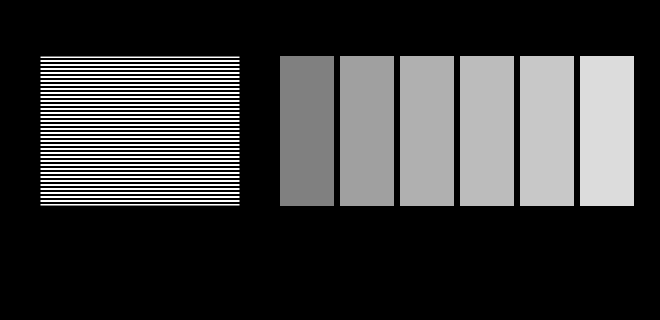
A gamma probe: which grey matches a half-white dither?. The striped block on the left is half white and half black, so it carries half the luminance of white. Stand back until the stripes blur and find the patch that matches it. On an sRGB display the answer is code 188, not 128 — code 128 has only 22 per cent of white's luminance.

The display is an unknown

This site is displayed on the very apparatus it is about, and it knows almost nothing about that apparatus. Two figures here stop assuming and ask instead — a probe for the transfer function and a probe for the gamut.

limits · Limits
The sRGB transfer function, and the gamma 2.2 curve it is not. Code value against relative luminance. The sRGB function is piecewise — a short linear segment near black, then a 2.4 power law with an offset — and it is close to but not the same as a plain 2.2 power law. Half-way along the axis of stored values sits at 21 per cent luminance, and half the luminance of white is at code 188.

A hex code is not a colour

Six hexadecimal digits identify three numbers. Turning three numbers into a colour needs a colour space, a transfer function, a white point and a display, and leaving any of them unstated is the everyday version of every confusion in colour management.

matching · Gamut
Four adaptation transforms, measured against CAT16 (D65 to D50). Twenty-seven colours moved from D65 to D50 by each transform, compared with the current recommendation. Bars are the worst disagreement in CIELAB, the number beside each is the mean. Plain XYZ scaling — still shipping, still called von Kries by people who have not read von Kries — misses by up to ΔE 13.7, which is many times any tolerance a supplier would be held to.

Four ways to move a white point

Every chromatic adaptation transform is the same three lines with a different matrix. The matrices disagree by more than any tolerance a supplier is held to, and the oldest one — still shipping, still called von Kries — is not a cone basis at all.
brain · Appearance
sRGB, Display P3 and Rec. 2020 compared on the chromaticity diagram. Three nested triangles inside the horseshoe. sRGB covers 74 per cent of the area P3 covers. Rec. 2020's red and green primaries sit on the spectral locus itself, within 0.000 and 0.006 of it, meaning they are monochromatic.

Six numbers make a space

An RGB colour space is eight numbers — three primary chromaticities, a white point, and a transfer function — and everything else about it is derived. Deriving it rather than copying the matrix is the difference between having a colour space and having a table somebody else computed.

matching · Gamut
The two components of daylight, computed from one radiator and one scattering law. A 5800 K radiator through the atmosphere at air mass 1. The direct beam is the radiator times e^{−τm}; the sky is what that extinction removed, so the two are complements and neither needs its own model. The sky is steeply blue because τ ∝ λ⁻⁴, and a surface in shadow is lit by that component alone. Open ground and shadowed ground therefore sit under two illuminants differing by ΔE00 = 21.4 — which is why a photograph of snow has blue shadows and why no single white balance fixes both halves of it.

A shadow has its own illuminant

Outdoors there are two lights, not one. The direct beam is a radiator reddened by the atmosphere; the sky is precisely the power that reddening removed. A shadow is lit by the second alone, so shadowed ground and sunlit ground sit under illuminants 21 units of ΔE apart — before any surface, any eye or any opinion is involved.

scene · Scene
A glossy surface returns two spectra, and only one of them is the paint. The dichromatic reflection model, computed rather than assumed. Light that enters a dielectric binder, scatters off pigment and comes back carries the reflectance — the body component, ΔE00 = 33.7 from the lamp. Light reflected at the interface never entered, so it carries the lamp's spectrum with only Fresnel's slight dispersion on it: ΔE00 = 1.06. The interface term is computed from Fresnel's equations on a Cauchy index at 55°, so its near-neutrality is a result here rather than an assumption. This is why a highlight is the one region of a photograph that tells a white balancer what the light was, and why removing highlights removes the evidence.

The highlight is the lamp

Light reflected at the surface of a glossy material never entered it, so it never met a pigment. Fresnel's reflectance varies by 5.5% across the visible band and the paint underneath varies by a factor of twenty — which makes a highlight the one region of a photograph that reports what the light was rather than what the object is.

scene · Scene
How far three channels drift from eighty-one, per bounce. One room, one geometry, one reduction to three channels, and the only thing changing is how many bounces of the Neumann series are kept. At one bounce the two agree to 2.5e-13 — the only reflectance in that path is the floor's, which is flat, and a flat reflectance is one of the few three numbers carry exactly. Every bounce after it multiplies another non-flat reflectance into the spectrum, and three numbers cannot carry a product they were never given the factors of. The curve levels off at ΔE00 = 2.38 because the light has run out, not because the disagreement has.

Rendering in three numbers

Almost every renderer ever shipped bounces red, green and blue rather than a spectrum. The error that costs is exactly zero at the first product and grows at every one after it — because three numbers cannot carry a product they were never given the factors of, and each bounce is another product.
scene · Scene
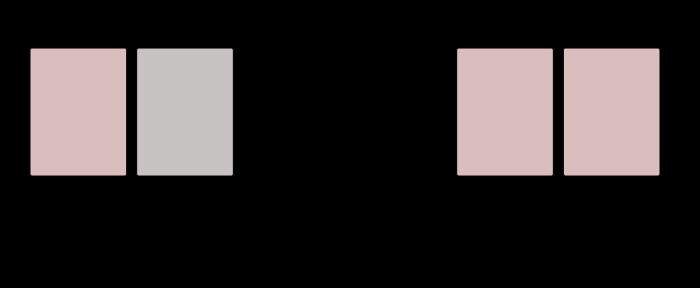
Every face of the solved room. The red room after the transport is solved in all 81 bands. Only the ceiling emits; the other five faces are lit entirely by what the ceiling and each other send them, so their colour is the lamp multiplied by every reflectance along every path that reached them. The ceiling itself comes out 1.05× brighter than it emits, because a closed room returns light to its own source. The two chromaticities under each swatch are the spectral solve and the three-channel one, and the faces furthest from the lamp — the ones the light reached by the most bounces — are where they disagree most.

The room is the illuminant

Colour bleeding is usually described as an aesthetic phenomenon of rendered images. It is better described as a measurement. In a room with one lamp, five of six surfaces emit nothing at all, so their light is entirely a product of other surfaces' reflectances — and the bleeding saturates rather than running away, for a reason worth deriving.

scene · Scene
Mixing two paints and stacking two filters are different operations. The same two reflectances combined two ways. Stacking them as filters multiplies the transmittances, which is right for gels in front of a lamp and wrong for pigment stirred into pigment: a stirred mixture is one scattering layer, not two in series, and light meets whichever particle is nearest rather than passing through both. Kubelka–Munk handles it by moving to K/S = (1 − R)²/2R, in which absorption and scattering add by concentration, and inverting afterwards. The two answers differ by ΔE00 = 15.0, and the filter model is the darker of the two because it charges every photon for both pigments.

Paint is not a filter

Stacking two filters multiplies their transmittances. Stirring two pigments together does not multiply their reflectances, because a mixture is one scattering layer rather than two in series — light meets whichever particle is nearest. Treating the two as the same operation is a 15-unit error, and which way it errs turns out to depend on whether the comparison holds the amount of pigment fixed.

scene · Scene
Why blue and yellow make green. 7 mixtures between a blue and a yellow pigment, mixed in Kubelka–Munk — K/S summed by concentration and inverted back to reflectance — and plotted against the straight line joining the two endpoints. The path bows towards green by 0.099 in chromaticity, and the reason is in the spectra rather than in the eye: the blue reflects below about 520 nm and the yellow above about 500, so the only band both return is the overlap between them. Mixing lights adds spectra and lands on the chord; mixing pigments intersects them and does not.

Why blue and yellow make green

The oldest fact in colour, and the usual explanations are wrong. It is not because green sits between blue and yellow, and it is not a fact about the eye at all — it is that the only band both pigments return is their overlap, and the overlap of a blue and a yellow reflectance is green. Computed, the mixing path bows away from the straight line by a measurable amount.
scene · Scene
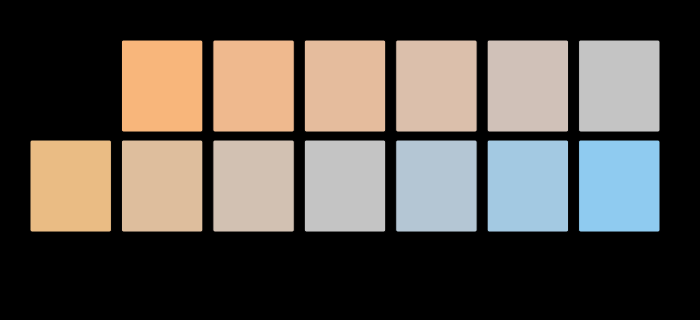
One white balance across a scene lit by two lamps. A neutral surface of albedo 0.6 under 7 mixtures of A and D65, corrected by one diagonal transform chosen for the middle of the run — which is what a camera does when it estimates a single illuminant. The middle patch comes out neutral to ΔE00 = 0.00 and both ends do not: 19.8 at the A end and 16.9 at the D65 one. The failure is structural rather than a matter of a better estimator: white balance is one transform for the whole image, and a scene with two lamps in it has no single answer for that transform to be. Every patch here is the same surface.

A scene has no white point

White balance is one transform applied to a whole image, and a scene lit by two lamps has no single answer for that transform to be. The failure is structural rather than a matter of a better estimator — and every colour-managed workflow in existence takes exactly one white point as an input, with no field in which to say there were two.

scene · Scene
A glossy surface returns two spectra, and only one of them is the paint. The dichromatic reflection model, computed rather than assumed. Light that enters a dielectric binder, scatters off pigment and comes back carries the reflectance — the body component, ΔE00 = 33.7 from the lamp. Light reflected at the interface never entered, so it carries the lamp's spectrum with only Fresnel's slight dispersion on it: ΔE00 = 1.14. The interface term is computed from Fresnel's equations on a Cauchy index at 45°, so its near-neutrality is a result here rather than an assumption. This is why a highlight is the one region of a photograph that tells a white balancer what the light was, and why removing highlights removes the evidence.

Gloss changes the measurement

The same sample measured with the specular component included and excluded returns two different numbers, and both are correct answers to different questions. Colour is one of four appearance attributes and the only one most instruments report — so a specification that names a colour has silently named a geometry too, and usually does not say which.

scene · Scene
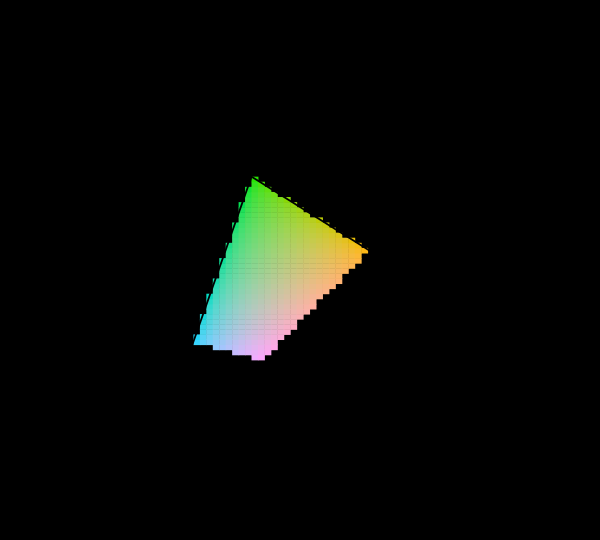
What a press and a display can reach at L* = 50. A slice through both solids at lightness 50, with the press dashed and the display solid. The boundaries cross: the press reaches past sRGB in 15 of 48 directions and falls inside it in 31. That is the shape of every conversion between them — colours are lost in one direction and gained in the other, and the picture cannot show the gained ones, because it is being displayed on the gamut that cannot reach them. Those are hatched.

Neither gamut contains the other

Converting a picture to CMYK is described everywhere as a reduction, as though the press were a smaller version of the screen. Measured as solids, the press reaches eleven per cent of its volume outside sRGB while sRGB reaches fifty-four per cent of its volume outside the press — and in the cyans the press wins by seventy per cent of chroma.

applied · Delivery
How wrong a profile is between its entries. A device profile is a lattice of measured patches and an interpolation. At every node of every grid drawn here the error is exactly zero, which is why a profile checked at its own patches always looks perfect. Sampled between the nodes, a 3-step grid is worst by ΔE00 = 2.93 and a 17-step grid by 0.30. Both are honest tables of the same press.

A profile is a table

An ICC profile does not contain a model of the device it describes. It contains a lattice of patches that were printed and measured, and everything between them is interpolation — which is exactly zero at every patch, so a profile checked against its own target reports perfection for ever.

applied · Delivery
The process inks as reflectance. Each ink is a sum of Gaussian absorbance bands with stated centres, widths and peak densities, and the reflectance shown is the substrate's times the square of the ink's transmittance, because light crosses the film going down and coming back. The first band of each ink is what it is for; the rest are what is wrong with it. Magenta's unwanted absorption in the blue-violet reaches an optical density of 0.46 against 0.95 for the band it exists to have — 48 per cent of its own strength, absorbing exactly where a saturated blue needs light to survive.

The paper is the white point

A printed colour is reported against the sheet it sits on rather than against the light in the room, and the choice is a switch in every colour engine. Flipped one way, the same separation on coated stock and on newsprint is a 3.04 colour difference; flipped the other, it is 0.13 — and the two answers are about different questions.
applied · Delivery
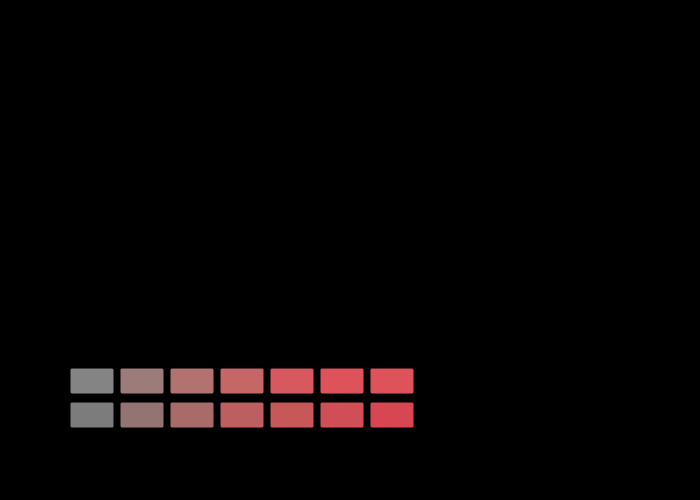
A gradient of one hue, mapped into a press's gamut 2 ways. Chroma asked for along the bottom, chroma delivered up the side, for a ramp at lightness 55 and hue angle 25°. A colorimetric intent follows the diagonal until the press runs out and is flat afterwards — the flat part is a gradient arriving as a single colour. The perceptual intent is under the diagonal from the start, which is the price of never going flat.

No mapping preserves everything

More than half the sRGB solid is outside a press's gamut, so something has to be done with it, and there are two things that can be done. One leaves every reproducible colour exactly where it was and delivers a gradient as a flat area. The other keeps the gradient and moves every colour that needed no help by about three.
applied · Delivery
Lightness against colourfulness, in a booth and on a screen. Each arrow is one colour, from what the model predicts under a print in a 2000 lux booth to what it predicts under a display in a dim room. Every arrow points the same way, which is the content: a dimmer surround lowers predicted lightness and colourfulness together, so a proof does not merely differ from the print, it differs in a direction — and that is why proofing standards specify the room and not only the numbers.

The proof is a different object

A soft proof can be made colorimetrically exact and still not match the print, because the print is in a booth at two thousand lux with an average surround and the screen is in a dim room at a fifth of the luminance. The appearance model puts four CAM16-UCS units between them, with no change of stimulus anywhere — larger than the error any rendering intent is arguing about.

applied · Delivery
Several sources on one scale. planck, led, narrowband, each normalised to its own peak and drawn on shared axes with the colour each produces beside it. Every one of these is sold as white light and every one is ordinarily described that way; what they have in common is a chromaticity, and very little else.

A screen is a poor lamp

A display's white is a light. Shone on a surface it renders colour worse than a fluorescent tube — and the wider the gamut, the worse it gets, because the narrow primaries that buy a large triangle are exactly the ones that leave holes in the spectrum.

light · Light
How often two colour-difference formulae disagree about which pair is worse. Pairs of colours sampled in CIELAB, compared two at a time. A rank inversion is a case where one formula calls pair A worse and the other calls pair B worse; no monotone rescaling of either can remove one. The left bar of each group is the rate over the whole space and the right bar is the rate among pairs sitting near a tolerance of ΔE 1, where the decision is actually made — and it is between 35 and 44 per cent, against a coin flip at fifty.

Which of two is worse

Two colour-difference formulae disagree about which of two pairs is the larger difference in thirteen per cent of comparisons overall — and in forty-three per cent of comparisons among pairs sitting near a tolerance of one unit, which is where every acceptance decision is actually made.

difference · Metric
How much colour a display delivers, against how bright the room is. The appearance solid of the whole code cube, with the room's reflected light added to every code value and the surround ratio computed from the room's own white against the display's. A 300 cd/m² panel delivers most at 200 lux, and the curve falls on both sides: darker costs the surround, brighter costs the black. At the 32 lux the softproofing standards specify, the solid is 89 per cent of its best — which is not a criticism of the standard, since it is written for matching a screen to a print viewing booth rather than for delivering the most colour.

A display in a room is a smaller display

Two results here turn the room's light in opposite directions and neither knows about the other. A room has one light level and does both at once — so there is a brightness at which a display delivers the most colour, it is not at either end, and it scales with the panel.

limits · Limits
Which of two reproductions is better depends on which statistic is asked. A specification for a proof or a print run is written against a set and has to reduce the set to one number. Here are two candidates: the one with the lower mean has the higher ninety-fifth percentile, so the mean prefers A and the tail prefers B. Across 2000 pairs of candidates generated the same way, the two statistics disagree about the winner 30 per cent of the time. Both numbers are honest; only one of them is what somebody notices.

A mean is not a difference

A specification for a proof, a profile or a print run is written against a set of colours and has to reduce that set to one number. The mean and the ninety-fifth percentile disagree about which of two reproductions is better in thirty per cent of cases, and both numbers are honest.

difference · Metric
A lamp switched on, and what it is still doing minutes later. The junction warms from ambient to 80 °C with a time constant of 150 seconds, and three quoted slopes act as it does: the die's peak moves, the die loses efficiency, and the converter loses quantum yield. The output falls 25 per cent and the colour moves ΔE00 2.6. Nine tenths of the way takes 405 seconds. The vertical mark is the eye's own slow adaptation constant, 60 seconds, for scale.

A lamp switched on is not the lamp measured

A luminaire takes about seven minutes to reach nine tenths of its working temperature, loses a quarter of its output on the way, and moves ΔE00 2.6 while it does. That is slower than every clock in the eye — so for the first minutes after a switch is thrown, both ends of the measurement are moving, and every appearance claim here has assumed one of them was still.

light · Light
How wrong a camera profile is, and who it is wrong for. A colour matrix fitted against the 1931 observer, evaluated four ways. Its residual against that observer is ΔE00 0.92 — the Luther failure, which is a property of the sensor and is the honest measurement of the camera. Against a person drawn from a population of 160, the worst-off twentieth report 3.35. And a camera with no spectral error whatever, reporting the standard observer's own tristimulus values exactly, would leave 3.47. The camera is not the problem. It was fitted to somebody who does not exist, and so is the standard it was fitted against.

Fitted to an eye nobody has

A camera profile's residual against the observer it was fitted to is under a unit, and that is the number everybody quotes. Against a person drawn from a population it is 3.35 at the ninety-fifth percentile — and a camera with no spectral error whatever, reporting the standard observer's tristimulus values exactly, would carry 3.47. The camera is not the problem.

imaging · Capture
A viewing booth is a lamp, and a lamp has an angle. The same sample at five positions across a booth's plane, with the lamp 55 centimetres above it. The curve is how far each position is from the middle, in the units the judgement is made in. It reaches ΔE00 2.40 against a tolerance of 1, while the illuminance uniformity — the quantity the standard actually bounds — never falls below 73 per cent and stays comfortably inside it. The flat trace is the same booth with a source whose converter is the same thickness in every direction: ΔE00 0e+0, exactly, by construction.

The booth is a luminaire

A standard viewing booth is specified by its light's chromaticity, its rendering and the uniformity of its illuminance across the sample plane. Illuminance is a photometric integral, so two positions can be inside the uniformity tolerance and lit by two different spectra — and a sample at the far corner of a compliant booth is ΔE00 2.4 from one in the middle, against a tolerance of one.

applied · Delivery
Every published adaptation transform, and one computed from daylight, on every change. What each basis leaves an adapted observer with, row by row. Darker is worse. The last column is not a published transform: it is the basis in which a change from D65 to D50 is exactly diagonal, computed in closed form from the two spectra with nothing fitted. It is far the best on the daylight rows and it is beaten on the discharge lamps, which is the trade the published transforms are sitting in — they were fitted to data containing both kinds of light and are therefore optimal for neither. Over the census as a whole the winner is Bradford at ΔE00 1.14.

A gain needs a basis

Adaptation scales three signals, and which three is a choice. The basis in which a change from D65 to D50 is exactly diagonal can be computed in closed form from the two spectra, it beats every published transform on daylight by a factor of five, and it loses to all of them on a fluorescent tube.

brain · Appearance
Media-relative colorimetry is a von Kries adaptation in the worst basis there is. Changing the paper is a change of the light reaching the reader, and the rule colour management uses for it — divide the tristimulus values by the substrate's — is a gain applied in XYZ. That is the one transform the table here describes as the oldest mistake still shipping. On the three stocks a press actually uses the penalty is real and small, because a sheet of paper-mill white is the smoothest change of light in the census. On blue it is 10.2 times the residual the same rule would leave in a cone basis.

Dividing by the paper

Media-relative colorimetry divides tristimulus values by the substrate's, which is a von Kries adaptation applied in XYZ — the one basis the table here describes as the oldest mistake still shipping. On a paper-mill white it costs a few hundredths of a unit. On a tinted sheet it costs ten times what the same rule costs in a cone basis.

applied · Delivery
Four devices, and what each of them can do about a change of light. The mean over the census of what each device is left with. A press has no mechanism, so its number is the whole change — a printed sheet does not adapt to the room it is read in. A display can move its white point, which is a gain in its own primaries. A camera applies a gain in whatever basis its filter dyes happen to give it. And the sensor that satisfies the Luther condition exactly is worse than the silicon one — satisfying the condition means its channels are the matching functions, and a per-channel gain on the matching functions is the transform this site calls the oldest mistake still shipping.

Only one of these devices adapts

An eye, a camera, a display and a press all meet the same changes of light, and each has at most one thing it can do about them. The press has nothing at all, so its column is the whole change; and this collection's sensor built to satisfy the Luther condition exactly is the one that adapts worst.

limits · Limits
Two sheets with the same reflectance and two different colours. A brightened sheet and a dyed one built to match it under an instrument with no ultraviolet. Under that instrument the pair agrees to ΔE00 0.00, which is a rounding and is true by construction — the dyed sheet's reflectance is the curve the brightened one measured. Under an instrument that includes the ultraviolet they are 7.1 apart, and under daylight 10.6. This is not ordinary metamerism: the two sheets do not differ in reflectance anywhere the eye can see, so no change of light puts them back together and no adaptation removes the difference. One of them is a curve and the other is an operator.

Two sheets that match until the window

Ordinary metamerism is two reflectances that agree under one light and not another, and it can always be undone by putting the first light back. A dyed sheet and a brightened one have the same reflectance everywhere an eye can see, agree exactly under any lamp with no ultraviolet, and separate by ten units under daylight — and no change of light puts them back together.

scene · Scene
What a sheet of glass takes out of the band a brightener eats. The transmittance of four glazings across the short-wave band, with the brightener's own absorption shaded underneath. The overlap between a curve and the shading is what the sheet behind that glass has to work with. Ordinary window glass stops below about 310 nanometres and leaves most of the band; laminated glass has a plastic interlayer that was put there to hold the sheet together in a crash and happens to absorb almost to 380; a filter sold to protect a print removes the band entirely. The curves are logistic edges at stated wavelengths rather than measurements of particular products.

The window is part of the light

A viewing condition here has always been a spectrum and a geometry. For anything fluorescent it needs a third thing — the transmittance of whatever the daylight came through — because ordinary window glass, a laminated windscreen and a museum filter remove three quite different parts of the band a brightener eats, and the sheet is a different colour behind each.

scene · Scene
What a proof on an unbrightened sheet cannot reach. The paper white of a heavily brightened stock beside the paper white of an unbrightened one, both under an ultraviolet-included instrument. They are ΔE00 9.8 apart and 10.3 of that is in the blue-yellow axis. A proofing system on the unbrightened sheet can print towards the brightened one only by adding ink, which makes the paper darker rather than bluer; it cannot add light at 435 nanometres because it has no brightener and its own lamp is the one in the room. This is why a soft proof and a hard proof of the same job disagree about the white, and why the disagreement is in one direction.

A proof cannot glow

A proof is a different sheet of paper pretending to be the production one, and the pretence works by adding ink until the two agree. It cannot work for a brightened stock, because the direction the proof has to travel is towards more blue at the same lightness and every ink a proofer owns moves it towards less light instead.

applied · Delivery
The dyes a camera has, and the dyes an adaptation basis would want. Three sensor sensitivities drawn twice: faintly, the silicon-and-filter-array set this collection models, and boldly, three Gaussian dyes chosen to make the inverse of their own response matrix a good basis for a white-balance gain. The designed dyes sit at 610, 542, 449 nm with widths of 35, 26, 30 nm — narrower and further apart than the real ones, which is what sharpening looks like when a search rather than a committee does it. They leave 0.97 ΔE00 against the real sensor's 1.62, and they are held within 0.28 of the Luther condition so that the result is still a camera.

A sensor designed for its inverse

A camera's white balance is a gain in a basis made from its own dyes and the light in the room. Choose the dyes for that basis instead of for cost and quantum efficiency, hold the sensor within a stated distance of the Luther condition, and the design reaches the best adaptation figure any basis achieves — and then the room moves it.

imaging · Capture
Four cameras that all satisfy the Luther condition exactly. Four sensors whose sensitivities are linear combinations of the colour-matching functions — the theoretical ideal, satisfying the condition to machine precision, each with an adaptation basis that does not move when the light does. They differ only in which linear combination, which the condition does not constrain, and they leave 2.46, 0.97, 1.65, 2.37 ΔE00 after a white balance. The best of them reaches 0.974, which is the best any basis at all achieves. Being a perfect colorimeter costs nothing in adaptation; what costs is the mixing matrix, and the control measured here carries one nobody chose.

The condition chooses no axes

It has long been said here that a sensor satisfying the Luther condition exactly adapts worse than a silicon one, and offered a reason — that its channels are the matching functions, and a gain on those is the oldest mistake in the subject. The measurement was of one sensor. The condition leaves the axes entirely free.

imaging · Capture
Best on the average, undefined at the edge. Two rows of bars sharing one set of labels. On the left, each adaptation basis's mean residual over the fourteen changes of light the census lists — Bradford is the shortest bar at 1.14 ΔE00 and is what colour management uses. On the right, the same bases against the worst change the same family of painted rooms can produce. Three of the five have no bar there at all, marked instead with the gain that replaced it: under a deep narrow notch their reading of the white passes through zero, so the diagonal is a division by nothing and the model stops being defined rather than merely doing badly. Bradford's middle gain reaches -1.0e+19. CAT16, which exists because CAT02 was withdrawn for going negative in practice, is one of the two that survives.

Best on the average, undefined at the edge

Bradford has the lowest mean residual of any adaptation transform over the census of illumination changes, which is why colour management uses it. Inside the family that census was drawn from, its middle row's reading of the white passes through zero — so the gain is a division by nothing, and the model stops being defined rather than merely doing badly. CAT16, which exists because its predecessor did this, does not.
applied · Delivery
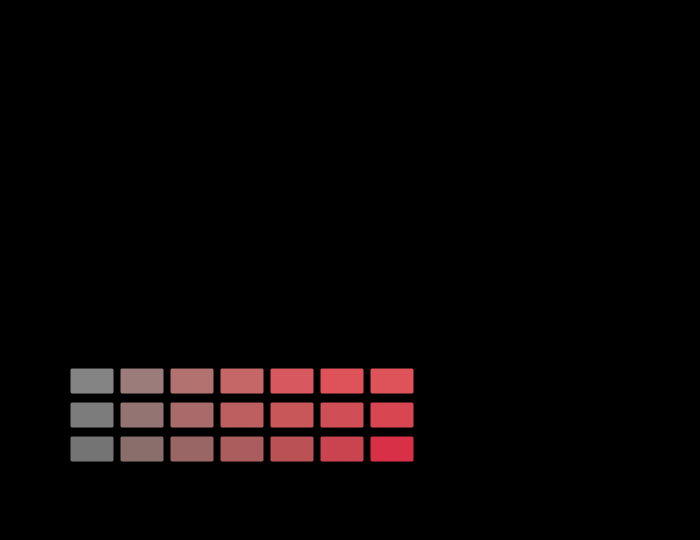
A gradient of one hue, mapped into a press's gamut 3 ways. Chroma asked for along the bottom, chroma delivered up the side, for a ramp at lightness 55 and hue angle 25°. A colorimetric intent follows the diagonal until the press runs out and is flat afterwards — the flat part is a gradient arriving as a single colour. The perceptual intent is under the diagonal from the start, which is the price of never going flat.

A budget drawn through one hue

The three-stage error budget this collection publishes for a colour-management chain is computed over twenty-four colours of a single hue at a single lightness. The quantity that actually varies with hue — how many distinguishable colours a rendering intent destroys — runs from nothing at all to more than a third, and the hue the budget uses is near the bottom of that range.

applied · Delivery
The arguments a standard observer does not have. Seven choices inside a set of colour-matching functions, each with the shape it takes and what it is worth in ΔE₀₀ on a red pigment under a 6500 K radiator. Six are measurements: a field size, an age, a macular density, a cone optical density, three peak wavelengths and a rod contribution. The seventh is not — a change of basis is a change of curves and not a change of observer, and its entry is exactly zero because the space an experiment measures is what an observer is. Printing that zero beside the others is the clearest statement of what the other six are measurements of.

An observer is a contract

Six departures, all above a delivery tolerance, none dominant, and no reader matching the standard on any of them. That would be a demolition if the standard observer were a description of an eye. It is not — it is an agreement about what a number means, and an agreement is not falsified by being unlike anybody.

limits · Limits
Each departure over forty-two surfaces rather than one. The same six departures measured over a family of forty-two analytic reflectances — an absorption band of stated centre, width and depth — with the smallest, the median, the ninety-fifth percentile and the largest marked. Every one of them spans more than a factor of three, and the ranking between them is not stable across the family: what decides a departure's size is which sample it is asked about, because a departure is a pairing and the sample is one of the two factors. Quoting any single number for what an observer's age is worth is quoting a choice of example.

A brand colour for a population

A brand colour is chosen once, specified in a number, and seen by everybody. The observer audit says two candidate colours with identical specifications can carry observer spreads differing by an order of magnitude, and that the spread is computable from an ink's spectrum at the moment the ink is chosen.

applied · Delivery
Three exchanges, two of which move the colour. The documented pipeline is a white balance, a colour matrix, a tone curve and a clip. Each bar is what happens when two neighbours change places, over 30 surfaces the modelled sensor captures: the filled bar is the mean and the tick is the worst patch. Exchanging the balance and the matrix costs 9.2 colour differences at the mean and 13.2 at the worst. Exchanging the curve and the clip costs exactly nothing, and that is a theorem rather than a small number: a monotone curve onto the unit interval commutes with clamping to it.

The order is not in the documentation

A raw converter performs a white balance, a colour matrix, a tone curve and a clip, and every account of the process lists them in that order without saying the order decides anything. Exchanging the first two moves the picture by nine colour differences at the mean and thirteen at the worst patch. The twenty-four arrangements collapse into five outcomes running out to sixty-five, and nothing a converter ships says which of them it is.

imaging · Capture
Where the mosaic is filled in, along one row through an edge. A Bayer row across a step from 0.9 to 0.08, in units of the sensor's own ceiling, reconstructed in linear light and reconstructed after the tone curve, with the second undone so the two are compared at the same point in the chain. Away from the edge they agree to 8.3e-14, because a constant interpolates to itself under any curve. At the edge they differ by 5.78 colour differences. Interpolating encoded values pulls an edge towards its dark side.

One step has no choice

Four of a raw converter's operations can be arranged twenty-four ways. The reconstruction cannot be arranged at all — a colour matrix needs three numbers and a mosaic site has one, so filling in the mosaic is forced to the front by arithmetic rather than by convention. What is not forced is whether it happens in linear light or after the curve, and that decision costs 5.8 colour differences at an ordinary edge and nothing at all four sites away from it.

imaging · Capture
The same highlight, clipped in two places. A ramp running from inside the sensor's range to 1.6 times over it, clipped at the sensor and clipped after the matrix. Below the ceiling the two are identical to the floating-point floor. Above it they part, reaching 21.0 colour differences and 78 degrees of hue. Clipping late keeps a highlight neutral and clipping early keeps its hue, and converters do both.

Two converters and one highlight

The clip is the only step in a raw pipeline that destroys information rather than moving it, and it is the step whose position varies most between converters. Below the sensor's ceiling its position changes nothing at all, exactly. Above it, clipping at the sensor and clipping after the matrix land twenty-one colour differences and seventy-eight degrees of hue apart, and which hues are affected is a property of the camera's own dyes.

imaging · Capture
The budget's three numbers, and the units they are in. The published three-stage budget's own figures, with each one's unit named, beside the same stage re-measured in a single unit over the same colours. Two of the three are colour differences between stimuli and the third is a distance between appearances, and the budget adds them. The fourth row is a stage the budget has no entry for: the colours the separation cannot reach even after the mapping has moved them, which comes to 1.45.

The budget adds two units

This collection publishes a three-stage error budget for a colour-management chain and prints its sum. Two of the three stages are colour differences between stimuli and the third is a distance between appearances, and the conversion between those is not a constant. Re-measured in one unit over the same colours the chain has four stages rather than three, its end-to-end error is 5.05 against a sum of 7.66, and the profile's contribution where a job actually lands is 3.2 times its published average.

applied · Delivery
The same blend, taken on the stored values and on the light. Six pairs blended at 50 per cent, once by averaging the values as they are stored and once by averaging the light they stand for. Every resize, every antialiased edge and every transparency composite in an ordinary pipeline does the first. The two land 15.8 colour differences apart at the mean and 19.3 on a red against a green, and the stored-value blend is the darker on all six, by up to 23 units of lightness.

An average on the stored values

A resize, an antialiased edge, a transparency composite and a chroma subsample are all averages, and in almost every pipeline they are taken on the numbers as stored. The numbers as stored are encoded, the encoding is a compression, and a half-and-half blend of black and white taken that way lands 18.7 colour differences from the half-and-half blend of the light — 22.7 units of lightness darker, on every pair, always in the same direction.

applied · Delivery
The same colour, delivered from two documents. A ramp of chroma, mapped into a press's gamut under the perceptual intent from two source solids: the whole of sRGB, and the same solid with its chroma limited, which is what a document containing only muted colours amounts to. Under a colorimetric intent the two answers are identical to the floating-point floor. Under the perceptual one they are 0.69 apart at the mean and 2.64 at the worst, on colours the destination could hold either way.

An intent is not a function of the colour

A rendering intent is chosen per job and applied per pixel, which suggests it is a function of the colour. The colorimetric ones are, exactly — the same colour from two documents comes out identical to the floating-point floor. The perceptual one is not — it compresses the whole source solid into the destination, so the same colour delivered from a wide document and from a muted one lands 2.6 colour differences apart, on colours the destination could hold either way.

applied · Delivery
Out to the device and back, once and again. Each intent applied 3 times in succession to the same ramp. The upper bar is what the first pass moves and the lower is what the second moves. relative-colorimetric is idempotent — the second pass moves nothing, to the floating-point floor — and the other two are not: perceptual moves another 2.73 and saturation moves another 3.09. A file converted twice is not a file converted once.

A second conversion is not a repeat

A colour converted to a device and back is described as lossy where the device cannot hold it and exact where it can, which suggests that a colour surviving one round trip survives any number. One of the four intents is idempotent to the floating-point floor. The other two are not — a perceptual conversion moves a ramp 3.70 colour differences on its first pass and another 2.73 on its second, and after three passes it is still moving by 2.42.

applied · Delivery
A soft proof exact for one observer, as two hundred others see it. Each display is driven to match each of thirty printed patches exactly for the reference observer, so for that observer screen and print are the same colour to fourteen decimal places. The bars are what two hundred observers drawn from the population make of the same pairs: the median observer's difference, median over the patches, and the ninety-fifth percentile observer's: 1.8 and 4.8 on the wide-gamut LCD, 2.0 and 5.4 on the OLED, 3.1 and 7.5 on the laser projector. The narrower a display's primaries, the larger both become.

A soft proof is exact for one reader

A display can be driven to match a printed patch exactly for the standard observer — three equations, three unknowns, agreement to fourteen decimal places. Two hundred observers drawn from a realistic population see the same screen and print a median of 2.1 colour differences apart on an OLED panel and 5.4 apart at the ninety-fifth percentile. On a laser projector the ninety-fifth percentile is 7.5. The patch that fails worst is unprinted paper, and in the chain's own unit the ninety-fifth percentile reader's stage is larger than every one of the four stages a delivery chain is budgeted for.

applied · Delivery
How far the chain falls short of its sum, and how much of that is the unit. For each rendering intent, three ratios of the chain's end-to-end error to the sum of its four stages. The lowest bar is the published one, in the power-corrected unit. The middle bar is what that unit reports for a chain whose stages point the same way and add exactly — the exponent on its own. The top bar is the same chain measured in the model's own Euclidean space. Under the colorimetric intent the published ratio is 0.66, the exponent alone gives 0.74 and the chain in a space that can add 0.84: 77 per cent of the shortfall is the unit.

A chain measured in a unit that cannot add

A delivery chain's four stages, measured in the power-corrected appearance difference, sum to 7.66 while the chain end to end measures 5.05, and the shortfall was read as the stages partly cancelling. A chain whose four stages lay in a straight line and added exactly would still read 0.74 of its sum in that unit, because a distance raised to the power 0.63 cannot add. Measured in the model's own Euclidean space the same chain reaches 0.84 of its sum. Three quarters of the published shortfall was the exponent.

applied · Delivery
One edge magnified four times, three ways: text on a page. A step between the two colours of text on a page, magnified four times by linear interpolation, by bicubic and by a three-lobe Lanczos kernel, once on the stored values and once on the light. The curves are the stored-value result's lightness minus the light's, sample by sample across the edge; below the line the stored-value resize is darker. Linear interpolation is darker everywhere it differs. The two kernels with negative lobes swing above the line beside the edge, where their negative weights fall — bicubic by up to 1.8 colour differences and Lanczos by 3.7.

A resize with a negative weight in it

A blend taken on stored values is always darker than the blend of the light, because the encoding is concave and a convex combination of a concave function's values lies below the function of the combination. A bicubic or Lanczos resize is not a convex combination. Beside an edge its negative weights make the stored-value result lighter than the light's own — by up to 6.1 colour differences with bicubic and 12.2 with Lanczos on skin against its shadow — and on edges between full-scale values the clip hides the overshoot and the old guarantee appears to hold.

applied · Delivery
The corner of a patch of skin against its own shadow, magnified four times by Lanczos, three lobes. A map of the neighbourhood of one corner of a square patch — the patch fills the lower right, the field the rest — once it has been magnified four times by Lanczos, three lobes. Each cell is shaded by how much lighter (warm) or darker (cool) the stored-value result is than the light's, the deepest shade 18.2 units of lightness. Within three source pixels of the corner the stored-value result is up to 14.5 colour differences lighter, 14.5 outside the patch against 3.1 inside it, and up to 7.3 darker.

The corner of a resized patch is lighter than its edges

A resize taken on stored values is darker than the resize of the light wherever its weights are positive, and lighter beside an edge where a kernel's negative lobes fall. In two dimensions the kernel is a product, and just outside a patch's corner a Lanczos magnification of skin against its shadow comes out 14.5 colour differences lighter — more than along either edge. A reduction to a quarter is mostly an average and errs lighter by at most two. And an unsharp mask, whose negative weights are its whole purpose, is lighter on the stored values at every amount on every pair, and never darker.

applied · Delivery
A soft proof exact for one observer, and three proofs tuned for readers. For each display, the median over printed patches of the 95th percentile reader's mismatch between screen and print, for four ways of choosing the display's three drive levels: exact for the reference observer; least squares over a population of a hundred; tuned on that population's 95th percentile; and tuned on the two hundred readers it is scored on, which no workflow could do. On a wide-gamut LCD the four give 4.57, 4.99, 4.74, 4.39, and the three tuned proofs cost the reference observer 0.70, 0.82, 0.69. On an OLED panel the four give 5.12, 5.72, 4.99, 4.86, and the three tuned proofs cost the reference observer 1.35, 0.95, 0.67. On a laser projector the four give 7.54, 7.00, 6.81, 6.50, and the three tuned proofs cost the reference observer 1.88, 1.23, 1.14.

A proof cannot be tuned for readers who disagree

A soft proof matched exactly for the standard observer is five colour differences wrong for one reader in twenty. Giving up that exactness to tune the display's three drives for a population instead moves the ninety-fifth percentile reader by 4 to 14 per cent even when the tuning is done on the very readers it is scored against — because what readers see is mostly each other's disagreement, and three drives act on every reader at once.

applied · Delivery
The error between a profile's nodes is a bias, not a scatter. Two quantities against the lattice size: the mean colour difference between the nodes, and the mean signed lightness error. If the interpolation erred in both directions the second would be near zero while the first was not. They lie on each other — 0.136 against 0.133 at a nine-step lattice — so the whole of what a profile does between its patches is to lighten. It errs light because a press's response is convex in ink coverage: the first drop of ink removes more light than the last, and a straight line between two points on a convex curve lies above it. At three steps 400 of 400 samples err light.

A profile interpolates light

A profile is exact at its patches and wrong between them, and how wrong has been measured twice. Which way it is wrong has not. At a nine-step lattice the mean signed lightness error between the nodes is +0.136 against a mean colour difference of 0.133 — the error is not a scatter but a bias, and it lightens. The repair costs nothing measured and is forbidden by how a profile is checked: let the table be wrong at its own patches.

applied · Delivery
One instrument, one uncertainty, six places on the scale. What an absolute uncertainty of 0.001 in measured reflectance is worth in lightness, at six levels from a four-colour solid to the paper. Nothing about the instrument changes between the rows: what changes is the slope of the lightness function, which is a straight line of 903 units per unit of luminance factor below a luminance of 0.0089 and a cube root above it. At the solid the uncertainty is 0.903 lightness units and at the paper 0.043 — 21 times as much, for the same measurement.

The scale hangs from one measurement

Black point compensation is a straight line between two blacks, and the destination's is a measurement of one patch at the darkest place a spectrophotometer is ever asked to read. The lightness scale's slope is 903 units per unit of luminance factor there and 43 at the paper, so a thousandth of a reflectance is worth nine tenths of a lightness unit at the black and four hundredths at the white. That one number moves a mid grey by nearly a quarter of a delivery tolerance, and no specification names it.

applied · Delivery
Two tables, two directions of error: 5-node ramps of four inks. For each ink, the mean signed lightness error between the nodes: of the ordinary forward table, which errs light, and of four ways to fill the inverse table, all of which err dark except the one refitted against its own objective. On cyan the forward table errs by +0.206; an inverse filled from the press by -0.317; one inverted from the ordinary table by -0.554, because it inherits the forward table's error on top of its own; one inverted from the refitted table by -0.367; and one refitted in its own right by -0.002.

The inverse table errs dark

A profile's forward table predicts a print lighter than the press makes, and refitting its nodes removes the bias. The table a colour engine actually uses to separate an image is the other one — the inverse, from colour to ink — and it errs the opposite way: filled exactly from the press it asks for too much ink and prints dark, and built by inverting the ordinary forward table it prints darker still. Inverting the refitted forward table removes the inherited part and leaves the inverse's own. The round trip through both tables improves only when each is refitted against its own error, and then the two are no longer each other's inverse.

applied · Delivery

Named alongside it

The objects these essays reach for when they reach for this one.

SpecificationThe ICC profileStandard observerIlluminantWhite pointΔEQuality controlReflectanceTransfer functionChromatic adaptationGamutGamut mapping

All concepts