ΔE — where it appears
Named by 60 essays across 9 fields — each of them below, with the objects they name alongside it.

How far apart are two colours
ΔE is meant to be a distance with the property that the same number means the same perceived difference everywhere. Three successive formulae have tried, they disagree with each other by more than a just-noticeable difference, and the disagreement decides real matching questions.

MacAdam measured it
In a perceptually uniform space the just-noticeable-difference contours would be circles of equal size. MacAdam's ellipses are neither, by a factor of eighty — and transforming them into each candidate space settles which spaces improved matters and by how much.
Simulating what cannot be simulated
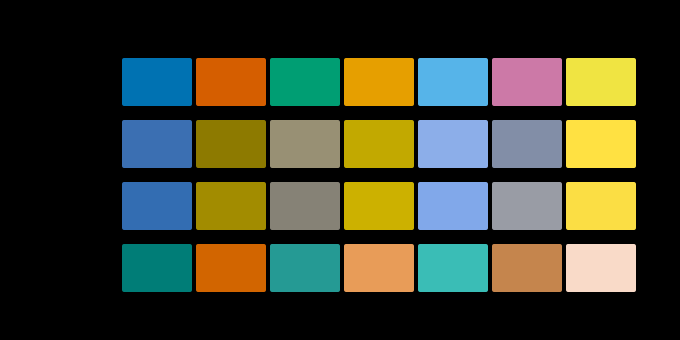
A colour-blindness simulation cannot show what anybody sees. What it can show is which discriminations survive, and that is a narrower claim, a checkable one, and the only one worth making.

Two spectra, one colour
Metamerism is usually described and almost never demonstrated. It does not have to be — the metameric black space is enormous, so a matching pair can be constructed to order, verified, and then made to come apart by changing the light.

A threshold is not a unit
MacAdam measured the smallest difference anyone could detect. ΔE2000 was fitted to how far apart plainly different colours look. The two are quoted interchangeably, and the contours they produce are not even the same shape.

A tolerance is a shape
A total colour difference below one, or every component within one — the two sound like the same requirement stated twice. They are different shapes, they disagree about most of what either accepts, and which one a supplier is held to is worth money.

Four ways to move a white point
Every chromatic adaptation transform is the same three lines with a different matrix. The matrices disagree by more than any tolerance a supplier is held to, and the oldest one — still shipping, still called von Kries — is not a cone basis at all.

What the instrument reports
A spectrophotometer sees a sample through a slit of finite width, at a finite number of wavelengths. What it writes down is the truth convolved with its own bandpass, and nothing in the file says which values were measured and which were invented.

How many colours are there
Sixteen point seven million counts code values in a file format. Ten million distinguishable colours is a volume divided by the size of a just-noticeable difference — and the two difference formulae this site implements disagree about that size by a factor of nearly five.

Where the formula is not smooth
A colour difference formula is a distance, and a distance ought to vary gently. CIEDE2000's does not everywhere — it carries a hue-rotation term with a hard edge in it, and the discontinuity sits where a great many industrial samples live.
Two paints that stop matching
A metameric match is an identity between three integrals that are linear in reflectance. A second bounce carries reflectance squared, and no linear identity survives being squared — so two paints certified identical on a flat chart come apart in a corner, by an amount the geometry decides and the colorimetry cannot express.

Rendering in three numbers
Almost every renderer ever shipped bounces red, green and blue rather than a spectrum. The error that costs is exactly zero at the first product and grows at every one after it — because three numbers cannot carry a product they were never given the factors of, and each bounce is another product.

Paint is not a filter
Stacking two filters multiplies their transmittances. Stirring two pigments together does not multiply their reflectances, because a mixture is one scattering layer rather than two in series — light meets whichever particle is nearest. Treating the two as the same operation is a 15-unit error, and which way it errs turns out to depend on whether the comparison holds the amount of pigment fixed.

A colour that moves with the viewer
A thin film has no pigment in it. Its reflectance spectrum is an interference condition containing a path length and an angle, so tilting the sample moves every maximum to a shorter wavelength and changes the colour by 40 units of ΔE. A pigment's spectrum contains neither, and cannot do this at all — which is the cleanest separation between the two kinds of colour there is, and it is geometric rather than chemical.
A scene has no white point
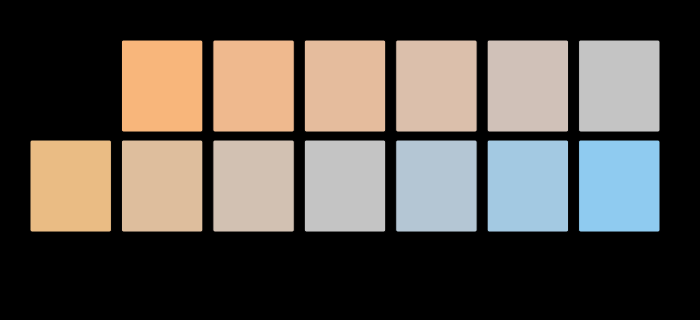
White balance is one transform applied to a whole image, and a scene lit by two lamps has no single answer for that transform to be. The failure is structural rather than a matter of a better estimator — and every colour-managed workflow in existence takes exactly one white point as an input, with no field in which to say there were two.

Gloss changes the measurement
The same sample measured with the specular component included and excluded returns two different numbers, and both are correct answers to different questions. Colour is one of four appearance attributes and the only one most instruments report — so a specification that names a colour has silently named a geometry too, and usually does not say which.

The camera has its own metamers
Two surfaces a camera records as identical can be plainly different to a person, and two a person cannot tell apart can be recorded as different. Both pairs are constructed rather than found, from one projection, used for both.

A camera profile is a fit
Since no matrix is exact, the one a manufacturer ships is a least-squares compromise over a set of surfaces somebody chose. Fitted on desaturated patches it is excellent on desaturated patches — and the sample set is a hidden argument to every camera profile in existence.

No matrix is right everywhere
The best three-by-three this sensor admits, fitted and tested on the same twenty-four surfaces, leaves a worst case of ΔE00 2.85. A control sensor built to satisfy Luther's condition reaches ten to the minus seven under the identical computation, which is what makes the first number a measurement.

Correcting colour costs noise
The matrix that turns a sensor's raw into XYZ has large off-diagonal terms of both signs, because that is what correcting a sensor which fails Luther's condition requires. Differences of large numbers are where noise grows, and the full correction amplifies photon noise by 1.66 times.

Five nanometres is a choice
Every integral here is taken in five-nanometre steps, and the interval has never had to be defended. Coarsening it to twenty costs daylight two hundredths of a colour difference and a fluorescent tube six and a half — and which way of coarsening is used decides a further factor of six.
A gradient is a path
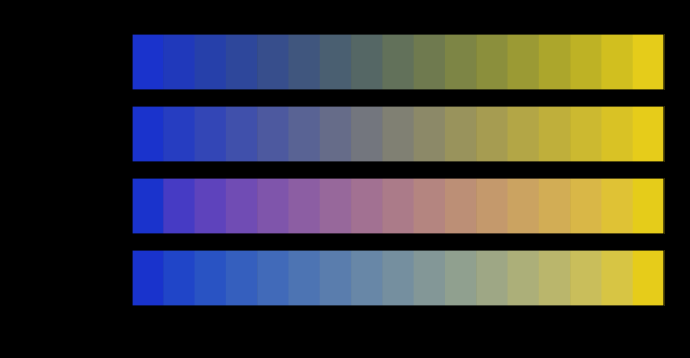
Two colours fix the ends of a blend and nothing else. The middle is decided by the space the interpolation happens in, and four spaces in daily use put the halfway point of one ordinary gradient as much as thirty-seven units of colour difference apart.
A difference is not a distance
Two earlier essays here said that CIEDE2000 violates the triangle inequality and left it at that. Searching for the violation finds a detour half the length of the direct route, a smaller one inside a five-unit ball, and a second defect nobody mentions — ΔE94 is not even symmetric.
A difference has no size
A colour difference formula answers a question about two large patches seen side by side. Applied to a pattern, it reports fourteen units where the eye is left with less than one — and the ratio depends on nothing but how finely the difference is spread.

Colour stops at the edge of sight
Cone density falls twenty-one-fold between the centre of gaze and ten degrees out, and the three channels give out at three different rates — so a colour difference in the periphery does not merely shrink, it turns. At the exact point of fixation there are no short-wavelength cones at all.

White is a region
A lamp is not sold as a chromaticity. It is sold as 4000 K, and what that means is that its chromaticity fell inside a quadrangle — which two lamps can occupy at opposite corners, eleven ΔE00 apart. In a room with either of them, the same twelve surfaces differ by one unit.

Which of two is worse
Two colour-difference formulae disagree about which of two pairs is the larger difference in thirteen per cent of comparisons overall — and in forty-three per cent of comparisons among pairs sitting near a tolerance of one unit, which is where every acceptance decision is actually made.
A difference has no place
A colour difference formula answers a question about two patches somebody is looking straight at. Move the same pair ten degrees into the periphery and a third of it is left — and it has turned twenty-four degrees of hue, because the three channels give out at three different rates.

Nobody here has two eyes
One person's two eyes differ in macular pigment and lens density, so the same light produces two colours — a whole ΔE00 apart for an ordinary pair, seven for one replaced lens. Adaptation hides it exactly, which is why nobody notices and why nothing in colorimetry has a term for it.

A colour has a name
Every quantity here is a number, and the question a reader arrives with is what colour something is called. The eleven basic terms of English divide the space into territories that differ by a factor of five, the metric accounts for fifteen per cent of that, and one of the eleven focal colours cannot be shown on this page at all.

A name is not a threshold
Two colours have to move about ten times a just-noticeable difference apart before people stop calling them the same thing, and how far varies threefold across one plane of the space. A tolerance and a word are answering different questions, and nothing in colorimetry converts between them.

A catalogue is not a vocabulary
A colour order system is a regular lattice, because a person has to be able to find a page. Sorted by what its chips would be called, that lattice comes apart into piles differing by a factor of three — and a fifth of all one-step moves in it change the name.

Four primaries have a choice
Three primaries matching three numbers have one answer. Four have a family of them, every member exact to floating point for the observer they were solved for — and the members are not equally good for anybody else, so a display with a fourth primary has a setting that is robust to who is looking at it and a setting that is not.

A tolerance is a probability
A colorimeter reports one number and a specification compares it with another, and both are computed for an observer who does not exist. Handed to two hundred people, the same pair at ΔE00 1.0 is read from 0.8 to 3.7 — and which of those two ranges applies depends on something no specification records.

Three constants nobody quotes
CIEDE2000 is defined with three parametric factors in it, the CIE leaves them to the industry using the formula, and the two settings in ordinary use differ by a factor of two in one of them. Twenty-nine per cent of acceptance decisions change between the two — a larger disagreement than any between the formulae themselves.

A mean is not a difference
A specification for a proof, a profile or a print run is written against a set of colours and has to reduce that set to one number. The mean and the ninety-fifth percentile disagree about which of two reproductions is better in thirty per cent of cases, and both numbers are honest.

A tint at the edge of a page
The last phase left this join open and guessed at its answer — how visible a halftone tint is away from the centre of gaze should be the product of two effects it had measured separately. It is not the product. At five degrees the guess is fifty-three times too generous, and by twenty it is out by eight orders of magnitude.

A lamp has a direction
A white LED is a blue die under a converter, and light leaving at an angle has travelled further through the converter than light leaving straight up. So the mixture is different in every direction, the beam is bluer in the middle than at its edge, and the number on the box is one direction's worth of a device that has no single colour.

Three ways to dim a lamp
"Dimmed to ten per cent" names three different colours. Switching the lamp on and off faster than anybody can see changes the chromaticity by nothing at all — exactly, to floating point. Reducing the current moves it a few units. Reducing the power to a filament moves it eighteen hundred kelvin down the Planckian locus, and stays on the locus exactly the whole way.

A lamp switched on is not the lamp measured
A luminaire takes about seven minutes to reach nine tenths of its working temperature, loses a quarter of its output on the way, and moves ΔE00 2.6 while it does. That is slower than every clock in the eye — so for the first minutes after a switch is thrown, both ends of the measurement are moving, and every appearance claim here has assumed one of them was still.

A tolerance needs a second number
Two samples one colour difference apart can be read almost identically by everybody or two units apart by the worst-off twentieth, and which of those it is depends on how far apart their spectra are — a quantity every spectrophotometer has already measured and none of them prints. Adding it as a second field predicts the population three times better, and at the tolerances where it matters it is right about a third of the decisions the difference alone gets wrong.

A name moves with the room
Eleven basic colour terms are quoted as centroids in CIELAB and a colour is named by which one it is nearest. Two things nobody records decide the answer — which distance function is used, which renames a fifth of the displayable gamut, and which room the colour is in, which renames more than a quarter of it.

The booth is a luminaire
A standard viewing booth is specified by its light's chromaticity, its rendering and the uniformity of its illuminance across the sample plane. Illuminance is a photometric integral, so two positions can be inside the uniformity tolerance and lit by two different spectra — and a sample at the far corner of a compliant booth is ΔE00 2.4 from one in the middle, against a tolerance of one.

What no adaptation can remove
A change of light is exactly a 3×3 matrix on tristimulus values, and adaptation is a diagonal one. Putting every change of illumination this site models through that distinction sorts them by how much of themselves they leave behind, and the smallest residual in the census belongs to a filter inside the eye.

One unit in another room
Twenty-three pairs built at exactly ΔE00 1.000 under D65, re-measured under every change of light this site models with the observer adapted to each, come out anywhere between 0.64 and 1.57. A tolerance is written as a property of a pair and it is a property of a pair and a room.

A name in the model's own words
The eleven basic colour terms move when the room does, and the obvious objection is that they were being measured in a space with no room in it. Quoting them in an appearance model's own coordinates instead does not shrink the renaming — it grows it by four per cent — and the space alone renames an eighth of the gamut with the room held still.

No diagram makes them circles
Every chromaticity diagram is a projective picture of the same measurement, so how badly MacAdam's ellipses fail to be circles can be minimised over the whole family of them. The best plane there is still leaves the average ellipse twice as long as it is wide — which makes the residual a fact about the eye rather than about anybody's choice of primaries.

A difference needs a basis too
A linear change of coordinates leaves every colour match exactly where it was. A cube root does not commute with one — so a lightness–chroma space, and every colour difference computed in it, is a property of the basis that happened to be in place before the nonlinearity. CIELAB's basis was chosen in 1931 for reasons that had nothing to do with difference.

The colour is right first
A reconstruction of a lamp from twelve filtered readings gets its colour right to half a unit while two thirds of its spectrum is still unmeasured. That combination is not a partial success — it is the exact condition under which a spectral prediction made from the reconstruction will be confidently wrong.

The departures are larger than the tolerance
A delivery tolerance is written around one ΔE₀₀ and every one of this round's four departures is above it on ordinary material. A specification that names an illuminant, an observer and a tolerance, and does not name a measurement condition, an aperture and a field, has written a number that two honest laboratories can miss each other on by more than the number itself.

A tolerance with an observer in it
A delivery tolerance is written in ΔE₀₀ against the 1931 observer, and six departures of that observer combine to about three of the same units on an ordinary saturated sample. A one-unit tolerance is being asked to contain a three-unit uncertainty that nothing in its budget mentions.

A distance raised to a power has no length
CAM16-UCS's colour difference is its Euclidean distance raised to the power 0.63 and multiplied by 1.41. That is still a metric — the triangle inequality holds on every one of four thousand random triples — and it has no length. A grey ramp from black to white measures 25 units in one step, 137 in a hundred and 755 in ten thousand, growing as the number of steps to the power 0.37, and halving the size of a step triples the number of steps that fit.

The inverse table errs dark
A profile's forward table predicts a print lighter than the press makes, and refitting its nodes removes the bias. The table a colour engine actually uses to separate an image is the other one — the inverse, from colour to ink — and it errs the opposite way: filled exactly from the press it asks for too much ink and prints dark, and built by inverting the ordinary forward table it prints darker still. Inverting the refitted forward table removes the inherited part and leaves the inverse's own. The round trip through both tables improves only when each is refitted against its own error, and then the two are no longer each other's inverse.

The eye counts a corner's error, not its peak
A Lanczos-magnified patch errs a fifth more at its corner than along its edges, pixel by pixel, and an unsharp mask errs almost exactly as much at its corner as along its edges. Filtered by the eye over the plane rather than along a line, the two swap: the magnified corner is seen exactly as its edge is, and on a printed page the sharpened corner is seen at 2.4 times its edge. What decides it is whether the error changes sign. Ringing averages away and a one-sided halo does not, and a corner is where two edges' halos land on the same patch of retina.

Two units with a light level disagree about lightness
ΔE₀₀ has no argument for how bright a display is. Two colour differences do: CAM16-UCS takes the room's adapting luminance, and ΔEITP — the difference defined for high-dynamic-range television — takes the stimulus's own absolute luminance. Twenty-three pairs at exactly one ΔE₀₀ grow in both as the display brightens, 2.1 times in ΔEITP and 1.5 in CAM16-UCS from a 5 to a 5,000 cd/m² white. But in ΔEITP the lightness part grows fastest, 2.7 times, and in CAM16-UCS it does not grow at all.

The units part by hue, not by light level
Two colour differences with a light level in them were compared on a display running from 5 to 5,000 cd/m², and a prediction was drawn from how each divided a difference between lightness and chroma. Built into pairs that differ in lightness alone and in chroma alone, both units say the same thing about light level: as a display brightens, chroma differences gain on lightness differences — ΔEITP by a tenth, CAM16-UCS by a quarter. Where they part is hue. The appearance model moves every colour's balance by the same factor; ΔEITP moves the violets, reds and cyan-blues the other way, and at nine of twelve base colours the two units disagree about the direction.

The shadows a unit counts are the ones a room removes
ΔEITP's growth with display brightness is largest in the dark greys, and dark greys are where a lit room's light reflected off the screen sits. One candela a square metre of veiling luminance removes 22 per cent of the difference the unit gives a step at the bottom of the scale on a 1,000-candela display and nothing measurable at the top. The same veil raises the growth the unit reports across display levels from a factor of six to a factor of seventeen, because it destroys a dim display's shadows first.

Sharpened type errs on its dark side
A sharpened square hides its halo along its edges and shows it at its corners, so a sharpened page of type was predicted to show its error at the corners of its letters, several times out of proportion to their length. Black type does the opposite: its outer corners and stroke ends hold between two thirds and nine tenths of their share. As the eye leaves it, the error lies on the dark side of every edge, and a corner holds as much of it as it has dark ground around it — a quarter of a disc where a black corner points out into paper, three quarters where black wraps round a pale one.

A lit room brings the units' medians together
As a display brightens, CAM16-UCS says chroma differences gain a quarter on lightness differences and ΔEITP says a tenth. All of the appearance model's movement comes from what the viewer is adapted to, and every calculation had the viewer adapted to the display alone. Give the room its share of the adaptation and the model's movement shrinks at every step: with a 20 cd/m² room supplying two thirds of it, the two units' medians fall by the same amount. What does not shrink is their disagreement about direction. The model still moves every colour the same way, ΔEITP still moves violets, reds and cyan-blues the other way, and in a lit room that becomes the whole of what separates them.

A guessed veil halves the error
A colour difference that takes a display's absolute luminance leaves out the light a room reflects off the screen, and on an ordinary display in an ordinary room that makes it wrong about the darkest greys by a factor of three. Giving the unit the veil as a declared argument fixes that when the veil is known. The worry was that it never would be — that a guessed argument is no better than none. It is better: any declared veil up to about twice the true one beats declaring none, and one middling guess for every room halves the worst error. What a guess cannot do is reach ten per cent; that needs the veil known within a sixth, which is what a luminance meter aimed at a black screen gives.
Named alongside it
The objects these essays reach for when they reach for this one.
ToleranceSpecificationQuality controlCIEDE2000Standard observerPerceptual uniformityCIELABLightnessThresholdIlluminantJust-noticeable differenceViewing condition