Concept

Lightness — where it appears

How light a colour looks compared with the white in the field, which is a ratio and therefore needs something else to be present. It is why a patch has no lightness in isolation and why the same luminance reads as white in one surround and grey in another.

Named by 49 essays across 7 fields — each of them below, with the objects they name alongside it.

Three colour-difference formulae, disagreeing. ΔE76, ΔE94 and ΔE2000 for the same 9 pairs of colours. The largest disagreement between ΔE76 and ΔE2000 here is 26.6 units — larger than the threshold usually quoted for a just-noticeable difference, so the choice of formula can decide whether two colours count as matching.

How far apart are two colours

ΔE is meant to be a distance with the property that the same number means the same perceived difference everywhere. Three successive formulae have tried, they disagree with each other by more than a just-noticeable difference, and the disagreement decides real matching questions.

difference · Metric
Two identical grey patches on different surrounds. Both inner squares are #818181. The one on the dark field looks lighter. The values are checked to be equal before the figure is drawn, so the claim is a fact about the drawing rather than a promise.

These two patches are identical

It is the most repeated and least checkable sentence in visual perception, because the whole point is that it does not look true. Every instance here is computed, and checked before the figure is drawn.
brain · Appearance
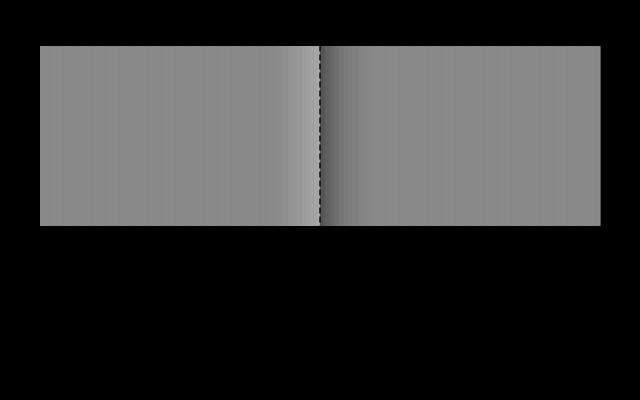
The Cornsweet edge, with its luminance profile. The two plateaux are both #898989 and are flat to exactly — the profile below shows that everything which differs lies within a narrow band at the boundary. Cover the centre line and the two halves become obviously identical.

Brightness is inferred from edges

The Cornsweet effect makes two identical regions look different by altering nothing except a narrow band at the boundary between them. Cover the boundary and the difference vanishes, which says the visual system is reconstructing surfaces rather than reading off intensities.

brain · Appearance
Two identical grey patches on different surrounds. Both inner squares are #868686. The one on the dark field looks lighter. The values are checked to be equal before the figure is drawn, so the claim is a fact about the drawing rather than a promise.

Matching is not appearance

CIE XYZ predicts when two lights will look the same under identical viewing conditions. It was never a model of how anything looks, and most of the confusion in applied colour comes from using it as one.
matching · Gamut
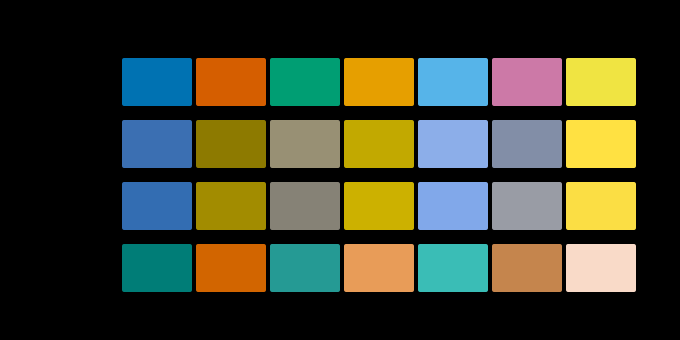
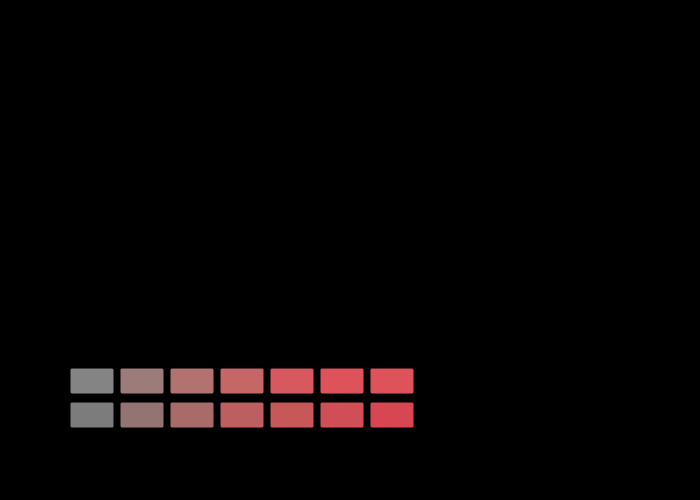
One palette under normal vision and three dichromacies. The same 7 colours simulated by the Brettel–Viénot–Mollon construction at severity 1.0. protanopia and deuteranopia collapse the red-green distinctions, and tritanopia leaves them and collapses blue against yellow instead. This shows which discriminations survive, not what anybody sees.

Simulating what cannot be simulated

A colour-blindness simulation cannot show what anybody sees. What it can show is which discriminations survive, and that is a narrower claim, a checkable one, and the only one worth making.

limits · Limits
The sRGB transfer function, and the gamma 2.2 curve it is not. Code value against relative luminance. The sRGB function is piecewise — a short linear segment near black, then a 2.4 power law with an offset — and it is close to but not the same as a plain 2.2 power law. Half-way along the axis of stored values sits at 21 per cent luminance, and half the luminance of white is at code 188.

The midpoint is not half

Code 128 sits halfway along the sRGB scale and carries about a fifth of white's luminance. Half the luminance is code 188. Almost every gradient, blur and resize on the web gets this wrong, and the errors are visible once known.
difference · Metric
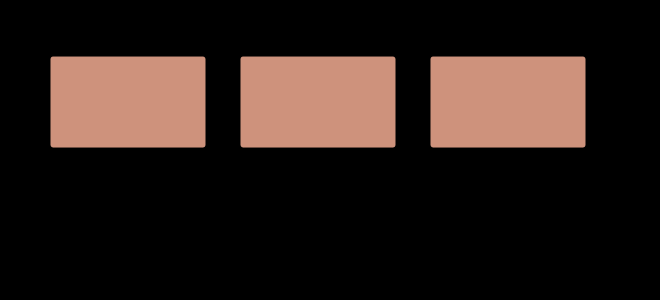
One stimulus, three rooms, three appearances. The same XYZ in a dark, a dim and an average surround. The stimulus does not change and is drawn identically in all three panels; what changes is what CIECAM16 says it looks like. Predicted lightness runs from 65.6 to 57.5 — a spread of 8.1 — with chroma and colourfulness moving too. Colorimetry returns one answer here because it has nowhere to put the room.

A viewing condition is an argument

An appearance model takes a stimulus and a situation. The second argument is not a refinement of the first — it is the content of the claim, and a model that returns an appearance from a colour alone has assumed a room without saying which.

brain · Appearance
A box tolerance and a ΔE tolerance around the same colour. A slice through CIELAB at L* 50, with the ΔE2000 = 1 contour traced point by point and a ±1 component box drawn over it. The contour is 2.1 times longer in one direction than the other, and the box is square. Of every sample either rule accepts, the two disagree about 74% — accepted by one specification and rejected by the other, on the same measurement.

A tolerance is a shape

A total colour difference below one, or every component within one — the two sound like the same requirement stated twice. They are different shapes, they disagree about most of what either accepts, and which one a supplier is held to is worth money.

difference · Metric
Three lightness scales, seventy years apart. Munsell value, CIELAB's L* and CIECAM16's J against luminance, all rescaled to run 0 to 100. Each is somebody's answer to how evenly spaced lightness steps map onto light. They put the midpoint of the scale at 19.8%, 18.4% and 28.0% of the white's luminance respectively — close enough to be three measurements of one thing, far enough apart to be three measurements rather than one restated twice.

Colour by catalogue

A colour order system arranges physical samples on a regular lattice so a person can find one and name it. The space it samples is not regular, and everything interesting about such systems is what happens at that mismatch.
matching · Gamut
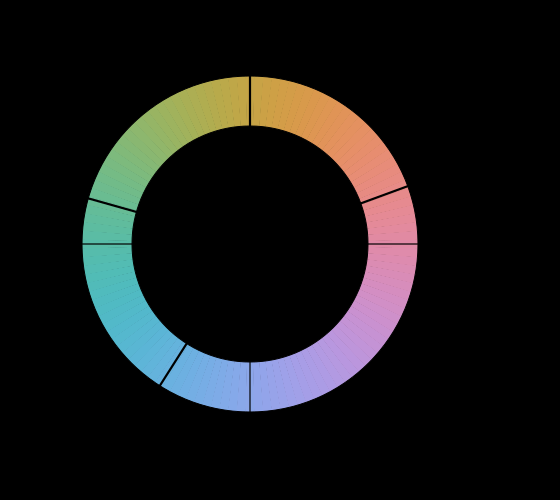
The four unique hues, and the axes they are said to define. A constant-lightness, constant-chroma ring in CIECAM16, with the four unique hue anchors marked and CIELAB's a and b axes drawn through the same circle. If a* really were the red-green axis the anchors would fall on the crosshairs. Unique red sits 25° off, and the four are not 90° apart in any case. Hatched sectors are hues this display cannot reach at this chroma.

Why there are four unique hues

Observers agree that four hues are elementary and that no colour is reddish green. Nothing in the three receptors predicts either fact, and the axes of every standard colour space miss the four by tens of degrees.
brain · Appearance
One stimulus, three rooms, three appearances. The same XYZ in a dark, a dim and an average surround. The stimulus does not change and is drawn identically in all three panels; what changes is what CIECAM16 says it looks like. Predicted lightness runs from 65.6 to 57.5 — a spread of 8.1 — with chroma and colourfulness moving too. Colorimetry returns one answer here because it has nowhere to put the room.

A patch is not a scene

A paint chip is the wrong size, on the wrong background, at the wrong luminance, in the wrong surround. Every one of those is a term in an appearance model, and the model says how much each of them moves the answer — which is the difference between a caution and a prediction.
brain · Appearance
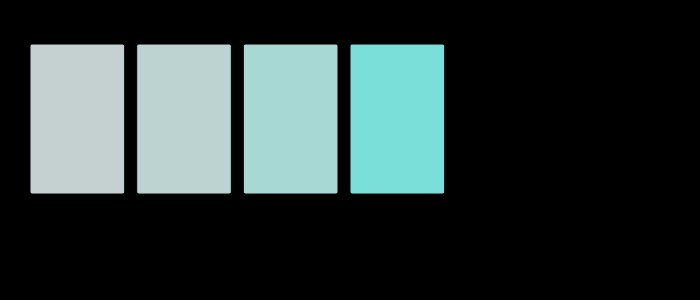
The same medium at six path lengths. Beer's law at 6 depths of one absorbing medium. The absorption coefficient is a single spectrum and the only thing changing is how far the light travelled, yet the patches differ in hue by 7.8° as well as in lightness — because absorption is exponential in depth and the observer is linear, so the bands that survive at d = 8 are not a scaled copy of the ones that survive at d = 0.25. Path length belongs to the geometry, not to the substance, which is why this sits in a field about scenes.

The colour is in the thickness

Transmittance is exponential in path length and the observer is linear, so doubling the depth of an absorbing medium squares the transmittance rather than halving the colour. A translucent object therefore has no one colour — its thin edge and its thick middle are different spectra of the same substance, and the hue moves between them.

scene · Scene
What happens to a tone the destination cannot print. Source lightness along the bottom, destination lightness up the side, for a print whose black is L* = 8. Clipping is the flat segment on the left — 4 of 10 levels in the bottom twenty points of the scale arrive as the same number, and nothing downstream can recover them. Black point compensation is the straight line: all 10 levels survive as different numbers, and every tone in the picture has moved to pay for it.

A black that is not black

The deepest colour a four-colour press can make is L* 2.4, and against its own paper that is a contrast of about 320 to 1 — less than a cheap display manages in a dark room. Everything a printed picture does in the shadows is done inside that range, and the two ways of fitting a picture into it destroy different things.
applied · Delivery
A gradient of one hue, mapped into a press's gamut 2 ways. Chroma asked for along the bottom, chroma delivered up the side, for a ramp at lightness 55 and hue angle 25°. A colorimetric intent follows the diagonal until the press runs out and is flat afterwards — the flat part is a gradient arriving as a single colour. The perceptual intent is under the diagonal from the start, which is the price of never going flat.

No mapping preserves everything

More than half the sRGB solid is outside a press's gamut, so something has to be done with it, and there are two things that can be done. One leaves every reproducible colour exactly where it was and delivers a gradient as a flat area. The other keeps the gradient and moves every colour that needed no help by about three.
applied · Delivery
Lightness against colourfulness, in a booth and on a screen. Each arrow is one colour, from what the model predicts under a print in a 2000 lux booth to what it predicts under a display in a dim room. Every arrow points the same way, which is the content: a dimmer surround lowers predicted lightness and colourfulness together, so a proof does not merely differ from the print, it differs in a direction — and that is why proofing standards specify the room and not only the numbers.

The proof is a different object

A soft proof can be made colorimetrically exact and still not match the print, because the print is in a booth at two thousand lux with an average surround and the screen is in a dim room at a fifth of the luminance. The appearance model puts four CAM16-UCS units between them, with no change of stimulus anywhere — larger than the error any rendering intent is arguing about.

applied · Delivery
The tone scale of one display, in four rooms. Code value along the bottom, the lightness it comes out at up the side. The curves are the same display: what changes is the light falling on the screen, which adds a fixed luminance to every pixel. The signal value that means black arrives at L* = 11.7 at 600 lux, against 0.9 in the dark — the lightness of a dark grey card, from a pixel that is switched off.

The screen is not the room

A thousand-to-one display in an ordinary office is a hundred-and-thirty-seven-to-one display, and the signal value that means black comes out at the lightness of a dark grey card. Nothing is wrong with the panel. Light falls on the screen and comes back off it, and the two per cent it returns is added to every pixel — most of all to the ones with nothing else in them.
applied · Delivery
Brightness against chroma, at exactly constant luminance. Seven stimuli of identical luminance and rising chroma at hue 25. The model's brightness moves by 2.2 per cent across the whole sweep, and at some hues it moves the other way. The Helmholtz–Kohlrausch effect — measured repeatedly, by several methods — is that a saturated colour looks as bright as a neutral of 1.3 to 2 times its luminance, shown as the band. The gap is the model's, and nothing here closes it: the term that would is not in CIECAM16 and is not invented for the occasion.

Brightness is not luminance

Photometry is additive because the CIE defined it that way. Brightness is not, and a saturated colour looks as bright as a neutral of one and a half times its luminance — an effect this site's appearance model moves by two per cent, in a direction that depends on the hue.
brain · Appearance
One light, seven rooms. The same stimulus — fixed in XYZ, unchanged throughout — shown against whites from 12 to 800 candelas per square metre. Its lightness falls from 152 to 16 and its brightness rises, because one of those is a ratio to the white and the other is not. Brown is the low-lightness end: a colour that exists only when something brighter is present, which is why no lamp is brown and no star is.

There is no brown light

Brown is dark orange, dark is a ratio to a white, and a light in a dark room has no white to be dark against. The same stimulus, unchanged in XYZ, runs from lightness 152 to lightness 16 as the surround is raised — and only the bottom of that range has a name.

brain · Appearance
A colour-order system's chips, sorted by what they would be called. A regular lattice in lightness, chroma and hue — the idealisation of a swatch book, and regular by construction because a person has to be able to find a page. Named, it comes apart: 1320 chips inside the gamut divide into 198 for grey and 66 for blue. And 22 per cent of one-step moves in the lattice change the name, so a page of a swatch book is not a page of a vocabulary.

A catalogue is not a vocabulary

A colour order system is a regular lattice, because a person has to be able to find a page. Sorted by what its chips would be called, that lattice comes apart into piles differing by a factor of three — and a fifth of all one-step moves in it change the name.

matching · Gamut
The three constants a specification does not quote. ΔE2000 is defined with three parametric factors in it — kL, kC and kH — which the CIE leaves to the industry using the formula rather than fixing. Graphic arts uses ones throughout; the textile standard weighs lightness at half, which is kL = 2. Applied to 4000 pairs at a tolerance of 1, the two settings accept 46 and 75 per cent, and 29 per cent of pairs change verdict — a larger disagreement than any between the formulae themselves. The reference conditions the ones assume are diffuse illumination at 1000 lux, a mid-grey surround, samples abutting, subtending over four degrees, differing by under five units, with no visible texture.

Three constants nobody quotes

CIEDE2000 is defined with three parametric factors in it, the CIE leaves them to the industry using the formula, and the two settings in ordinary use differ by a factor of two in one of them. Twenty-nine per cent of acceptance decisions change between the two — a larger disagreement than any between the formulae themselves.

difference · Metric
What a halftone measures, against what it looks like. A 50 per cent screen, measured by an aperture that averages the patch and seen by an eye that blurs it first and compresses afterwards. At a coarse ruling the two disagree by ΔE00 11.1, and the patch looks 14.3 lightness units darker than it measures — the average of a concave function is below the function of the average, which is Jensen's inequality and not an illusion. The gap falls under a unit above 30 cycles per degree. That is a viewing distance, and the correction a press applies for dot gain has no distance in it anywhere.

Measured with an aperture, seen with an eye

A spectrophotometer averages a halftone patch and reports one reflectance. An eye blurs it first and compresses afterwards, and the average of a concave function is below the function of the average — so a resolvable screen looks darker than it measures, by fourteen lightness units at a coarse ruling and by nothing at a fine one. The correction a press applies is the same size and has no viewing distance in it.

applied · Delivery
The floor as a function of the exponent, and the fixed basis beside it. Two curves against the compression exponent on a logarithmic axis from 1 to 10. The lower curve is the best mean ellipse axis ratio any basis can reach with that exponent applied after it, and it falls from 2.33 at no compression to 1.66 at a square root and 1.61 at a cube root, then hardly moves — 1.57 at a tenth root. The upper curve is CIELAB's own basis at the same exponents and gets steadily worse, from 3.57 to 3.77. Almost everything a compression buys arrives with the first step away from linearity, and after that the exponent is choosing between 1.66 and 1.61 while the basis is choosing between 1.61 and 3.44.

The exponent was never the argument

A century of colour science has argued about whether the eye's response is a cube root, a square root or a logarithm. Minimise the anisotropy of MacAdam's ellipses over every basis, at each of eight exponents, and the floor moves by under three per cent between a cube root and a tenth root — while the basis moves it by a factor of two.

difference · Metric
A mid-grey's lightness across a continuum of rooms. The lightness a mid-grey is predicted to have, plotted along the continuous surround parameter running from an average room to a dark one. The three rooms the standard tabulates are marked on it: average at the left, dark at the right, and dim 61% of the way between them rather than halfway. The whole span is 9.71 units of lightness and the step from average to dim is 5.64 of it — 58% — so choosing one of the three rows is a decision worth most of the range.

The surround is three rows of a table

An appearance model takes the room as three constants, and the standard tabulates three rooms. Every appearance figure in this collection is drawn at one of them. The parameter they are three points of is continuous, and the middle row is not in the middle.

brain · Appearance
How far each census row moves when the test set's own description does. A grid of bars, one row per change of light in the census and one bar in each row per number that describes the region the test surfaces are drawn from: how saturated they are, how bright, and how far the two modulations may go together. A bar's length is the elasticity — the proportional change in the published residual for a proportional change in that number. Saturation runs from 0.49 to 0.91 and brightness averages 0.104, so a test set's chroma range is nearly everything and its lightness range is nearly nothing. For scale, the largest elasticity found anywhere among this collection's five declared population widths is about a half — and those at least have declared ranges, while these three numbers have never been quoted with one.

Saturation is nearly everything

The set of test surfaces has three numbers describing it, and only one of them matters. How saturated the surfaces are carries an elasticity of about 0.7 on every result computed over them; how bright they are carries 0.10. A test chart's chroma range decides its answer and its lightness range does not.

difference · Metric
What six of this collection's published numbers do when the unit changes. Six quantities, from six calculations that share nothing: a change of light after an observer has adapted, a camera profile's error, the gap between the two standard observers, a metameric pair under the lamp that breaks it, the same image on two papers, and an observer two seconds into a new room. Each is recomputed under all six units and every unit is calibrated onto ΔE2000's scale first, so the bar is not a change of units in the ordinary sense. The bar is the ratio of the largest reading to the smallest, and it runs from 1.71 to 2.30. Five of the six are printed in ΔE2000 by the essays that report them; the sixth is printed in CAM16-UCS, because the model it comes out of defines that unit.

A model judged in another model's unit

An appearance shift is a change in what an observer would report, not a change in a stimulus, so measuring one with a matching difference means first asking what stimulus a settled observer would need to be shown to give the same report. That step is not bookkeeping — it is the whole distinction the field rests on, and it costs a factor of 1.7 across the menu.

brain · Appearance
One surface dimmed sixteen times, and the two things that happen to it. A single surface, dimmed by successive halvings, with the lens age departure measured on it at every level. The tristimulus deviation falls by exactly the dimming factor — 16 times over the sweep, to the last bit, because the colour integral is linear in the stimulus. What a unit of that deviation is worth rises by 8.2 times over the same sweep. The colour difference the audit reports is the product of the two, and it falls by only 1.95.

A deviation is not a difference

The previous round priced twenty departures in colour differences and treated each number as a property of the thing that departed. Every one of them is a product of two factors — how far the reading moved, which is linear and belongs to the departure, and what a unit of that movement is worth where it landed, which is not linear and belongs to the colour. Dimming one surface sixteen times scales the first by exactly sixteen and the second by eight.

matching · Gamut
The straight piece under the cube root, and where it stops. CIELAB's lightness against relative luminance, over the bottom 5.0 per cent of the range. Below Y = 0.008856 it is a straight line of slope 7.787; above it, a cube root. The two meet at L* 8 in value and in slope, exactly — the CIE's two constants are chosen to make that true. The dashed curve is the pure cube root, which reaches negative lightness before it reaches zero luminance and has an infinite slope there. The break is marked, and the axis runs to Y = 0.050.

The straight piece under the cube root

CIELAB's lightness is described everywhere as a cube root and below a stated luminance it is a straight line, spliced on with two constants chosen so the join is exact in value and in slope. Every black a delivery chain reaches is inside that straight piece — a press black at L* 2.4, a projected black at 1.1 — where the compression does not compress, the price of a deviation is flat to two parts in a thousand, and the second derivative the composition of two departures needs does not exist.

matching · Gamut
What a code lattice costs, and where. Twelve thousand colours quantised to 8 bits per channel through the sRGB transfer function and read back, with lightness across the bottom and the colour difference the rounding cost up the side. The mean is 0.191 and the worst case is 1.15, a factor of 6.0. The bars are band means, and they rise: the encoding spends its codes in the shadows, so the top of the ramp is where the lattice is coarsest against a metric that does not compress as hard.

A lattice has no derivative

Every departure priced here was priced by perturbing something and reading the answer, which requires the thing being perturbed to have a derivative. A file written on a code lattice does not have one — its output is flat almost everywhere and jumps on a set of measure zero — so quantisation can be bounded and never propagated. The bound is 1.15 colour differences at eight bits per channel against a mean of 0.19, and it is worst where the encoding spends fewest codes.
matching · Gamut
A hue circle through a per-channel curve. 28 colours on a circle of constant lightness 55 and chroma 38, each put through the tone curve one channel at a time and read back. The curve is a function of a single number and has no idea what hue is, and it rotates the circle by up to 4.4 degrees — largest at hue 260 — while raising chroma by a factor of 1.27 and lightness by about 1 units.

A contrast control is three controls

A tone curve is a function of one number at a time and knows nothing about hue. Applied to each channel separately it rotates a hue circle by up to seventeen degrees, raises chroma by a factor of 1.27 at ordinary strength, and lifts lightness — so a photographer who moves a contrast slider has moved three things and the interface names one of them. All three scale with the curve's strength, monotonically, and the hue rotation depends on which hue it is.

imaging · Capture
A stop taken in raw, and the same lightness reached afterwards. Each row is a stop of exposure applied to the raw values, against a gain applied after the whole pipeline and solved so that an eighteen per cent grey comes out at the same lightness. The two are then the same brightness by construction and differ by 4.2 colour differences at the mean and 11.1 at the worst patch. A stop is a scalar in front of the curve and is not a scalar behind it.

A stop is not a stop afterwards

Doubling the light is exactly a factor of two in raw values and in tristimulus values, which is the one thing about exposure everybody is sure of. A stop taken after the tone curve is a factor of something else, and matching the two on an eighteen per cent grey leaves the rest of the frame between three and four colour differences apart at the mean and up to eleven at the worst patch. The gain that matches one stop is 2.47 rather than 2.

imaging · Capture
What a stated lightness pins down, and where. A lightness quoted to 0.05 of a unit, inverted, and the luminance it fixes. Read as a fraction of the colour's own luminance the requirement is 0.90 per cent at J 10 and 0.097 at J 95, a factor of 9.3. Read in absolute luminance it is the other way round, by a factor of 6.5. Both readings are true and they answer different questions.

A stated lightness is two requirements

A specification quotes an appearance to a stated precision — a lightness to a tenth of a unit, say — and the same precision everywhere. Inverted, a twentieth of a unit of lightness fixes the luminance to nine tenths of one per cent at the bottom of the scale and to a tenth of one per cent at the top, a factor of 9.3. Read in absolute luminance it is the other way round by a factor of 6.5, and both readings are true.
brain · Appearance
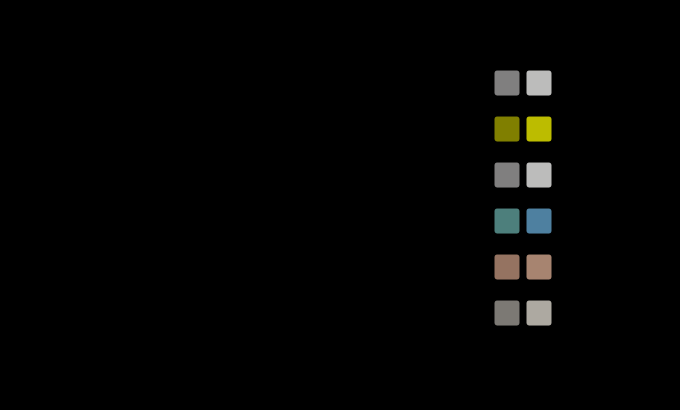
The same blend, taken on the stored values and on the light. Six pairs blended at 50 per cent, once by averaging the values as they are stored and once by averaging the light they stand for. Every resize, every antialiased edge and every transparency composite in an ordinary pipeline does the first. The two land 15.8 colour differences apart at the mean and 19.3 on a red against a green, and the stored-value blend is the darker on all six, by up to 23 units of lightness.

An average on the stored values

A resize, an antialiased edge, a transparency composite and a chroma subsample are all averages, and in almost every pipeline they are taken on the numbers as stored. The numbers as stored are encoded, the encoding is a compression, and a half-and-half blend of black and white taken that way lands 18.7 colour differences from the half-and-half blend of the light — 22.7 units of lightness darker, on every pair, always in the same direction.

applied · Delivery
What a small neutral deviation costs as the grey darkens, in two lightness scales. The price of a fixed fraction of deviation on a neutral — how much lightness it is worth per unit of luminance — from L 40 down to L 0.25, both axes logarithmic. CIELAB's L is a straight line below L 8 and its price there is exactly flat. The appearance model's J′ has no straight piece: its price keeps rising, by a factor of 5.0 across the same range, as the luminance to the power -0.442 — the derived exponent is -0.441 in an average surround.

The appearance model has no straight piece

CIELAB's lightness is a straight line below L* 8, so a deviation near black has a fixed price and a black has a floor under it. CIECAM16 has no such piece. Its lightness near zero goes as the luminance to a power set by the room, the price of a deviation rises without limit as the black deepens — as Y to the power −0.44 in a lit room and −0.58 in a dark one — and on a projected black a lightness unit in the model allows under half the luminance change a unit of L* allows.

matching · Gamut
How far the answer for the average is from the average answer, over eight spreads. For each spread of inputs, the distance between the mean of the model's answers and its answer for the mean input, as a share of the spread of the answers. Over a population of observers it is 1.4 per cent. Over surfaces it is 21 on smooth natural reflectances, 27 on a banded family with lightness in it, and 9 on a set of pale surfaces. Over the light one room sees in a day it is 59.

The average surface does not look average

Over a population of observers the appearance model is so nearly linear that the mean of its answers is its answer for the mean, to 1.4 per cent of the spread. Over the surfaces in a scene it is not. On 240 smooth reflectances the gap is 21 per cent of the spread, and the mean surface looks 4.2 units lighter than the surfaces look on average. The grey that matches the average light is a 47 per cent reflectance; the grey that matches the average look is a 43 per cent one.

brain · Appearance
One grey scale, three backgrounds. CIECAM16's lightness against the luminance factor of a neutral sample, with only the background changed. A grey reflecting 19% reads 46.7 on a near-black background and 32.8 on a near-white one. The three curves are not three shapes: each is the same curve raised to a different power, because the background reaches lightness only through the exponent z, which runs 1.621 to 2.374 across the three.

A dark background moves every difference and no match

CIECAM16's background is one number, and it reaches lightness as one exponent. That is enough to change what a grey looks like and not enough to change which of two greys is lighter — so a match survives the background exactly, a corresponding colour is invariant to it, and a tolerance is not. The effect the background is usually invoked to explain is absent from the model entirely.

brain · Appearance
A crispening term puts the peak where the background is. How much lightness the model returns for a small change in the sample's level, against the sample's level measured as a log ratio to the background's — so that all three backgrounds share one axis and a peak at the background is a peak at zero. The pale curves are CIECAM16 as it stands, which has no peak anywhere: they rise slowly and monotonically because a background that enters as four constants fixed before the sample arrives cannot know where the sample sits relative to it. The solid curves are the same model with a term of amplitude 6 and width 0.5 added to lightness. Each peaks at zero to within 0.000 of a log unit, and the peak's height is 12.00 lightness units per log unit of level — the amplitude divided by the width, exactly.

The cancellation is exact and cheap to lose

CIECAM16 has no crispening, and adding one was expected to be expensive: the background's exactness in a corresponding colour comes from its being a common exponent, and a function of the sample's own level is not one. It is expensive in kind and not in size. A term that raises a straddling pair's lightness difference by half moves a corresponding colour by five thousandths of a tristimulus unit — a thousandth of what stating the background differently at the two ends already costs.

brain · Appearance
The pairs that change places in chroma are a wedge with two straight edges. Every pair of samples, plotted by the log ratio of the two samples' background-free responses across and the log ratio of their chroma at a background of 2 up. A pair changes places between that background and one of 80 exactly when its chroma ratio and its response ratio point in opposite directions and the chroma ratio is the smaller — which is the wedge between the horizontal axis and a line of slope -0.2598, half the change in the lightness exponent. 754 of 14028 pairs are inside it, and the condition names every one of them and nothing else: 0 disagreements between the line and the model. The pale dots are one pair in eleven of those outside; the filled ones are every pair inside.

The reversals have a straight edge

Twenty-one of 276 pairs change places in chroma between a dark background and a light one, and the reason given was that chroma is a product of a term carrying the exponent and a term that does not. That is true and it is not a description of which pairs. Chroma at one background is a single common factor times a power of lightness at another, so a pair reverses exactly when its chroma ratio and its lightness ratio point opposite ways and the first is the smaller — a wedge with two straight edges, which names every reversal and nothing else.

brain · Appearance
One lightness scale, drawn as a contour across the rooms. Three surrounds up the page and the background's luminance factor across it, on a square-root scale so that the model's own exponent base is linear in the axis. Each curve joins the rooms whose lightness exponent is the same, and every room on one curve returns the same lightness for every sample. The marked curve is the one through a television in a lit living room against a mid grey: it also passes through a print on a desk against a background of 2.8 and a projection in a dark room against 47.0. A curve that leaves the plot has no member in that surround, because each surround multiplies a base that runs only from 1.48 to 2.48.

Two rooms with one lightness scale

CIECAM16's surround and its background both reach lightness, and they reach it through one product. So the rooms fall into classes: a television in a lit living room against a mid grey returns exactly the lightness a print on a desk against a background of 2.8 does, for every sample, to the last bit of a double. It returns 0.76 of its chroma and 0.81 of its brightness. Two of the model's four viewing-condition parameters are one parameter, and only colour tells them apart.

brain · Appearance
One instrument, one uncertainty, six places on the scale. What an absolute uncertainty of 0.001 in measured reflectance is worth in lightness, at six levels from a four-colour solid to the paper. Nothing about the instrument changes between the rows: what changes is the slope of the lightness function, which is a straight line of 903 units per unit of luminance factor below a luminance of 0.0089 and a cube root above it. At the solid the uncertainty is 0.903 lightness units and at the paper 0.043 — 21 times as much, for the same measurement.

The scale hangs from one measurement

Black point compensation is a straight line between two blacks, and the destination's is a measurement of one patch at the darkest place a spectrophotometer is ever asked to read. The lightness scale's slope is 903 units per unit of luminance factor there and 43 at the paper, so a thousandth of a reflectance is worth nine tenths of a lightness unit at the black and four hundredths at the white. That one number moves a mid grey by nearly a quarter of a delivery tolerance, and no specification names it.

applied · Delivery
The share a finish takes falls with how much light the wall returns. Seventy-two rooms under daylight, each with a different paint on two opposite walls — six hues, four band widths, three peak reflectances — at a satin finish. Across is the wall's luminance factor, the share of the lamp's light it returns; up is the share of the room's chroma the finish takes. The losses fall with the luminance factor at a rank correlation of −0.89, from 15.5 per cent on the darkest walls to 2.5 on the palest. The two ringed paints make rooms of the same matt chroma and lose 14.7 and 2.5 per cent.

A dark wall pays for a finish

A satin finish takes about a tenth of a room's colour, and the tenth varies. The natural explanation is that a weak colour loses a larger share of itself to the white light a glossy surface adds. Over seventy-two paints under one lamp that explanation orders nothing: the loss runs from 2.5 to 15.5 per cent, it follows how much light the wall returns at a rank correlation of −0.89, and it follows how colourful the wall is at −0.04. Two rooms equally colourful matt lose shares nearly six times apart, and the one that loses more is the darker.

scene · Scene
Two tables, two directions of error: 5-node ramps of four inks. For each ink, the mean signed lightness error between the nodes: of the ordinary forward table, which errs light, and of four ways to fill the inverse table, all of which err dark except the one refitted against its own objective. On cyan the forward table errs by +0.206; an inverse filled from the press by -0.317; one inverted from the ordinary table by -0.554, because it inherits the forward table's error on top of its own; one inverted from the refitted table by -0.367; and one refitted in its own right by -0.002.

The inverse table errs dark

A profile's forward table predicts a print lighter than the press makes, and refitting its nodes removes the bias. The table a colour engine actually uses to separate an image is the other one — the inverse, from colour to ink — and it errs the opposite way: filled exactly from the press it asks for too much ink and prints dark, and built by inverting the ordinary forward table it prints darker still. Inverting the refitted forward table removes the inherited part and leaves the inverse's own. The round trip through both tables improves only when each is refitted against its own error, and then the two are no longer each other's inverse.

applied · Delivery
Where an unsharp mask errs, per pixel and as seen: print, 40 cm. The upper-left corner of a patch of skin against its shadow after an unsharp mask, as two maps of the colour difference between the result taken on stored values and taken on light. Left, pixel by pixel: the corner peaks at 16.8 and the middle of the edge at 16.6. Right, after the eye's three spatial channels at a print at 40 cm: the corner is seen at 17.1 and the edge at 7.1, a ratio of 2.40. Darker is larger, on one scale for both maps.

The eye counts a corner's error, not its peak

A Lanczos-magnified patch errs a fifth more at its corner than along its edges, pixel by pixel, and an unsharp mask errs almost exactly as much at its corner as along its edges. Filtered by the eye over the plane rather than along a line, the two swap: the magnified corner is seen exactly as its edge is, and on a printed page the sharpened corner is seen at 2.4 times its edge. What decides it is whether the error changes sign. Ringing averages away and a one-sided halo does not, and a corner is where two edges' halos land on the same patch of retina.

applied · Delivery
Twenty-three pairs at one ΔE₀₀, read in two units that know the light level. Twenty-three pairs of surface colours, each exactly one ΔE₀₀ apart, on a display whose white runs from 1.5 to 10,000 cd/m² across, with a background at a fifth of the white. ΔE₀₀ has no argument for the light and stays at one. The median ΔEITP rises from 1.01 to 2.75 and flattens near the top, and the median CAM16-UCS distance from 0.76 to 1.20.

Two units with a light level disagree about lightness

ΔE₀₀ has no argument for how bright a display is. Two colour differences do: CAM16-UCS takes the room's adapting luminance, and ΔEITP — the difference defined for high-dynamic-range television — takes the stimulus's own absolute luminance. Twenty-three pairs at exactly one ΔE₀₀ grow in both as the display brightens, 2.1 times in ΔEITP and 1.5 in CAM16-UCS from a 5 to a 5,000 cd/m² white. But in ΔEITP the lightness part grows fastest, 2.7 times, and in CAM16-UCS it does not grow at all.

difference · Metric
How each unit balances lightness against chroma, as a display brightens. Twelve pairs built to differ in lightness alone and twelve built to differ in chroma alone, each at exactly one ΔE₀₀, read in both units at nine display levels. Up is the median lightness pair's reading divided by the median chroma pair's, so a falling curve means chroma differences becoming relatively more visible. Both fall. ΔEITP's median runs from 0.91 at a 1.5-candela white to 0.81 at 10,000, a fall of 11 per cent; CAM16-UCS's from 1.13 to 0.87, a fall of 23 per cent. Neither turns: both units say chroma differences gain on lightness differences as a display brightens, and CAM16-UCS says it twice as strongly.

The units part by hue, not by light level

Two colour differences with a light level in them were compared on a display running from 5 to 5,000 cd/m², and a prediction was drawn from how each divided a difference between lightness and chroma. Built into pairs that differ in lightness alone and in chroma alone, both units say the same thing about light level: as a display brightens, chroma differences gain on lightness differences — ΔEITP by a tenth, CAM16-UCS by a quarter. Where they part is hue. The appearance model moves every colour's balance by the same factor; ΔEITP moves the violets, reds and cyan-blues the other way, and at nine of twelve base colours the two units disagree about the direction.

difference · Metric
What a lit room takes, and where it takes it. On a display whose white is 1,000 cd/m², how much of the ΔEITP a one-unit lightness step is given survives a veiling luminance reflected off the screen, against where on the lightness scale the step sits. At L 2 — a deep shadow — one candela of reflected light removes 22 per cent of the difference and three candelas remove 46. At L 90 the same veils remove nothing measurable. The shadows the unit counts most are the ones a room removes first.

The shadows a unit counts are the ones a room removes

ΔEITP's growth with display brightness is largest in the dark greys, and dark greys are where a lit room's light reflected off the screen sits. One candela a square metre of veiling luminance removes 22 per cent of the difference the unit gives a step at the bottom of the scale on a 1,000-candela display and nothing measurable at the top. The same veil raises the growth the unit reports across display levels from a factor of six to a factor of seventeen, because it destroys a dim display's shadows first.

difference · Metric
Where a sharpened E errs, per pixel and as seen: black type on paper, 10 point. The letter E at 10 point on a 300-dot-an-inch page, black type on paper, sharpened by an unsharp mask on stored values and on light; the two maps show the colour difference between the results, pixel by pixel on the left and after the eye's three spatial channels at 40 centimetres on the right, on one scale. The thin line is the letter's outline and the dashed circles mark two pixels round each corner — 8 outer corners and stroke ends, 4 inside angles. The circled zones are 31% of the outline and hold 28% of the per-pixel error and 25% of the seen error.

Sharpened type errs on its dark side

A sharpened square hides its halo along its edges and shows it at its corners, so a sharpened page of type was predicted to show its error at the corners of its letters, several times out of proportion to their length. Black type does the opposite: its outer corners and stroke ends hold between two thirds and nine tenths of their share. As the eye leaves it, the error lies on the dark side of every edge, and a corner holds as much of it as it has dark ground around it — a quarter of a disc where a black corner points out into paper, three quarters where black wraps round a pale one.

applied · Delivery
A four-ink inverse table's error along the grey axis, 9 nodes, black from L* 60. The colour difference between a grey asked for and the grey printed, from L 92 to 14, for a 9-node inverse table whose separation strategy begins black generation at L 60 (dashed line). Three tables: filled exactly from the strategy, mean 0.073; refitted with each node sliding along the strategy, 0.050; refitted freely, 0.036. To the left of the dashed line the strategy-bound refit lies close to the filled table; to the right it lies close to the free refit. Every table is exact at its nodes, marked on the axis.

A strategy keeps the refit only where black prints

Refitting an inverse table's nodes against their own error halves it, and in a four-ink table the refit has to leave the separation strategy's choice of black alone. Held to the strategy, it keeps the whole of its gain wherever the strategy prints black and almost none of it where the strategy does not — and the share it keeps equals the share of the grey ramp printed with black, to within three hundredths. The start of black generation, predicted to be where the refit would fail, is where the table needs it least.

applied · Delivery
The appearance model's lightness-to-chroma balance, as the room takes a share of the adaptation. The median lightness pair's reading over the median chroma pair's, for twelve base colours, against the display's white, in a room of 20 cd/m². Solid: CAM16-UCS, with the viewer taking all, three quarters, half, a quarter and none of the adaptation from the display — darker lines take more from the display. Dashed: ΔEITP, which no room enters. With the display alone the model's balance falls 23 per cent; with half from the room, 13; with none from the display it does not move.

A lit room brings the units' medians together

As a display brightens, CAM16-UCS says chroma differences gain a quarter on lightness differences and ΔEITP says a tenth. All of the appearance model's movement comes from what the viewer is adapted to, and every calculation had the viewer adapted to the display alone. Give the room its share of the adaptation and the model's movement shrinks at every step: with a 20 cd/m² room supplying two thirds of it, the two units' medians fall by the same amount. What does not shrink is their disagreement about direction. The model still moves every colour the same way, ΔEITP still moves violets, reds and cyan-blues the other way, and in a lit room that becomes the whole of what separates them.

difference · Metric
How wrong a declared veil makes the unit, for four true veils. On a 100 cd/m² display, the worst error over grey steps from L 2 to L 90 — the size of the natural logarithm of the declared reading over the true one — against the veil declared, for rooms putting 0.1, 0.3, 1 and 3 cd/m² on the screen. Each curve reaches nought at its own true veil and rises on both sides. The flat stretch at the left is declaring almost nothing, which is declaring none: 0.22 for a true veil of 0.1, 0.54 for a true veil of 0.3, 1.14 for a true veil of 1, 1.89 for a true veil of 3.

A guessed veil halves the error

A colour difference that takes a display's absolute luminance leaves out the light a room reflects off the screen, and on an ordinary display in an ordinary room that makes it wrong about the darkest greys by a factor of three. Giving the unit the veil as a declared argument fixes that when the veil is known. The worry was that it never would be — that a guessed argument is no better than none. It is better: any declared veil up to about twice the true one beats declaring none, and one middling guess for every room halves the worst error. What a guess cannot do is reach ten per cent; that needs the veil known within a sixth, which is what a luminance meter aimed at a black screen gives.

difference · Metric

Named alongside it

The objects these essays reach for when they reach for this one.

SpecificationCIECAM16Viewing conditionCIELABΔEChromaColour appearanceSurroundToleranceLuminanceQuality controlColour difference

All concepts