Why there are four unique hues
Assumes Three cones, two axes and A viewing condition is an argument.
Ask somebody to find a red with no yellow and no blue in it, and they will. Ask for a green that is neither yellowish nor bluish, and they will find that too, though less confidently. Ask for a colour that is both reddish and greenish and they will refuse, not because they cannot find one but because the request does not parse.
Four hues are elementary. The other two combinations are impossible. Neither fact follows from anything about the three receptors, and both are among the most robust findings in perception.
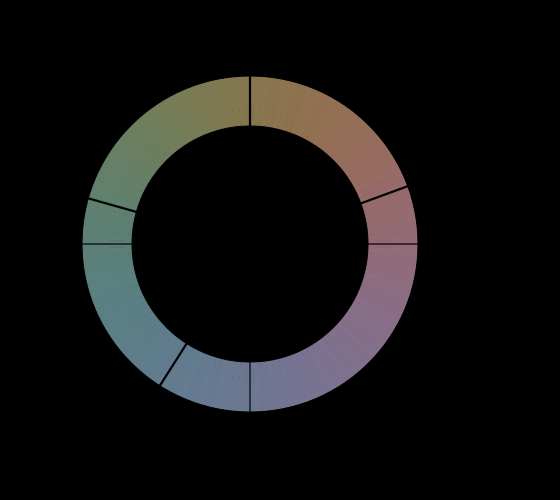
The ring is drawn at one lightness and one chroma, and the four angles are supposed to be properties of the observer rather than of the ring.
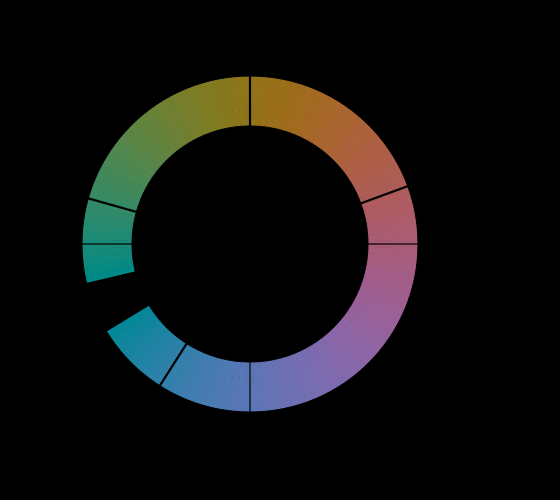
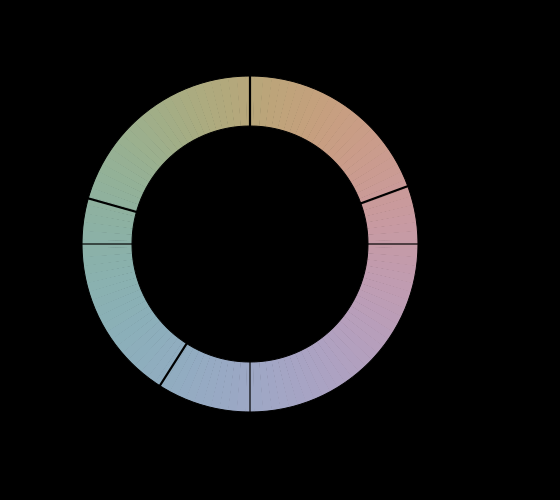
Both of the ring’s coordinates can be pushed further than that, and the four angles keep moving as they are — which is not what a property of the observer would do.
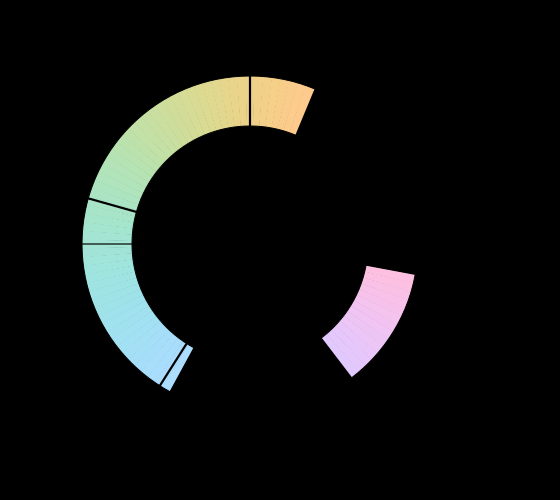
The corner of the space where a colour is least like a hue at all is the last of the four, and the marks have not settled there either.
What a unique hue is
The definition is a request rather than a measurement: a hue containing no trace of its neighbours. Unique yellow is a yellow with no red in it and no green; unique blue has no red and no green either.
The remarkable thing is that observers can do this at all, and that they largely agree. A person shown a series of yellows and asked to pick the one that is neither reddish nor greenish will pick within a few nanometres of the same wavelength on repeated trials, and different people will pick within a fairly narrow band of each other.
Not equally narrow for all four. Unique yellow is the tightest — observers cluster within a few nanometres. Unique green is the loosest by far, with a spread across observers of some thirty nanometres, and nobody has a fully satisfying account of why. Unique blue and unique red sit between.
Unique red is a special case worth flagging: it is not a spectral colour at all. Every long-wavelength monochromatic light looks slightly yellowish, so unique red requires a trace of violet added, which puts it on the line of purples rather than on the spectral locus.
Why three receptors do not predict four
The receptors give three numbers, and three numbers give a three-dimensional space. Nothing about that predicts four special directions in it, or that two of six possible pairings should be impossible.
The answer is that the four hues are a fact about the second stage rather than the first. The retina recodes the three cone signals into one achromatic channel and two chromatic ones before anything leaves the eye, and a channel that carries a signed difference has two ends. Two chromatic channels, two ends each, is four.
The impossibility follows immediately and is the more satisfying half. A single channel cannot be positive and negative at once, so a colour cannot be at both ends of the red-green channel simultaneously — no reddish green. It can be at one end of each channel, which is why reddish blue and yellowish green are ordinary colours with ordinary names.
This is the strongest structural prediction opponent theory makes, and it is a prediction about a class of experiences rather than a number. The recoding itself is where the channels come from and why there are exactly two of them.
Where the anchors actually are
CIECAM16 carries the four unique hues as quoted values — they are among the very few numbers in the model that are measurements of people rather than derivations. They sit at hue angles of 20.14°, 90.00°, 164.25° and 237.53°.
Those are not evenly spaced. Red to yellow is 70°; yellow to green is 74°; green to blue is 73°; blue back round to red is 143°, which is more than twice any of the others.
That last gap is worth dwelling on. Between blue and red — through the purples and magentas — the hue circle contains a stretch nearly as long as the other three put together, with no elementary colour anywhere in it. Every purple is describable only as a mixture, and the region is exactly where the line of purples sits, which is the part of the chromaticity diagram containing no monochromatic light at all.
Hue quadrature, and why it has to exist
An uneven circle is a problem for anybody building a colour order system, because such a system has to divide hue into equal steps and “equal” has to mean something perceptual.
Hue quadrature is the fix. It maps the four anchors onto 0, 100, 200 and 300 and interpolates between them, so that a step of ten quadrature units means the same perceptual distance wherever on the circle it is taken.
The measured spread is a factor of three. Divide the hue angle into ten equal parts and the perceptual gaps between consecutive hues range from 19.7 quadrature units to 59.8 — so some neighbouring pairs in an evenly-stepped palette are three times as different as others.
Anything generating a palette by stepping a hue variable produces the outer ring. That includes most colour pickers, most generated categorical palettes, and most of the “evenly spaced hues” in charting libraries. The steps are even in the parameter and uneven in what they look like, which is the sort of failure that is invisible until it is pointed out and then hard to stop seeing.
The axes that are not the axes
Here is the claim this essay exists to dispute, in the form it is usually stated: CIELAB’s a* axis runs from red to green and its b* axis from yellow to blue.
It is in textbooks, in software documentation, and in most explanations of what Lab coordinates mean. If it were true, the four unique hues would sit at 0°, 90°, 180° and 270° in CIELAB.
They do not. Realising each anchor as a moderate-chroma stimulus and asking CIELAB where it thinks it is gives 25°, 88°, 161° and 250°. Unique red misses the +a* axis by 25°, unique blue misses −b* by 20°, and only unique yellow lands close.
So a* is not the red-green axis. It is an axis that passes reasonably near two of the four elementary hues and is called after them, which is a different and much weaker statement.
This matters beyond pedantry in one specific way. Anybody reasoning about hue by looking at the sign of a* and b* — a quadrant test, a “is this warm or cool” heuristic, a hue category assignment — is using boundaries placed 20 to 25 degrees from where observers put them. Near the boundaries that is the difference between a colour called red and a colour called orange.
The evidence from language, and what it is worth
There is a second body of evidence for the four-fold structure, from an entirely different discipline, and it is worth weighing because it is both striking and frequently over-claimed.
Berlin and Kay’s survey of colour terms across languages, published in 1969, found that basic colour vocabularies grow in a constrained order. A language with two terms divides light-warm from dark-cool. The third term to appear is red. The fourth and fifth are green and yellow in either order, then blue, then brown, then the rest in a looser sequence.
The first six terms are black, white, red, green, yellow, blue: the two achromatic ends and the four unique hues, in almost exactly the order opponent theory would rank them by channel strength. That is a remarkable convergence between a linguistic survey and a physiological model, arrived at independently.
It is also weaker evidence than it looks, and the weaknesses are well documented. The original sample was heavily biased toward languages with literate informants; the “basic term” criterion involved judgement calls that determined the outcome in several cases; and later fieldwork found genuine counterexamples, including languages whose terms cut the space in ways the sequence does not allow. The strong universalist reading has not survived.
What survives is a statistical tendency rather than a law, and a statistical tendency across languages is still interesting when it matches a structure predicted from receptor physiology. The honest statement is that two independent lines of evidence point at four elementary hues, that neither is conclusive, and that the agreement between them is the reason the four-fold structure is believed rather than either one alone.
What the four hues are not
Three things the unique hues do not turn out to be, each of which has been claimed.
They are not the cone peaks. The L, M and S cones peak near 564, 534 and 420 nm; unique yellow sits near 577 and unique green near 500. There is no correspondence, and there is no reason to expect one — the hues are second-stage phenomena and the peaks are first-stage.
They are not the opponent channel zeros in any simple sense. The naive expectation is that unique yellow is where the red-green channel reads zero. The measured loci do not line up with any straightforward L−M or S−(L+M) combination, which is one of the standing problems in the field: opponent theory predicts four correctly and predicts where they are poorly.
They are not universal in the way the four-ness is. The four-fold structure is remarkably stable across observers and languages. The precise locations are not: they vary between observers by well over the measurement error, and unique green varies enormously. The structure is robust and the coordinates are not.
The asymmetry between the two channels
The four hues are usually presented as two symmetrical pairs, and the two channels they come from are nothing like symmetrical.
Decorrelating cone responses to natural spectra gives an achromatic channel carrying some 97% of the variance, a blue-yellow channel carrying under 3%, and a red-green channel carrying about one part in ten thousand. The two chromatic channels differ from each other by more than two orders of magnitude.
Several facts about the unique hues look different in that light.
The red-green channel is the one built from the smallest difference, and it is the one whose elementary hues observers place least consistently — unique green has a thirty-nanometre spread. A channel carrying a signal that small might reasonably be expected to have the loosest anchors, and it does.
It is also the channel most often missing. Red-green colour deficiency is common precisely because the two pigments it differentiates are close in wavelength and closely related genetically, and a small shift in either collapses the difference. What that does to the space is the loss of one elementary pair, which leaves two unique hues rather than four.
So the symmetry in the usual diagram — two axes, four ends, drawn at right angles and equal length — is a schematic rather than a picture of anything. The two chromatic channels are radically different in strength, in reliability, and in how likely a given person is to have both.
What was computed here
The four anchors are quoted from the specification — they are measurements of people, and this site quotes measurements and computes everything downstream.
Everything downstream is computed. Each anchor is realised as an actual stimulus by inverting CIECAM16 at a stated lightness and chroma, and that stimulus is then handed to CIELAB, which returns its own hue angle. The comparison is between two models’ opinions about one physical stimulus, not between two tables.
Two assertions run in the gate. The unique hues must miss CIELAB’s axes by a wide margin — asserted in that direction, because the essay’s claim is a denial and would need withdrawing if the axes ever lined up. And hue quadrature must divide evenly by construction while the hue angle does not: stepping quadrature into ten parts gives gaps equal to within arithmetic, and stepping the angle gives a threefold spread.
The first of those is the unusual one. It is an assertion that a received description is false, and it is written so that the received description becoming true would break the build.
What a catalogue does with an uneven circle
The practical consequence of an uneven hue circle is a problem somebody had to solve with physical samples long before anybody could compute it.
A colour order system divides hue into steps and those steps have to look even, or interpolating between neighbouring chips means nothing. Munsell’s forty hue steps were arrived at by arranging chips until observers judged the spacing right — the same objective hue quadrature achieves arithmetically, reached by asking people.
So a system built entirely from judgements in 1905 and a coordinate computed from an appearance model in 2016 are attempting the same thing, and the agreement between them is the only evidence either is right. There is no external standard for perceptual evenness — no instrument that measures it — so every scale in this subject terminates in somebody having been asked.
That is worth sitting with, because it is unusual. Wavelength is measured, luminance is measured, and the matching functions are measurements of a null judgement, which is about as objective as a judgement gets. Hue quadrature is a fit to reports about what things look like, and there is nothing underneath it. Colour by catalogue takes that up properly.
Where the model stops
The anchors are for a particular set of viewing conditions, and hue is the correlate least sensitive to viewing conditions — which is convenient and not the same as insensitive. Under a very different adapting white the loci move, and the model’s own hue angle moves with them, so a table of four numbers is a table for a stated situation.
More fundamentally, hue quadrature is an interpolation between four measured points. Between the anchors it assumes a particular form, and the form was chosen to fit rather than derived. So the claim that stepping quadrature gives perceptually even steps is exactly as good as that interpolation, which is good near the anchors and less well established in the middle of the 143° purple gap — where there is the most distance and the fewest measurements.
What the pictures cannot show
The unique hues are defined by a judgement, and no figure can make the judgement for the reader.
The hero figure marks where the CIE’s anchors are. It cannot show that they are right, because rightness here means that a reader looking at the marked red would report no yellow and no blue in it — and whether they would depends on their own observer, their adaptation state, and the room. A reader whose unique red sits ten degrees away will find the mark slightly off and will be correct.
There is a sharper limitation for unique red specifically. It is not a spectral colour, it sits toward the line of purples, and much of that region is outside what this display can reach. The hatched sectors in the hero figure are not decoration: they are hues the essay is about and the page cannot show.
Hue is the correlate that travels best
One consolation, and it is a real one: of all the appearance correlates, hue is the least sensitive to the viewing situation.
Change the surround from average to dark and predicted lightness moves by tens of units. Change the adapting luminance by four decades and colourfulness more than doubles. Hue moves a few degrees.
That stability is why hue names work at all. A red object is called red in a lit room and in a dim one, by people adapted to daylight and to tungsten, and the agreement is not an achievement of language — it is a consequence of hue being the correlate the visual system holds most nearly constant.
It also explains why the unique hue anchors can be quoted as four numbers rather than four functions of the viewing situation. They do move, and by less than the spread between observers, so the table is a reasonable simplification. That is a smaller claim than “hue is invariant”, which is false, and it is the claim the table actually supports.
Who found it, and when
Ewald Hering argued in the 1870s that colour experience is organised around four elementary hues in two opponent pairs, against Helmholtz’s three-receptor account. The dispute ran for decades and was framed as a contradiction; it was not. Both were right about different stages, and the two-stage picture — three receptors feeding two chromatic channels — was assembled in the 1950s when Hurvich and Jameson measured the opponent responses directly by hue cancellation.
Hurvich and Jameson’s method is worth describing because it is elegant. To measure how much redness a stimulus contains, present it and let the observer add green until the redness is exactly cancelled; the amount of green added is the measure. That turns an unquantifiable introspective report into a null measurement, which is the same trick colour matching uses.
Rolf Kuehni assembled the observer-variation data in the 2000s and it is his surveys that establish how wide the spread on unique green is. The awkward conclusion — opponent theory gets the number of unique hues right and their positions wrong — is largely his, and it remains unresolved.
Where this goes next
The recoding that produces two chromatic channels, derived rather than asserted, is three cones, two axes. The model that carries these anchors, and what else it takes as arguments, is a viewing condition is an argument. And the systems built to divide the hue circle into steps a person would call even are colour by catalogue.
Where this goes next
 Three cones, two axes
The retina does not send three receptor signals down the optic nerve. It sends a sum and two differences, and the reason falls out of the statistics of natural light rather than out of anything the eye intended.
Three cones, two axes
The retina does not send three receptor signals down the optic nerve. It sends a sum and two differences, and the reason falls out of the statistics of natural light rather than out of anything the eye intended.
 A viewing condition is an argument
An appearance model takes a stimulus and a situation. The second argument is not a refinement of the first — it is the content of the claim, and a model that returns an appearance from a colour alone has assumed a room without saying which.
A viewing condition is an argument
An appearance model takes a stimulus and a situation. The second argument is not a refinement of the first — it is the content of the claim, and a model that returns an appearance from a colour alone has assumed a room without saying which.
 Colour by catalogue
A colour order system arranges physical samples on a regular lattice so a person can find one and name it. The space it samples is not regular, and everything interesting about such systems is what happens at that mismatch.
Colour by catalogue
A colour order system arranges physical samples on a regular lattice so a person can find one and name it. The space it samples is not regular, and everything interesting about such systems is what happens at that mismatch.
What this makes readable
Essays that name this one as a prerequisite.
Named alongside this one
Essays reaching for the same objects. Nobody chose these; they are what the index of named objects makes visible.
- A name moves with the room ciecam16 · cielab · naming · viewing condition
- The appearance model has no straight piece ciecam16 · cielab · lightness · viewing condition
- There is no brown light ciecam16 · lightness · naming · viewing condition
- A dark background moves every difference and no match ciecam16 · lightness · viewing condition
- A difference has no place cielab · opponent processing · viewing condition
- A gain has a time constant ciecam16 · opponent processing · viewing condition
What links here
The 8 essays that link to this one and share the most of its objects, of 11 that link here.
The objects this essay names
Each one links to every other essay that touches it.
CIECAM16CIELABElementary coloursHering's opponent theoryHue quadratureLightnessNamingOpponent processingUnique huesViewing condition