Opponent processing — where it appears
Named by 19 essays across 4 fields — each of them below, with the objects they name alongside it.
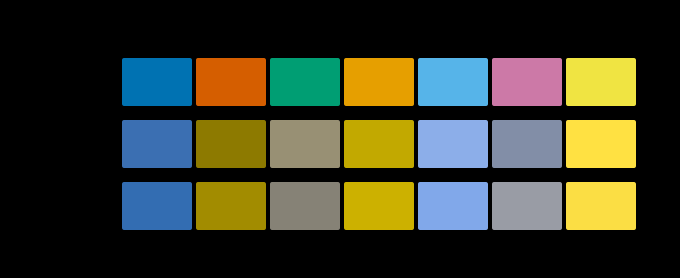
Three cones, two axes
The retina does not send three receptor signals down the optic nerve. It sends a sum and two differences, and the reason falls out of the statistics of natural light rather than out of anything the eye intended.
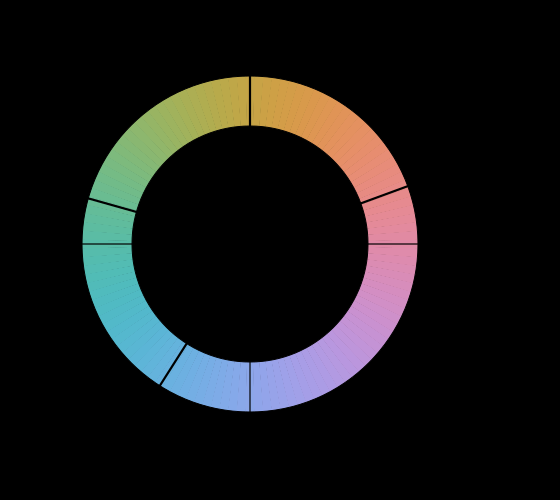
Why there are four unique hues
Observers agree that four hues are elementary and that no colour is reddish green. Nothing in the three receptors predicts either fact, and the axes of every standard colour space miss the four by tens of degrees.
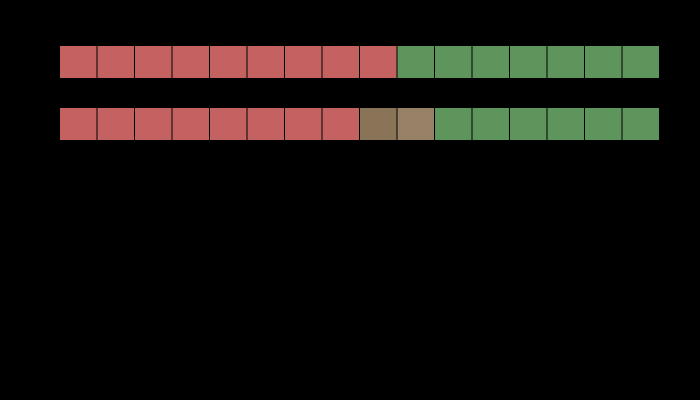
Colour thrown away on purpose
Every video format in use discards three quarters of its colour information and keeps all of its luminance, because the eye resolves fine colour detail badly. On an edge that carries luminance the loss is exactly zero. On an edge of nearly equal luminance it is a colour difference of forty-three, and the two edges are the same edge to the codec.

How fine a colour edge can be
The eye resolves a lightness pattern to about fifty cycles per degree and a red–green one to twelve. Every colour difference here is quoted as though a patch had no size, and the same difference is plainly visible at one scale and gone at another.

An afterimage is an adaptation
The demonstration everybody gives is an inverted image, which is a statement about a file format. Running the receptoral arithmetic instead puts the afterimage of a saturated red sixty degrees of hue away from the inverse — and outside what any display can show.
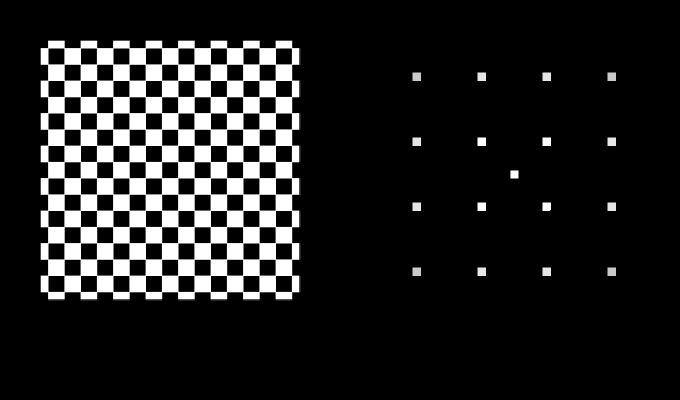
A pattern has a direction
Every spatial claim here is a claim about a frequency, and a frequency has no direction in it. Turning a printed screen forty-five degrees makes it exactly twice as quiet with nothing else changed — and the same rotation does nothing at all to a chromatic one.

Colour stops at the edge of sight
Cone density falls twenty-one-fold between the centre of gaze and ten degrees out, and the three channels give out at three different rates — so a colour difference in the periphery does not merely shrink, it turns. At the exact point of fixation there are no short-wavelength cones at all.

The eye has a shutter
An isoluminant flicker fuses at fifteen hertz and a luminance one at sixty, so a light whose colour changes forty times a second is a steady light of a colour it never emits. And the frequency at which flicker stops being visible is not a property of the eye — it moves twelve and a half hertz for every decade of light.
A difference has no place
A colour difference formula answers a question about two patches somebody is looking straight at. Move the same pair ten degrees into the periphery and a third of it is left — and it has turned twenty-four degrees of hue, because the three channels give out at three different rates.
A gain has a time constant
An afterimage and the clock on chromatic adaptation were built in different files from what the last phase said was one mechanism. Joining them removes a free parameter, reproduces both, and predicts a third thing — that two people in one room, at one moment, looking at one patch, do not agree about its colour.

The eye is never still
A perfectly stabilised retinal image disappears within seconds. What keeps the world there is a drift of about half a degree a second between the microsaccades — fast enough to keep the finest detail modulating and slow enough not to carry it past fusion, in a band whose upper edge is at 0.71 degrees a second.

The drift is a luminance mechanism
The eye's own drift was shown to sit inside a band of speeds that keeps every spatial frequency modulating, and the band was quoted as though it were about vision. Asked about colour, it has no slow edge at all — a stationary chromatic pattern needs no eye movement whatever. And a stabilised chromatic pattern is the first thing to fade.

What a still eye stops seeing
A stabilised image is said to vanish, and nothing in a temporal filter predicts it — sensitivity at zero frequency is a quarter of the peak, not nothing. Give the adaptation gain a size and the answer falls out — fading is a high-pass filter that switches on over a minute, it takes the fill and leaves the outline, and a patch has to be about two degrees across before it goes at all.

A halftone is a luminance object
The eye's three spatial channels resolve a screen at 55, 15 and 10 cycles per degree, so at any ruling a press actually runs only one of them can see it at all. The corollary corrects a guess already published here — rotating a screen matters more to the chromatic channels, not less — but only at rulings so coarse that nobody prints there.

A difference has no rate
A colour difference formula answers for two patches that are both there and stay. Alternate the same two colours and the difference is not scaled but taken apart: the colour half is gone by fifteen hertz and the lightness half is four times louder at eight, so twenty-three pairs the formula calls identical run over a factor of six at the rate the eye is best at, and are worth nothing at all above sixty.

The eye keeps the lightness errors
Four essays have priced what a resize taken on stored values costs, in colour differences between pixels. A reader does not see a pixel. Put the two versions of each image through the visual system's own three channels and the ranking reverses: the unsharp mask, the largest error per pixel at 16.6, is seen at 6.3 on a printed page, while the corner's 7.1 is seen at 9.9. What decides it is not the size of an error but how much of it is colour.

The eye counts a corner's error, not its peak
A Lanczos-magnified patch errs a fifth more at its corner than along its edges, pixel by pixel, and an unsharp mask errs almost exactly as much at its corner as along its edges. Filtered by the eye over the plane rather than along a line, the two swap: the magnified corner is seen exactly as its edge is, and on a printed page the sharpened corner is seen at 2.4 times its edge. What decides it is whether the error changes sign. Ringing averages away and a one-sided halo does not, and a corner is where two edges' halos land on the same patch of retina.

The rods' route is priced by the lamp
A rod signal in a dim room disturbs a colour match, and how much depends on which of the cone pathways it reaches — a weight the physiology leaves uncertain, especially for the blue–yellow pathway. Under daylight the uncertainty is nearly free: a rod signal that skips the S pathway costs 0.90 at the median surface against 1.03 for one that enters all three. Under a phosphor white LED it is worth a factor of 2.75, 0.45 against 1.24. What decides it is one number per lamp: how large the rod signal is compared with each cone class's own catch of the light.

Sharpened type errs on its dark side
A sharpened square hides its halo along its edges and shows it at its corners, so a sharpened page of type was predicted to show its error at the corners of its letters, several times out of proportion to their length. Black type does the opposite: its outer corners and stroke ends hold between two thirds and nine tenths of their share. As the eye leaves it, the error lies on the dark side of every edge, and a corner holds as much of it as it has dark ground around it — a quarter of a disc where a black corner points out into paper, three quarters where black wraps round a pale one.
Named alongside it
The objects these essays reach for when they reach for this one.
Spatial frequencyContrast sensitivityThresholdViewing distanceAdaptationEccentricityIndividual variationLuminanceTemporal sensitivityViewing conditionAfterimageΔE