Concept

Individual variation — where it appears

The measured differences between two pairs of eyes — lens, macular pigment, cone density and pigment peaks — that a standard observer averages away. It is measurable in four separate quantities — lens density, macular pigment, cone ratios and pigment peaks — and the standard observer averages all four.

Named by 60 essays across 8 fields — each of them below, with the objects they name alongside it.

How far a match comes apart when the observer changes. A broad source and a three-primary source, solved at each primary width so the pair is an exact tristimulus match for the CIE 1931 observer. The pair is then handed to the 1964 observer, and the gap between them is plotted. For the observer they were built for the gap is arithmetic noise at every width. For the other it grows as the primaries narrow, reaching 0.012 at 10 nm — and displays have been getting narrower for twenty years.

Whose eyes

The standard observer is an average over seventeen people, and no reader is it. What that costs was small when displays were broad and grows every time the primaries get narrower.

limits · Limits
Three retinas of different composition, making identical colour matches. Seeded mosaics at L:M ratios of 1, 4, 16 to one — the range found between people, and a 16-fold difference in what the retina is made of. A colour match is the claim that two spectra produce equal excitation in all three cone classes, and changing how many of a class there are multiplies that class's excitation by a constant, which cannot disturb an equality. The relation between the two test spectra is identical to twelve decimal places across the whole sweep. Luminance, which is a weighted sum rather than an equality, moves by 1.33× over the same range. That asymmetry is why a standard observer exists and why V(λ) has a much larger between-observer variance than the colour-matching functions do.

The mosaic is not the observer

The ratio of long-wavelength to medium-wavelength cones varies between ordinary people by a factor of sixteen. Those people make the same colour matches, to twelve decimal places, and that single fact is the reason a standard observer can exist at all.

eye · Cones
How far a match comes apart when the observer changes. A broad source and a three-primary source, solved at each primary width so the pair is an exact tristimulus match for the CIE 1931 observer. The pair is then handed to the 1964 observer, and the gap between them is plotted. For the observer they were built for the gap is arithmetic noise at every width. For the other it grows as the primaries narrow, reaching 0.012 at 10 nm — and displays have been getting narrower for twenty years.

Two degrees or ten

This site names the observer on every figure it draws, which was supposed to be the point. Measuring what it had actually done found two hundred and four figures naming the same observer, three naming the other, and sixty-two of sixty-four generators printing a string that had never once varied.

limits · Limits
Contrast sensitivity, three channels, normalised to each channel's peak. Spatial frequency in cycles per degree against relative sensitivity. The luminance channel runs to 50 cycles per degree, red–green to 12 and blue–yellow to 8, each by the same criterion of 5 per cent of that channel's own peak. Only the luminance channel dips at low frequency; the two chromatic ones are low-pass, so a chromatic edge of any size at all is seen at its full contrast.

How fine a colour edge can be

The eye resolves a lightness pattern to about fifty cycles per degree and a red–green one to twelve. Every colour difference here is quoted as though a patch had no size, and the same difference is plainly visible at one scale and gone at another.

eye · Cones
The L cone's sensitivity at three axial pigment densities. Each curve is normalised to its own peak, so the only difference visible is shape. Raising the density from 0.1 to 0.9 widens the curve from 113.6 to 145.9 nm at half height while the peak stays within 5 nm of where it was. That is Beer–Lambert saturating: at the peak the pigment already absorbs nearly everything, so more of it can only catch more light in the wings.

A cone absorbs its own light

A photopigment's absorbance is a property of a molecule; a cone's sensitivity is that molecule stacked in a column deep enough to absorb most of what arrives. The stacking broadens the curve by thirty-five nanometres, and two observers differing in nothing else disagree about a match that is exact for one of them.

eye · Cones
Photons caught by one cone in one integration time, under D65. Each curve is one cone class, counting isomerisations during a 0.1 s integration through a pupil that closes as the light rises. At 1000 cd/m² a long-wavelength cone catches about 11522 and at 0.001 it catches 0.12 — which is where the square root of the count stops being a small correction and starts being the signal. The rate works out at 30 isomerisations per second per troland, inside the published band of 5–50.

Colour goes first in the dark

A cone reports a count, and a count carries the square root of itself as noise. Counting the photons says where colour vision stops — a chromatic difference runs out four hundred times sooner than a lightness difference of the same size — and says just as clearly that in daylight the eye is nowhere near that limit.

eye · Cones
One adapting colour, two answers. The left patch is what was stared at. The middle is the afterimage the cone-gain arithmetic predicts at 15 per cent adaptation; the right is the inverted code values. They are 22.1 ΔE00 apart. The gains that produced the middle patch are 0.95, 1.06, 1.69 on the long, medium and short cone classes — the reciprocal of what each class had been receiving, taken 15 per cent of the way.

An afterimage is an adaptation

The demonstration everybody gives is an inverted image, which is a statement about a file format. Running the receptoral arithmetic instead puts the afterimage of a saturated red sixty degrees of hue away from the inverse — and outside what any display can show.

brain · Appearance
Cone density, out from the centre of gaze. Quoted landmarks with logarithmic interpolation between them: 199,000 cones per square millimetre at the fovea, 9,500 at ten degrees — a factor of 21. The shaded bands are the two standard observers' fields. The 2° observer averages over a region whose density falls by 3.3× between its centre and its edge and the 10° observer by 12.4×, which is what "a 10° field" contains and is why the two sets of matching functions are different shapes rather than the same shape scaled.

Colour stops at the edge of sight

Cone density falls twenty-one-fold between the centre of gaze and ten degrees out, and the three channels give out at three different rates — so a colour difference in the periphery does not merely shrink, it turns. At the exact point of fixation there are no short-wavelength cones at all.

eye · Cones
Grassmann's four laws, exact — and the two things that break them. For a linear observer every one of the four is exact and the residual is floating point, which is the control that makes the two failures below measurements rather than artefacts. Rods break a cone-metameric match by 23 per cent of a rod excitation at dusk; bleaching breaks it by 0.59 per cent of a cone excitation in the sun. Both are stated as fractions of a receptor's own response, so they can be put on one scale.

The laws that make colour add up

Colorimetry is an integral, and an integral assumes matching is linear. Grassmann's four laws are exact for a linear observer, to floating point — and they fail at both ends of the light range, by two different mechanisms, leaving colorimetry an operating band of three and a bit decades that no standard states.

matching · Gamut
One match, and what it says about the observer making it. The anomaloscope: a monochromatic 589 nm yellow set against a mixture of 545 and 670 nm. Only two cone classes respond at those wavelengths, so the match is two equations in two unknowns and has one solution for any observer whose two pigments differ. The bar is the fraction of the accepted band; the mark is the solution. A normal observer accepts 0.7 per cent of the scale; an observer whose two pigments are the same accepts all of it, because their two equations are one equation twice. Nothing here is fitted to clinical data: the pigments are the same template used for every observer here, at stated peaks, and the match is the solution of the linear system.

One match names the observer

A yellow at 589 nanometres set against a mixture of 545 and 670 is two equations in two unknowns. It has one solution for a normal observer, a solution somewhere else for an anomalous one, and no unique solution at all for a dichromat — whose two equations are one equation twice.

matching · Gamut
One light, two eyes. The same stimulus through two sets of ocular media differing only in macular pigment (0.35 and 0.41) and lens age (55 and 55 years). Compared under one white the two differ by ΔE00 1.00; compared with each eye adapted to its own long-run white — which is what the visual system does — by 0.00. The second number is why nobody notices, and the first is why a person who has had one lens replaced reports that the other eye has turned yellow.

Nobody here has two eyes

One person's two eyes differ in macular pigment and lens density, so the same light produces two colours — a whole ΔE00 apart for an ordinary pair, seven for one replaced lens. Adaptation hides it exactly, which is why nobody notices and why nothing in colorimetry has a term for it.
limits · Limits
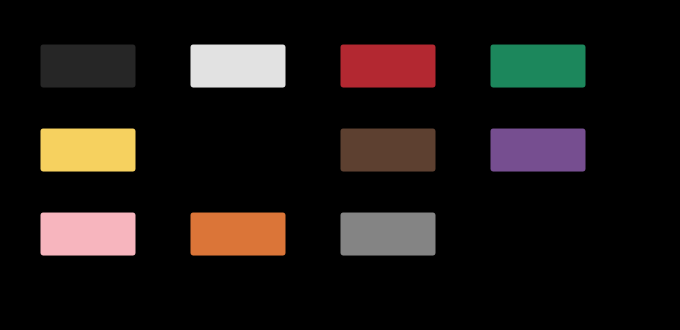
The eleven basic colour terms, at their quoted centroids. Each patch is the CIELAB centroid quoted for that term, converted to a stimulus and drawn — except blue, whose focal colour is outside the sRGB gamut and is therefore hatched rather than clipped, which is the rule for an unreachable colour everywhere else and applies here too. The centroids are rounded to 5 units in each coordinate, and moving them by that much either way leaves the same term outside.

A colour has a name

Every quantity here is a number, and the question a reader arrives with is what colour something is called. The eleven basic terms of English divide the space into territories that differ by a factor of five, the metric accounts for fifteen per cent of that, and one of the eleven focal colours cannot be shown on this page at all.

brain · Appearance
How large a step changes the name, across the ab plane at L* 60. At each point, the smallest ΔE00 step in any direction after which the probability of two people using the same word has halved. It runs from 4.8 to 33.8 units across this one plane, in eight quantised levels: the palest cells are where a name is finest — a short step changes it — and the strongest are the middles of large territories, where a colour can move twenty units and keep its word. The ragged edge is the sRGB boundary at this lightness rather than a property of the vocabulary. The boundary softness is a stated parameter of the model, and the map barely moves when it is changed fourfold, because what sets this quantity is how far apart the centroids are.

A name is not a threshold

Two colours have to move about ten times a just-noticeable difference apart before people stop calling them the same thing, and how far varies threefold across one plane of the space. A tolerance and a word are answering different questions, and nothing in colorimetry converts between them.

brain · Appearance
A fourth primary, swept — every setting an exact match, none of them the same. Four primaries matching three numbers leave one degree of freedom. Along the horizontal axis it is the fourth primary's share of the white's luminance; at each value the other three powers are solved exactly, so every point on this plot is a floating-point-exact match for the reference member — worst residual 1.3e-15 — and no colorimeter can tell them apart. What the population sees runs from 13.7 ΔE00 at the ninety-fifth percentile to 17.3, a factor of 1.26. The best setting is the largest share the arithmetic admits, so what stops it is not colour but the requirement that four powers stay positive.

Four primaries have a choice

Three primaries matching three numbers have one answer. Four have a family of them, every member exact to floating point for the observer they were solved for — and the members are not equally good for anybody else, so a display with a fourth primary has a setting that is robust to who is looking at it and a setting that is not.

matching · Gamut
One tolerance decision, at four spectral distances. Every column is a pair of samples ΔE00 1.0 apart for the observer a colorimeter models — solved to that value by bisection, so the instrument would report the same number for all four. What differs is how far apart the two spectra are, which is achieved by adding a metameric black the reference observer cannot see. The bands are what two hundred people report: from 1.13 at the ninety-fifth percentile when the spectra are the same shape to 2.32 when they are not, and the worst case reaches 3.7. No specification records the quantity on the horizontal axis.

A tolerance is a probability

A colorimeter reports one number and a specification compares it with another, and both are computed for an observer who does not exist. Handed to two hundred people, the same pair at ΔE00 1.0 is read from 0.8 to 3.7 — and which of those two ranges applies depends on something no specification records.

difference · Metric
The drift window, asked about each channel in turn. Every spatial frequency a channel can resolve, drifting at v degrees a second, arrives at f × v hertz; the bar is the range of v over which all of them stay above a quarter of that channel's temporal peak. The luminance band is closed at both ends — 0.018 to 0.71 degrees a second — because its temporal sensitivity has a dip at zero to fall into. The chromatic bands have no slow edge at all, because chromatic temporal sensitivity is low-pass: a stationary chromatic pattern sits at the top of its own sensitivity. The mark is the measured drift, and it is inside all three.

The drift is a luminance mechanism

The eye's own drift was shown to sit inside a band of speeds that keeps every spatial frequency modulating, and the band was quoted as though it were about vision. Asked about colour, it has no slow edge at all — a stationary chromatic pattern needs no eye movement whatever. And a stabilised chromatic pattern is the first thing to fade.

eye · Cones
Coming back from a bleach, against the clock already measured. A 94 per cent bleach, and the pigment returning at its own time constant of 120 seconds. The lower curve is the site's slow neural adaptation constant, 60 seconds, started from the same place — it is finished while the chemistry is barely half done. Regeneration does not speed up because the light went away: the rate constant is the same one it always was, which is why the recovery is slow while the bleaching was fast.

The slowest clock is chemical

An earlier essay here joined the afterimage to the adaptation clock and named what was still missing — a third gain, upstream of both, in the pigment itself. It is twice as slow as anything measured before it, it leaves a coloured after-tint from a white field, and at steady state it cancels exactly, which is why nobody has ever needed to model it.
eye · Cones
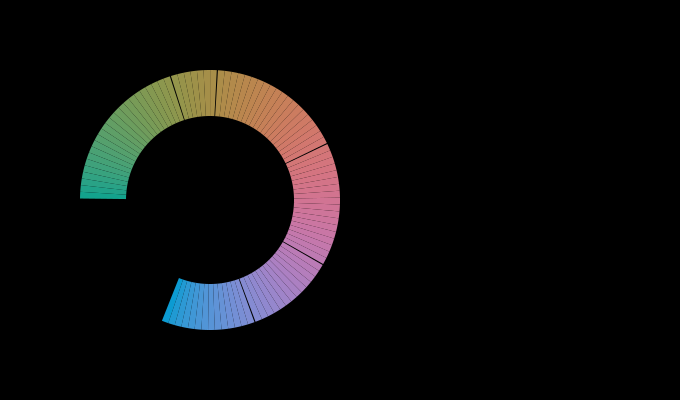
The hue circle cut into names, at L 60 and C 40. Left, the arcs each name claims, drawn at the colour of their midpoints; right, the same arcs measured in ΔE00 by integrating the difference along the ring rather than in degrees. The widest is 5.3 times the narrowest in degrees and 4.5 times in colour difference, so the metric accounts for 15 per cent of the inequality and no more. Only the eight chromatic terms compete on this ring: at this chroma the achromatic three would otherwise take the region where no basic English term sits, which is a defect of the model and is named in the essay.

There is no word for that colour

The naming model built this phase gives a saturated cyan the name green, calls part of a chromatic ring grey, and puts one of the eleven focal colours outside what a display can show. Each failure is a measurement rather than a disclaimer, and together they say what a vocabulary is that eleven points and a distance are not.

limits · Limits
Where a pooled gain gives out, against where the eye does. The falling curve is how much of a pattern of each spatial frequency a local adaptation pool of 0.5° can see — and therefore how much of it a settled eye can cancel. It is half gone by 0.37 cycles per degree, which is a feature about 2.7° across. The three marks are the acuity limits of the luminance channel and the two chromatic ones. Every one of them is more than an order of magnitude finer than the pool, which is why a stabilised eye loses the fill of a picture and keeps its outline rather than losing the picture.

What a still eye stops seeing

A stabilised image is said to vanish, and nothing in a temporal filter predicts it — sensitivity at zero frequency is a quarter of the peak, not nothing. Give the adaptation gain a size and the answer falls out — fading is a high-pass filter that switches on over a minute, it takes the fill and leaves the outline, and a patch has to be about two degrees across before it goes at all.
eye · Cones
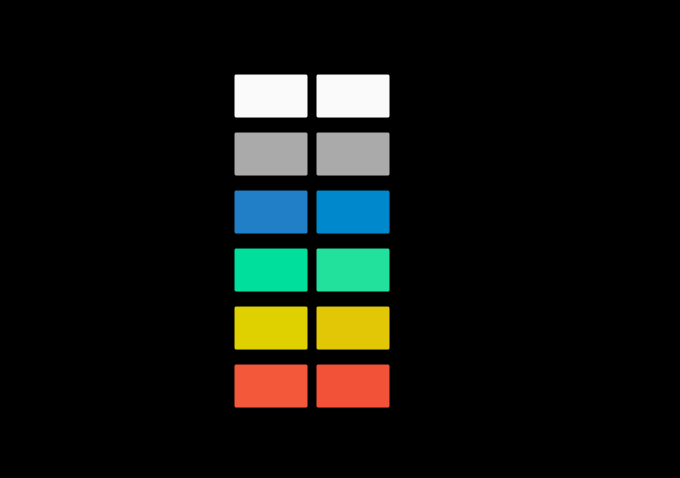
What the same eye reports about one field, in the middle and at the edge. Each row is a uniform field, drawn at the most saturated version of itself this page can show — the percentage is how much of the full stimulus survived, the rest being the adapting light added to bring it inside the gamut. The left patch is what the centre of gaze reports and the right one what 10 degrees out reports, each adapted to the same light as that position sees it. The adapting white comes out identical to 5e-13, because an adapted eye cancels its own filter exactly. Nothing else does, and the largest difference is in the blue. tungsten light is not drawn: it cannot be shown at any useful saturation, and at full strength it differs by ΔE00 1.87.

One person is two observers

The macular pigment is a yellow screen over the fovea and nowhere else, so a cone at the centre of gaze and a cone ten degrees away have different colour-matching functions in the same eye. A match made in the middle comes apart at the edge by six units — and fitting one filter to the gap between the CIE's two standard observers gives a density of 0.40 against a measured 0.35.

eye · Cones
A colour rendering index, computed for everybody instead of for one observer. Each bar spans what 120 eyes make of one lamp: the same reflectances, the same reference illuminant, the same arithmetic, different colour-matching functions. The mark is the standard observer's own answer, which is the number printed on the box. One lamp's spread is 3.8 points wide while the whole range the standard observer puts these lamps in is 1.8 — so a ranking quoted to a tenth of a point is a statement about one set of tables. Two of the marks fall outside the population's range entirely.

The index is one observer's opinion

A colour rendering index is printed to a tenth of a point and computed for a single set of colour-matching functions that no standard names as a choice. Scored by two hundred eyes instead, one lamp's spread is wider than the whole range the standard observer puts five lamps in — and two lamps the standard separates by four tenths of a point come out the other way round for every member of the population.

light · Light
What a fourth primary actually buys. All three displays are floating-point-exact matches for the reference observer, so no colorimeter can tell them apart. The bars are the 95th percentile of what two hundred other eyes report. Held to the same gamut floor of 1.4× sRGB, the four-primary design leaves the population 2.6 times closer together than the three-primary one. That is what the extra emitter is worth, and it is not more colour — the gamut is held fixed while it is measured.

A fourth primary is a design

A display's fourth emitter is sold as more colour. Optimised instead against how far apart two hundred eyes are about its white — with the gamut held fixed so it cannot cheat — it buys agreement, and two and a half times closer together than three primaries reaching the same area, and the wavelengths it chooses are not the ones anybody would pick.

matching · Gamut
One tolerance decision, about pairs that agree less and less about the spectrum. Every point is a pair of samples that the reference observer reports as exactly ΔE00 1.0 apart — the same number, the same decision, the same line in the same specification. Along the axis is how far apart their two reflectances are. Up the side is the 95th percentile of what two hundred other eyes report. It runs from 1.13 to 2.32. The document records the horizontal line and not the axis it is plotted against.

A tolerance needs a second number

Two samples one colour difference apart can be read almost identically by everybody or two units apart by the worst-off twentieth, and which of those it is depends on how far apart their spectra are — a quantity every spectrophotometer has already measured and none of them prints. Adding it as a second field predicts the population three times better, and at the tolerances where it matters it is right about a third of the decisions the difference alone gets wrong.

difference · Metric
How much of the gamut changes name, and what changed it. The eleven basic terms are quoted as centroids in CIELAB, and a colour is named by which one it is nearest. Two things nobody records decide the answer. Changing the distance function renames 20.5 per cent of the displayable gamut. Changing the room — the same colours, the same words, a different surround, through the appearance model — renames up to 26.8 per cent. The centroids were measured in one viewing condition and are applied here in every essay as though a name were a region of a space with no room in it.

A name moves with the room

Eleven basic colour terms are quoted as centroids in CIELAB and a colour is named by which one it is nearest. Two things nobody records decide the answer — which distance function is used, which renames a fifth of the displayable gamut, and which room the colour is in, which renames more than a quarter of it.

brain · Appearance
How wrong a camera profile is, and who it is wrong for. A colour matrix fitted against the 1931 observer, evaluated four ways. Its residual against that observer is ΔE00 0.92 — the Luther failure, which is a property of the sensor and is the honest measurement of the camera. Against a person drawn from a population of 160, the worst-off twentieth report 3.35. And a camera with no spectral error whatever, reporting the standard observer's own tristimulus values exactly, would leave 3.47. The camera is not the problem. It was fitted to somebody who does not exist, and so is the standard it was fitted against.

Fitted to an eye nobody has

A camera profile's residual against the observer it was fitted to is under a unit, and that is the number everybody quotes. Against a person drawn from a population it is 3.35 at the ninety-fifth percentile — and a camera with no spectral error whatever, reporting the standard observer's tristimulus values exactly, would carry 3.47. The camera is not the problem.

imaging · Capture
Every claim here that was computed with one model, recomputed with two. Each row is a claim one of these essays makes. The bar is how many times the two-model answer differs from the one-model answer, on a logarithmic scale. 3 of 13 have no bar at all: the first model's answer for them is exactly zero, not because it computed zero but because it has no variable for the quantity. Those are the rows where a second model did not correct an answer — it supplied one.

What a second model changed

Thirteen claims here, each computed with one model and recomputed with two. Ten of them move by half again or more. Three of them do not move at all in the ordinary sense — the first model's answer is exactly zero, not because it computed zero but because it has no variable for the quantity — and every one of those three is a join that supplied a state or a device rather than a spread.

limits · Limits
The share of itself each change leaves behind, and the smallest is inside the eye. The residual as a fraction of the change rather than as a colour difference, which sorts the census differently. At the top is the macular pigment — the filter in front of the central few degrees of one's own retina — leaving 2.4 per cent of itself. It is a fixed transmittance multiplying the light and the white together, which is as close to a pure gain as anything here gets, and it is why nobody notices they have one.

The filters inside the eye

The macular pigment leaves 2.4 per cent of itself after adaptation — the smallest share of anything in this site's census of light changes, and less than half the next smallest. Fifty years of lens yellowing leaves 7.9 per cent, and the difference between the two says what a gain is actually good at.

eye · Cones
Which of these paints the display can show, and to how many people. Each row is a real surface under D65, and the bar is the share of 120 observers for whom a non-negative mixture of this display's three primaries reproduces it. The question has no observer-free answer: the paint is a reflectance, the primaries are emission spectra, and whether one matches the other is a fact about somebody's cones. A dot marks the rows the 1931 observer calls displayable. 2 of them are rows some real people cannot see, and 4 more go the other way.

A gamut has a population

Whether a display can reproduce a paint is a fact about somebody's cones, so the boundary of a gamut is not a curve but a band. On a laser projector, ten of twenty-eight boundary surfaces are ones the standard observer calls displayable and some real people cannot see — and the wider the gamut, the wider the band.

matching · Gamut
The arguments a standard observer does not have. Seven choices inside a set of colour-matching functions, each with the shape it takes and what it is worth in ΔE₀₀ on a red pigment under a 6500 K radiator. Six are measurements: a field size, an age, a macular density, a cone optical density, three peak wavelengths and a rod contribution. The seventh is not — a change of basis is a change of curves and not a change of observer, and its entry is exactly zero because the space an experiment measures is what an observer is. Printing that zero beside the others is the clearest statement of what the other six are measurements of.

The third factor is a construction

Every figure in this collection names its observer, which was the whole point. None of them says what an observer is made of. Three curves are not a measurement of the eye; they are a projection of one, with a field size, an age, a macular density, three peak wavelengths and a luminance constraint inside them.

eye · Cones
The conditions under which an observer's departure is exactly zero. A departure of the observer is the pairing of something belonging to the observer with something belonging to the stimulus, so emptying either factor empties the product. The axis is logarithmic in what is left when the condition is imposed. Six rows empty the stimulus's factor — a perfectly neutral sample is the same colour for every observer, at any age and any field size — and two empty the observer's, since a gain on each cone and a change of basis are both absorbed exactly. All eight are identities rather than small numbers. The last two are the same two conditions imposed in a published cone space rather than in the observer's own, and they are worth eight and thirteen units: the identity is about the eye, and the arithmetic everybody uses is in somebody else's coordinates.

A neutral is everyone's colour

Two eyes differing by fifty years of lens yellowing, by a factor of three in macular pigment and by six nanometres of long-wavelength peak agree about a grey card to four parts in ten thousand billion. The agreement is an identity rather than a coincidence, and it says exactly what an observer disagreement is a disagreement about.

eye · Cones
The three cone absorptances at two settings of the cone optical density. Solid and dashed are the same construction at the two ends of two standard deviations of the reported spread. The curves are built from one pigment template through its ocular media, which is the same model its population of two hundred eyes is drawn from. The largest difference between the two sets is 18.8 per cent of the peak, and where it sits along the wavelength axis is what decides which stimuli the two observers disagree about — a departure concentrated in the blue is invisible on a sample with no blue in it.

A gain is not an observer

Multiply one eye's three cone sensitivities by 1.6, 0.7 and 2.4 and it is not a different eye. The white-point division is that multiplication's inverse, so the two agree exactly — and most of what a cone optical density change does is that multiplication, which is why the largest number in the table of individual variation is the one that matters least.

eye · Cones
Every departure under every light. Six departures across six lights, each cell the difference between two observers in ΔE₀₀, drawn as a bar whose length is the number. The rows are not multiples of one another: the lens is worst under tungsten and the pigment peaks are worst under a three-emitter LED, because a departure is a pairing and which light is being paired with decides it. The laser projector's row is empty, and that is not a fact about lasers — on this collection's five-nanometre grid a three-line spectrum is a one-line spectrum, and a single wavelength is a stimulus every observer agrees about exactly.

The lens is worst under tungsten

An ageing lens costs 4.38 ΔE₀₀ under a tungsten lamp and 2.20 under a fluorescent tube. The pigment peaks cost 2.84 under a three-emitter LED and 1.87 under the same tube. Six departures across six lights do not form a single ordering, which is what a pairing looks like and what a dominant term would not.

eye · Cones
A departure against how far the sample sits from the light. The sample is mixed with a flat reflectance, from the flat one at the left to its own at the right, and two observers differing in the macular pigment look at each mixture. The straight line is the distance between their relative cone excitations, and it is straight to 0.0 per cent: the departure is a pairing, and scaling one factor scales the product. The curved line is the same sequence in ΔE₀₀, which is not a linear function of the excitations and cannot be — it has cube roots in it and a chroma weighting underneath. The identity is about the eye; the curvature belongs to the unit.

A departure is straight in the excitations

Walk a sample a quarter of the way from the light towards its own reflectance and exactly a quarter of the observer disagreement remains — in cone excitations, to two parts in a hundred. In ΔE₀₀ the same quarter leaves 0.347 where proportionality wants 0.428, and the discrepancy belongs entirely to the unit.

difference · Metric
Each departure over forty-two surfaces rather than one. The same six departures measured over a family of forty-two analytic reflectances — an absorption band of stated centre, width and depth — with the smallest, the median, the ninety-fifth percentile and the largest marked. Every one of them spans more than a factor of three, and the ranking between them is not stable across the family: what decides a departure's size is which sample it is asked about, because a departure is a pairing and the sample is one of the two factors. Quoting any single number for what an observer's age is worth is quoting a choice of example.

The ranking is not stable

On a red pigment under daylight the six observer departures run from 2.38 down to 1.20 ΔE₀₀. Over forty-two surfaces two of them change places, the top two separate, and every one spans between a factor of ten and a factor of thirty-five. A chart of six bars is a chart of one example.

eye · Cones
What this collection's grid does to its own observer audit. Two bars per light: the mean departure of the observer computed on this collection's five-nanometre grid, and the same computation on a quarter-nanometre one. For five of the six lights the two agree to two decimal places, which is what a well-sampled spectrum looks like. For the laser projector the coarse answer is exactly zero and the fine one is 2.34 — the largest in the table. On a five-nanometre grid a three-line spectrum with lines at 465, 532 and 638 nanometres is a one-line spectrum, and a single wavelength is a stimulus every observer agrees about to the last bit. The two departures do not compound here; the first conceals the second.

The grid hid the observer

On this collection's five-nanometre grid a three-laser projector's observer disagreement is exactly zero. On a quarter-nanometre grid it is 2.34 ΔE₀₀ and the largest in the table. The two audits of this round meet here, and the first one does not compound with the second — it removes it.

limits · Limits
What this collection's grid does to its own observer audit. Two bars per light: the mean departure of the observer computed on this collection's five-nanometre grid, and the same computation on a quarter-nanometre one. For five of the six lights the two agree to two decimal places, which is what a well-sampled spectrum looks like. For the laser projector the coarse answer is exactly zero and the fine one is 1.80 — the largest in the table. On a five-nanometre grid a three-line spectrum with lines at 465, 532 and 638 nanometres is a one-line spectrum, and a single wavelength is a stimulus every observer agrees about to the last bit. The two departures do not compound here; the first conceals the second.

One wavelength is everyone's colour

A stimulus with a single wavelength in it produces the same relative cone excitations for every observer, exactly, whatever their age or field size. A display made of three such stimuli is where observers disagree most. Both statements are consequences of the same algebra, and the second is why laser projection has an observer problem.

matching · Gamut
The three cone absorptances at two settings of the field size. Solid and dashed are the same construction at the two ends of the CIE's own second observer. The curves are built from one pigment template through its ocular media, which is the same model its population of two hundred eyes is drawn from. The largest difference between the two sets is 16.0 per cent of the peak, and where it sits along the wavelength axis is what decides which stimuli the two observers disagree about — a departure concentrated in the blue is invisible on a sample with no blue in it.

A field size is two changes

The CIE publishes two standard observers and the difference between them is usually described as a field size. What actually differs is a macular pigment the light no longer passes through and a cone outer segment the light no longer travels the length of — two changes, in two places, with different signs and different sample dependence.

eye · Cones
The three cone absorptances at two settings of the age of the lens. Solid and dashed are the same construction at the two ends of twenty years old against seventy. The curves are built from one pigment template through its ocular media, which is the same model its population of two hundred eyes is drawn from. The largest difference between the two sets is 25.5 per cent of the peak, and where it sits along the wavelength axis is what decides which stimuli the two observers disagree about — a departure concentrated in the blue is invisible on a sample with no blue in it.

The observer has no age

Five of the six arguments in this round are spreads — a population differs about them and the mean is a reasonable summary. The lens is not. Everybody's lens yellows in the same direction at about the same rate, so a standard observer with no age is not an average over a population; it is a snapshot of one moment in every reader's life.

eye · Cones
The three cone absorptances at two settings of the rods. Solid and dashed are the same construction at the two ends of a tenth of the cone response, which is a dim room. The curves are built from one pigment template through its ocular media, which is the same model its population of two hundred eyes is drawn from. The largest difference between the two sets is 9.1 per cent of the peak, and where it sits along the wavelength axis is what decides which stimuli the two observers disagree about — a departure concentrated in the blue is invisible on a sample with no blue in it.

The rods are a fourth curve

Colorimetry has three numbers and a rod signal is a fourth. It cannot be absorbed by a gain, it cannot be removed by a white point, and adding a tenth of one to a three-curve observer costs 1.60 ΔE₀₀ — the narrowest distribution of the six departures, because an addition behaves quite differently from a filter.

eye · Cones
The three cone absorptances at two settings of the macular pigment. Solid and dashed are the same construction at the two ends of two standard deviations of the reported spread. The curves are built from one pigment template through its ocular media, which is the same model its population of two hundred eyes is drawn from. The largest difference between the two sets is 31.5 per cent of the peak, and where it sits along the wavelength axis is what decides which stimuli the two observers disagree about — a departure concentrated in the blue is invisible on a sample with no blue in it.

The macular is a band, not a filter

The lens absorbs everything below 500 nanometres with a long tail; the macular pigment absorbs forty nanometres either side of 460 and nothing else. The two have similar sizes and completely different distributions, and the reason is that one is broad and one is narrow — which is what decides whether a sample is affected at all.

eye · Cones
The three cone absorptances at two settings of the pigment peaks. Solid and dashed are the same construction at the two ends of two standard deviations, and the L/M polymorphism on top. The curves are built from one pigment template through its ocular media, which is the same model its population of two hundred eyes is drawn from. The largest difference between the two sets is 8.9 per cent of the peak, and where it sits along the wavelength axis is what decides which stimuli the two observers disagree about — a departure concentrated in the blue is invisible on a sample with no blue in it.

The peaks move the flanks

Shifting a cone's peak wavelength by three nanometres changes its sensitivity at its own maximum by almost nothing and on its flanks by several per cent, because a maximum is flat and a flank is steep. Every display primary sits on a flank, which is why a pigment polymorphism is worth 3.60 ΔE₀₀ under a laser projector.

eye · Cones
The arguments a standard observer does not have. Seven choices inside a set of colour-matching functions, each with the shape it takes and what it is worth in ΔE₀₀ on a red pigment under a 6500 K radiator. Six are measurements: a field size, an age, a macular density, a cone optical density, three peak wavelengths and a rod contribution. The seventh is not — a change of basis is a change of curves and not a change of observer, and its entry is exactly zero because the space an experiment measures is what an observer is. Printing that zero beside the others is the clearest statement of what the other six are measurements of.

An observer is a contract

Six departures, all above a delivery tolerance, none dominant, and no reader matching the standard on any of them. That would be a demolition if the standard observer were a description of an eye. It is not — it is an agreement about what a number means, and an agreement is not falsified by being unlike anybody.

limits · Limits
Each departure over forty-two surfaces rather than one. The same six departures measured over a family of forty-two analytic reflectances — an absorption band of stated centre, width and depth — with the smallest, the median, the ninety-fifth percentile and the largest marked. Every one of them spans more than a factor of three, and the ranking between them is not stable across the family: what decides a departure's size is which sample it is asked about, because a departure is a pairing and the sample is one of the two factors. Quoting any single number for what an observer's age is worth is quoting a choice of example.

A tolerance with an observer in it

A delivery tolerance is written in ΔE₀₀ against the 1931 observer, and six departures of that observer combine to about three of the same units on an ordinary saturated sample. A one-unit tolerance is being asked to contain a three-unit uncertainty that nothing in its budget mentions.

difference · Metric
The conditions under which an observer's departure is exactly zero. A departure of the observer is the pairing of something belonging to the observer with something belonging to the stimulus, so emptying either factor empties the product. The axis is logarithmic in what is left when the condition is imposed. Six rows empty the stimulus's factor — a perfectly neutral sample is the same colour for every observer, at any age and any field size — and two empty the observer's, since a gain on each cone and a change of basis are both absorbed exactly. All eight are identities rather than small numbers. The last two are the same two conditions imposed in a published cone space rather than in the observer's own, and they are worth eight and thirteen units: the identity is about the eye, and the arithmetic everybody uses is in somebody else's coordinates.

The instrument is one observer exactly

A spectrophotometer has no observer uncertainty. It computes through the 1931 tables to the last bit, reproducibly, forever — which is its whole value and is also why it cannot report the three colour differences of observer spread between itself and whoever is looking at the sample.

applied · Delivery
The same white, matched at six primary widths. At every width the three primaries are solved to match D65 exactly for the reference member; the bands are what the population sees. A broad primary integrates the observer differences over a band and averages them away; a narrow one samples them at a point and passes them straight through. From 40 nm to 2 the ninety-fifth percentile rises from 11.3 to 17.9 ΔE00, monotonically, and the technology has been moving from left to right for thirty years.

A narrow primary buys a disagreement

The observer audit decomposes what a display costs a population. Narrowing the primaries raises the pigment-peak departure monotonically, moving one raises or lowers the macular departure, and the two respond to different design variables — so a wide gamut and an observer-robust display are bought with the same money.

matching · Gamut
Each departure over forty-two surfaces rather than one. The same six departures measured over a family of forty-two analytic reflectances — an absorption band of stated centre, width and depth — with the smallest, the median, the ninety-fifth percentile and the largest marked. Every one of them spans more than a factor of three, and the ranking between them is not stable across the family: what decides a departure's size is which sample it is asked about, because a departure is a pairing and the sample is one of the two factors. Quoting any single number for what an observer's age is worth is quoting a choice of example.

The census under another observer

This collection's largest computed result is an adaptation census — fourteen changes of light judged over a hundred and twenty-five constructed surfaces. Every number in it was computed through one observer, and the observer's own departures are between one and two and a half units on the same surfaces, which is the size of the effects the census reports.

brain · Appearance
Every departure under every light. Six departures across six lights, each cell the difference between two observers in ΔE₀₀, drawn as a bar whose length is the number. The rows are not multiples of one another: the lens is worst under tungsten and the pigment peaks are worst under a three-emitter LED, because a departure is a pairing and which light is being paired with decides it. The laser projector's row is empty, and that is not a fact about lasers — on this collection's five-nanometre grid a three-line spectrum is a one-line spectrum, and a single wavelength is a stimulus every observer agrees about exactly.

The booth and the eye disagree

A viewing booth is specified to simulate daylight, and daylight is the light under which observers disagree least. So a booth is the condition in which a specification is least likely to be tested against the thing that breaks it, and the shop it will be judged in roughly doubles the term.

applied · Delivery
Each departure over forty-two surfaces rather than one. The same six departures measured over a family of forty-two analytic reflectances — an absorption band of stated centre, width and depth — with the smallest, the median, the ninety-fifth percentile and the largest marked. Every one of them spans more than a factor of three, and the ranking between them is not stable across the family: what decides a departure's size is which sample it is asked about, because a departure is a pairing and the sample is one of the two factors. Quoting any single number for what an observer's age is worth is quoting a choice of example.

A brand colour for a population

A brand colour is chosen once, specified in a number, and seen by everybody. The observer audit says two candidate colours with identical specifications can carry observer spreads differing by an order of magnitude, and that the spread is computable from an ink's spectrum at the moment the ink is chosen.

applied · Delivery
What choosing a space to divide the white out in is worth. Three pairs of routes to the same colour, over forty-two surfaces: dividing the white out in tristimulus values, in a published cone space, and in the observer's own cones. The first two agree to 0.59 ΔE₀₀ at the median. Either of them differs from the observer's own cones by more than fifteen. That is why the two exact conditions in this round are exact only in the eye's own coordinates: the identity belongs to the receptors, and every published arithmetic works in a basis somebody else chose.

The appearance model takes XYZ

CIECAM16 predicts how a colour looks, and its input is three tristimulus values computed through a standard observer. Everything this round measures happens before the model is called, so an appearance prediction inherits six observer departures and a choice of cone space before it begins.

brain · Appearance
The conditions under which an observer's departure is exactly zero. A departure of the observer is the pairing of something belonging to the observer with something belonging to the stimulus, so emptying either factor empties the product. The axis is logarithmic in what is left when the condition is imposed. Six rows empty the stimulus's factor — a perfectly neutral sample is the same colour for every observer, at any age and any field size — and two empty the observer's, since a gain on each cone and a change of basis are both absorbed exactly. All eight are identities rather than small numbers. The last two are the same two conditions imposed in a published cone space rather than in the observer's own, and they are worth eight and thirteen units: the identity is about the eye, and the arithmetic everybody uses is in somebody else's coordinates.

Two observers and one metamer

An observer departure is invisible on a single sample compared with nothing. It becomes a disagreement the moment two spectra are being asked to match, because a match is an identity between three integrals and a different observer takes different integrals. Everything in this round is a statement about pairs wearing a single sample's clothes.

eye · Cones
The arguments a standard observer does not have. Seven choices inside a set of colour-matching functions, each with the shape it takes and what it is worth in ΔE₀₀ on a red pigment under a 6500 K radiator. Six are measurements: a field size, an age, a macular density, a cone optical density, three peak wavelengths and a rod contribution. The seventh is not — a change of basis is a change of curves and not a change of observer, and its entry is exactly zero because the space an experiment measures is what an observer is. Printing that zero beside the others is the clearest statement of what the other six are measurements of.

A sensor has no lens

A camera is a fourth observer and it is the only one with none of the six arguments this round measured. It does not age, it has no macular pigment, its response does not broaden with density and its peaks do not vary — so it is perfectly reproducible and is not any of the observers it is fitted to reproduce.

imaging · Capture
The angle between the lens and the macular pigment, before and after adaptation. On each of 120 surfaces the angle, in the local metric, between what an older lens does to the reading and what a denser macular pigment does, binned in ten-degree steps. Read without adaptation, where both filters yellow the observer's white along with everything else, the two point nearly the same way: a median of 8 degrees. Read after each observer has adapted to its own white, the median is 156, and the two together cost less than the larger alone on 115 of the 120.

Two yellow filters cancel on a slope

An older lens and a denser macular pigment both take blue out of the light, and read before adaptation they move a colour in nearly the same direction, eight degrees apart. Once each eye has adapted to its own white they point a median 156 degrees apart on smooth reflectances and together cost less than the lens alone. On surfaces with a narrow absorption band they still sit 26 degrees apart and add. What decides it is the width of the surface's own features.

difference · Metric
A soft proof exact for one observer, as two hundred others see it. Each display is driven to match each of thirty printed patches exactly for the reference observer, so for that observer screen and print are the same colour to fourteen decimal places. The bars are what two hundred observers drawn from the population make of the same pairs: the median observer's difference, median over the patches, and the ninety-fifth percentile observer's: 1.8 and 4.8 on the wide-gamut LCD, 2.0 and 5.4 on the OLED, 3.1 and 7.5 on the laser projector. The narrower a display's primaries, the larger both become.

A soft proof is exact for one reader

A display can be driven to match a printed patch exactly for the standard observer — three equations, three unknowns, agreement to fourteen decimal places. Two hundred observers drawn from a realistic population see the same screen and print a median of 2.1 colour differences apart on an OLED panel and 5.4 apart at the ninety-fifth percentile. On a laser projector the ninety-fifth percentile is 7.5. The patch that fails worst is unprinted paper, and in the chain's own unit the ninety-fifth percentile reader's stage is larger than every one of the four stages a delivery chain is budgeted for.

applied · Delivery
A soft proof exact for one observer, and three proofs tuned for readers. For each display, the median over printed patches of the 95th percentile reader's mismatch between screen and print, for four ways of choosing the display's three drive levels: exact for the reference observer; least squares over a population of a hundred; tuned on that population's 95th percentile; and tuned on the two hundred readers it is scored on, which no workflow could do. On a wide-gamut LCD the four give 4.57, 4.99, 4.74, 4.39, and the three tuned proofs cost the reference observer 0.70, 0.82, 0.69. On an OLED panel the four give 5.12, 5.72, 4.99, 4.86, and the three tuned proofs cost the reference observer 1.35, 0.95, 0.67. On a laser projector the four give 7.54, 7.00, 6.81, 6.50, and the three tuned proofs cost the reference observer 1.88, 1.23, 1.14.

A proof cannot be tuned for readers who disagree

A soft proof matched exactly for the standard observer is five colour differences wrong for one reader in twenty. Giving up that exactness to tune the display's three drives for a population instead moves the ninety-fifth percentile reader by 4 to 14 per cent even when the tuning is done on the very readers it is scored against — because what readers see is mostly each other's disagreement, and three drives act on every reader at once.

applied · Delivery
The angle between the two filters against how completely the eye has adapted. The angle, in the local metric, between what an older lens does to a reading and what a denser macular pigment does, on 120 smooth reflectances, as the degree of adaptation runs from nought to one. The median angle is 8 degrees unadapted and 156 at complete adaptation, and almost all of the turn happens in the last tenth: it passes a right angle at a degree of 0.928. The marks are the degrees CIECAM16 gives five rooms — an overcast sky 1.00, an office 0.94, a lit living room 0.86, a dim room 0.75, a cinema 0.66 — so only the outdoor one is at the end of the dial.

Two filters cancel only in a bright enough room

An older lens and a denser macular pigment cancel each other once an eye has adapted — and that result belongs to the end of a dial nobody stands at. Read at the degree of adaptation CIECAM16 gives an ordinary room, the two barely cancel; in a living room they add, and in a cinema they cost six times what they cost under the sky. The room has to be about as bright as an office before the cancelling begins at all.

difference · Metric
How much of a display's gamut each observer names differently. Each of 60 observers names every colour of the displayable gamut that the panel can make — 823 of them — and the histogram is how much of that gamut each observer names differently from the standard observer. On an OLED panel the median observer renames 8.1 per cent and the furthest 13.1 per cent. Nobody agrees with the standard observer about all of it.

A name moves with the reader

Three earlier essays have moved a colour's name by changing the distance function, the room and the space. All three held the observer fixed. Handed the same light from the same display, sixty observers rename between 3.5 and 13.1 per cent of the gamut against the standard observer, a quarter of its colours have a dissenter in twenty, and the narrower the display's primaries the worse it gets.

brain · Appearance
Every pair of departures, before adaptation and after it. The fifteen pairs of the six audited observer departures. Each row runs from the angle between that pair's two deviations with no adaptation to the angle with complete adaptation; an angle past ninety degrees is a pair pointing apart, which is where a pair can cost less together than the larger of the two costs alone. 3 pairs gain that behaviour as the eye adapts, 3 keep it, 5 lose it and 4 never have it. The pair followed here — the lens against the macular pigment — is in the smallest group that is not empty, and every result quoted from it generalises in the wrong direction.

Adaptation turns more pairs off than on

One pair of observer departures was followed across the degree of adaptation and found to cancel only in a bright enough room. The same calculation takes any two, and run over all fifteen pairs it says something the single pair does not: adaptation is a rotation rather than a mechanism for making departures oppose each other. Five pairs lose their cancellation as the eye adapts, three gain it, three keep it and four never have it — and the pair everybody quotes is one of the three it turns on.

difference · Metric
Six departures, and three ways of adding them up. The six audited observer departures on 120 smooth reflectances, across the dial. Summing them assumes they all point the same way and is an overestimate everywhere; taking the largest alone assumes only one matters and is an underestimate everywhere. Quadrature — the usual way of combining contributions taken to be independent — assumes they are mutually perpendicular, and the measured combination crosses it at a degree of 0.8618. Below that the departures are on balance pointing together and quadrature is too small; above it they are on balance pointing apart and quadrature is too large. It is exactly right in one room.

Quadrature is exact in one room

An observer allowance is built by adding the departures in quadrature, which assumes they are mutually perpendicular. Over fifteen pairs their angles run from 18 degrees to 179 and hardly any are perpendicular. Measured against the real combination, quadrature is too small in a cinema by eight per cent and too large under the sky by fourteen, crossing at an adapting luminance of 22 candelas a square metre — and on individual surfaces it is out by a third in both directions in every room.

difference · Metric
Where a surface's band sits decides the room it needs. Each of 168 surfaces at its own crossing — the degree of adaptation at which the part adaptation has yet to remove falls to the size of the part it will leave — against where that surface's absorption band sits. The line joins the median at each band centre and the rooms are marked across. A surface absorbing at 470 nm crosses at 0.883 and one absorbing at 670 nm at 0.972. Both of the filters this is about absorb in the blue, so a surface with a blue band is where the two differ in shape and has a large residual, while a surface with a red band is nearly invisible to both and its whole deviation is the shared yellowing of the observer's white.

The room a surface needs is written in its band

Whether two yellow filters cancel on a surface depends on the room, and each surface has its own crossing — the degree of adaptation at which the shared yellowing falls to the size of what is left underneath. Those crossings run from 0.68 to 0.99, and where a surface's absorption band sits accounts for almost all of the spread while how much light it returns accounts for almost none. The reds need a room brighter than a graphic-arts viewing booth, which is brighter than any room a sample is judged in.

difference · Metric
Two ways to ask how much rod signal an older eye has. The rod signal's catch of each lamp divided by the S cones' own catch, against the observer's age, for five lamps — drawn twice. The upper curves take the rod signal at a fixed absolute size, and every one of them roughly doubles from twenty to seventy-five: an older lens cuts the blue before the S cones see it and the rods, peaking further into the green, lose much less. The lower curves take the rod signal at a tenth of each cone's own peak absorptance, which is the model's own definition, and they barely move at all. Nothing about the retina differs between the two; only the normalisation does.

A rod signal has no natural size

An older lens absorbs where the S cones are sensitive, so it should make the uncertain rod-to-S-cone weight cheaper. Measured, the rod signal's catch of a phosphor LED as a share of the S cones' own catch more than doubles from twenty to seventy-five — and the share the model actually uses falls by a fifth. The two differ by the S cone's peak absorptance, which the lens takes 60 per cent of, and which entered the model as a normalisation rather than as a claim.

eye · Cones

Named alongside it

The objects these essays reach for when they reach for this one.

Standard observerObserver metamerismSpecificationCone fundamentalsMacular pigmentAdaptationAssertionMetamerismQuality controlChromatic adaptationToleranceViewing condition

All concepts