Concept

Adaptation — where it appears

The eye adjusting its gains to whatever it has been receiving, which makes a light disappear and takes about a minute to do it. It removes whatever part of a change of light is diagonal in the axes the gain is applied along, and nothing else — which is what decides its limits.

Named by 48 essays across 9 fields — each of them below, with the objects they name alongside it.
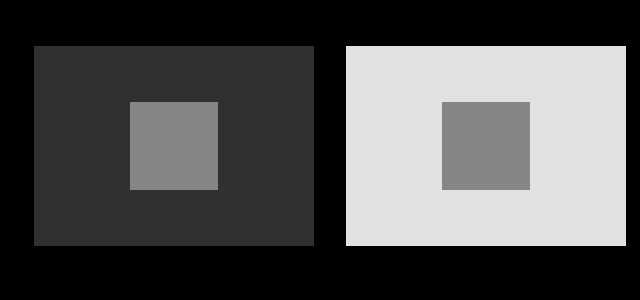
Two identical grey patches on different surrounds. Both inner squares are #868686. The one on the dark field looks lighter. The values are checked to be equal before the figure is drawn, so the claim is a fact about the drawing rather than a promise.

Matching is not appearance

CIE XYZ predicts when two lights will look the same under identical viewing conditions. It was never a model of how anything looks, and most of the confusion in applied colour comes from using it as one.
matching · Gamut
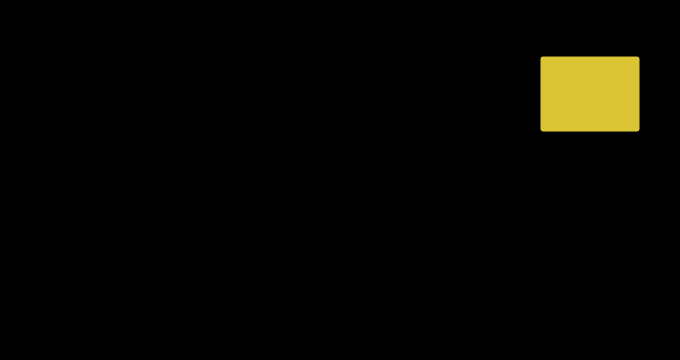
One reflectance, two illuminants, two colours. A reflectance peaking near 580 nm, and the colours it produces under D65 and A. The object has not changed. The light has, and colour is a property of the pair.

Constancy is the default

A sheet of paper looks white in daylight and white under a tungsten lamp, although the light reaching the eye differs enormously. The visual system is solving one equation with two unknowns, and it solves it by assumption.
brain · Appearance
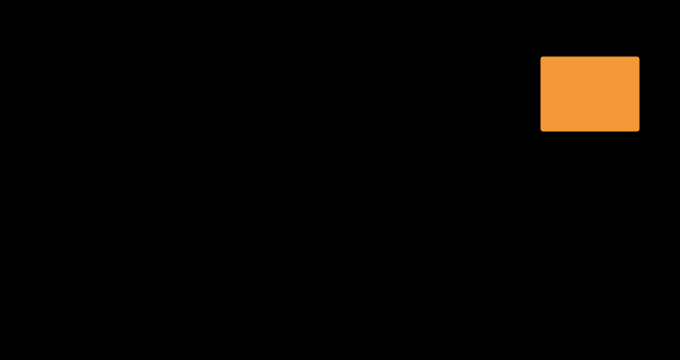
One reflectance, two illuminants, two colours. A reflectance peaking near 610 nm, and the colours it produces under D65 and A. The object has not changed. The light has, and colour is a property of the pair.

The illuminant is half the answer

An object has a reflectance, not a colour. The colour appears when a specified light falls on it, which is why two surfaces can match in a shop and clash outside, and why every serious matching standard names the light.
light · Light
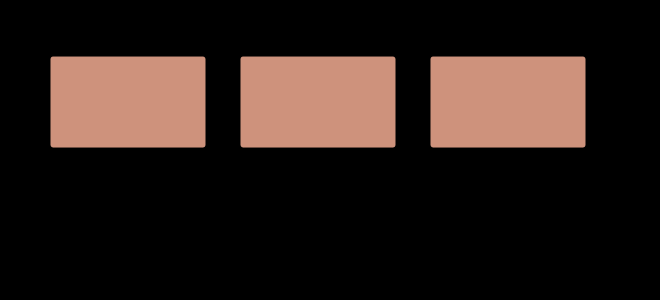
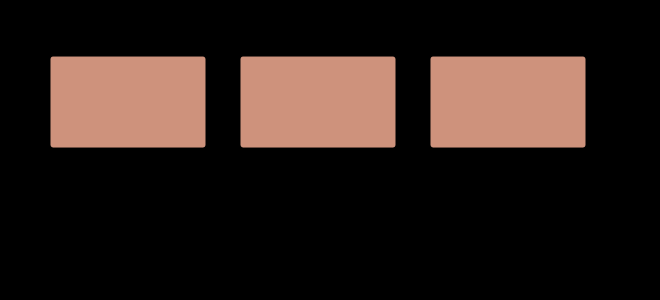
One stimulus, three rooms, three appearances. The same XYZ in a dark, a dim and an average surround. The stimulus does not change and is drawn identically in all three panels; what changes is what CIECAM16 says it looks like. Predicted lightness runs from 65.6 to 57.5 — a spread of 8.1 — with chroma and colourfulness moving too. Colorimetry returns one answer here because it has nowhere to put the room.

A viewing condition is an argument

An appearance model takes a stimulus and a situation. The second argument is not a refinement of the first — it is the content of the claim, and a model that returns an appearance from a colour alone has assumed a room without saying which.

brain · Appearance
The same two surfaces, weighed by each system. A long-wavelength and a short-wavelength surface under D65, with their relative luminance under the photopic curve and under the scotopic one. Under daylight vision the red surface is 1.33 times the blue; under rod vision it is 0.15 times, a reversal by a factor of 9.0. The swatches are the photopic appearance, which is the only one a display can produce: rod vision has no colour, and drawing a guess at it would be an invention.

The eye that has no colour

Rods outnumber cones twenty to one, work alone below a hundredth of a candela, and are absent from the centre of gaze. Between dusk and a lit room both systems run at once, and neither standard curve describes what is happening.

eye · Cones
Colourfulness rises with light level; apparent contrast does not. Predicted colourfulness M for one stimulus across four decades of adapting luminance, and the exponent of the lightness curve over the same range. M rises by a factor of 2.24 — the Hunt effect, which the model does predict. The lightness exponent changes by -2.2%, and in the wrong direction — the Stevens effect, which it does not.

Brighter looks more colourful

Colourfulness rises with light level and the model predicts it. Apparent contrast is supposed to rise too, and the model does not — which turns out to be right, because the thing that actually carries contrast is the surround.

brain · Appearance
Four adaptation transforms, measured against CAT16 (D65 to D50). Twenty-seven colours moved from D65 to D50 by each transform, compared with the current recommendation. Bars are the worst disagreement in CIELAB, the number beside each is the mean. Plain XYZ scaling — still shipping, still called von Kries by people who have not read von Kries — misses by up to ΔE 13.7, which is many times any tolerance a supplier would be held to.

Four ways to move a white point

Every chromatic adaptation transform is the same three lines with a different matrix. The matrices disagree by more than any tolerance a supplier is held to, and the oldest one — still shipping, still called von Kries — is not a cone basis at all.
brain · Appearance
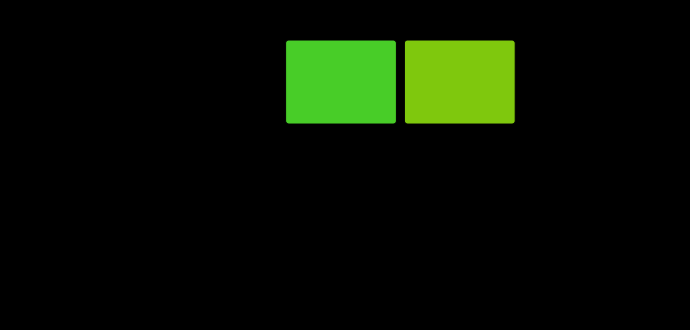
five greens, no neutral, under D65 — four guesses at the illuminant. The scene's surfaces as they reach the eye, and each estimator's angular error in degrees against the illuminant that actually lit them. Grey-world 43.1°, Max-RGB 27.7°, Shades-of-grey (p = 6) 31.4°, Grey-edge 34.4°. The best here is Max-RGB, which is best because this scene happens to satisfy its assumption — something reflects fully in every band — and not because it is the better algorithm. Any hatched patch is a surface this display cannot show under this light.

The algorithms that guess the light

What reaches a sensor is an illuminant multiplied by a reflectance, and no arithmetic separates a product into its factors. Every white-balance algorithm therefore works by assuming something about the world — and the interesting content of each is not its formula but the assumption, because a scene can violate it.
brain · Appearance
One stimulus, three rooms, three appearances. The same XYZ in a dark, a dim and an average surround. The stimulus does not change and is drawn identically in all three panels; what changes is what CIECAM16 says it looks like. Predicted lightness runs from 65.6 to 57.5 — a spread of 8.1 — with chroma and colourfulness moving too. Colorimetry returns one answer here because it has nowhere to put the room.

A patch is not a scene

A paint chip is the wrong size, on the wrong background, at the wrong luminance, in the wrong surround. Every one of those is a term in an appearance model, and the model says how much each of them moves the answer — which is the difference between a caution and a prediction.
brain · Appearance
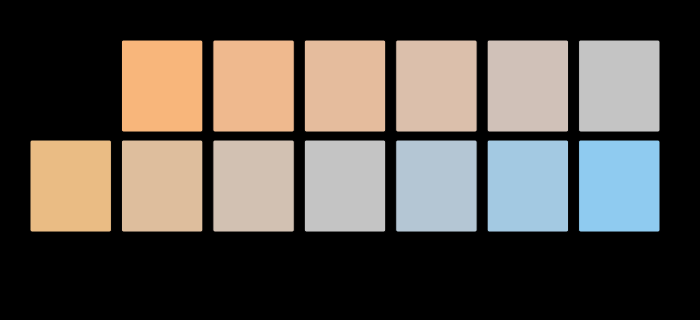
One white balance across a scene lit by two lamps. A neutral surface of albedo 0.6 under 7 mixtures of A and D65, corrected by one diagonal transform chosen for the middle of the run — which is what a camera does when it estimates a single illuminant. The middle patch comes out neutral to ΔE00 = 0.00 and both ends do not: 19.8 at the A end and 16.9 at the D65 one. The failure is structural rather than a matter of a better estimator: white balance is one transform for the whole image, and a scene with two lamps in it has no single answer for that transform to be. Every patch here is the same surface.

A scene has no white point

White balance is one transform applied to a whole image, and a scene lit by two lamps has no single answer for that transform to be. The failure is structural rather than a matter of a better estimator — and every colour-managed workflow in existence takes exactly one white point as an input, with no field in which to say there were two.

scene · Scene
The tone scale of one display, in four rooms. Code value along the bottom, the lightness it comes out at up the side. The curves are the same display: what changes is the light falling on the screen, which adds a fixed luminance to every pixel. The signal value that means black arrives at L* = 11.7 at 600 lux, against 0.9 in the dark — the lightness of a dark grey card, from a pixel that is switched off.

The screen is not the room

A thousand-to-one display in an ordinary office is a hundred-and-thirty-seven-to-one display, and the signal value that means black comes out at the lightness of a dark grey card. Nothing is wrong with the panel. Light falls on the screen and comes back off it, and the two per cent it returns is added to every pixel — most of all to the ones with nothing else in them.

applied · Delivery
Photons caught by one cone in one integration time, under D65. Each curve is one cone class, counting isomerisations during a 0.1 s integration through a pupil that closes as the light rises. At 1000 cd/m² a long-wavelength cone catches about 11522 and at 0.001 it catches 0.12 — which is where the square root of the count stops being a small correction and starts being the signal. The rate works out at 30 isomerisations per second per troland, inside the published band of 5–50.

Colour goes first in the dark

A cone reports a count, and a count carries the square root of itself as noise. Counting the photons says where colour vision stops — a chromatic difference runs out four hundred times sooner than a lightness difference of the same size — and says just as clearly that in daylight the eye is nowhere near that limit.
eye · Cones
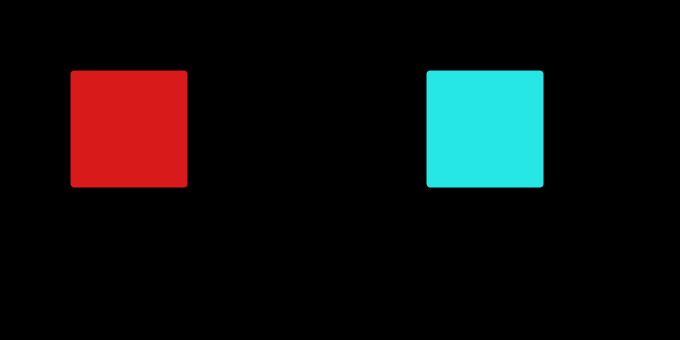
One adapting colour, two answers. The left patch is what was stared at. The middle is the afterimage the cone-gain arithmetic predicts at 15 per cent adaptation; the right is the inverted code values. They are 22.1 ΔE00 apart. The gains that produced the middle patch are 0.95, 1.06, 1.69 on the long, medium and short cone classes — the reciprocal of what each class had been receiving, taken 15 per cent of the way.

An afterimage is an adaptation

The demonstration everybody gives is an inverted image, which is a statement about a file format. Running the receptoral arithmetic instead puts the afterimage of a saturated red sixty degrees of hue away from the inverse — and outside what any display can show.

brain · Appearance
The colourfulness the sRGB cube reaches, against the light in the room. The display is the same display throughout and the signal is the same signal. What moves is the adapting luminance, which enters the appearance model and nothing else. The furthest colourfulness the cube reaches falls from 131 to 57, a factor of 2.29. A gamut in CIELAB cannot show this at all, because CIELAB has no light level in it — which is why every gamut percentage in circulation is quoted without one.

The gamut shrinks in the dark

Every gamut number here is a property of a device and of nothing else, which is why the same display has the same gamut in a studio and in a cinema. It does not. Turn the room down four decades and the solid loses a fifth of its reach and two thirds of its volume, with the signal unchanged.

limits · Limits
How far a judgement is from the settled one, second by second. The light changed from one white to another at t = 0 and nothing else moved. The model has one degree of adaptation and no clock, so the distance plotted is what a clock adds: 3.6 CAM16-UCS units half a second in, still 1.3 after a minute, and 0.11 after five. Every appearance number on this site is the value at the right-hand end.

The model has no clock

An appearance model takes a stimulus and a situation and returns what it looks like. It does not take a time, and adaptation is not instantaneous — half a second after the light changes a judgement is three and a half CAM16-UCS units from the settled one, and a minute later it is still 1.3.

limits · Limits
Temporal sensitivity, and where each channel gives out. Modulation frequency in hertz against relative sensitivity. The luminance channel is band-pass, peaking at 8 hertz and running out at 60; an isoluminant modulation is low-pass and runs out at 15, which is 4.0 times sooner. Both cutoffs are at the same criterion of 5 per cent of that channel's own peak, so the ratio between them is a ratio between two measurements rather than between two conventions.

The eye has a shutter

An isoluminant flicker fuses at fifteen hertz and a luminance one at sixty, so a light whose colour changes forty times a second is a steady light of a colour it never emits. And the frequency at which flicker stops being visible is not a property of the eye — it moves twelve and a half hertz for every decade of light.

eye · Cones
Grassmann's four laws, exact — and the two things that break them. For a linear observer every one of the four is exact and the residual is floating point, which is the control that makes the two failures below measurements rather than artefacts. Rods break a cone-metameric match by 23 per cent of a rod excitation at dusk; bleaching breaks it by 0.59 per cent of a cone excitation in the sun. Both are stated as fractions of a receptor's own response, so they can be put on one scale.

The laws that make colour add up

Colorimetry is an integral, and an integral assumes matching is linear. Grassmann's four laws are exact for a linear observer, to floating point — and they fail at both ends of the light range, by two different mechanisms, leaving colorimetry an operating band of three and a bit decades that no standard states.
matching · Gamut
An afterimage, as the local pool coming back to equilibrium. The local pool has adapted to the patch and the global pool has not, so the gain change is exactly the local share of a full von Kries change — which is why afterimage's free strength parameter is not free here. The dwell is 20 seconds. The swatches are the predicted appearance of the test surface at four moments. They are predictions of hue and direction; there is no response compression in this model, so the chroma is a ceiling rather than an estimate.

A gain has a time constant

An afterimage and the clock on chromatic adaptation were built in different files from what the last phase said was one mechanism. Joining them removes a free parameter, reproduces both, and predicts a third thing — that two people in one room, at one moment, looking at one patch, do not agree about its colour.

brain · Appearance
The eye's own drift, and what it does to every spatial frequency. A pattern of f cycles per degree, drifting across the retina at 0.5 degrees a second, arrives at each receptor at f × 0.5 hertz. The curve is the temporal sensitivity at that rate, against the pattern's spatial frequency. Every frequency the eye can resolve stays above a quarter of the temporal peak, and the band of drift speeds for which that holds is 0.02–0.71 degrees a second — with the measured drift inside it. Faster and the finest detail is carried past 60 hertz, where there is no sensitivity at all.

The eye is never still

A perfectly stabilised retinal image disappears within seconds. What keeps the world there is a drift of about half a degree a second between the microsaccades — fast enough to keep the finest detail modulating and slow enough not to carry it past fusion, in a band whose upper edge is at 0.71 degrees a second.

brain · Appearance
How much colour a display delivers, against how bright the room is. The appearance solid of the whole code cube, with the room's reflected light added to every code value and the surround ratio computed from the room's own white against the display's. A 300 cd/m² panel delivers most at 200 lux, and the curve falls on both sides: darker costs the surround, brighter costs the black. At the 32 lux the softproofing standards specify, the solid is 89 per cent of its best — which is not a criticism of the standard, since it is written for matching a screen to a print viewing booth rather than for delivering the most colour.

A display in a room is a smaller display

Two results here turn the room's light in opposite directions and neither knows about the other. A room has one light level and does both at once — so there is a brightness at which a display delivers the most colour, it is not at either end, and it scales with the panel.
limits · Limits
One light, two eyes. The same stimulus through two sets of ocular media differing only in macular pigment (0.35 and 0.41) and lens age (55 and 55 years). Compared under one white the two differ by ΔE00 1.00; compared with each eye adapted to its own long-run white — which is what the visual system does — by 0.00. The second number is why nobody notices, and the first is why a person who has had one lens replaced reports that the other eye has turned yellow.

Nobody here has two eyes

One person's two eyes differ in macular pigment and lens density, so the same light produces two colours — a whole ΔE00 apart for an ordinary pair, seven for one replaced lens. Adaptation hides it exactly, which is why nobody notices and why nothing in colorimetry has a term for it.

limits · Limits
The drift window, asked about each channel in turn. Every spatial frequency a channel can resolve, drifting at v degrees a second, arrives at f × v hertz; the bar is the range of v over which all of them stay above a quarter of that channel's temporal peak. The luminance band is closed at both ends — 0.018 to 0.71 degrees a second — because its temporal sensitivity has a dip at zero to fall into. The chromatic bands have no slow edge at all, because chromatic temporal sensitivity is low-pass: a stationary chromatic pattern sits at the top of its own sensitivity. The mark is the measured drift, and it is inside all three.

The drift is a luminance mechanism

The eye's own drift was shown to sit inside a band of speeds that keeps every spatial frequency modulating, and the band was quoted as though it were about vision. Asked about colour, it has no slow edge at all — a stationary chromatic pattern needs no eye movement whatever. And a stabilised chromatic pattern is the first thing to fade.

eye · Cones
Coming back from a bleach, against the clock already measured. A 94 per cent bleach, and the pigment returning at its own time constant of 120 seconds. The lower curve is the site's slow neural adaptation constant, 60 seconds, started from the same place — it is finished while the chemistry is barely half done. Regeneration does not speed up because the light went away: the rate constant is the same one it always was, which is why the recovery is slow while the bleaching was fast.

The slowest clock is chemical

An earlier essay here joined the afterimage to the adaptation clock and named what was still missing — a third gain, upstream of both, in the pigment itself. It is twice as slow as anything measured before it, it leaves a coloured after-tint from a white field, and at steady state it cancels exactly, which is why nobody has ever needed to model it.

eye · Cones
A lamp switched on, and what it is still doing minutes later. The junction warms from ambient to 80 °C with a time constant of 150 seconds, and three quoted slopes act as it does: the die's peak moves, the die loses efficiency, and the converter loses quantum yield. The output falls 25 per cent and the colour moves ΔE00 2.6. Nine tenths of the way takes 405 seconds. The vertical mark is the eye's own slow adaptation constant, 60 seconds, for scale.

A lamp switched on is not the lamp measured

A luminaire takes about seven minutes to reach nine tenths of its working temperature, loses a quarter of its output on the way, and moves ΔE00 2.6 while it does. That is slower than every clock in the eye — so for the first minutes after a switch is thrown, both ends of the measurement are moving, and every appearance claim here has assumed one of them was still.

light · Light
Where a pooled gain gives out, against where the eye does. The falling curve is how much of a pattern of each spatial frequency a local adaptation pool of 0.5° can see — and therefore how much of it a settled eye can cancel. It is half gone by 0.37 cycles per degree, which is a feature about 2.7° across. The three marks are the acuity limits of the luminance channel and the two chromatic ones. Every one of them is more than an order of magnitude finer than the pool, which is why a stabilised eye loses the fill of a picture and keeps its outline rather than losing the picture.

What a still eye stops seeing

A stabilised image is said to vanish, and nothing in a temporal filter predicts it — sensitivity at zero frequency is a quarter of the peak, not nothing. Give the adaptation gain a size and the answer falls out — fading is a high-pass filter that switches on over a minute, it takes the fill and leaves the outline, and a patch has to be about two degrees across before it goes at all.

eye · Cones
A surface in a room, from the moment the light goes on. How far a blue surface is from the colour it will settle at, second by second, for an observer who walked in from the snow as the lamp was switched on. It starts ΔE00 27 away, is still 6.1 away after a minute — the point at which the eye is conventionally said to have adapted — and does not fall under a unit until 295 seconds.

The room settles after the eye does

Four clocks run in a room and only three of them are in the observer. The slowest is the lamp, which takes four hundred seconds to reach nine tenths of its colour change — so a minute after the light goes on, when the eye is conventionally said to have settled, most of what is left is the lamp, and three quarters of that could not be adapted away by an observer of any speed.

light · Light
The appearance model's three rooms, read as three moments. CIECAM16's degree of adaptation is a function of the surround and the adapting luminance and of nothing else — the model has no time in it. Solving for the moment at which an observer who will adapt completely has got that far turns each of the three tabulated surrounds into a reading on a clock. At 100 candelas per square metre they are 106, 49, 21 seconds. They are presented as three rooms. They are also one observer, in one room, at three times in the first two minutes.

A viewing condition is a moment

CIECAM16's degree of adaptation is a function of the surround and the adapting luminance and of nothing else, because the model has no time in it. Solving for when an observer who will adapt completely has got that far turns the standard's three surrounds into three clock readings — 107, 50 and 21 seconds — and the two readings are distinguishable by waiting.

brain · Appearance
Every claim here that was computed with one model, recomputed with two. Each row is a claim one of these essays makes. The bar is how many times the two-model answer differs from the one-model answer, on a logarithmic scale. 3 of 13 have no bar at all: the first model's answer for them is exactly zero, not because it computed zero but because it has no variable for the quantity. Those are the rows where a second model did not correct an answer — it supplied one.

What a second model changed

Thirteen claims here, each computed with one model and recomputed with two. Ten of them move by half again or more. Three of them do not move at all in the ordinary sense — the first model's answer is exactly zero, not because it computed zero but because it has no variable for the quantity — and every one of those three is a join that supplied a state or a device rather than a spread.

limits · Limits
Every change of light this site models, and how much of it a gain removes. Each row is a change of illumination. The pale bar is how far it moves an ordinary surface for an observer who does not adapt; the solid bar at its left end is what is left after the observer has applied the one gain adaptation gives them, which is the ratio of the two whites in the CAT16 basis and is not fitted to anything. Sorted by the fraction left rather than by the size of the change, because the two orderings are different: the largest change here is removed almost entirely and the worst row is a change less than a third its size.

What no adaptation can remove

A change of light is exactly a 3×3 matrix on tristimulus values, and adaptation is a diagonal one. Putting every change of illumination this site models through that distinction sorts them by how much of themselves they leave behind, and the smallest residual in the census belongs to a filter inside the eye.

limits · Limits
Every published adaptation transform, and one computed from daylight, on every change. What each basis leaves an adapted observer with, row by row. Darker is worse. The last column is not a published transform: it is the basis in which a change from D65 to D50 is exactly diagonal, computed in closed form from the two spectra with nothing fitted. It is far the best on the daylight rows and it is beaten on the discharge lamps, which is the trade the published transforms are sitting in — they were fitted to data containing both kinds of light and are therefore optimal for neither. Over the census as a whole the winner is Bradford at ΔE00 1.14.

A gain needs a basis

Adaptation scales three signals, and which three is a choice. The basis in which a change from D65 to D50 is exactly diagonal can be computed in closed form from the two spectra, it beats every published transform on daylight by a factor of five, and it loses to all of them on a fluorescent tube.

brain · Appearance
The same census, sorted by where the change of light came from. Each row is a change of illumination. The pale bar is how far it moves an ordinary surface for an observer who does not adapt; the solid bar at its left end is what is left after the observer has applied the one gain adaptation gives them, which is the ratio of the two whites in the CAT16 basis and is not fitted to anything. Sorted by where the change came from. The two kinds of light that existed before electricity sit at the top and leave the smallest share of themselves behind; the discharge lamps are worse, and the worst of them is d65 to a triphosphor tube at 33 per cent.

Which lamp changes are free

The changes of light that existed before electricity commute with one another to a couple of parts in a thousand, so one set of axes handles all of them. The lights the lighting industry invented do not, and the worst pair in the census is seventy-six times further from commuting than the best.

light · Light
The same wall, applied once and applied twice. A room lit by light that has bounced off its own walls is a change of illumination like any other, and a corner is the same change applied twice. Squaring a reflectance sharpens it, a sharper change of light is further from being a gain, and the residual an adapted observer is left with therefore grows faster than the change does: the second bounce is 1.33 times the change and 1.96 times the residual. This is the adaptation half of what a corner does to a metameric match.

The same wall applied twice

A bounce off a painted wall is a change of illumination, and adaptation handles it about as well as it handles a change of colour temperature. A corner applies the same reflectance twice, which sharpens it — and leaves an adapted observer with 1.96 times as much for a change only 1.33 times as large.

scene · Scene
The share of itself each change leaves behind, and the smallest is inside the eye. The residual as a fraction of the change rather than as a colour difference, which sorts the census differently. At the top is the macular pigment — the filter in front of the central few degrees of one's own retina — leaving 2.4 per cent of itself. It is a fixed transmittance multiplying the light and the white together, which is as close to a pure gain as anything here gets, and it is why nobody notices they have one.

The filters inside the eye

The macular pigment leaves 2.4 per cent of itself after adaptation — the smallest share of anything in this site's census of light changes, and less than half the next smallest. Fifty years of lens yellowing leaves 7.9 per cent, and the difference between the two says what a gain is actually good at.

eye · Cones
The basis a camera balances in is a different basis for every light. A camera's white balance is a per-channel gain on raw values, which is a von Kries adaptation in whatever basis the filter dyes give it. That basis is not a property of the dyes alone: it is the dyes and the light in the room, and it moves when the light does. Each bar is how far the basis has turned, in degrees, from where it sits under D65. A sensor satisfying the Luther condition would have a bar of exactly zero on every row, because for such a sensor the light cancels — which is the one property nobody buys a sensor for.

A camera balances in another basis

White balance is a per-channel gain on raw values, which makes it a von Kries adaptation in whatever axes the filter dyes happen to give. Those axes are not a property of the dyes alone — they move with the light, by up to seventeen degrees across the adaptation census — and the sensor for which they would not move is the one that adapts worst of all.

imaging · Capture
A tolerance of one unit, re-measured under every light in the census. Every one of the 23 pairs behind this figure is at exactly ΔE00 1.000 under D65 by construction. Each bar is what those same pairs measure under another light, after the observer has adapted to it: the line is the median and the bar spans the pairs. A tolerance is written as a property of a pair and it is not one — the light multiplies both members, and the difference between two products is not the product of the difference. The widest row is a lens at twenty against a lens at seventy, spanning 0.81 to 1.57.

One unit in another room

Twenty-three pairs built at exactly ΔE00 1.000 under D65, re-measured under every change of light this site models with the observer adapted to each, come out anywhere between 0.64 and 1.57. A tolerance is written as a property of a pair and it is a property of a pair and a room.

difference · Metric
A stabilised grating fades at a rate that depends on which way its bars run. What is left of a 0.3 cycle-per-degree grating, in multiples of its own threshold, as a function of its orientation, at four moments after the image was stabilised on the retina. The first curve is flat to floating point: at the instant the pattern arrives, orientation does not matter, because the filter that carries it has no orientation preference at this frequency. The anisotropy arrives with the fading, reaching ×2.09 after five minutes, and a pool with no axis predicts none of it.

A fading pool has a shape

Giving the local adaptation pool two axes instead of one costs a single parameter and produces a prediction the circular version cannot make — a stabilised grating fades at a rate that depends on which way its bars run. The obvious objection is the oblique effect, and the two act in bands that do not overlap.

eye · Cones
Three ways to dim a lamp, and only one of them is free. What an adapted observer is left with, as the same lamp is taken down to one per cent by each of the three methods. Duty-cycle dimming lies exactly on zero at every depth: it scales the spectrum, a scaling is a gain in every basis, and adaptation removes all of it. Current dimming moves the pump and the phosphor apart and leaves 0.15 at a tenth. A filament follows the Planckian locus, which is the largest chromaticity change of the three and leaves 3.63 — the ordering by chromaticity and the ordering by what a person sees are not the same ordering.

Only one dimmer is invisible

An earlier essay separated the three ways to dim a lamp by the chromaticity each arrives at. Asked instead what an adapted observer is left with, the ordering is different and one method comes out at exactly zero — a duty cycle is a scaling, a scaling is a gain in every basis, and adaptation removes all of it at every depth.

light · Light
Four devices, and what each of them can do about a change of light. The mean over the census of what each device is left with. A press has no mechanism, so its number is the whole change — a printed sheet does not adapt to the room it is read in. A display can move its white point, which is a gain in its own primaries. A camera applies a gain in whatever basis its filter dyes happen to give it. And the sensor that satisfies the Luther condition exactly is worse than the silicon one — satisfying the condition means its channels are the matching functions, and a per-channel gain on the matching functions is the transform this site calls the oldest mistake still shipping.

Only one of these devices adapts

An eye, a camera, a display and a press all meet the same changes of light, and each has at most one thing it can do about them. The press has nothing at all, so its column is the whole change; and this collection's sensor built to satisfy the Luther condition exactly is the one that adapts worst.

limits · Limits
How blue the sheet reads, and how much of that is the room. Chroma in an appearance model, with the observer adapted to the light the sheet is under. The three markers on each row are an average, a dim and a dark surround; the open marker at the left is the same sheet with the ultraviolet removed. Every stock is close to neutral without the excitation and carries real chroma with it, at a hue of about 295 degrees — blue-violet — so the colour is the fluorescence and not the substrate. And it falls by nearly half between a bright room and a dark one, which makes how blue a sheet looks a property of where it is being looked at.

A brighter white still looks white

Colorimetry says a brightened sheet is nine units of b* from neutral, which sounds like a visible blue. An appearance model with the observer adapted to the room says it carries eleven units of chroma at a hue of 295 degrees — genuinely blue-violet — and that the number falls by nearly half between a bright room and a dark one. What it cannot say is why anybody calls the result white.

brain · Appearance
A mid-grey's lightness across a continuum of rooms. The lightness a mid-grey is predicted to have, plotted along the continuous surround parameter running from an average room to a dark one. The three rooms the standard tabulates are marked on it: average at the left, dark at the right, and dim 61% of the way between them rather than halfway. The whole span is 9.71 units of lightness and the step from average to dim is 5.64 of it — 58% — so choosing one of the three rows is a decision worth most of the range.

The surround is three rows of a table

An appearance model takes the room as three constants, and the standard tabulates three rooms. Every appearance figure in this collection is drawn at one of them. The parameter they are three points of is continuous, and the middle row is not in the middle.

brain · Appearance
Every adaptation number here assumes a complete adaptation. Three curves and their mean: the colour difference an adapted observer is left with after a change of light, against the degree of adaptation from zero — no adaptation at all — to one. Every adaptation figure in this collection is computed at one, the right-hand end. The appearance model's own formula puts the degree at 0.941 for an average surround at a hundred candelas, marked, where the residual is 2.21 ΔE00 rather than 1.27 — larger by a factor of 1.74. The left-hand end is exactly the unadapted change, which is not an approximation but an identity, and is what says the curve interpolates between the two things it claims to.

A discount nobody measured

Every adaptation number in this collection assumes an observer who adapts completely. The appearance model's own formula says they do not — it puts the degree at 0.94 in an ordinary room — and the difference is not a rounding. It is a factor of 1.7 on the residual every one of those figures reports.

brain · Appearance
The three cone absorptances at two settings of the rods. Solid and dashed are the same construction at the two ends of a tenth of the cone response, which is a dim room. The curves are built from one pigment template through its ocular media, which is the same model its population of two hundred eyes is drawn from. The largest difference between the two sets is 9.1 per cent of the peak, and where it sits along the wavelength axis is what decides which stimuli the two observers disagree about — a departure concentrated in the blue is invisible on a sample with no blue in it.

The rods are a fourth curve

Colorimetry has three numbers and a rod signal is a fourth. It cannot be absorbed by a gain, it cannot be removed by a white point, and adding a tenth of one to a three-curve observer costs 1.60 ΔE₀₀ — the narrowest distribution of the six departures, because an addition behaves quite differently from a filter.

eye · Cones
Where averaging the model's answers is and is not averaging its argument. Each row takes a spread of situations, averages the model's predictions across them, and compares that against the model's prediction for the average situation. The bar is the gap as a share of the spread itself. Over the differences between observers it is 1.4 per cent — the model is very nearly linear there. Over the range of adapting luminance one room covers in a day it is 59 per cent, and from indoors to outdoors 74.

Where the model's curve does not matter

This round has been about what a nonlinearity does to an average, and CIECAM16 is the most nonlinear thing in the collection. Over the spread a population of observers produces, the average of its predictions is its prediction for the average to within 1.4 per cent — the nonlinearity is there and the excursion is too small to reach it. Over the range of adapting luminance one room covers in a day, the same gap is 59 per cent of the spread, and from indoors to outdoors 74.

brain · Appearance
The angle between the two filters against how completely the eye has adapted. The angle, in the local metric, between what an older lens does to a reading and what a denser macular pigment does, on 120 smooth reflectances, as the degree of adaptation runs from nought to one. The median angle is 8 degrees unadapted and 156 at complete adaptation, and almost all of the turn happens in the last tenth: it passes a right angle at a degree of 0.928. The marks are the degrees CIECAM16 gives five rooms — an overcast sky 1.00, an office 0.94, a lit living room 0.86, a dim room 0.75, a cinema 0.66 — so only the outdoor one is at the end of the dial.

Two filters cancel only in a bright enough room

An older lens and a denser macular pigment cancel each other once an eye has adapted — and that result belongs to the end of a dial nobody stands at. Read at the degree of adaptation CIECAM16 gives an ordinary room, the two barely cancel; in a living room they add, and in a cinema they cost six times what they cost under the sky. The room has to be about as bright as an office before the cancelling begins at all.

difference · Metric
What the choice of adopted white is worth, in a room lit by two lights. A room lit half by daylight and half by an incandescent lamp. The light on the surfaces is fixed; what varies is the white the model is told the observer has adapted to, running from the lamp on the left to the window on the right. The median of twelve surfaces moves 32.6 CAM16-UCS units if the lamp is adopted and 24.5 if the window is, against the room's own mixture in the middle. The model offers no way to choose, and its degree of adaptation is 0.94 at every point of the dial.

A room with two lights has no white

An appearance model takes one adapting white. A desk beside a window has two, and the mixture falling on the paper is not the same thing as the white the person reading it has adapted to. Mixing the lights is arithmetic. Choosing the white is not, and the choice is worth sixty units of appearance — most of which is a cast, and not all of which is.

brain · Appearance
Every pair of departures, before adaptation and after it. The fifteen pairs of the six audited observer departures. Each row runs from the angle between that pair's two deviations with no adaptation to the angle with complete adaptation; an angle past ninety degrees is a pair pointing apart, which is where a pair can cost less together than the larger of the two costs alone. 3 pairs gain that behaviour as the eye adapts, 3 keep it, 5 lose it and 4 never have it. The pair followed here — the lens against the macular pigment — is in the smallest group that is not empty, and every result quoted from it generalises in the wrong direction.

Adaptation turns more pairs off than on

One pair of observer departures was followed across the degree of adaptation and found to cancel only in a bright enough room. The same calculation takes any two, and run over all fifteen pairs it says something the single pair does not: adaptation is a rotation rather than a mechanism for making departures oppose each other. Five pairs lose their cancellation as the eye adapts, three gain it, three keep it and four never have it — and the pair everybody quotes is one of the three it turns on.

difference · Metric
Six departures, and three ways of adding them up. The six audited observer departures on 120 smooth reflectances, across the dial. Summing them assumes they all point the same way and is an overestimate everywhere; taking the largest alone assumes only one matters and is an underestimate everywhere. Quadrature — the usual way of combining contributions taken to be independent — assumes they are mutually perpendicular, and the measured combination crosses it at a degree of 0.8618. Below that the departures are on balance pointing together and quadrature is too small; above it they are on balance pointing apart and quadrature is too large. It is exactly right in one room.

Quadrature is exact in one room

An observer allowance is built by adding the departures in quadrature, which assumes they are mutually perpendicular. Over fifteen pairs their angles run from 18 degrees to 179 and hardly any are perpendicular. Measured against the real combination, quadrature is too small in a cinema by eight per cent and too large under the sky by fourteen, crossing at an adapting luminance of 22 candelas a square metre — and on individual surfaces it is out by a third in both directions in every room.

difference · Metric
Where a surface's band sits decides the room it needs. Each of 168 surfaces at its own crossing — the degree of adaptation at which the part adaptation has yet to remove falls to the size of the part it will leave — against where that surface's absorption band sits. The line joins the median at each band centre and the rooms are marked across. A surface absorbing at 470 nm crosses at 0.883 and one absorbing at 670 nm at 0.972. Both of the filters this is about absorb in the blue, so a surface with a blue band is where the two differ in shape and has a large residual, while a surface with a red band is nearly invisible to both and its whole deviation is the shared yellowing of the observer's white.

The room a surface needs is written in its band

Whether two yellow filters cancel on a surface depends on the room, and each surface has its own crossing — the degree of adaptation at which the shared yellowing falls to the size of what is left underneath. Those crossings run from 0.68 to 0.99, and where a surface's absorption band sits accounts for almost all of the spread while how much light it returns accounts for almost none. The reds need a room brighter than a graphic-arts viewing booth, which is brighter than any room a sample is judged in.

difference · Metric

Named alongside it

The objects these essays reach for when they reach for this one.

Viewing conditionChromatic adaptationAssertionCIECAM16IlluminantIndividual variationColour appearanceColour constancySpecificationThe von Kries transformSurroundLuminance

All concepts