Nobody here has two eyes
Assumes Whose eyes and Seventeen observers in 1931.
The standard observer has one eye. So does every observer on this site, every colour-matching function ever published, and every appearance model in use.
A person has two, they are not the same instrument, and the discipline has no field for the difference.
The claim
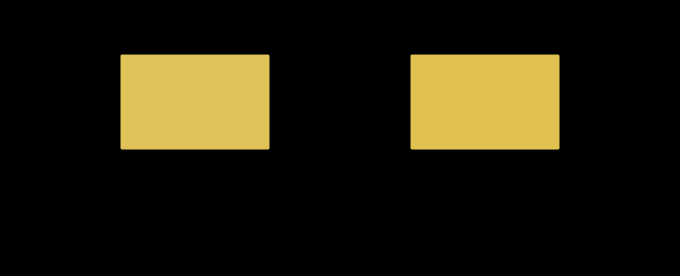
One person’s two eyes see two colours, and adaptation removes the difference so completely that nobody can check it.
Three measurements and an absence:
- An ordinary pair of eyes differs by ΔE00 1.00, from macular pigment alone, at a typical interocular difference of 0.06 in density. That is at the threshold of what a person can see between two patches side by side.
- A replaced lens is a different order of thing. Fifty years of lens yellowing between one eye and the other gives ΔE00 7.32 — which is why somebody who has had a cataract operation on one eye reports, reliably and with surprise, that the other eye has turned yellow.
- Adapting each eye to its own white removes it exactly, to the last bit — which is a statement about this model rather than about a person, and is the reason the effect is invisible.
- And what two eyes actually do together, this site cannot compute. Red to one eye and green to the other does not give yellow. The averaging model here says it does, by construction, and
assertBinocularMixingIsNotExplainedHererequires the model to keep being wrong about it.
Why the difference exists
Nothing about the difference is neural. It is entirely in front of the retina, in two filters that vary independently between a person’s two eyes.
The macular pigment is a yellow screen over the central retina, absorbing in the blue. Its density varies between people by a large factor and between one person’s eyes by a small one — 0.02 to 0.12 is the reported interocular range, against a mean around 0.35.
The crystalline lens yellows steadily from about the age of twenty, so an eighty-year-old receives roughly a third of the 440-nanometre light a twenty-year-old does. Both eyes age together, which is why the ordinary interocular lens difference is small — and why replacing one of them is not.
Both are the mechanisms whose eyes identified as the largest source of observer-to-observer variation in colour matching, and both are pre-neural, which is why the same arithmetic works here: two eyes are two observers who happen to share a brain.
Why nobody can check it
The natural test — close one eye, then the other — does not work, and the reason is the most interesting thing here.
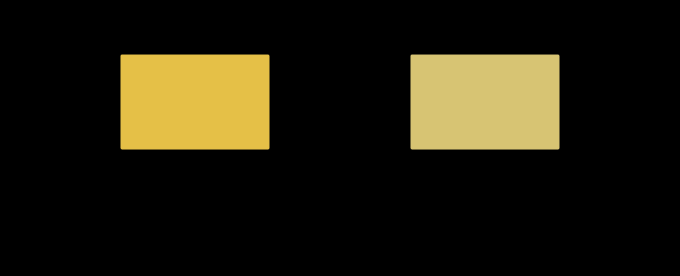
Each eye is adapted to its own long-run average. An eye behind a denser macular screen receives less blue from everything, including from whatever it is adapted to, so its gains rise in the blue to compensate. The compensation is exactly the size of the difference, because both are proportional to the same filter.
In this model that cancellation is exact — the adapted difference is zero to the last bit, because each eye’s white is computed through its own media and the ratio is taken against it. That exactness is a property of the model rather than of a person, and it is the honest form of the result: it says the model has nothing left over, not that a person has nothing left over.
What survives in reality is a mismatch in the transient. Adaptation follows the light with a time constant, and the two eyes are adapting to the same room — so any change is tracked by both at the same rate and the steady-state cancellation is undisturbed. The exception is the surgical one: a lens replaced in an afternoon changes one eye’s filter and not the other’s, and the adaptation takes weeks to months rather than seconds, which is exactly how long the reported effect lasts.

Which filter does the work, in numbers
The two mechanisms are quoted at one setting each, and dividing by their own differences turns them into coefficients that cover the whole reported range:
| interocular difference | ΔE00 | |
|---|---|---|
| macular, low end of the reported range | 0.02 | 0.33 |
| macular, typical | 0.06 | 1.00 |
| macular, high end | 0.12 | 2.00 |
| lens, one year | — | 0.15 |
| lens, two years | — | 0.29 |
| lens, fifty years — a replacement | — | 7.32 |
For an intact pair of eyes the macular pigment does essentially all of it. Both lenses age together, so the interocular lens term is worth a year or two of ageing at most — a tenth to a third of a unit — against the macular term’s third to two units. The lens is the larger mechanism by far and it is almost entirely common-mode, which is why it contributes nothing until surgery makes it differential.
That also puts the surgical figure in proportion. Seven and a third units is not the lens being a bigger effect than the macular pigment; it is the same lens mechanism with fifty years of it moved from the common-mode column to the differential one in an afternoon.
An exact zero is a claim about the model, and it is worth saying which
The cancellation is reported as exact to the last bit, and the reason given is that both filter and adaptation are multiplications so the ratio cancels. That is right for the white and it is not right in general, and the difference matters because a sibling essay on this site depends on it being wrong.
Write it out. Eye two’s coordinate for a stimulus under a transmittance is , and its own white gives . The ratio of those is the adapted coordinate, and it equals eye one’s only when is constant across the support of . A macular filter is a Gaussian absorption in the blue; it is emphatically not constant across the short-wavelength fundamental, which is exactly where it acts.
So a spectral filter does not scale a cone response — it reshapes the fundamental, and a diagonal gain cannot undo a change of shape. That is the whole finding of the essay on self-screening: a filter in front of a receptor produces observer metamerism that no adaptation removes, measured there at half a per cent of cone contrast for an ordinary difference in pigment density.
Both essays cannot be right about a general stimulus. The resolution is that the white is a fixed point by construction — every adaptation transform maps its own white to its own white exactly — so a cancellation tested on the adapting white is exact and says nothing. A cancellation tested on a stimulus away from the white should leave a residue, and the residue is what the other essay measures.
Which means the exact zero here is a claim about where the model was evaluated rather than about what a filter does, and it has a specific test: hand both eyes a metameric pair constructed for one of them. Two eyes with different macular densities are two observers with different fundamentals; a pair that matches for the first must fail for the second, whatever the adaptation does, because a match is an equality of three integrals and the integrals are taken against different functions. The residue would be small — the interocular difference in density is a fifth of the between-person one — and it would not be zero, and the section below that calls this a property of the model rather than of a person is right for a sharper reason than it gives.
What two eyes buy
The one thing binocular vision demonstrably does for colour is lower the threshold, by a factor between 1.2 and 1.7 — probability summation alone gives the square root of two.
That is a quoted number rather than a derivation, and it is here so that the one benefit can be stated beside the several things binocular vision does not do:
- It does not improve a match. Two eyes with different filters make the same match, because each is adapted to its own white and a match is a ratio.
- It does not average two colours. That is the absence below.
- And it does not extend the gamut. Nothing about having two eyes reaches a colour one eye cannot.
The absence, asserted
Present red to one eye and green to the other, filling both fields, and the visual system does not deliver yellow. It delivers rivalry: the two alternate, in irregular patches, over seconds, with neither winning and no stable percept at all.
This site’s model of two eyes is that they average. That model predicts a single steady colour, ΔE00 30 from one eye’s stimulus and 36 from the other’s — a dull yellow that nobody ever sees.
The prediction is computed rather than described, so that the size of the error can be stated, and assertBinocularMixingIsNotExplainedHere requires it to stay an error. If a revision ever starts predicting alternation, the build stops and somebody reads why rather than discovering that the site has quietly begun agreeing with a textbook it has not earned. It is the same shape as the dither null and the Helmholtz–Kohlrausch absence, and it is the fourth on the site.
What is missing is not a term but a whole layer. Rivalry needs competition between two representations with a state and a time course, which is a mechanism of a completely different kind from three gains and an integral. Nothing that averages can produce it, and nothing on this site is not an average.
Where it would bite, if anything depended on it
Almost nothing does, and the two places it might are worth naming.
Colour-critical work is done with two eyes. A press operator judging a sheet, a colourist grading a film and a paint matcher at a booth all use both, and the arithmetic above says the two eyes’ inputs differ by about a unit and their adapted outputs by nothing. So the practice is safe, and it is safe for a reason nobody states rather than by anybody’s design.
And the surgical case is not. Somebody who has had one lens replaced is, for weeks, an observer whose two eyes are seven ΔE00 apart, and the adaptation that will eventually cancel it is running at two different rates. A person in that state doing colour-critical work is judging with an instrument whose two halves disagree by more than any tolerance they are working to — and there is no procedure anywhere for it, because there is no field anywhere for which eye a judgement was made with.
The third place is not a person at all. A stereoscopic display sends different images to the two eyes deliberately, and the two paths through it — two lenses, two polarisers or two shutter states — are not identical either. A colour difference between the two channels of such a display is a manufactured interocular difference, without an adaptation that can cancel it, because it changes with what is being shown.
What was computed, and how
Both eyes are one function with two arguments. ocularMedia takes a lens age and a macular density and returns a transmittance; the two eyes are two calls. The stimulus goes through each and out to XYZ through the same observer, so nothing about the neural observer differs between the two eyes — which is the modelling claim and is the reason the effect is entirely pre-neural.
The raw comparison is against a shared white, which is what a person would see if neither eye rescaled. The adapted comparison is against each eye’s own white, computed through that eye’s own media, which is what the visual system does.
The control is two identical eyes, which agree to 10⁻⁹ raw. That is what makes the 1.00 a measurement rather than an artefact of the media model.
And the ocular media are stated forms rather than tables — an exponential lens absorption and a Gaussian macular one, of stated peak and width. They carry the argument and they are not measurements of anybody’s eye.
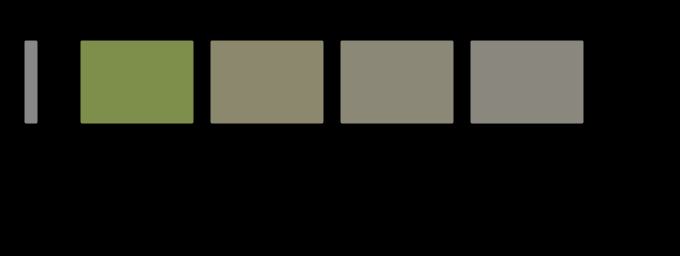
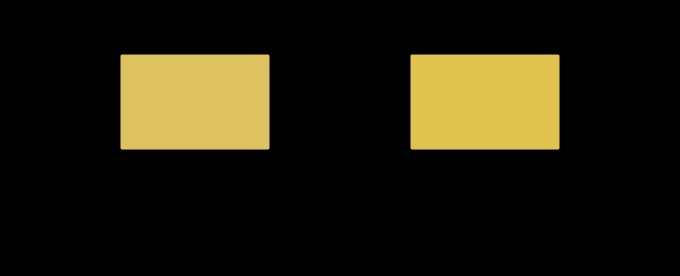
The two eyes in the opening figure differ by less than a real pair can, and pushing both parameters to the ends of their measured ranges is the honest worst case.
Where the model stops
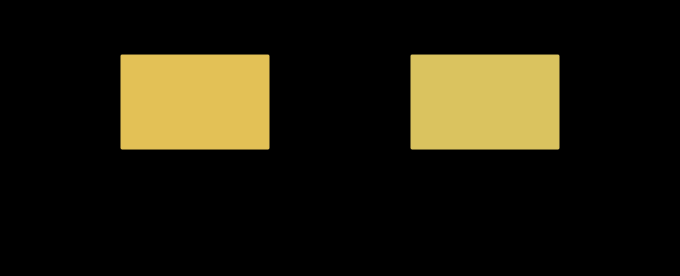
The exact cancellation is the model’s, not a person’s — and, as the section above works out, it is exact for the white rather than for a general stimulus. A real observer’s two eyes do not cancel perfectly, and there are two reasons rather than one. The first is that a spectral filter reshapes a cone fundamental and a diagonal gain cannot undo a reshaping. The second is everything a proportional model has no term for at all: differences in receptor density, in cone ratio, and in neural gain, none of which is a filter in front of the retina.
There is no second retina. Cone density falls with eccentricity and the two eyes’ maps are not identical; nothing here has a position in it at all.
The binocular gain is quoted and not derived. Probability summation would give the square root of two from an independence assumption this file does not make.
And there is no dominance. Most people have a dominant eye, and under rivalry the dominant one wins more often — which is a fact about a mechanism this model does not have.
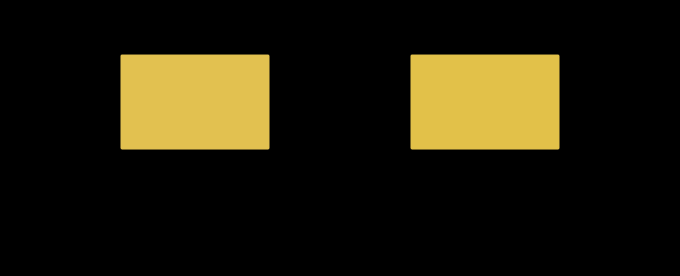
A different pair of colours is the check that the eccentricity result is about the channels rather than about one direction in colour space.
The generalisation
The sentence worth carrying: the observer is a population, and every level of the population has been averaged over silently.
The standard observer averages over seventeen people. Each of those people averaged over two eyes. Each eye averages over a disc of retina whose composition varies threefold across it. Each patch of retina averages over a cone mosaic whose long-to-medium ratio varies sixteenfold.
Four levels of averaging, three of them invisible in any published function, and the discipline’s whole treatment of variation is a footnote about individual differences.
The surprising connection is that the averaging works, at three of the four levels, for the same reason. A match is an integral, an integral over a mixture does not care about the mixture, and the ratio that a match is cancels a common filter. The mosaic result, the eccentricity result and this one are one argument. The level where it stops working is the first one — seventeen different people cannot adapt to each other — which is why observer metamerism is the variation that has a name and the other three do not.
Who found it, and when
Interocular colour differences have been reported since the nineteenth century and are one of the standard demonstrations that colour is not a property of light: alternate the eyes on a white card and most people report a small difference, larger in the blue.
The cataract case is the version everybody knows about. The literature on it is medical rather than colorimetric, and the reported symptom — the unoperated eye looks yellow — is the correct direction: the operated eye is now the newer instrument and becomes the reference.
Binocular rivalry was described by Wheatstone in 1838, with the stereoscope he had just invented, and it remains one of the standard tools for studying visual awareness precisely because the stimulus is constant and the percept is not.
What has not changed is the standard. There is no binocular colorimetry, no colour-matching function pair, and no field anywhere for which eye a measurement was made with.
A larger target is the version of the fovea experiment somebody could actually run, since a 0.4° patch is smaller than most stimuli anybody presents.
What the pictures cannot show
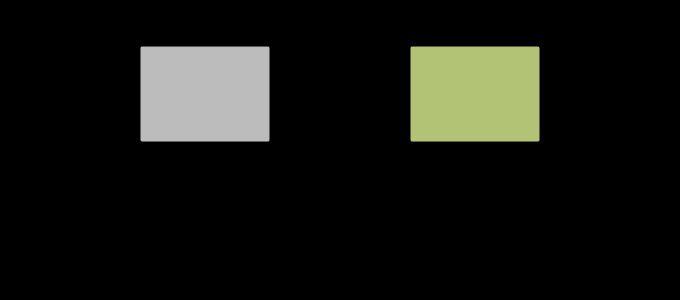
They cannot be shown to one eye. Every figure here is delivered to both eyes at once, which is the arrangement in which the effect is cancelled. A reader can approximate the interocular test by covering each eye in turn on a white area of the page, and will find whatever they find — but the adaptation is already complete for both, so the test measures what is left over rather than the raw difference the arithmetic computes.
And the rivalry figure does not exist. Presenting different images to the two eyes needs an apparatus a page does not have. The nearest available demonstration is a hand held between the eyes with each looking at a different half of a screen, which most readers can do and which is not a controlled measurement of anything.
Where the ladder goes next
The nearest unfinished piece is what survives the cancellation. The exact zero here is a consequence of the media being multiplicative filters, and every mechanism that is not — cone density, cone ratio, neural gain — leaves a residue. Computing the residue for a stated set of those would give the number this essay currently reports as zero.
The second is the transient. A lens is replaced in an afternoon and the adaptation takes months, so the interocular difference is a step into a system with a time constant — which is the machinery this phase built with a step function a hundred million times longer than any it was written for.
Where this goes next
 Whose eyes
The standard observer is an average over seventeen people, and no reader is it. What that costs was small when displays were broad and grows every time the primaries get narrower.
Whose eyes
The standard observer is an average over seventeen people, and no reader is it. What that costs was small when displays were broad and grows every time the primaries get narrower.
 Seventeen observers in 1931
The standard observer that governs every colour specification in industrial use is an average over seventeen young British men, measured with equipment from the 1920s. It is known to be wrong in the blue, the correction has existed since 1951, and it has never been adopted.
Seventeen observers in 1931
The standard observer that governs every colour specification in industrial use is an average over seventeen young British men, measured with equipment from the 1920s. It is known to be wrong in the blue, the correction has existed since 1951, and it has never been adopted.
 The mosaic is not the observer
The ratio of long-wavelength to medium-wavelength cones varies between ordinary people by a factor of sixteen. Those people make the same colour matches, to twelve decimal places, and that single fact is the reason a standard observer can exist at all.
The mosaic is not the observer
The ratio of long-wavelength to medium-wavelength cones varies between ordinary people by a factor of sixteen. Those people make the same colour matches, to twelve decimal places, and that single fact is the reason a standard observer can exist at all.
Named alongside this one
Essays reaching for the same objects. Nobody chose these; they are what the index of named objects makes visible.
- Four primaries have a choice colour-matching functions · cone fundamentals · δe · individual variation · observer metamerism · specification · standard observer
- One match names the observer colour-matching functions · cone fundamentals · individual variation · observer metamerism · specification · spectral sensitivity · standard observer
- One person is two observers chromatic adaptation · colour-matching functions · cone fundamentals · individual variation · observer metamerism · spectral sensitivity · standard observer
- The laws that make colour add up adaptation · colour-matching functions · cone fundamentals · individual variation · specification · spectral sensitivity · standard observer
- The filters inside the eye adaptation · chromatic adaptation · cone fundamentals · individual variation · observer metamerism · spectral sensitivity
- A difference has no place δe · specification · standard observer · threshold · viewing condition
What links here
Every essay whose body links to this one.
The objects this essay names
Each one links to every other essay that touches it.
AdaptationChromatic adaptationColour-matching functionsCone fundamentalsΔEIndividual variationObserver metamerismSpecificationSpectral sensitivityStandard observerThresholdViewing condition