Concept

Colour-matching functions — where it appears

The three functions of wavelength an observer's matches are expressed in, tabulated by the CIE in 1931 and 1964. They are measurements of people rather than derived quantities, and everything downstream of them on this site is computed.

Named by 19 essays across 4 fields — each of them below, with the objects they name alongside it.

The CIE 1931 colour-matching functions. The three functions that turn a spectrum into three numbers. They are all positive, which is why XYZ exists — the RGB functions they were derived from are not. ȳ is by construction the luminous efficiency function, which is why luminance comes out of Y.

Seventeen observers in 1931

The standard observer that governs every colour specification in industrial use is an average over seventeen young British men, measured with equipment from the 1920s. It is known to be wrong in the blue, the correction has existed since 1951, and it has never been adopted.

limits · Limits
A spectrum, weighted three ways, and the three numbers left over. The illuminant D65 above; below, the same spectrum multiplied by each matching function. The area under each product is one coordinate of XYZ. Everything else about the spectrum — its shape, its structure, all its remaining degrees of freedom — is discarded here.

Three numbers

A spectrum has as many degrees of freedom as anyone cares to give it. The eye reports three. Everything colour science can do, and every way it fails, follows from that one collapse.

eye · Cones
The CIE 1931 colour-matching functions. The three functions that turn a spectrum into three numbers. They are all positive, which is why XYZ exists — the RGB functions they were derived from are not. ȳ is by construction the luminous efficiency function, which is why luminance comes out of Y.

Why colour is exactly three-dimensional

Matching every wavelength with three primaries requires, for some wavelengths, a negative amount of one of them. That physical awkwardness is why the colour-matching functions were transformed into XYZ, and why the horseshoe is curved.

eye · Cones
Three retinas of different composition, making identical colour matches. Seeded mosaics at L:M ratios of 1, 4, 16 to one — the range found between people, and a 16-fold difference in what the retina is made of. A colour match is the claim that two spectra produce equal excitation in all three cone classes, and changing how many of a class there are multiplies that class's excitation by a constant, which cannot disturb an equality. The relation between the two test spectra is identical to twelve decimal places across the whole sweep. Luminance, which is a weighted sum rather than an equality, moves by 1.33× over the same range. That asymmetry is why a standard observer exists and why V(λ) has a much larger between-observer variance than the colour-matching functions do.

The mosaic is not the observer

The ratio of long-wavelength to medium-wavelength cones varies between ordinary people by a factor of sixteen. Those people make the same colour matches, to twelve decimal places, and that single fact is the reason a standard observer can exist at all.

eye · Cones
How far a match comes apart when the observer changes. A broad source and a three-primary source, solved at each primary width so the pair is an exact tristimulus match for the CIE 1931 observer. The pair is then handed to the 1964 observer, and the gap between them is plotted. For the observer they were built for the gap is arithmetic noise at every width. For the other it grows as the primaries narrow, reaching 0.012 at 10 nm — and displays have been getting narrower for twenty years.

Two degrees or ten

This site names the observer on every figure it draws, which was supposed to be the point. Measuring what it had actually done found two hundred and four figures naming the same observer, three naming the other, and sixty-two of sixty-four generators printing a string that had never once varied.
limits · Limits
A metameric match that a corner breaks. Two reflectances with identical XYZ under D65 — metamers, matching to ΔE00 = 5.4e-14, which is the numerical floor rather than an approximation. On a flat wall the light meets one of them once and the two patches are the same colour. In a corner, a fraction 0.200 of what leaves the surface returns to it, so part of what reaches the eye carries ρ twice — and the match fails by ΔE00 = 1.53. A metameric match is an identity between three integrals that are linear in ρ, and there is nothing linear left after a second bounce. The geometry, not the light and not the paint, is what breaks it.

Two paints that stop matching

A metameric match is an identity between three integrals that are linear in reflectance. A second bounce carries reflectance squared, and no linear identity survives being squared — so two paints certified identical on a flat chart come apart in a corner, by an amount the geometry decides and the colorimetry cannot express.

scene · Scene
The L cone's sensitivity at three axial pigment densities. Each curve is normalised to its own peak, so the only difference visible is shape. Raising the density from 0.1 to 0.9 widens the curve from 113.6 to 145.9 nm at half height while the peak stays within 5 nm of where it was. That is Beer–Lambert saturating: at the peak the pigment already absorbs nearly everything, so more of it can only catch more light in the wings.

A cone absorbs its own light

A photopigment's absorbance is a property of a molecule; a cone's sensitivity is that molecule stacked in a column deep enough to absorb most of what arrives. The stacking broadens the curve by thirty-five nanometres, and two observers differing in nothing else disagree about a match that is exact for one of them.

eye · Cones
Grassmann's four laws, exact — and the two things that break them. For a linear observer every one of the four is exact and the residual is floating point, which is the control that makes the two failures below measurements rather than artefacts. Rods break a cone-metameric match by 23 per cent of a rod excitation at dusk; bleaching breaks it by 0.59 per cent of a cone excitation in the sun. Both are stated as fractions of a receptor's own response, so they can be put on one scale.

The laws that make colour add up

Colorimetry is an integral, and an integral assumes matching is linear. Grassmann's four laws are exact for a linear observer, to floating point — and they fail at both ends of the light range, by two different mechanisms, leaving colorimetry an operating band of three and a bit decades that no standard states.

matching · Gamut
One match, and what it says about the observer making it. The anomaloscope: a monochromatic 589 nm yellow set against a mixture of 545 and 670 nm. Only two cone classes respond at those wavelengths, so the match is two equations in two unknowns and has one solution for any observer whose two pigments differ. The bar is the fraction of the accepted band; the mark is the solution. A normal observer accepts 0.7 per cent of the scale; an observer whose two pigments are the same accepts all of it, because their two equations are one equation twice. Nothing here is fitted to clinical data: the pigments are the same template used for every observer here, at stated peaks, and the match is the solution of the linear system.

One match names the observer

A yellow at 589 nanometres set against a mixture of 545 and 670 is two equations in two unknowns. It has one solution for a normal observer, a solution somewhere else for an anomalous one, and no unique solution at all for a dichromat — whose two equations are one equation twice.

matching · Gamut
One light, two eyes. The same stimulus through two sets of ocular media differing only in macular pigment (0.35 and 0.41) and lens age (55 and 55 years). Compared under one white the two differ by ΔE00 1.00; compared with each eye adapted to its own long-run white — which is what the visual system does — by 0.00. The second number is why nobody notices, and the first is why a person who has had one lens replaced reports that the other eye has turned yellow.

Nobody here has two eyes

One person's two eyes differ in macular pigment and lens density, so the same light produces two colours — a whole ΔE00 apart for an ordinary pair, seven for one replaced lens. Adaptation hides it exactly, which is why nobody notices and why nothing in colorimetry has a term for it.

limits · Limits
A fourth primary, swept — every setting an exact match, none of them the same. Four primaries matching three numbers leave one degree of freedom. Along the horizontal axis it is the fourth primary's share of the white's luminance; at each value the other three powers are solved exactly, so every point on this plot is a floating-point-exact match for the reference member — worst residual 1.3e-15 — and no colorimeter can tell them apart. What the population sees runs from 13.7 ΔE00 at the ninety-fifth percentile to 17.3, a factor of 1.26. The best setting is the largest share the arithmetic admits, so what stops it is not colour but the requirement that four powers stay positive.

Four primaries have a choice

Three primaries matching three numbers have one answer. Four have a family of them, every member exact to floating point for the observer they were solved for — and the members are not equally good for anybody else, so a display with a fourth primary has a setting that is robust to who is looking at it and a setting that is not.
matching · Gamut
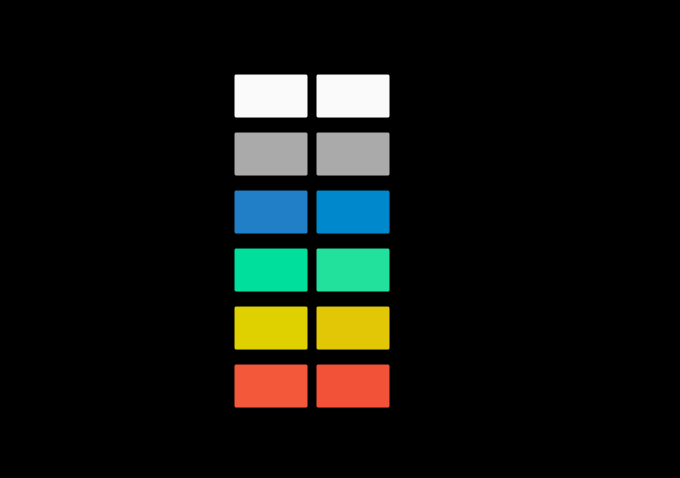
What the same eye reports about one field, in the middle and at the edge. Each row is a uniform field, drawn at the most saturated version of itself this page can show — the percentage is how much of the full stimulus survived, the rest being the adapting light added to bring it inside the gamut. The left patch is what the centre of gaze reports and the right one what 10 degrees out reports, each adapted to the same light as that position sees it. The adapting white comes out identical to 5e-13, because an adapted eye cancels its own filter exactly. Nothing else does, and the largest difference is in the blue. tungsten light is not drawn: it cannot be shown at any useful saturation, and at full strength it differs by ΔE00 1.87.

One person is two observers

The macular pigment is a yellow screen over the fovea and nowhere else, so a cone at the centre of gaze and a cone ten degrees away have different colour-matching functions in the same eye. A match made in the middle comes apart at the edge by six units — and fitting one filter to the gap between the CIE's two standard observers gives a density of 0.40 against a measured 0.35.

eye · Cones
One observer's matching functions, in three of the bases the matches leave free. The three colour-matching functions after a change of basis 0.00 of the way from Hunt–Pointer–Estévez towards the set built from the dichromat confusion points. Every one of these triples predicts exactly the same matches as every other, because a match is an equality and a matrix applied to both sides of an equality changes nothing. What moves is where the peaks are and whether the curves go negative — these ones do not, and going negative is what the 1931 committee constructed XYZ to avoid.

The matches do not name the cones

Colour matching is the whole empirical basis of colorimetry, and it fixes the observer's three curves only up to a nonsingular 3×3 — nine numbers that no match, in any quantity, to any precision, can see. One particular choice of those nine is used throughout here, and it was made for a different purpose.

eye · Cones
What six of this collection's published numbers do when the unit changes. Six quantities, from six calculations that share nothing: a change of light after an observer has adapted, a camera profile's error, the gap between the two standard observers, a metameric pair under the lamp that breaks it, the same image on two papers, and an observer two seconds into a new room. Each is recomputed under all six units and every unit is calibrated onto ΔE2000's scale first, so the bar is not a change of units in the ordinary sense. The bar is the ratio of the largest reading to the smallest, and it runs from 1.71 to 2.30. Five of the six are printed in ΔE2000 by the essays that report them; the sixth is printed in CAM16-UCS, because the model it comes out of defines that unit.

The observers differ by a unit's worth

The gap between the 1931 and 1964 standard observers is the one quantity in this collection's audit with no published number under it — nothing here reports it as a single figure over a stated set. It also has the second-largest dependence on which colour-difference formula is used, running from 1.60 to 3.55 across the menu.

matching · Gamut
How far this site's median observer sits from the 1931 standard, by template. Twenty-four natural reflectances under D65, each given a tristimulus value twice: once by the 1931 colour-matching functions and once by this site's median member, with each judged against its own white. The bar is the mean difference, which is the residual this collection bounds and calls inescapable. It is inescapable, and it is smallest for the simpler template: Lamb's 1995 nomogram gives 0.9006 against Govardovskii's 0.9522, and removing Govardovskii's secondary band brings it down again to 0.9354. Neither is an argument for changing template — a nomogram is fitted to measurements of individual receptors, not to colour matches, so agreement with the standard observer is not what either was trying to achieve. What it says is that the residual is a mismatch between two kinds of observer rather than a shortfall a better pigment model would close. The number after each bar is the template's tail ratio: how far the L cone's half-maximum reaches below its peak against how far it reaches above.

The population rests on a template

Two hundred observers here are built from one formula fitted to microspectrophotometry in 2000. The obvious alternative — the tabulated cone fundamentals — is not available, and the reason is the finding. A tabulated fundamental has no peak wavelength to move, so the moment it is used the population collapses to a single observer.

eye · Cones
A template's asymmetry against what its observer costs. The horizontal axis is the tail ratio of the L cone's pigment absorbance — how far the curve reaches below its peak at half maximum against how far it reaches above — and the vertical is how far the observer built from that template sits from the 1931 standard. A real visual pigment has a long short-wavelength tail, so the three curves derived from a published nomogram sit above 1.1 and the two Gaussians sit below. The four are matched in width, so nothing here is about size. The ordering is the point: the two caricatures cost between two and four times what either nomogram does, and the axis they are separated on is the one feature the caricatures do not have.

A template is mostly its tail

Four pigment templates matched to the same width at the same peak, differing only in which side of the peak their half-maximum reaches further. Ordered by that one number, the observers they build are ordered by how far they sit from the standard one — and the two with the tail on the wrong side cost two and four times what either real nomogram costs.

eye · Cones
How far this collection's analytic observer is from the tabulated one. The construction every figure in this family uses is three pigment absorptances through one fitted 3×3, and this is the residual of that fit against the CIE's 1931 functions: root-mean-square error as a percentage of each curve's peak, and the colour difference it produces over forty-two surfaces. The short-wavelength function is the worst at 16.4 per cent, which is where a pigment template is weakest and where the ocular media are doing most of the work. The median colour difference is 1.42 ΔE₀₀, so this is an observer of the right shape rather than a copy of the table — and every departure in this family should be read beside that number rather than against zero.

The reference had to be built

A five-nanometre error cannot be measured with five-nanometre data. Interpolating the tables and integrating finely measures the interpolator, not the grid — so the audit of this collection's index had to be run against an observer made of formulae, and the price of that is a residual of 1.42 ΔE₀₀ that every number in the section is read beside.

limits · Limits
The arguments a standard observer does not have. Seven choices inside a set of colour-matching functions, each with the shape it takes and what it is worth in ΔE₀₀ on a red pigment under a 6500 K radiator. Six are measurements: a field size, an age, a macular density, a cone optical density, three peak wavelengths and a rod contribution. The seventh is not — a change of basis is a change of curves and not a change of observer, and its entry is exactly zero because the space an experiment measures is what an observer is. Printing that zero beside the others is the clearest statement of what the other six are measurements of.

The third factor is a construction

Every figure in this collection names its observer, which was the whole point. None of them says what an observer is made of. Three curves are not a measurement of the eye; they are a projection of one, with a field size, an age, a macular density, three peak wavelengths and a luminance constraint inside them.

eye · Cones
The arguments a standard observer does not have. Seven choices inside a set of colour-matching functions, each with the shape it takes and what it is worth in ΔE₀₀ on a red pigment under a 6500 K radiator. Six are measurements: a field size, an age, a macular density, a cone optical density, three peak wavelengths and a rod contribution. The seventh is not — a change of basis is a change of curves and not a change of observer, and its entry is exactly zero because the space an experiment measures is what an observer is. Printing that zero beside the others is the clearest statement of what the other six are measurements of.

Three curves for one space

Rotate a set of colour-matching functions by an arbitrary invertible matrix, undo the rotation at the end, and the computed colour is identical to eight parts in a thousand million million. An observer is a three-dimensional subspace, not a set of curves, and the literature keeps reopening a question that is a theorem.

eye · Cones

Named alongside it

The objects these essays reach for when they reach for this one.

Standard observerCone fundamentalsIndividual variationMetamerismObserver metamerismMacular pigmentTrichromacyNull spacePrimariesSpecificationSpectral sensitivityXYZ

All concepts