Concept

Trichromacy — where it appears

Colour vision resting on exactly three classes of receptor, which is why three numbers suffice and why matching is possible at all. It is a fact about the eye rather than about light, and the dimension count is what every colour space inherits.

Named by 10 essays across 4 fields — each of them below, with the objects they name alongside it.

A spectrum, weighted three ways, and the three numbers left over. The illuminant D65 above; below, the same spectrum multiplied by each matching function. The area under each product is one coordinate of XYZ. Everything else about the spectrum — its shape, its structure, all its remaining degrees of freedom — is discarded here.

Three numbers

A spectrum has as many degrees of freedom as anyone cares to give it. The eye reports three. Everything colour science can do, and every way it fails, follows from that one collapse.
eye · Cones
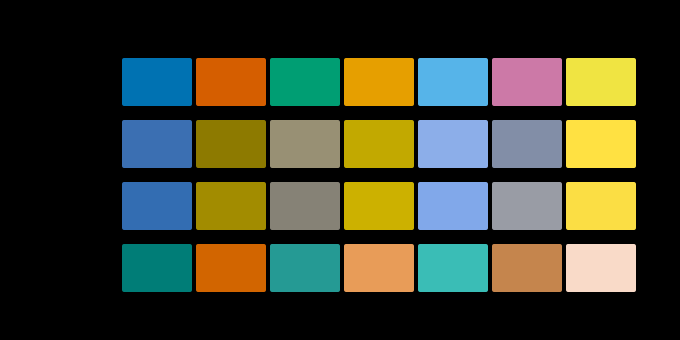
One palette under normal vision and three dichromacies. The same 7 colours simulated by the Brettel–Viénot–Mollon construction at severity 1.0. protanopia and deuteranopia collapse the red-green distinctions, and tritanopia leaves them and collapses blue against yellow instead. This shows which discriminations survive, not what anybody sees.

Simulating what cannot be simulated

A colour-blindness simulation cannot show what anybody sees. What it can show is which discriminations survive, and that is a narrower claim, a checkable one, and the only one worth making.

limits · Limits
Longitudinal chromatic aberration of the eye, focused at 555 nm. Thibos's chromatic eye, plotted as defocus in dioptres relative to 555 nm. The curve crosses zero exactly once, at the wavelength the eye is accommodating on, and everything else is out of focus — by -1.22 D at 420 nm and 0.50 D at 680 nm. Through a 3 mm pupil that first figure is a blur circle of 12.6 minutes of arc, against a foveal acuity limit of about one. The eye is never in focus across the spectrum and never can be.

Nothing is in focus at both ends

The eye carries about two dioptres of chromatic aberration across the visible band, which is a strong reading prescription. Whatever it is focused on, most of the spectrum is landing somewhere other than the retina — and the cone class that gets the worst of it is the one the retina bothered least to sample.

eye · Cones
Three retinas of different composition, making identical colour matches. Seeded mosaics at L:M ratios of 1, 4, 16 to one — the range found between people, and a 16-fold difference in what the retina is made of. A colour match is the claim that two spectra produce equal excitation in all three cone classes, and changing how many of a class there are multiplies that class's excitation by a constant, which cannot disturb an equality. The relation between the two test spectra is identical to twelve decimal places across the whole sweep. Luminance, which is a weighted sum rather than an equality, moves by 1.33× over the same range. That asymmetry is why a standard observer exists and why V(λ) has a much larger between-observer variance than the colour-matching functions do.

The mosaic is not the observer

The ratio of long-wavelength to medium-wavelength cones varies between ordinary people by a factor of sixteen. Those people make the same colour matches, to twelve decimal places, and that single fact is the reason a standard observer can exist at all.

eye · Cones
A camera's spectral sensitivities, after the infrared-cut filter. Silicon quantum efficiency times the colour-filter dye times the infrared-cut filter, per channel, on a grid running to 1100 nm rather than to 780. With the filter removed, 68 per cent of the area under the three curves lies beyond the visible band, and all three curves are the same curve out there.

A camera is a fourth observer

The 1931 functions, the 1964 functions and a person's own cones are three sets of three curves that collapse a spectrum onto three numbers. A camera is a fourth, built from silicon and dye rather than from pigment and neural wiring, and it agrees with none of them.

imaging · Capture
Cone density, out from the centre of gaze. Quoted landmarks with logarithmic interpolation between them: 199,000 cones per square millimetre at the fovea, 9,500 at ten degrees — a factor of 21. The shaded bands are the two standard observers' fields. The 2° observer averages over a region whose density falls by 3.3× between its centre and its edge and the 10° observer by 12.4×, which is what "a 10° field" contains and is why the two sets of matching functions are different shapes rather than the same shape scaled.

Colour stops at the edge of sight

Cone density falls twenty-one-fold between the centre of gaze and ten degrees out, and the three channels give out at three different rates — so a colour difference in the periphery does not merely shrink, it turns. At the exact point of fixation there are no short-wavelength cones at all.

eye · Cones
Grassmann's four laws, exact — and the two things that break them. For a linear observer every one of the four is exact and the residual is floating point, which is the control that makes the two failures below measurements rather than artefacts. Rods break a cone-metameric match by 23 per cent of a rod excitation at dusk; bleaching breaks it by 0.59 per cent of a cone excitation in the sun. Both are stated as fractions of a receptor's own response, so they can be put on one scale.

The laws that make colour add up

Colorimetry is an integral, and an integral assumes matching is linear. Grassmann's four laws are exact for a linear observer, to floating point — and they fail at both ends of the light range, by two different mechanisms, leaving colorimetry an operating band of three and a bit decades that no standard states.

matching · Gamut
One match, and what it says about the observer making it. The anomaloscope: a monochromatic 589 nm yellow set against a mixture of 545 and 670 nm. Only two cone classes respond at those wavelengths, so the match is two equations in two unknowns and has one solution for any observer whose two pigments differ. The bar is the fraction of the accepted band; the mark is the solution. A normal observer accepts 0.7 per cent of the scale; an observer whose two pigments are the same accepts all of it, because their two equations are one equation twice. Nothing here is fitted to clinical data: the pigments are the same template used for every observer here, at stated peaks, and the match is the solution of the linear system.

One match names the observer

A yellow at 589 nanometres set against a mixture of 545 and 670 is two equations in two unknowns. It has one solution for a normal observer, a solution somewhere else for an anomalous one, and no unique solution at all for a dichromat — whose two equations are one equation twice.

matching · Gamut
One observer's matching functions, in three of the bases the matches leave free. The three colour-matching functions after a change of basis 0.00 of the way from Hunt–Pointer–Estévez towards the set built from the dichromat confusion points. Every one of these triples predicts exactly the same matches as every other, because a match is an equality and a matrix applied to both sides of an equality changes nothing. What moves is where the peaks are and whether the curves go negative — these ones do not, and going negative is what the 1931 committee constructed XYZ to avoid.

The matches do not name the cones

Colour matching is the whole empirical basis of colorimetry, and it fixes the observer's three curves only up to a nonsingular 3×3 — nine numbers that no match, in any quantity, to any precision, can see. One particular choice of those nine is used throughout here, and it was made for a different purpose.

eye · Cones
The three cone absorptances at two settings of the rods. Solid and dashed are the same construction at the two ends of a tenth of the cone response, which is a dim room. The curves are built from one pigment template through its ocular media, which is the same model its population of two hundred eyes is drawn from. The largest difference between the two sets is 9.1 per cent of the peak, and where it sits along the wavelength axis is what decides which stimuli the two observers disagree about — a departure concentrated in the blue is invisible on a sample with no blue in it.

The rods are a fourth curve

Colorimetry has three numbers and a rod signal is a fourth. It cannot be absorbed by a gain, it cannot be removed by a white point, and adding a tenth of one to a three-curve observer costs 1.60 ΔE₀₀ — the narrowest distribution of the six departures, because an addition behaves quite differently from a filter.

eye · Cones

Named alongside it

The objects these essays reach for when they reach for this one.

Standard observerCone fundamentalsColour-matching functionsColour vision deficiencyIndividual variationMetamerismSpectral sensitivityLuminanceVisual pigmentAdaptationΔELuminous efficiency

All concepts