Concept

Colour vision deficiency — where it appears

A cone class missing or shifted, which reduces the dimension of colour matching or narrows the space between two channels. Simulating it names a model and a severity, because no method supports the claim that a picture shows what such an observer sees.

Named by 7 essays across 3 fields — each of them below, with the objects they name alongside it.
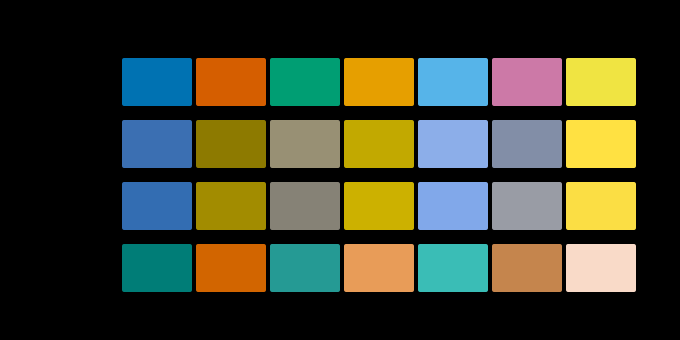
One palette under normal vision and three dichromacies. The same 7 colours simulated by the Brettel–Viénot–Mollon construction at severity 1.0. protanopia and deuteranopia collapse the red-green distinctions, and tritanopia leaves them and collapses blue against yellow instead. This shows which discriminations survive, not what anybody sees.

Simulating what cannot be simulated

A colour-blindness simulation cannot show what anybody sees. What it can show is which discriminations survive, and that is a narrower claim, a checkable one, and the only one worth making.

limits · Limits
Cone density, out from the centre of gaze. Quoted landmarks with logarithmic interpolation between them: 199,000 cones per square millimetre at the fovea, 9,500 at ten degrees — a factor of 21. The shaded bands are the two standard observers' fields. The 2° observer averages over a region whose density falls by 3.3× between its centre and its edge and the 10° observer by 12.4×, which is what "a 10° field" contains and is why the two sets of matching functions are different shapes rather than the same shape scaled.

Colour stops at the edge of sight

Cone density falls twenty-one-fold between the centre of gaze and ten degrees out, and the three channels give out at three different rates — so a colour difference in the periphery does not merely shrink, it turns. At the exact point of fixation there are no short-wavelength cones at all.

eye · Cones
One match, and what it says about the observer making it. The anomaloscope: a monochromatic 589 nm yellow set against a mixture of 545 and 670 nm. Only two cone classes respond at those wavelengths, so the match is two equations in two unknowns and has one solution for any observer whose two pigments differ. The bar is the fraction of the accepted band; the mark is the solution. A normal observer accepts 0.7 per cent of the scale; an observer whose two pigments are the same accepts all of it, because their two equations are one equation twice. Nothing here is fitted to clinical data: the pigments are the same template used for every observer here, at stated peaks, and the match is the solution of the linear system.

One match names the observer

A yellow at 589 nanometres set against a mixture of 545 and 670 is two equations in two unknowns. It has one solution for a normal observer, a solution somewhere else for an anomalous one, and no unique solution at all for a dichromat — whose two equations are one equation twice.

matching · Gamut
One observer's matching functions, in three of the bases the matches leave free. The three colour-matching functions after a change of basis 0.00 of the way from Hunt–Pointer–Estévez towards the set built from the dichromat confusion points. Every one of these triples predicts exactly the same matches as every other, because a match is an equality and a matrix applied to both sides of an equality changes nothing. What moves is where the peaks are and whether the curves go negative — these ones do not, and going negative is what the 1931 committee constructed XYZ to avoid.

The matches do not name the cones

Colour matching is the whole empirical basis of colorimetry, and it fixes the observer's three curves only up to a nonsingular 3×3 — nine numbers that no match, in any quantity, to any precision, can see. One particular choice of those nine is used throughout here, and it was made for a different purpose.

eye · Cones
Where a dichromat's confusions converge. Every pair of colours a protanope cannot tell apart lies on one of these lines, and all the lines meet at a single point — at (0.7465, 0.2535) for this class. The point is the chromaticity of the missing cone's own response direction, which is why it need not lie inside the diagram or correspond to any light at all. Two of the three do not. The three points between them carry six numbers, and six is two thirds of what the matching data leave undetermined.

A confusion point is a missing pigment

The nine numbers colour matching leaves free are fixed by three points on a chromaticity diagram, each of them the place where everything one class of dichromat cannot tell apart converges. Two of the three lie outside the diagram entirely, which is not a defect — a direction in tristimulus space need not correspond to a light.

eye · Cones
Which of this collection's own claims survive a change of basis, and which are about the paper. Nine sentences this site says, sorted by whether they mean the same thing after the observer's three curves are replaced by a nonsingular combination of themselves. 5 of the nine do. The four that do not are not thereby wrong — they are statements about a chosen set of coordinates, and they are true of those coordinates. What they cannot be is statements about the eye, which is how every one of them is usually read.

Which of these is a convention

Nine ordinary sentences from this collection, put through one test — do they mean the same thing after the observer's three curves are replaced by a nonsingular combination of themselves? Five survive and four do not, and none of the four is wrong, because each is a statement about a set of coordinates being read as a statement about an eye.

limits · Limits
The three cone absorptances at two settings of the rods. Solid and dashed are the same construction at the two ends of a tenth of the cone response, which is a dim room. The curves are built from one pigment template through its ocular media, which is the same model its population of two hundred eyes is drawn from. The largest difference between the two sets is 9.1 per cent of the peak, and where it sits along the wavelength axis is what decides which stimuli the two observers disagree about — a departure concentrated in the blue is invisible on a sample with no blue in it.

The rods are a fourth curve

Colorimetry has three numbers and a rod signal is a fourth. It cannot be absorbed by a gain, it cannot be removed by a white point, and adding a tenth of one to a three-curve observer costs 1.60 ΔE₀₀ — the narrowest distribution of the six departures, because an addition behaves quite differently from a filter.

eye · Cones

Named alongside it

The objects these essays reach for when they reach for this one.

Standard observerTrichromacyCone fundamentalsIdentifiabilityIndividual variationAssertionColour-matching functionsConfusion lineCopunctal pointDegrees of freedomΔEDeuteranopia

All concepts