Assertion — where it appears
Named by 51 essays across 9 fields — each of them below, with the objects they name alongside it.
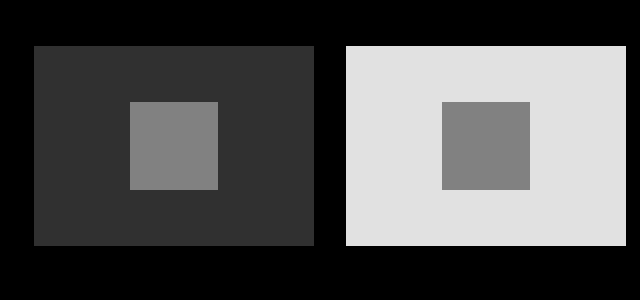
These two patches are identical
It is the most repeated and least checkable sentence in visual perception, because the whole point is that it does not look true. Every instance here is computed, and checked before the figure is drawn.
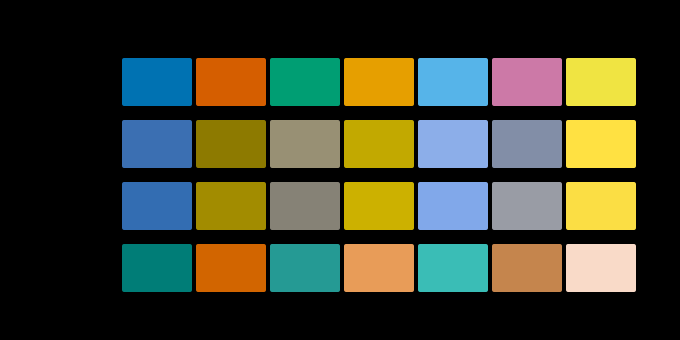
Simulating what cannot be simulated
A colour-blindness simulation cannot show what anybody sees. What it can show is which discriminations survive, and that is a narrower claim, a checkable one, and the only one worth making.
A difference is not a distance
Two earlier essays here said that CIEDE2000 violates the triangle inequality and left it at that. Searching for the violation finds a detour half the length of the direct route, a smaller one inside a five-unit ball, and a second defect nobody mentions — ΔE94 is not even symmetric.
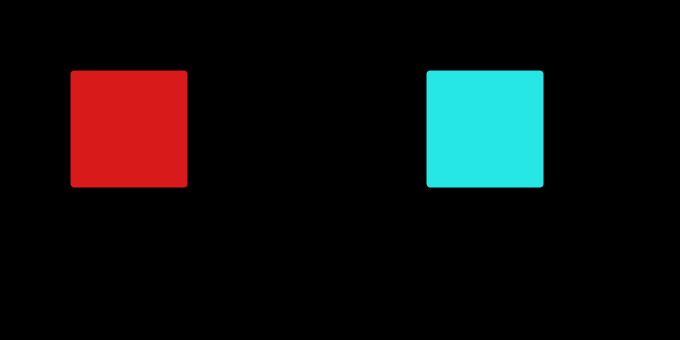
An afterimage is an adaptation
The demonstration everybody gives is an inverted image, which is a statement about a file format. Running the receptoral arithmetic instead puts the afterimage of a saturated red sixty degrees of hue away from the inverse — and outside what any display can show.

The model has no clock
An appearance model takes a stimulus and a situation and returns what it looks like. It does not take a time, and adaptation is not instantaneous — half a second after the light changes a judgement is three and a half CAM16-UCS units from the settled one, and a minute later it is still 1.3.

A name is not a threshold
Two colours have to move about ten times a just-noticeable difference apart before people stop calling them the same thing, and how far varies threefold across one plane of the space. A tolerance and a word are answering different questions, and nothing in colorimetry converts between them.

The drift is a luminance mechanism
The eye's own drift was shown to sit inside a band of speeds that keeps every spatial frequency modulating, and the band was quoted as though it were about vision. Asked about colour, it has no slow edge at all — a stationary chromatic pattern needs no eye movement whatever. And a stabilised chromatic pattern is the first thing to fade.

The slowest clock is chemical
An earlier essay here joined the afterimage to the adaptation clock and named what was still missing — a third gain, upstream of both, in the pigment itself. It is twice as slow as anything measured before it, it leaves a coloured after-tint from a white field, and at steady state it cancels exactly, which is why nobody has ever needed to model it.

The list nobody made
The last phase found that reading a filtered signal at a point asks a question its thresholds were never fitted to, made it a standing rule, and admitted that nobody had gone back through the site to see which claims it touched. Here is the list. Every claim with noise on one side of it moves — and so do two that have no noise in them at all, which the rule said would not.
There is no word for that colour
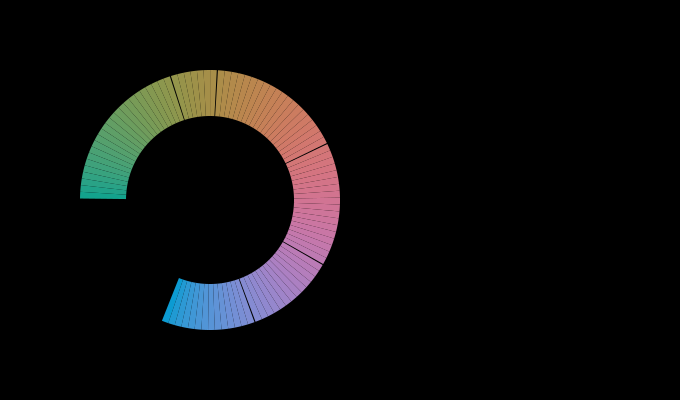
The naming model built this phase gives a saturated cyan the name green, calls part of a chromatic ring grey, and puts one of the eleven focal colours outside what a display can show. Each failure is a measurement rather than a disclaimer, and together they say what a vocabulary is that eleven points and a distance are not.

What a still eye stops seeing
A stabilised image is said to vanish, and nothing in a temporal filter predicts it — sensitivity at zero frequency is a quarter of the peak, not nothing. Give the adaptation gain a size and the answer falls out — fading is a high-pass filter that switches on over a minute, it takes the fill and leaves the outline, and a patch has to be about two degrees across before it goes at all.

A viewing condition is a moment
CIECAM16's degree of adaptation is a function of the surround and the adapting luminance and of nothing else, because the model has no time in it. Solving for when an observer who will adapt completely has got that far turns the standard's three surrounds into three clock readings — 107, 50 and 21 seconds — and the two readings are distinguishable by waiting.

What a second model changed
Thirteen claims here, each computed with one model and recomputed with two. Ten of them move by half again or more. Three of them do not move at all in the ordinary sense — the first model's answer is exactly zero, not because it computed zero but because it has no variable for the quantity — and every one of those three is a join that supplied a state or a device rather than a spread.

What no adaptation can remove
A change of light is exactly a 3×3 matrix on tristimulus values, and adaptation is a diagonal one. Putting every change of illumination this site models through that distinction sorts them by how much of themselves they leave behind, and the smallest residual in the census belongs to a filter inside the eye.

A gain needs a basis
Adaptation scales three signals, and which three is a choice. The basis in which a change from D65 to D50 is exactly diagonal can be computed in closed form from the two spectra, it beats every published transform on daylight by a factor of five, and it loses to all of them on a fluorescent tube.

Which lamp changes are free
The changes of light that existed before electricity commute with one another to a couple of parts in a thousand, so one set of axes handles all of them. The lights the lighting industry invented do not, and the worst pair in the census is seventy-six times further from commuting than the best.

The same wall applied twice
A bounce off a painted wall is a change of illumination, and adaptation handles it about as well as it handles a change of colour temperature. A corner applies the same reflectance twice, which sharpens it — and leaves an adapted observer with 1.96 times as much for a change only 1.33 times as large.

The filters inside the eye
The macular pigment leaves 2.4 per cent of itself after adaptation — the smallest share of anything in this site's census of light changes, and less than half the next smallest. Fifty years of lens yellowing leaves 7.9 per cent, and the difference between the two says what a gain is actually good at.

A camera balances in another basis
White balance is a per-channel gain on raw values, which makes it a von Kries adaptation in whatever axes the filter dyes happen to give. Those axes are not a property of the dyes alone — they move with the light, by up to seventeen degrees across the adaptation census — and the sensor for which they would not move is the one that adapts worst of all.

Dividing by the paper
Media-relative colorimetry divides tristimulus values by the substrate's, which is a von Kries adaptation applied in XYZ — the one basis the table here describes as the oldest mistake still shipping. On a paper-mill white it costs a few hundredths of a unit. On a tinted sheet it costs ten times what the same rule costs in a cone basis.

One unit in another room
Twenty-three pairs built at exactly ΔE00 1.000 under D65, re-measured under every change of light this site models with the observer adapted to each, come out anywhere between 0.64 and 1.57. A tolerance is written as a property of a pair and it is a property of a pair and a room.

A gamut has a population
Whether a display can reproduce a paint is a fact about somebody's cones, so the boundary of a gamut is not a curve but a band. On a laser projector, ten of twenty-eight boundary surfaces are ones the standard observer calls displayable and some real people cannot see — and the wider the gamut, the wider the band.

An instrument has a geometry
Every reflectance here arrives through a model with a bandpass, a sampling interval and no position at all. Real instruments say where they were standing, and the two standard answers disagree by ΔE00 8.35 on a dark gloss sample — a difference that adds rather than multiplies, and that no adaptation removes.

A surface that is not a multiplication
Every argument here about what light does to a surface begins by multiplying two spectra together. A surface with a brightener in it takes light at one wavelength and returns it at another, so it is a full operator rather than a diagonal one — and it does not have a reflectance at all.

A fading pool has a shape
Giving the local adaptation pool two axes instead of one costs a single parameter and produces a prediction the circular version cannot make — a stabilised grating fades at a rate that depends on which way its bars run. The obvious objection is the oblique effect, and the two act in bands that do not overlap.

A name in the model's own words
The eleven basic colour terms move when the room does, and the obvious objection is that they were being measured in a space with no room in it. Quoting them in an appearance model's own coordinates instead does not shrink the renaming — it grows it by four per cent — and the space alone renames an eighth of the gamut with the room held still.

Only one dimmer is invisible
An earlier essay separated the three ways to dim a lamp by the chromaticity each arrives at. Asked instead what an adapted observer is left with, the ordering is different and one method comes out at exactly zero — a duty cycle is a scaling, a scaling is a gain in every basis, and adaptation removes all of it at every depth.

Only one of these devices adapts
An eye, a camera, a display and a press all meet the same changes of light, and each has at most one thing it can do about them. The press has nothing at all, so its column is the whole change; and this collection's sensor built to satisfy the Luther condition exactly is the one that adapts worst.

The tables do not stop together
This collection integrates from 380 to 780 nanometres, and decided once, in writing, that the range could not honestly be widened. The argument was correct at the long end and wrong at the short one — the CIE publishes the daylight basis from 300 nanometres, and publishes it from there for exactly the reason it matters.

A reflectance is a diagonal
A reflecting surface returns light at the wavelength it arrived at, so its whole description is one number per wavelength. A fluorescent one returns it somewhere else, so its description is a square matrix — and the curve every instrument reports is that matrix's diagonal with the rest of it folded in at whatever weight the lamp happened to give.

Two sheets that match until the window
Ordinary metamerism is two reflectances that agree under one light and not another, and it can always be undone by putting the first light back. A dyed sheet and a brightened one have the same reflectance everywhere an eye can see, agree exactly under any lamp with no ultraviolet, and separate by ten units under daylight — and no change of light puts them back together.

A tolerance cannot cross a condition
If two measurement conditions disagree by seven units, the obvious repair is a correction matrix fitted between them. The best least-squares 3×3 over seventeen printed patches leaves 23 per cent of the disagreement and makes five patches worse than doing nothing — because the term it is trying to remove is proportional to how much paper is showing, and no linear map on three numbers can express that.

A white that is not a reflectance
The object-colour solid is the hardest boundary in colorimetry — the set of tristimulus values any reflecting surface can produce, with no assumption about pigments in it at all. A coated press stock under a measurement standard's own lamp sits 1.5 per cent outside it, and a heavily brightened one 4.0, and with the ultraviolet removed both come back inside.

Which of these is a convention
Nine ordinary sentences from this collection, put through one test — do they mean the same thing after the observer's three curves are replaced by a nonsingular combination of themselves? Five survive and four do not, and none of the four is wrong, because each is a statement about a set of coordinates being read as a statement about an eye.

The condition chooses no axes
It has long been said here that a sensor satisfying the Luther condition exactly adapts worse than a silicon one, and offered a reason — that its channels are the matching functions, and a gain on those is the oldest mistake in the subject. The measurement was of one sensor. The condition leaves the axes entirely free.
A pool with an edge
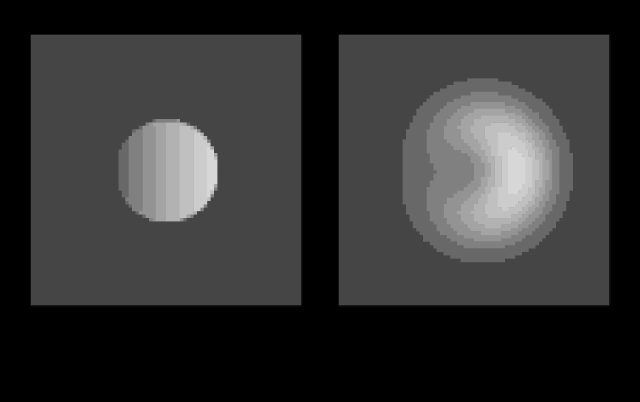
A Gaussian pool says how much of a stabilised image survives and can say nothing about what the remainder looks like, because a Gaussian has no edge. Give the pool a boundary and the interior of a faded region takes the average of its own border — exactly, by the mean value theorem, arriving as a prediction about appearance.

A gap in the drive, not in the wall
Break the contour around a region and leave its border signal unbroken, and the interior does not move by one part in a million — a ring of driven cells encloses a centre whatever the wall outside it is doing. Break the signal too and the shortfall goes as the square of what is missing. All of what a gap costs is the piece of border that stopped driving.

A constraint costs what it points at
Three primary chromaticities remove three of the nine numbers in an adaptation basis and cost one per cent. Three dichromat confusion points remove six and cost seventy. Counting what a constraint removes predicts neither, because an optimum is a long bowl and what matters is which way the constraint points.

A pair the aperture separates
Two constructed slabs with the same reflectance at every wavelength, to fifteen figures — the same colour to any observer under any light — and 6.25 ΔE₀₀ apart when measured through a four-millimetre aperture. It is a metamerism with no observer in it, no illuminant in it, and no spectral difference to construct it from.

A neutral has no grid
A perfectly flat reflectance computes to exactly the same colour on every wavelength grid, through every slit, at every origin, and for every observer — not nearly, but to the last bit of a floating-point number. The condition is an identity rather than a limit, and what makes it one is the white point.

The reference had to be built
A five-nanometre error cannot be measured with five-nanometre data. Interpolating the tables and integrating finely measures the interpolator, not the grid — so the audit of this collection's index had to be run against an observer made of formulae, and the price of that is a residual of 1.42 ΔE₀₀ that every number in the section is read beside.

A neutral is everyone's colour
Two eyes differing by fifty years of lens yellowing, by a factor of three in macular pigment and by six nanometres of long-wavelength peak agree about a grey card to four parts in ten thousand billion. The agreement is an identity rather than a coincidence, and it says exactly what an observer disagreement is a disagreement about.

A gain is not an observer
Multiply one eye's three cone sensitivities by 1.6, 0.7 and 2.4 and it is not a different eye. The white-point division is that multiplication's inverse, so the two agree exactly — and most of what a cone optical density change does is that multiplication, which is why the largest number in the table of individual variation is the one that matters least.

Three curves for one space
Rotate a set of colour-matching functions by an arbitrary invertible matrix, undo the rotation at the end, and the computed colour is identical to eight parts in a thousand million million. An observer is a three-dimensional subspace, not a set of curves, and the literature keeps reopening a question that is a theorem.

The identity is in the eye's own coordinates
Two conditions in this round are exact — a gain on each cone is not a different observer, and three curves for one space are one observer. Imposed in a published cone space rather than the eye's own they leave 13.0 and 8.11 ΔE₀₀ standing. The identities belong to the physiology and every arithmetic in use works somewhere else.

A departure is straight in the excitations
Walk a sample a quarter of the way from the light towards its own reflectance and exactly a quarter of the observer disagreement remains — in cone excitations, to two parts in a hundred. In ΔE₀₀ the same quarter leaves 0.347 where proportionality wants 0.428, and the discrepancy belongs entirely to the unit.

One wavelength is everyone's colour
A stimulus with a single wavelength in it produces the same relative cone excitations for every observer, exactly, whatever their age or field size. A display made of three such stimuli is where observers disagree most. Both statements are consequences of the same algebra, and the second is why laser projection has an observer problem.

Thirty unknowns instead of six
A directional transport solver is worth nothing until it reproduces the one it replaces. Setting every wall's bidirectional distribution to ρ over π collapses thirty ordered-pair radiances onto six radiosities and reproduces this collection's existing answer to 9.8 × 10⁻¹⁶ relative — which is the only reason anything else it says can be believed.
Two observers and one metamer
An observer departure is invisible on a single sample compared with nothing. It becomes a disagreement the moment two spectra are being asked to match, because a match is an identity between three integrals and a different observer takes different integrals. Everything in this round is a statement about pairs wearing a single sample's clothes.

Three audits and one shape
The tabulation, the observer and the scene solver have nothing in common as subjects. Each turned out to hold a departure that is a pairing of two deviations, vanishes exactly when either is empty, and had been invisible because its parameter had no call site. Three subjects, one shape, and the shape is the round's result.
The conditions are the result
The round measured about twenty departures and established ten conditions. The departures are numbers that depend on a sample, a light and a construction; the conditions are exact, they hold under every substitution tried, and they are what a reader can act on. A size is a measurement and a condition is a mechanism.
Named alongside it
The objects these essays reach for when they reach for this one.
Chromatic adaptationAdaptationStandard observerIndividual variationSpecificationThe von Kries transformInvarianceReflectanceIlluminantCone fundamentalsMeasurement errorMetamerism