Illuminant — where it appears
Named by 69 essays across 9 fields — each of them below, with the objects they name alongside it.

A spectrum is not a colour
What arrives at the eye is a function of wavelength. What the eye reports is three numbers. Keeping the two apart is the single most useful habit in the subject, and almost every confusion in applied colour comes from letting them merge.

Blackbody and the colour of temperature
Heat something and it glows, in a colour fixed by its temperature alone. Planck's law gives the whole spectrum from one number, and the Planckian locus is the only curve in colour science derived from physics rather than from measurements of people.
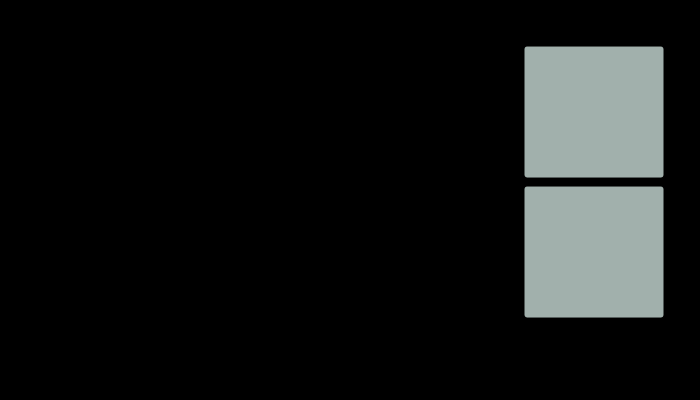
Two spectra, one colour
Metamerism is usually described and almost never demonstrated. It does not have to be — the metameric black space is enormous, so a matching pair can be constructed to order, verified, and then made to come apart by changing the light.

Constancy is the default
A sheet of paper looks white in daylight and white under a tungsten lamp, although the light reaching the eye differs enormously. The visual system is solving one equation with two unknowns, and it solves it by assumption.

The illuminant is half the answer
An object has a reflectance, not a colour. The colour appears when a specified light falls on it, which is why two surfaces can match in a shop and clash outside, and why every serious matching standard names the light.

Some paper is brighter than white
The reflectance model assumes light leaving at a wavelength arrived at that wavelength. A fluorescent sample breaks the assumption, has no reflectance curve at all, and is in almost every sheet of white paper sold.

Four ways to move a white point
Every chromatic adaptation transform is the same three lines with a different matrix. The matrices disagree by more than any tolerance a supplier is held to, and the oldest one — still shipping, still called von Kries — is not a cone basis at all.

What the instrument reports
A spectrophotometer sees a sample through a slit of finite width, at a finite number of wavelengths. What it writes down is the truth convolved with its own bandpass, and nothing in the file says which values were measured and which were invented.

What a lamp cannot give back
Six hundred and eighty-three lumens per watt is not a measurement of anything. It is the definition of the candela, it is a ceiling no white light can approach, and the distance between a lamp and that ceiling is mostly the price of being able to see what colour things are.
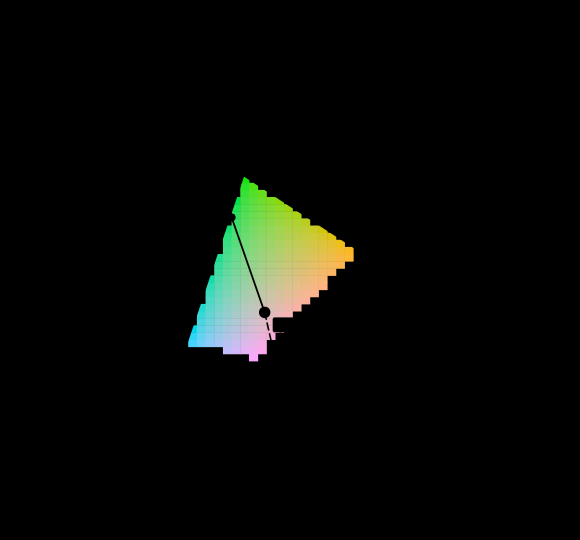
Not every colour has a wavelength
The question every reader arrives with is which wavelength a colour is. For close to a third of the directions on the chromaticity diagram the honest answer is that there is none, and the construction colorimetry offers instead is a statement about a diagram rather than about light.
The algorithms that guess the light
What reaches a sensor is an illuminant multiplied by a reflectance, and no arithmetic separates a product into its factors. Every white-balance algorithm therefore works by assuming something about the world — and the interesting content of each is not its formula but the assumption, because a scene can violate it.

The sun is not one illuminant
Daylight is not a blackbody and is not one spectrum. It is a one-parameter family reconstructed from three measured basis functions, its chromaticities lie on a curve that is near the Planckian locus and not on it, and the difference is the reason a colour temperature needs a second number beside it.
A bounce is a multiplication
Colorimetry multiplies an illuminant by a reflectance once and integrates. A surface in a room is lit by every other surface the lamp reached first, so the spectrum arriving at the eye has been multiplied several times — and the second multiplication is where the whole apparatus of matching starts to come apart.

A shadow has its own illuminant
Outdoors there are two lights, not one. The direct beam is a radiator reddened by the atmosphere; the sky is precisely the power that reddening removed. A shadow is lit by the second alone, so shadowed ground and sunlit ground sit under illuminants 21 units of ΔE apart — before any surface, any eye or any opinion is involved.

The highlight is the lamp
Light reflected at the surface of a glossy material never entered it, so it never met a pigment. Fresnel's reflectance varies by 5.5% across the visible band and the paint underneath varies by a factor of twenty — which makes a highlight the one region of a photograph that reports what the light was rather than what the object is.
What a white wall costs
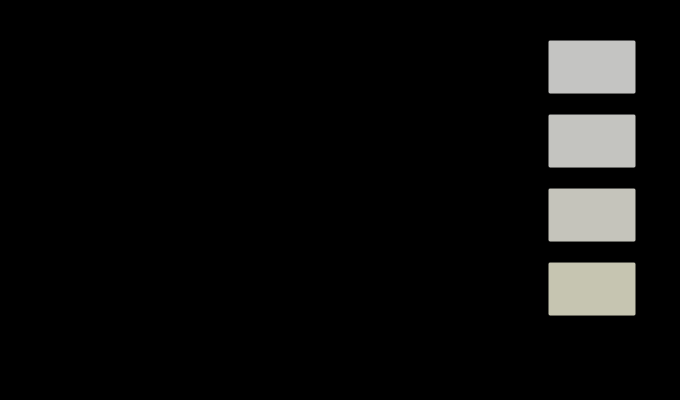
A closed room returns 1/(1−ρ) times the light that entered it, computed band by band — so a paint that is five percent off neutral becomes a strongly coloured illuminant once the room has finished bouncing. The gain amplifies the tint along with the brightness, and the last few percent of albedo cost far more than the first.
The room is the illuminant
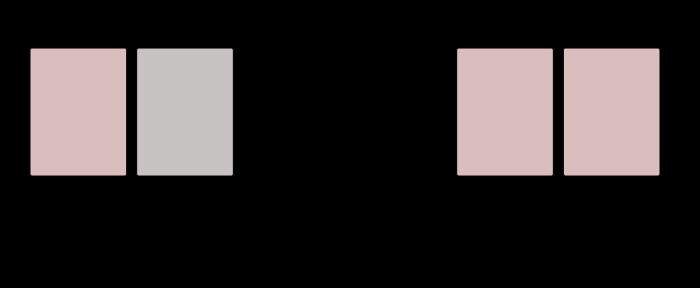
Colour bleeding is usually described as an aesthetic phenomenon of rendered images. It is better described as a measurement. In a room with one lamp, five of six surfaces emit nothing at all, so their light is entirely a product of other surfaces' reflectances — and the bleeding saturates rather than running away, for a reason worth deriving.
A scene has no white point
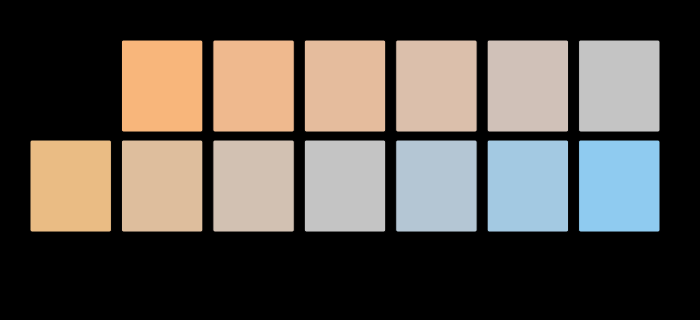
White balance is one transform applied to a whole image, and a scene lit by two lamps has no single answer for that transform to be. The failure is structural rather than a matter of a better estimator — and every colour-managed workflow in existence takes exactly one white point as an input, with no field in which to say there were two.

The filter that makes colour possible
An infrared-cut filter is not a refinement on a colour camera. Removing it collapses the separation between the three channels by a factor of nearly nine under tungsten, and the component that keeps colour photography working is the one nobody photographs.

Most things are pale in the infrared
A spectrophotometer stops at 780 nanometres and a black cotton shirt reflecting five per cent of visible light reflects more than half the near infrared. The measurement everybody has and the quantity a camera integrates are different quantities, and nothing in the first says so.

A camera profile is a fit
Since no matrix is exact, the one a manufacturer ships is a least-squares compromise over a set of surfaces somebody chose. Fitted on desaturated patches it is excellent on desaturated patches — and the sample set is a hidden argument to every camera profile in existence.

The highlight is the white balance
Every estimator a camera uses is an assumption about the scene wearing the costume of a measurement. The specular component of a glossy surface is not — it carries the illuminant to within a third of a degree on a scene where averaging is fifty times worse, and it does so without knowing what colour the paint underneath is.

The grid outside every figure
Every figure here is computed on 380 to 780 nanometres, which is exactly right for an eye and insufficient for a sensor. This field met the first subject the grid cannot hold, and the decision was not to widen it — because widening it honestly is impossible.

Two lamps do not average
Light adds, band by band, and every number a lamp is sold by is a projection of the sum rather than a sum of the projections. Two radiators sitting exactly on the Planckian locus mix into a light that is measurably pink; two poor lamps mix into a better one than either.

There is no D65 lamp
D65 is standardised by three numbers, and three numbers do not pin a spectrum. A source built to hit them exactly — matched to a part in a billion, with a third of the visible band nearly empty — separates pairs that D65 says are identical by up to eight and a half units of colour difference.

White is a region
A lamp is not sold as a chromaticity. It is sold as 4000 K, and what that means is that its chromaticity fell inside a quadrangle — which two lamps can occupy at opposite corners, eleven ΔE00 apart. In a room with either of them, the same twelve surfaces differ by one unit.

A screen is a poor lamp
A display's white is a light. Shone on a surface it renders colour worse than a fluorescent tube — and the wider the gamut, the worse it gets, because the narrow primaries that buy a large triangle are exactly the ones that leave holes in the spectrum.

A lamp has a direction
A white LED is a blue die under a converter, and light leaving at an angle has travelled further through the converter than light leaving straight up. So the mixture is different in every direction, the beam is bluer in the middle than at its edge, and the number on the box is one direction's worth of a device that has no single colour.

Three ways to dim a lamp
"Dimmed to ten per cent" names three different colours. Switching the lamp on and off faster than anybody can see changes the chromaticity by nothing at all — exactly, to floating point. Reducing the current moves it a few units. Reducing the power to a filament moves it eighteen hundred kelvin down the Planckian locus, and stays on the locus exactly the whole way.

A lamp switched on is not the lamp measured
A luminaire takes about seven minutes to reach nine tenths of its working temperature, loses a quarter of its output on the way, and moves ΔE00 2.6 while it does. That is slower than every clock in the eye — so for the first minutes after a switch is thrown, both ends of the measurement are moving, and every appearance claim here has assumed one of them was still.

The room settles after the eye does
Four clocks run in a room and only three of them are in the observer. The slowest is the lamp, which takes four hundred seconds to reach nine tenths of its colour change — so a minute after the light goes on, when the eye is conventionally said to have settled, most of what is left is the lamp, and three quarters of that could not be adapted away by an observer of any speed.

The booth is a luminaire
A standard viewing booth is specified by its light's chromaticity, its rendering and the uniformity of its illuminance across the sample plane. Illuminance is a photometric integral, so two positions can be inside the uniformity tolerance and lit by two different spectra — and a sample at the far corner of a compliant booth is ΔE00 2.4 from one in the middle, against a tolerance of one.

What no adaptation can remove
A change of light is exactly a 3×3 matrix on tristimulus values, and adaptation is a diagonal one. Putting every change of illumination this site models through that distinction sorts them by how much of themselves they leave behind, and the smallest residual in the census belongs to a filter inside the eye.

A gain needs a basis
Adaptation scales three signals, and which three is a choice. The basis in which a change from D65 to D50 is exactly diagonal can be computed in closed form from the two spectra, it beats every published transform on daylight by a factor of five, and it loses to all of them on a fluorescent tube.

Which lamp changes are free
The changes of light that existed before electricity commute with one another to a couple of parts in a thousand, so one set of axes handles all of them. The lights the lighting industry invented do not, and the worst pair in the census is seventy-six times further from commuting than the best.

The same wall applied twice
A bounce off a painted wall is a change of illumination, and adaptation handles it about as well as it handles a change of colour temperature. A corner applies the same reflectance twice, which sharpens it — and leaves an adapted observer with 1.96 times as much for a change only 1.33 times as large.

A camera balances in another basis
White balance is a per-channel gain on raw values, which makes it a von Kries adaptation in whatever axes the filter dyes happen to give. Those axes are not a property of the dyes alone — they move with the light, by up to seventeen degrees across the adaptation census — and the sensor for which they would not move is the one that adapts worst of all.

One unit in another room
Twenty-three pairs built at exactly ΔE00 1.000 under D65, re-measured under every change of light this site models with the observer adapted to each, come out anywhere between 0.64 and 1.57. A tolerance is written as a property of a pair and it is a property of a pair and a room.
A surface that is not a multiplication
Every argument here about what light does to a surface begins by multiplying two spectra together. A surface with a brightener in it takes light at one wavelength and returns it at another, so it is a full operator rather than a diagonal one — and it does not have a reflectance at all.

The tables do not stop together
This collection integrates from 380 to 780 nanometres, and decided once, in writing, that the range could not honestly be widened. The argument was correct at the long end and wrong at the short one — the CIE publishes the daylight basis from 300 nanometres, and publishes it from there for exactly the reason it matters.

A reflectance is a diagonal
A reflecting surface returns light at the wavelength it arrived at, so its whole description is one number per wavelength. A fluorescent one returns it somewhere else, so its description is a square matrix — and the curve every instrument reports is that matrix's diagonal with the rest of it folded in at whatever weight the lamp happened to give.

Two sheets that match until the window
Ordinary metamerism is two reflectances that agree under one light and not another, and it can always be undone by putting the first light back. A dyed sheet and a brightened one have the same reflectance everywhere an eye can see, agree exactly under any lamp with no ultraviolet, and separate by ten units under daylight — and no change of light puts them back together.

The window is part of the light
A viewing condition here has always been a spectrum and a geometry. For anything fluorescent it needs a third thing — the transmittance of whatever the daylight came through — because ordinary window glass, a laminated windscreen and a museum filter remove three quite different parts of the band a brightener eats, and the sheet is a different colour behind each.

A camera cannot record the excitation
Two lamps of nearly the same chromaticity, one with ultraviolet and one with none, put a brightened sheet twelve units apart after a perfect white balance. Nothing in the camera measured the difference — the filter stack removed the band before the sensor saw it — so the correction that would fix the picture needs a quantity the file does not contain.

The lamp that stopped emitting ultraviolet
A blue-pumped white LED has a die at 450 nanometres and emits nothing shorter. Between about 2005 and 2020 that lamp replaced almost every other indoor source, which removed the excitation supply from a great many rooms — so brightened materials stopped glowing indoors without a single one of them being reformulated.

A matrix is fitted under one light
A camera's colour matrix is nine numbers determined by a chart photographed under a particular illuminant, and the error it quotes is the error under that illuminant. Fitted under a tungsten lamp and used under a cold sky it delivers eight times as much — and the two-matrix scheme every real profile uses turns out not to be a compromise at all.

Which changes of light pay for it
A fitted adaptation basis beats the receptors by 0.68 units on average, and an average is a poor description of what it does. On six of fourteen changes of light it is worse, and the whole of its advantage comes from four — a tungsten lamp and three coloured walls.
Everyone is beaten by the same wall
Eight candidate adaptation bases, fourteen changes of light, and seven of the eight have their worst row in the same place — not a lamp, but a green wall reflecting twice. The one that does not is the one that was fitted, and what its fit bought was permission to give up on that row.

The worst case is where the box stops
The worst change of light this collection quotes is two bounces off a green wall, and it is the worst of fourteen changes somebody wrote down. Searching the family those fourteen were drawn from reaches six times further — and does not stop, because the residual rises monotonically towards a narrower notch on a darker wall. There is no worst case in this family, and the number anybody quotes for one is a number about their own constraint.

Best on the average, undefined at the edge
Bradford has the lowest mean residual of any adaptation transform over the census of illumination changes, which is why colour management uses it. Inside the family that census was drawn from, its middle row's reading of the white passes through zero — so the gain is a division by nothing, and the model stops being defined rather than merely doing badly. CAT16, which exists because its predecessor did this, does not.

The census is a construction too
Five of the fourteen changes of light this collection scores adaptation transforms against are not measurements of anything — they are a wall somebody invented, at a wavelength somebody chose. Moving those constants by amounts plausible in their own units moves the mean residual by two fifths and never changes which transform wins.

Four steps the test set cannot order
The adaptation census prints fourteen numbers to four figures and its ranking is asked to say which lamps adaptation handles worst. Nine of its thirteen steps are established beyond any doubt the test set can raise; the other four are not, and three of them are consecutive — a tungsten lamp, a halogen lamp and a white LED are simply not ordered.

A fourth dimension has a shape
How much a fourth reflectance dimension costs spans a factor of nine across four equally plausible shapes at one amplitude, and the expensive ones are not the shapes a variance figure would identify. The band that hurts is set by the illuminant rather than by the eye, which is why a triphosphor tube and a tungsten lamp disagree about it.

The row a fourth dimension improves
Giving the test surfaces one more degree of freedom makes almost every change of light harder for an adapted observer — but not all of them, and which one it helps depends entirely on what the extra dimension looks like. A triphosphor tube is improved by one shape and hurt more than anything else in the census by another.

The census in six units
Recomputing every change of light in the adaptation census under six colour-difference formulae, with the scale factor divided out, leaves a table whose levels move by up to a factor of three point seven. The rows that move most are the mild ones, which is the opposite of what a reader would guess and is a property of where each formula was fitted.

The lens is worst under tungsten
An ageing lens costs 4.38 ΔE₀₀ under a tungsten lamp and 2.20 under a fluorescent tube. The pigment peaks cost 2.84 under a three-emitter LED and 1.87 under the same tube. Six departures across six lights do not form a single ordering, which is what a pairing looks like and what a dominant term would not.
The booth and the eye disagree
A viewing booth is specified to simulate daylight, and daylight is the light under which observers disagree least. So a booth is the condition in which a specification is least likely to be tested against the thing that breaks it, and the shop it will be judged in roughly doubles the term.

The grid under the census
The adaptation census is computed on eighty-one wavelengths from 380 to 780 nanometres. Under the daylight and blackbody sources it uses, the range is worth about half a colour difference on ordinary surfaces and the step about a twentieth — so the census carries a tabulation term as well as an observer one, and they are not the same size.

A lamp is two audits at once
A lamp's ultraviolet content decides what its tabulation costs and its blue content decides what its observer costs, and the two run in opposite directions with colour temperature. So no lamp is good for both audits and no lamp is bad for both, and a single figure of merit for either is a figure of merit for one property of a spectrum.

The corner of the frame has another filter
A camera's infrared-cut filter is an interference stack, and light crossing it at an angle sees its edge moved towards the blue — from 665 nm at the centre of a frame to 646 at twenty-five degrees. The corner's red channel loses a tenth of its response under daylight and a sixth under tungsten. A grey-card gain map makes the corner exactly right under the lamp it was made under; under a tungsten lamp the same grey is 2.6 colour differences wrong, under a white LED 4.2, and even under its own lamp the coloured patches are not corrected, because a moved edge is not a gain.

A corner is corrected by one row
A grey-card gain map makes the corner of a frame exactly right on grey and leaves coloured patches 1.86 colour differences wrong at twenty-five degrees. A three-by-three matrix fitted at that position halves it — and six of its nine numbers do nothing, because the moved filter edge is in one channel. The three that matter rebuild the lost red from green and blue, they carry to another lamp better than a gain map in eleven cases of twelve, and in the twelfth, a row fitted under tungsten and used in daylight, they leave the grey 9.2 off.

The metamerism index has two corrections
The index for a metameric pair is defined for a pair that matches exactly under the reference light, and no real pair does. The standard's remedy is to correct the sample first, and it names two corrections — scale the tristimulus values, or add the difference. On six pairs matched to one colour difference, the two answers differ by a tenth to four tenths of an index unit; at two, by a whole one.

A room with two lights has no white
An appearance model takes one adapting white. A desk beside a window has two, and the mixture falling on the paper is not the same thing as the white the person reading it has adapted to. Mixing the lights is arithmetic. Choosing the white is not, and the choice is worth sixty units of appearance — most of which is a cast, and not all of which is.

A finish adds colour only to a daylight meter
Measured against daylight's white, a satin finish under six lamps and six wall colours takes anything from −6 to 42 per cent of a room's colour, and one room reads as more colourful glossy than matt. Measured against the white of the lamp each room is actually lit by, the same thirty-six rooms lose between 7.7 and 12.9 per cent and none gains. The whole spread was the lamp's own colour, and the finish does one simple thing to every room: it pulls the room's colour a tenth of the way towards the lamp's white.

Three lines spare a slow pigment
A pigment that cannot switch faster than forty nanometres loses more than a per cent of its reach in 183 of the object-colour solid's 305 directions under daylight. Under an LED whose light sits in three narrow lines, it loses that much in 62. Between the lines almost nothing is measured, so a slow reflectance can do its changing there — until its transitions are as wide as the lines are far apart, at which point the lamp stops helping and the count jumps to daylight's.

Two lamps decide what one lamp could not
Under one lamp a handful of surfaces cannot tell a glossy highlight from a matt over-exposure without most of a frame, because there the two differ by a scale a ratio cannot see. In a room lit evenly by a 3000 K lamp and daylight, every surface on the chart is decided from ten pixels. A body can sit at one lamp's white, not at two, and the rescue holds only while the second lamp carries a fifth of the light and its white sits far enough from the first.

A fourth emitter spends the gap it fills
A three-emitter LED lets a pigment that takes forty nanometres to switch reach most of its ideal solid, because the lamp is dark where the pigment is slow. Adding a fourth emitter to render better takes that darkness back — but only if it is put in the middle of a gap. At 490 nanometres it costs 172 of the solid's 312 directions against the three-emitter lamp's 62, and renders two points worse. At 540 it costs three directions and renders two and a half points better.

The gap has to be dark, not the line narrow
A lamp whose light sits in three narrow emitters lets a blunt pigment reach most of its ideal solid, and the reason was given as the spacing of the lines. Broadening those emitters without moving them says otherwise. At 1.3 times their nominal width the lamp still looks like a line spectrum, its closest spacing has not changed at all, and half the rescue is gone — because the darkest point of the narrow gap has risen from one per cent of the lamp's peak to seven.

One row for every lamp costs the lamps that lose least
A corner correction fitted under one lamp is right under that lamp and can be badly wrong under another, so a converter unsure of its lamp was offered a single row fitted under several at once. Pooled over four lamps, one row holds every lamp's corner between 1.33 and 1.56 colour differences — no lamp worse than a grey-card map, and none near the 4.91 a wrong row can leave. The price falls on the white LED and the fluorescent tube, which it leaves four times worse than their own rows, because they lose the least red at the corner and the pooled row is built to repair the lamps that lose the most. Two rows, one per class of lamp, keep almost all of both.
Named alongside it
The objects these essays reach for when they reach for this one.
ReflectanceChromatic adaptationSpectral power distributionStandard observerWhite pointColour constancySpecificationWhite LEDAdaptationCorrelated colour temperatureColour managementΔE