The room is the illuminant
Assumes A corner is not a wall and What a white wall costs.
The demonstration image in the paper that introduced radiosity to graphics is a box with one red wall and one blue wall and nothing much in it. The point of the picture is not the walls. It is that the white surfaces between them are not white.
That effect is called colour bleeding, and it is usually presented as something a renderer can now do — a mark of realism, a feature. It is more useful read the other way round, as a measurement of how little of a room’s light is first-hand.
The room’s own reflectance is the only argument, and two more settings of it say how much of the answer belongs to the geometry.
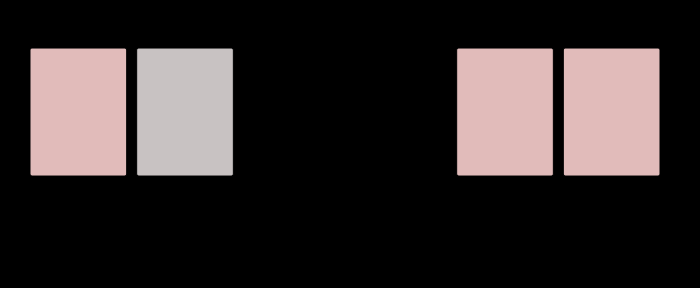
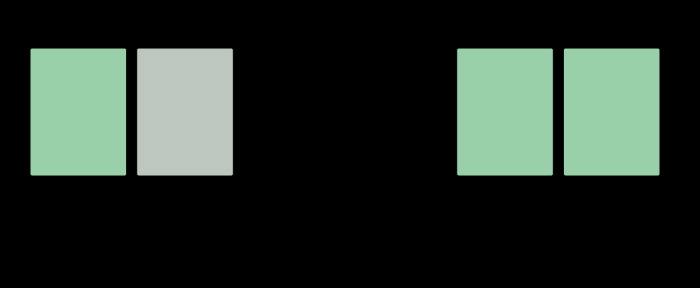
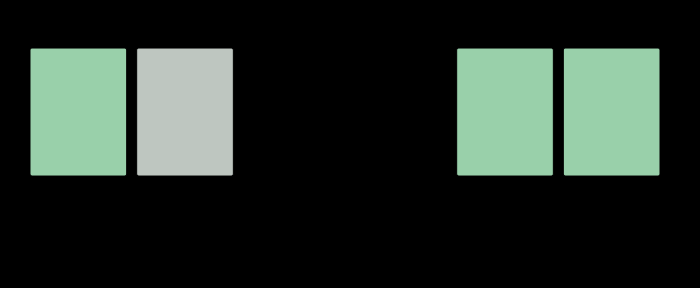
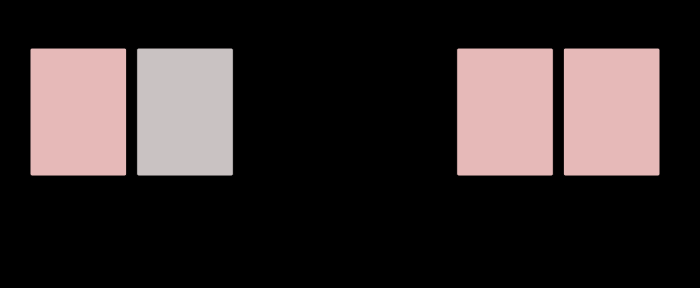
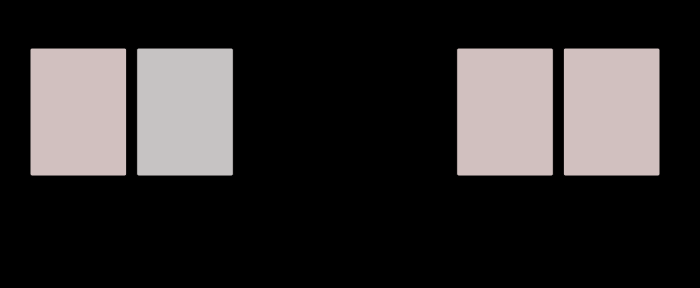
Two more rooms say that the effect follows the albedo and the wall colour independently, which is what makes a room an illuminant rather than a tint.
The claim
In a room with one lamp, the illuminant at a point is not the lamp. It is the lamp multiplied by every reflectance along every path that reached that point, and it is a different spectrum at every point.
Two consequences follow, and they pull in opposite directions. The first is that colour bleeding is not a small correction — for most surfaces in most rooms it is the whole of the light. The second is that it nevertheless converges, so a red room does not become infinitely red.
Five faces out of six emit nothing
Start with the arithmetic that makes the first consequence concrete.
In the room above, the ceiling carries the lamp and the other five faces carry nothing of their own. Their radiosity at equilibrium is entirely the transport term — remove it and those five faces are not dimmer, they are black.
That is asserted by the figure’s generator rather than inspected: it counts the faces whose direct emission is zero and refuses to draw unless there are five of them. The check exists because a scene with the transport accidentally disabled produces one lit face and five black ones, which looks like a deliberate stylistic choice rather than a bug.
The second thing the generator asserts is stranger and is easy to misread as an error. The emitting face comes out brighter than its own emission. The ceiling radiates more than the lamp puts into it, because the room hands light back to it — the walls send some of what they received upward, the ceiling reflects part of that, and the sum is larger than the input. No energy has appeared: the same photons cross the ceiling more than once, which is the geometric series seen from the source’s end.
Why the bleeding saturates
The obvious worry about a multiplicative process is that it runs away. Each bounce multiplies by again, the spectrum narrows again, and there is no obvious stopping point — so why is a red room not a monochromatic red room?
Because the terms are weighted by how much light is in them, and that weight falls geometrically while the narrowing accumulates only logarithmically in effect.
Write the light arriving at a surface as a sum over bounce counts. The -th term carries , which is very narrow for large — but it also carries for a geometry factor , so it contributes almost nothing. The equilibrium spectrum
is dominated by the low-order terms, and the high-order terms that would be spectrally extreme are the ones with no energy in them.
So the saturation is a competition between narrowing and dimming, and dimming wins. The limit is finite and is reached quickly: in a cube, the disagreement between a spectral and a three-channel solve has converged to within a few percent of its final value by the sixth bounce, which is the same statement about the same series.
The illuminant is local
The third consequence is the one that breaks the standard vocabulary.
Colour management, colour specification and colour measurement all take an illuminant as an input: a profile has a white point, a tolerance is quoted under a stated illuminant, a measurement names its source. Every one of those assumes the illuminant is a property of the scene — one spectrum, applying everywhere in it.
In the room above there are six different illuminants, one per face, and a finer discretisation would give as many as it had patches. The floor is lit mostly by the ceiling and the walls; the walls are lit by the ceiling, the floor and each other; and the face furthest from the lamp along the most bounces is the most strongly tinted.
There is a practical version of this that anybody who has colour-matched anything will recognise. A sample matched against a reference on a bench beside a coloured wall will match; carried to a different bench it will not, and the usual diagnosis is that the lighting is different. It is, but not because the lamps differ — because the walls differ, and the walls are most of the light.
What was computed, and how
The solve is spectral, in 81 bands. Every figure on this page inverts once per wavelength, so the reported chromaticities are what an integrating instrument would report for the converged radiosity rather than an approximation to it.
Both chromaticities are printed under every swatch — the spectral solve and the three-channel one — because the faces where they disagree most are precisely the faces the light reached by the most bounces, and printing both makes that visible without a second figure.
Two assertions guard the figure. The count of non-emitting faces must be five, and the emitting face must come out brighter than its own emission. Neither is a deep property; both are the kind of thing that would be silently wrong if the transport term were dropped, mis-signed, or applied to the wrong index.
The room’s dimensions and paints are stated in every caption. A red room and a green room differ only in the wall reflectance, and the green one is a narrow band chosen because narrow reflectances are the expensive case for a three-channel renderer.
The bleeding is a spectrum, not a tint
There is a distinction here that a three-channel account of colour bleeding cannot make, and it is the reason this belongs on a colour site rather than in a graphics one.
Described in three numbers, bleeding is a shift: the white wall moves towards the red wall’s colour by some amount. That description is complete if colour is three numbers, and it is what every RGB renderer implements.
Described spectrally, something else is happening. The light arriving at the white wall has had a notch cut in it — every band where the red wall’s reflectance is low has been attenuated, and bands where it is near zero are gone entirely and cannot be recovered by any subsequent surface. The white wall is not lit by reddened D65; it is lit by a spectrum with holes in it.
That difference has a practical edge. A surface in that room whose own reflectance peaks in a band the wall removed will look almost black there — not dark in proportion, but specifically unlit at the wavelengths it needed. This is exactly the mechanism by which a lamp fails to render a colour, applied to a wall rather than to a lamp, and it is why a strongly coloured interior can make some objects in it look inexplicably dead while leaving others untouched.
Three numbers cannot express “there is no light at 480 nm here”. They can only express “the light is somewhat orange”, which is a summary of the same situation that has thrown away the part that predicts which objects will suffer.
What the pictures cannot show
Three things, and the first is the most important.
A uniform radiosity per face is an averaging assumption, and the visible signature of colour bleeding is the gradient it destroys. A photograph of a real room shows the bleeding concentrated near the coloured wall and fading away from it. Six patches have no gradient at all; each swatch here is a face’s average. So these figures report the effect’s magnitude honestly and its appearance not at all.
Most of the interesting swatches are outside the display’s gamut. A face lit through three bounces off a saturated wall is a saturated colour, and where the display cannot reach it the figure hatches rather than clipping — the marking this site uses in place of the nearest available lie. A reader therefore cannot see the most strongly bled faces, only their coordinates.
Nothing here is about appearance. A person in that room adapts, discounts most of the cast, and reports the white surfaces as white. The measurement and the perception are different quantities and this page is entirely on the measurement side of the line this site keeps.
A shape that changes the answer
The mixture at a face is set by the form factors, so changing the room’s proportions changes which surface dominates which — with the paint, the lamp and the gain all held fixed.
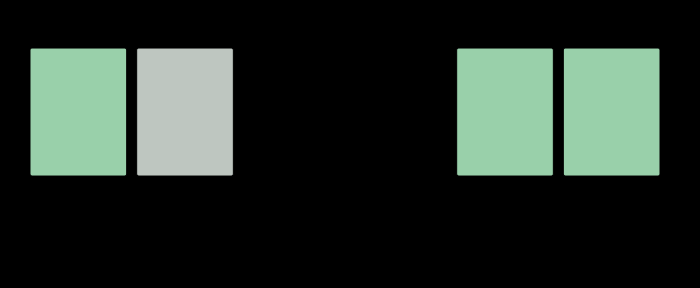
In a cube, a face’s opposite neighbour contributes 0.199825 and each of its four edge-sharing neighbours 0.200044 — nearly equal, so a face is lit by a fairly even blend of the whole room. Make the room three times as tall and the floor’s view of the ceiling collapses to 0.0330 while each wall rises to 0.2418: the floor is now lit almost entirely by the walls.
So a tall room bleeds its wall colour onto its floor far more strongly than a cubical one, from identical paint. That is a design consequence with no colour in it — a stairwell, an atrium or a lift lobby is spectrally a much more aggressive version of the same specification than a room of ordinary proportions, and nothing in a paint schedule records the difference.
The same argument runs the other way for a wide, low room, where the floor and ceiling dominate each other and the walls contribute little. Which is why the ceiling colour matters most in a large open-plan floor and the wall colour matters most in a narrow one, a rule interior designers hold as experience and which is a row of the form-factor matrix.
The room’s proportions, tabulated
Two aspect ratios are given and the trend between them is the design argument, so it is worth having the whole of it. For a square floor of unit width under a ceiling at height h, the share of the floor’s view that the ceiling occupies is:
| height / width | floor sees ceiling | floor sees each wall | walls’ total share |
|---|---|---|---|
| 0.25 | 0.632 | 0.092 | 37 % |
| 0.5 | 0.415 | 0.146 | 58 % |
| 1 (cube) | 0.1998 | 0.2000 | 80 % |
| 2 | 0.069 | 0.233 | 93 % |
| 3 | 0.033 | 0.242 | 97 % |
| 5 | 0.012 | 0.247 | 99 % |
The essay’s two rooms reproduce exactly — 0.199825 opposite and 0.200044 adjacent in the cube, 0.0330 and 0.2418 at three to one — and each row sums to one, which is the check that a flat face in a closed box sees the whole of the rest of it.
The interesting part is how fast the crossover happens. At a height of half the width the ceiling still supplies 42 per cent of the floor’s illuminant; at a height equal to the width it supplies 20; by two to one it is 7 and by three to one it is 3. A room only twice as tall as it is wide has already handed 93 per cent of its floor’s light to its walls.
That puts a number on the rule the essay attributes to designers’ experience. A ceiling colour is the dominant term only below about a 0.6 aspect ratio, which is a large open-plan floor and very little else; every ordinary room, at 0.5 to 1, is already in the regime where the walls supply most of the floor’s light, and a stairwell is in the regime where the ceiling supplies almost none.
The low-albedo end of the sweep is the one a specifier would think safe, and it is worth seeing what the solve does there.
Why dimming wins, stated as a bound
The saturation is a competition between narrowing and dimming, and dimming wins is right, and the reason is stronger than the argument given for it, which appeals to narrowing accumulating only logarithmically.
The narrowing is bounded and the dimming is not. Raising a reflectance to the power n drives it towards a delta function at its own maximum, so the n-th bounce’s chromaticity converges to a point on the spectral locus and stops. There is nowhere further to go: the locus is the boundary of the chromaticity diagram, and no number of bounces takes a colour past it. Meanwhile the n-th term’s energy falls geometrically with no floor.
So the competition is between a sequence with a finite limit and one that goes to zero, which settles it without needing to know how fast either moves. A red room cannot be redder than a monochromatic red, and it stops far short of that because the terms that would take it there carry no light.
The weights say how far short. In a closed cavity of albedo ρ the share of the light that has bounced exactly n times is (1 − ρ)ρⁿ, so the mean bounce count is ρ/(1 − ρ):
| albedo | direct share | mean bounces | still to arrive after six |
|---|---|---|---|
| 0.5 | 50 % | 1.00 | 0.8 % |
| 0.7 | 30 % | 2.33 | 8.2 % |
| 0.8 | 20 % | 4.00 | 21.0 % |
| 0.9 | 10 % | 9.00 | 47.8 % |
The equilibrium colour of a room at albedo 0.7 is essentially its two-and-a-third-bounce colour, and the claim that the series has converged by the sixth bounce is an albedo-0.7 statement rather than a general one — at 0.8 a fifth of the light has yet to arrive by then, and at 0.9 nearly half.
That also prices the generalisation’s own example exactly. In a cavity at albedo 0.8, four fifths of the input is recirculated output is not an estimate: the gain is 1/(1 − 0.8) = 5, so the direct term is one fifth of the total and the recirculated part is four fifths, precisely.
The two saturating quantities are different
One consequence of the bound is worth separating out, because the essay’s two consequences are said to pull in opposite directions and they saturate for different reasons.
The energy saturates because the geometry loses light, at a rate set by the albedo, and a room at albedo 0.9 is ten times brighter than its lamp alone. The colour saturates because the spectral locus is where chromaticities stop, at a limit set by the paint, and it is reached by the high-order terms that carry no energy.
So a room can be arbitrarily far from converged in energy and effectively converged in colour, and the two questions need different bounce counts. A renderer truncating the series at six bounces on a white room is making a photometric error of a fifth and a chromatic error of almost nothing; on a saturated one the arithmetic reverses, because the low-order terms are the coloured ones and they are the ones it kept.
Where the model stops
Six faces. A real solve subdivides into thousands of patches, and the reason is exactly the gradient above: the assumption that radiosity is constant across a face is badly wrong near a crease.
No occlusion and no furniture. Every face sees every other face entirely, which is true of a convex empty box and of nothing else. Visibility is where the real cost of radiosity lives.
Diffuse only. No gloss, no mirror, no directional transport. A glossy wall bleeds colour into a direction rather than into a hemisphere, and this model has no directions in it.
One lamp, and it is a whole face. A real room has small bright sources, which changes the direct term’s distribution completely while leaving the interreflection argument intact.
No fluorescence, and the band is 380–780 nm. A brightened white wall emits blue it was given in the ultraviolet, and that excitation band is outside this site’s range, so every fluorescence number here is a declared floor.
The generalisation
The transferable statement is about where a system’s inputs actually come from.
A quantity treated as an external input to a model is often mostly an output of the same model fed back. The illuminant is the clean case: it is written down as a boundary condition, and in an enclosed space most of it is the model’s own solution returning. Anything specified as an input while being dominated by feedback will behave in ways the specification cannot express, and the specification will keep being blamed for a modelling choice.
The tell is a system whose loop gain is close to one. In a cavity at albedo 0.8, four fifths of the “input” is recirculated output. In that regime, characterising the source tells almost nothing about what the system sees, and effort is much better spent characterising the loop.
Who found it, and when
Colour bleeding as a rendered phenomenon dates from Goral, Torrance, Greenberg and Battaile’s 1984 paper, and the striking thing about that paper is that it validated against a measurement. They built the physical box, photographed it, measured it, and compared — which was unusual then and is not universal now.
The underlying transport is older. Radiative exchange between diffuse surfaces was worked out in thermal engineering decades earlier, and the “interflection” of light between room surfaces entered illuminating engineering in the 1930s and 1940s, where it became the interreflection component of the lumen method. That calculation is scalar and photopic: one number for the whole band, which answers how many lamps a room needs and discards the spectral content this page is about.
Painters knew the phenomenon long before anybody computed it, and knew it as an instruction rather than a theory — that the shadowed side of a white object near a coloured one takes the neighbour’s colour. What the computation adds is the magnitude, and the magnitude is the surprise: not a tint on a shadow but the majority of the light on most surfaces in an ordinary room.
It is worth noting which discipline got there first and why. The illuminating engineers had the transport and threw away the spectrum; the painters had the spectrum, in the sense that they were matching what they saw, and had no transport at all. Graphics needed both at once because it was trying to predict an image rather than describe or specify one, and prediction is the requirement that forces a model to carry everything the phenomenon depends on. That pattern recurs across this site: the machinery gets built when somebody needs an answer before the fact rather than a classification after it.
Where the ladder goes next
The rung above leaves transport for materials, where multiplication stops being the right model altogether. Paint is not a filter: mixing two pigments is not multiplying their reflectances, because a mixture is one scattering layer rather than two in series, and getting that wrong is a 15-unit error.
Two of that rung’s neighbours are about colour that is not in a reflectance at all — colour that lives in a path length, and colour that changes when the reader moves.
Where this goes next
 A corner is not a wall
A form factor is the fraction of everything leaving one surface that arrives at another, and it is the only place geometry enters the colour of a room. It is also the one number here with a published closed form to check against — and the check turned out to converge at two different rates for two cases that look identical.
A corner is not a wall
A form factor is the fraction of everything leaving one surface that arrives at another, and it is the only place geometry enters the colour of a room. It is also the one number here with a published closed form to check against — and the check turned out to converge at two different rates for two cases that look identical.
 What a white wall costs
A closed room returns 1/(1−ρ) times the light that entered it, computed band by band — so a paint that is five percent off neutral becomes a strongly coloured illuminant once the room has finished bouncing. The gain amplifies the tint along with the brightness, and the last few percent of albedo cost far more than the first.
What a white wall costs
A closed room returns 1/(1−ρ) times the light that entered it, computed band by band — so a paint that is five percent off neutral becomes a strongly coloured illuminant once the room has finished bouncing. The gain amplifies the tint along with the brightness, and the last few percent of albedo cost far more than the first.
 The illuminant is half the answer
An object has a reflectance, not a colour. The colour appears when a specified light falls on it, which is why two surfaces can match in a shop and clash outside, and why every serious matching standard names the light.
The illuminant is half the answer
An object has a reflectance, not a colour. The colour appears when a specified light falls on it, which is why two surfaces can match in a shop and clash outside, and why every serious matching standard names the light.
What this makes readable
Essays that name this one as a prerequisite.
Named alongside this one
Essays reaching for the same objects. Nobody chose these; they are what the index of named objects makes visible.
- A bounce is a multiplication chromaticity · colour bleeding · form factor · illuminant · interreflection · radiosity · reflectance · standard observer
- The same wall applied twice albedo · colour bleeding · form factor · illuminant · interreflection · radiosity · reflectance
- The highlight is the lamp chromaticity · colour management · illuminant · reflectance · standard observer
- Two paints that stop matching colour bleeding · form factor · interreflection · reflectance · standard observer
- A lobe takes colour out of a bounce albedo · colour bleeding · interreflection · radiosity
- A probe at the wall prices the finish chromaticity · interreflection · radiosity · reflectance
What links here
The 8 essays that link to this one and share the most of its objects, of 14 that link here.
The objects this essay names
Each one links to every other essay that touches it.
AlbedoChromaticityColour bleedingColour managementForm factorIlluminantInterreflectionRadiosityReflectanceStandard observer