Concept

Radiosity — where it appears

Computing the light in a scene by solving for the mutual exchange between surfaces rather than tracing individual paths. It is where interreflection comes from, and its form factors are geometry rather than colour.

Named by 21 essays across 2 fields — each of them below, with the objects they name alongside it.
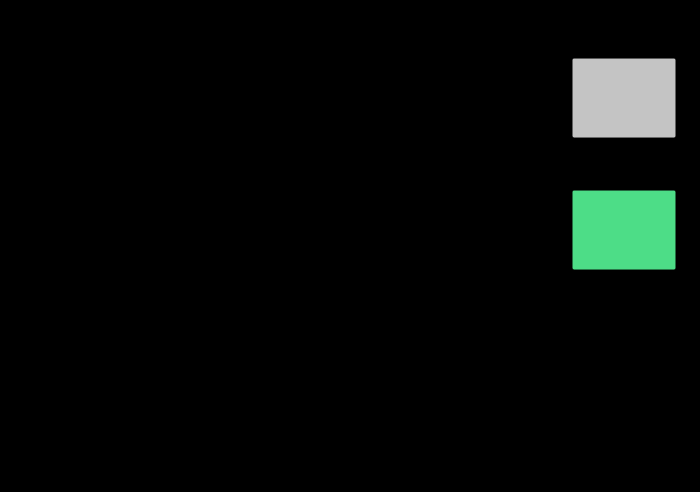
A spectrum after 2 bounces off the same surface. The lamp's spectrum at the top, then the same spectrum multiplied by a reflectance peaking at 530 nm once for each bounce. Interreflection is elementwise multiplication, so light that reaches the eye by the long way round carries ρ raised to the number of surfaces it met. Each row's swatch is drawn at fixed luminance so only the chromaticity changes, and the distance from the D65 white point, printed at the right, rises from 0.000 to 0.235. The spectrum narrows every time, which is why a room painted in one colour is more saturated in its corners than on its walls.

A bounce is a multiplication

Colorimetry multiplies an illuminant by a reflectance once and integrates. A surface in a room is lit by every other surface the lamp reached first, so the spectrum arriving at the eye has been multiplied several times — and the second multiplication is where the whole apparatus of matching starts to come apart.

scene · Scene
How far three channels drift from eighty-one, per bounce. One room, one geometry, one reduction to three channels, and the only thing changing is how many bounces of the Neumann series are kept. At one bounce the two agree to 2.5e-13 — the only reflectance in that path is the floor's, which is flat, and a flat reflectance is one of the few three numbers carry exactly. Every bounce after it multiplies another non-flat reflectance into the spectrum, and three numbers cannot carry a product they were never given the factors of. The curve levels off at ΔE00 = 2.38 because the light has run out, not because the disagreement has.

Rendering in three numbers

Almost every renderer ever shipped bounces red, green and blue rather than a spectrum. The error that costs is exactly zero at the first product and grows at every one after it — because three numbers cannot carry a product they were never given the factors of, and each bounce is another product.
scene · Scene
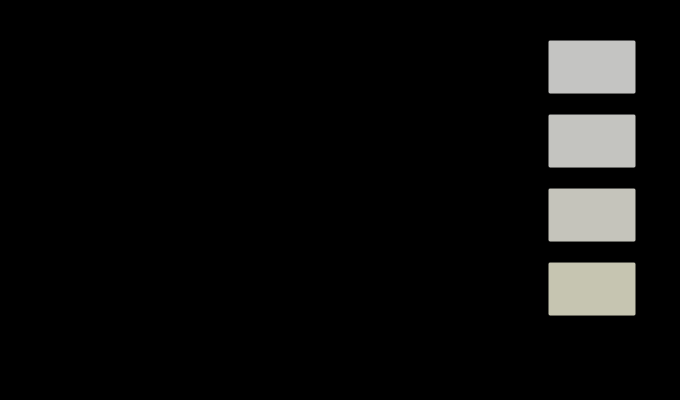
The interreflection gain of a room, band by band. A closed cavity of reflectance ρ returns 1/(1 − ρ) times the light that entered it, and because that is computed per band it amplifies the wall's colour along with its brightness. The wall here is only 5% off neutral — a paint anybody would call white — and at albedo 0.9 the room's white point has moved by ΔE00 = 50.7 against the lamp it was lit with. The gain is a geometric series, so the last few percent of albedo cost far more than the first: 1.64× at ρ = 0.4 against 8.41× at ρ = 0.9.

What a white wall costs

A closed room returns 1/(1−ρ) times the light that entered it, computed band by band — so a paint that is five percent off neutral becomes a strongly coloured illuminant once the room has finished bouncing. The gain amplifies the tint along with the brightness, and the last few percent of albedo cost far more than the first.

scene · Scene
The form-factor matrix of the box. F_ij is the fraction of everything leaving face i that arrives at face j. The diagonal is zero because a flat face sees none of itself; each row sums to exactly 1 because the cavity is closed; and A_i F_ij = A_j F_ji, which is reciprocity and is checked to 10⁻⁹. For a cube the opposite face takes 19.98% and each of the four adjacent faces 20.00%, and the near-equality of those two numbers is a coincidence of the cube rather than a rule.

A corner is not a wall

A form factor is the fraction of everything leaving one surface that arrives at another, and it is the only place geometry enters the colour of a room. It is also the one number here with a published closed form to check against — and the check turned out to converge at two different rates for two cases that look identical.
scene · Scene
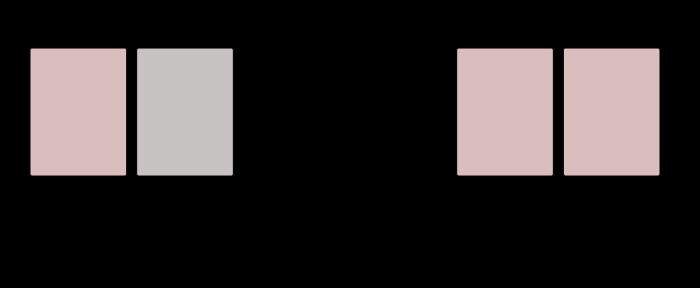
Every face of the solved room. The red room after the transport is solved in all 81 bands. Only the ceiling emits; the other five faces are lit entirely by what the ceiling and each other send them, so their colour is the lamp multiplied by every reflectance along every path that reached them. The ceiling itself comes out 1.05× brighter than it emits, because a closed room returns light to its own source. The two chromaticities under each swatch are the spectral solve and the three-channel one, and the faces furthest from the lamp — the ones the light reached by the most bounces — are where they disagree most.

The room is the illuminant

Colour bleeding is usually described as an aesthetic phenomenon of rendered images. It is better described as a measurement. In a room with one lamp, five of six surfaces emit nothing at all, so their light is entirely a product of other surfaces' reflectances — and the bleeding saturates rather than running away, for a reason worth deriving.

scene · Scene
A corner moves the spectrum and the viewing condition at once. A coloured patch in a corner of coloured walls, against how enclosed the corner is. The top curve is what a colorimeter set up at the door reports: light that has bounced carries the surrounding reflectance again, so the patch is lit by something the room is not. The middle curve is what is left once the patch is read against the corner's own white — most of it goes, because a corner is a change of illuminant and that is what chromatic adaptation is for. The bottom curve is the other thing a corner is: a brighter place, 1.76 times the light, which moves the appearance through the Hunt effect with the white point held still and cannot be adapted away at all.

A corner moves both terms

The interreflection essays compute what a corner does to a spectrum, which is one of the two things a corner does. It is also a brighter place with a differently coloured background — a viewing condition, not a stimulus — and adaptation removes most of the first and none of the second. At an enclosure of six tenths that is 63 per cent of seven units gone and a further unit arriving from the extra light alone.

scene · Scene
The same wall, applied once and applied twice. A room lit by light that has bounced off its own walls is a change of illumination like any other, and a corner is the same change applied twice. Squaring a reflectance sharpens it, a sharper change of light is further from being a gain, and the residual an adapted observer is left with therefore grows faster than the change does: the second bounce is 1.33 times the change and 1.96 times the residual. This is the adaptation half of what a corner does to a metameric match.

The same wall applied twice

A bounce off a painted wall is a change of illumination, and adaptation handles it about as well as it handles a change of colour temperature. A corner applies the same reflectance twice, which sharpens it — and leaves an adapted observer with 1.96 times as much for a change only 1.33 times as large.

scene · Scene
A room applies its wall a different number of times at each wavelength. The mean number of bounces the surviving light has made, wavelength by wavelength, in a closed room whose walls are the green paint the adaptation census uses. It runs from 0.33 in the band the wall absorbs to 5.67 in the band it reflects — a factor of 17.00 — because the light that survives many bounces is the light the wall was reflecting all along. The census has one bounce and two bounces as separate rows and a search treats the count as a free integer; a room has neither, and what it has is bounded by the walls reflecting less than everything.

A room bounds its own bounces

The adaptation census has one bounce and two bounces as separate rows, and a search over the family treats the count as a free integer it always takes to the largest value offered. A room offers no integer at all — it applies a geometric mixture of every number of bounces, and that mixture is bounded by the walls reflecting less than everything.

scene · Scene
Five fields, by how much light arrives from each elevation. The radiance arriving at a surface from each direction in one vertical plane, for five ways of lighting it. The vertical axis is logarithmic, spanning the three decades between a sun and the sky around it. The number beside each name is the share of the light that would have to be moved to make the field uniform: zero for the overcast sky, 0.93 for a lamp on a stand. A uniform field is the condition under which a reading is the sample's own reflectance, and the only place it exists is inside an instrument.

A room is not a sphere

An integrating sphere reads a surface's own reflectance exactly, and the exactness is a theorem rather than good engineering — under a hemisphere of constant radiance, reciprocity makes the reading the sample's directional-hemispherical reflectance whatever the surface is. Every room fails that condition, and a viewing booth and a window get the sign of the error wrong in opposite directions.

scene · Scene
What the Lambertian assumption costs a room, against how rough its walls are. The horizontal axis is the roughness of the two coloured walls; the right-hand end is nearly matt, which is what a radiosity calculation assumes. One line is the distance in ΔE₀₀ between the floor's colour and what radiosity gives for the same room — 4.89 at an eggshell finish, falling to 0.97 at the matt end. The other is the chroma of the bounce, which falls as the walls get glossier: what an interface returns is a Fresnel reflection and carries no pigment, so the fraction of the return that goes into the lobe is a fraction that arrives at the floor white. The lobe is taken out of the body term rather than added beside it, which is what a real finish does.

The solver had no slot for gloss

Every scene result in this collection is computed by radiosity, and radiosity is not an approximation that could be made more accurate. Its unknown is one number per surface, and a surface that returns light differently in different directions does not have one. A missing slot cannot be wrong by a small amount.

scene · Scene
The directional solver reduces to the radiosity solver exactly. A solver with a new unknown in it is worth nothing until it reproduces the one it replaces. Setting every wall's bidirectional distribution to ρ/π collapses all thirty ordered-pair radiances onto their patch's radiosity divided by π, and the answer agrees with this collection's existing radiosity solution to 9.8e-16 relative — the floating-point floor. That is the check that makes every other number in this family a statement about lobes rather than about a new piece of arithmetic, and it is the reason the reduction is drawn rather than mentioned.

Thirty unknowns instead of six

A directional transport solver is worth nothing until it reproduces the one it replaces. Setting every wall's bidirectional distribution to ρ over π collapses thirty ordered-pair radiances onto six radiosities and reproduces this collection's existing answer to 9.8 × 10⁻¹⁶ relative — which is the only reason anything else it says can be believed.

scene · Scene
What the floor receives, matt walls against walls of roughness 0.2. The spectral radiance leaving the floor towards the front of the room, computed twice. The matt curve peaks at 530 nanometres, where the walls' pigment is. The glossy curve is higher everywhere and higher by relatively more away from that peak, because the extra light is a Fresnel return and a Fresnel return has the lamp's spectrum rather than the paint's. That difference in shape is the desaturation, drawn before it is reduced to a number, and it is the reason the two lines cannot be brought together by any exposure change.

A lobe takes colour out of a bounce

A gloss wall sends more light to the floor and less colour. The extra light is a Fresnel reflection at the interface, it carries the lamp's spectrum rather than the paint's, and it arrives at the next surface white — so a green room in satin paint is less green than the same room in flat paint by nearly a colour difference of chroma.

scene · Scene
Where the viewer stands, at a wall roughness of 0.2. The chroma of the light the floor sends towards each of the five other faces of the room, at one roughness. The spread is 2.00 ΔE₀₀ between the extremes. A radiosity solution assigns one radiosity to the floor and therefore cannot have a spread at all — the whole width of this chart is a quantity the method has no slot for, rather than one it approximates badly. The two side walls see the most because they are where the coloured light comes from, and the direction the lobe favours is the direction it came from.

The floor is a different colour from the door

With a lobe on the walls the floor sends chroma 18.76 towards the front of the room and 20.94 towards the side walls, a spread of two colour differences. A radiosity solution assigns the floor one number, so the whole of that spread is a quantity the method has no slot for rather than one it estimates badly.

scene · Scene
Where a point-sampled patch stops resolving a lobe. The horizontal axis is the wall's roughness, logarithmic; the vertical is how far the answer moves when the cone quadrature is refined from eight directions to sixteen, also logarithmic. A patch in a cube subtends a cone of angular radius 25.8° at the face opposite, and a microfacet lobe of roughness a is about a radians wide, so a lobe below about 0.15 is narrower than the quadrature that samples it. The movement at 0.05 is 21.2 ΔE₀₀ and at 0.3 it is 0.033. This is where the method stops, not where the paint does: matt, eggshell and satin finishes are inside it and a high-gloss varnish is not.

Where a patch stops being a point

A patch in a cube subtends a cone of 25.8° at the face opposite. A microfacet lobe of roughness 0.05 is about three degrees wide. Point-sampling the second inside the first returned a chroma of thirty-four thousand and a negative lightness, and the boundary between working and not working is measured rather than declared.

limits · Limits
The lobe's share of what leaves a surface of body reflectance 0.5. For light arriving at 45°, the fraction of what leaves the surface that is the interface's Fresnel return rather than the pigment's. It runs from about 9.1 per cent at an eggshell finish down to 4.2 at a matt one. That is a small share, and it is the whole of the effect: a tenth of the return arriving white is enough to move the room's colour by units of ΔE₀₀, because the bounce is what a room's colour is made of and every bounce is multiplied by the next.

A tenth of the return arriving white

Nine per cent of what leaves a satin wall is a Fresnel reflection carrying no pigment. That nine per cent moves the room's colour by 4.89 ΔE₀₀ and its chroma by five per cent, because an interreflection multiplies and a small contribution with a different spectrum compounds into a large one.

scene · Scene
What the Lambertian assumption costs a room, against how rough its walls are. The horizontal axis is the roughness of the two coloured walls; the right-hand end is nearly matt, which is what a radiosity calculation assumes. One line is the distance in ΔE₀₀ between the floor's colour and what radiosity gives for the same room — 4.89 at an eggshell finish, falling to 0.97 at the matt end. The other is the chroma of the bounce, which falls as the walls get glossier: what an interface returns is a Fresnel reflection and carries no pigment, so the fraction of the return that goes into the lobe is a fraction that arrives at the floor white. The lobe is taken out of the body term rather than added beside it, which is what a real finish does.

Every scene in this collection was matt

The green wall, the corner, the bounce series and the metamer separation are all computed on Lambertian surfaces, because the solver that produced them requires it. Each would move by between one and five colour differences on an ordinary satin finish, and none of those essays says what finish it means.

scene · Scene
The room's reflected light and its colour, against how glossy the walls are. Four changes against the matt room as the coloured walls are made glossier, from roughness 0.8 on the left to 0.15 on the right. The room's reflected light rises by up to 19 per cent and its chroma falls by up to 9.1 per cent. The walls' own outgoing chroma falls fastest, by 14.6 per cent, and the floor's follows the room's. A lobe does not move colour from one face to another: the room as a whole has less of it.

A gloss finish takes colour out of the whole room

A gloss wall makes the floor's return less colourful seen from the front of a room and more colourful seen from the coloured walls, which leaves open whether the lobe removes colour or only moves it. A ledger of every flux between the room's faces answers it. At an eggshell finish the room's reflected light gains 16 per cent in quantity and loses 8.3 per cent of its chroma, and the loss is nearly the same for blue, green and orange walls while the walls' own losses range from 13 to 25 per cent. Only the painted walls receive light as colourful as before.

scene · Scene
The glossiest finish the solver can report, against what it costs to report it. Six quadratures, each with the roughness at which its answer stops being stable, on logarithmic axes. The line is a fit and its slope is -0.350: the reachable roughness falls as the cost to the power of about a third, so reaching a finish twice as glossy costs about 7 times the work. The solver used here sits at 108 directions and reports down to a roughness of 0.145, which is where its own note put the boundary by inspection.

The boundary belongs to the quadrature

The directional solver stops at a roughness of about 0.15, and below that its answers are not imprecise but unphysical. The boundary is where the lobe stops being resolved by the sampling, so it belongs to the discretisation rather than to the room — and moving it is a purchase. Measured across six quadratures the reachable roughness falls as the cost to the power of a third, so a finish twice as glossy costs seven times the work and a polished varnish costs two hundred and thirty-six times.

scene · Scene
What survives holding the lightness still. For each of five groups of rooms sorted by how much light the wall returns, the rank correlation of the finish's share with three properties of the paint, taken with the wall's luminance factor held. The wall's chroma runs from -0.90 among the darkest walls to 0.81 among the palest, crossing zero in the middle — the reversal. The band's width, which was the predicted mechanism, never leaves the range -0.15 to 0.22, and the census already contains four families whose bands are all the same width.

The finish adds the room's own colour

Among dark walls a more saturated paint loses a smaller share of its colour to a gloss finish, and among pale walls a larger one. The mechanism proposed for that reversal was spectral concentration — a narrow tall band — and the census that found it already contained four families of paints whose bands are all the same width. Holding lightness still, the band's width orders the losses at a rank correlation of 0.01. What does order them is that the light a finish adds has already bounced off the walls.

scene · Scene
Where chroma stops protecting a wall, in five rooms. The seventy-two paints in each of five rooms, sorted by how much light the wall returns and read in overlapping windows of eighteen: the rank correlation of the share of colour a satin finish takes with the wall's chroma, lightness held. Below zero a more saturated paint loses less; above, more. The dots are where each room's curve crosses: cube at 0.36, corridor at 0.37, low room at 0.38, one wall open at 0.29, two walls open at 0.24. Solid lines are closed rooms of three shapes; dashed are the cube with one and two walls opened.

An open room hands over sooner

A gloss finish takes the least colour from a saturated dark wall and the most from a saturated pale one, and in a closed cube the sign changes at a wall returning about a third of the light. The prediction was that a less enclosed room would move that point up the lightness scale and that a room with a window would have no pale end. Opening one wall moves it down, from a luminance factor of 0.36 to 0.29, and opening a second to 0.24; stretching the room into a corridor or flattening it nudges it slightly up. The ambient does whiten, as predicted. A whiter ambient does not delay the colour term — it weakens it, so the other term takes over sooner.

scene · Scene
The lamp's white, six walls and the light arriving at each. On the 1976 chromaticity diagram, in the closed cube under daylight: the lamp's white (centre), six saturated walls with bands centred from 450 to 650 nm (open circles), and the light arriving at each wall from the rest of the room, lamp included (filled). Each ambient lies on the line from the white to its wall, a fraction of the way along it: 450 nm 10 per cent, 490 nm 12 per cent, 530 nm 19 per cent, 570 nm 19 per cent, 610 nm 13 per cent, 650 nm 5 per cent.

A probe at the wall prices the finish

The light arriving at a painted wall from the rest of its room is what a gloss finish hands back, and a small probe held against the wall reads it. It lies on the line from the lamp's white to the wall's own colour, a fraction of the way along, and the fraction is set by how much light the wall returns, not by how colourful it is — as predicted. It is not the fixed fraction the prediction said: it runs from 2 to 46 per cent across seventy-two paints in one room. That variation is what makes it useful. Read in the matt room, it orders what a satin finish would cost more tightly than the paint's own lightness does, in every room tried.

scene · Scene

Named alongside it

The objects these essays reach for when they reach for this one.

InterreflectionSpecularReflectanceColour bleedingBidirectional reflectanceForm factorAlbedoModelling assumptionChromaticityChromaQuadratureStandard observer

All concepts