Reflectance — where it appears
Named by 78 essays across 9 fields — each of them below, with the objects they name alongside it.

A spectrum is not a colour
What arrives at the eye is a function of wavelength. What the eye reports is three numbers. Keeping the two apart is the single most useful habit in the subject, and almost every confusion in applied colour comes from letting them merge.
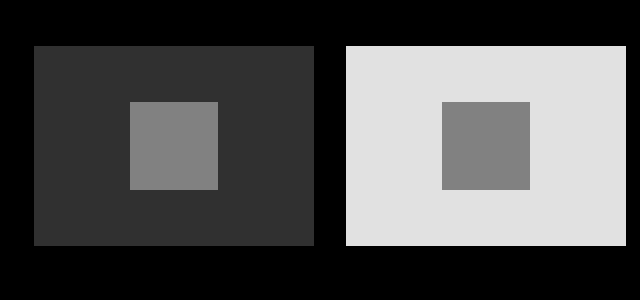
These two patches are identical
It is the most repeated and least checkable sentence in visual perception, because the whole point is that it does not look true. Every instance here is computed, and checked before the figure is drawn.
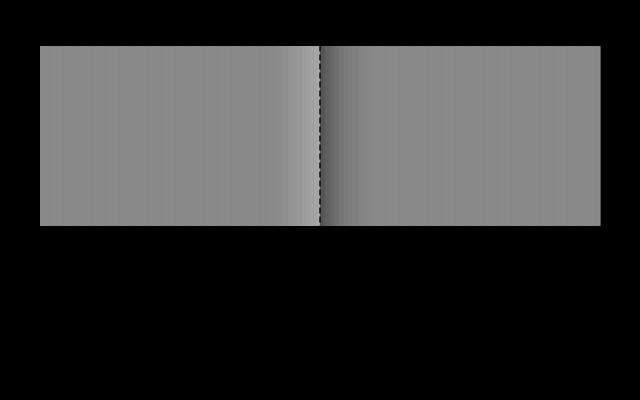
Brightness is inferred from edges
The Cornsweet effect makes two identical regions look different by altering nothing except a narrow band at the boundary between them. Cover the boundary and the difference vanishes, which says the visual system is reconstructing surfaces rather than reading off intensities.
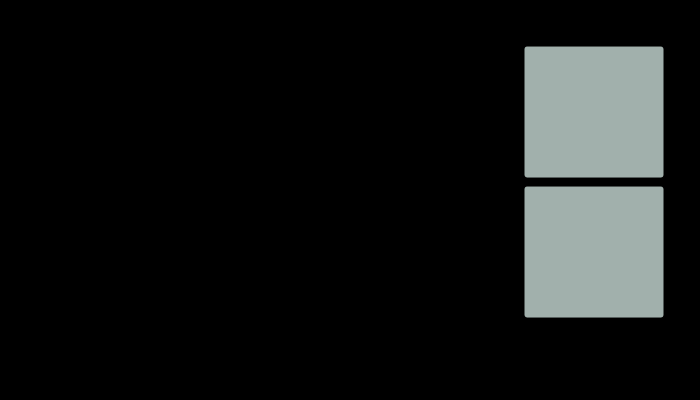
Two spectra, one colour
Metamerism is usually described and almost never demonstrated. It does not have to be — the metameric black space is enormous, so a matching pair can be constructed to order, verified, and then made to come apart by changing the light.
Constancy is the default
A sheet of paper looks white in daylight and white under a tungsten lamp, although the light reaching the eye differs enormously. The visual system is solving one equation with two unknowns, and it solves it by assumption.

The illuminant is half the answer
An object has a reflectance, not a colour. The colour appears when a specified light falls on it, which is why two surfaces can match in a shop and clash outside, and why every serious matching standard names the light.

A lamp is not a blackbody
A fluorescent tube puts a third of its light into four mercury lines. A white LED is a blue spike with a hole beside it. Both are sold by a colour temperature, and a colour temperature says nothing about either.

Some paper is brighter than white
The reflectance model assumes light leaving at a wavelength arrived at that wavelength. A fluorescent sample breaks the assumption, has no reflectance curve at all, and is in almost every sheet of white paper sold.
Three cones, two axes
The retina does not send three receptor signals down the optic nerve. It sends a sum and two differences, and the reason falls out of the statistics of natural light rather than out of anything the eye intended.

What the instrument reports
A spectrophotometer sees a sample through a slit of finite width, at a finite number of wavelengths. What it writes down is the truth convolved with its own bandpass, and nothing in the file says which values were measured and which were invented.
The algorithms that guess the light
What reaches a sensor is an illuminant multiplied by a reflectance, and no arithmetic separates a product into its factors. Every white-balance algorithm therefore works by assuming something about the world — and the interesting content of each is not its formula but the assumption, because a scene can violate it.
A bounce is a multiplication
Colorimetry multiplies an illuminant by a reflectance once and integrates. A surface in a room is lit by every other surface the lamp reached first, so the spectrum arriving at the eye has been multiplied several times — and the second multiplication is where the whole apparatus of matching starts to come apart.
Two paints that stop matching
A metameric match is an identity between three integrals that are linear in reflectance. A second bounce carries reflectance squared, and no linear identity survives being squared — so two paints certified identical on a flat chart come apart in a corner, by an amount the geometry decides and the colorimetry cannot express.

The highlight is the lamp
Light reflected at the surface of a glossy material never entered it, so it never met a pigment. Fresnel's reflectance varies by 5.5% across the visible band and the paint underneath varies by a factor of twenty — which makes a highlight the one region of a photograph that reports what the light was rather than what the object is.

Rendering in three numbers
Almost every renderer ever shipped bounces red, green and blue rather than a spectrum. The error that costs is exactly zero at the first product and grows at every one after it — because three numbers cannot carry a product they were never given the factors of, and each bounce is another product.
What a white wall costs
A closed room returns 1/(1−ρ) times the light that entered it, computed band by band — so a paint that is five percent off neutral becomes a strongly coloured illuminant once the room has finished bouncing. The gain amplifies the tint along with the brightness, and the last few percent of albedo cost far more than the first.

A corner is not a wall
A form factor is the fraction of everything leaving one surface that arrives at another, and it is the only place geometry enters the colour of a room. It is also the one number here with a published closed form to check against — and the check turned out to converge at two different rates for two cases that look identical.
The room is the illuminant
Colour bleeding is usually described as an aesthetic phenomenon of rendered images. It is better described as a measurement. In a room with one lamp, five of six surfaces emit nothing at all, so their light is entirely a product of other surfaces' reflectances — and the bleeding saturates rather than running away, for a reason worth deriving.

Paint is not a filter
Stacking two filters multiplies their transmittances. Stirring two pigments together does not multiply their reflectances, because a mixture is one scattering layer rather than two in series — light meets whichever particle is nearest. Treating the two as the same operation is a 15-unit error, and which way it errs turns out to depend on whether the comparison holds the amount of pigment fixed.

Why blue and yellow make green
The oldest fact in colour, and the usual explanations are wrong. It is not because green sits between blue and yellow, and it is not a fact about the eye at all — it is that the only band both pigments return is their overlap, and the overlap of a blue and a yellow reflectance is green. Computed, the mixing path bows away from the straight line by a measurable amount.
The colour is in the thickness
Transmittance is exponential in path length and the observer is linear, so doubling the depth of an absorbing medium squares the transmittance rather than halving the colour. A translucent object therefore has no one colour — its thin edge and its thick middle are different spectra of the same substance, and the hue moves between them.

A colour that moves with the viewer
A thin film has no pigment in it. Its reflectance spectrum is an interference condition containing a path length and an angle, so tilting the sample moves every maximum to a shorter wavelength and changes the colour by 40 units of ΔE. A pigment's spectrum contains neither, and cannot do this at all — which is the cleanest separation between the two kinds of colour there is, and it is geometric rather than chemical.

No surface can be that colourful
There is a hard bound on object colour that no pigment will ever move, and it follows from a reflectance being at most 1. Its boundary is generated by two numbers, it shrinks by a factor of eleven from dark to light — and measured against it properly, sRGB reaches 40% of what a surface could be at mid lightness while Rec. 2020 reaches 106%.
Gloss changes the measurement
The same sample measured with the specular component included and excluded returns two different numbers, and both are correct answers to different questions. Colour is one of four appearance attributes and the only one most instruments report — so a specification that names a colour has silently named a geometry too, and usually does not say which.

Most things are pale in the infrared
A spectrophotometer stops at 780 nanometres and a black cotton shirt reflecting five per cent of visible light reflects more than half the near infrared. The measurement everybody has and the quantity a camera integrates are different quantities, and nothing in the first says so.
The camera has its own metamers
Two surfaces a camera records as identical can be plainly different to a person, and two a person cannot tell apart can be recorded as different. Both pairs are constructed rather than found, from one projection, used for both.

The grid outside every figure
Every figure here is computed on 380 to 780 nanometres, which is exactly right for an eye and insufficient for a sensor. This field met the first subject the grid cannot hold, and the decision was not to widen it — because widening it honestly is impossible.
A halftone is not a mixture
Forty per cent cyan and thirty per cent magenta are not stirred together anywhere. They are laid down as dots, and the sheet is a mosaic of four fully-inked regions in proportions the two coverages fix — which is why the colour is an area average of four spectra rather than a blend of two, and why it lands nowhere near where mixing would put it.

The paper is the white point
A printed colour is reported against the sheet it sits on rather than against the light in the room, and the choice is a switch in every colour engine. Flipped one way, the same separation on coated stock and on newsprint is a 3.04 colour difference; flipped the other, it is 0.13 — and the two answers are about different questions.

A corner moves both terms
The interreflection essays compute what a corner does to a spectrum, which is one of the two things a corner does. It is also a brighter place with a differently coloured background — a viewing condition, not a stimulus — and adaptation removes most of the first and none of the second. At an enclosure of six tenths that is 63 per cent of seven units gone and a further unit arriving from the extra light alone.

What no adaptation can remove
A change of light is exactly a 3×3 matrix on tristimulus values, and adaptation is a diagonal one. Putting every change of illumination this site models through that distinction sorts them by how much of themselves they leave behind, and the smallest residual in the census belongs to a filter inside the eye.

The same wall applied twice
A bounce off a painted wall is a change of illumination, and adaptation handles it about as well as it handles a change of colour temperature. A corner applies the same reflectance twice, which sharpens it — and leaves an adapted observer with 1.96 times as much for a change only 1.33 times as large.

Dividing by the paper
Media-relative colorimetry divides tristimulus values by the substrate's, which is a von Kries adaptation applied in XYZ — the one basis the table here describes as the oldest mistake still shipping. On a paper-mill white it costs a few hundredths of a unit. On a tinted sheet it costs ten times what the same rule costs in a cone basis.

A gamut has a population
Whether a display can reproduce a paint is a fact about somebody's cones, so the boundary of a gamut is not a curve but a band. On a laser projector, ten of twenty-eight boundary surfaces are ones the standard observer calls displayable and some real people cannot see — and the wider the gamut, the wider the band.

An instrument has a geometry
Every reflectance here arrives through a model with a bandpass, a sampling interval and no position at all. Real instruments say where they were standing, and the two standard answers disagree by ΔE00 8.35 on a dark gloss sample — a difference that adds rather than multiplies, and that no adaptation removes.
A surface that is not a multiplication
Every argument here about what light does to a surface begins by multiplying two spectra together. A surface with a brightener in it takes light at one wavelength and returns it at another, so it is a full operator rather than a diagonal one — and it does not have a reflectance at all.

The tables do not stop together
This collection integrates from 380 to 780 nanometres, and decided once, in writing, that the range could not honestly be widened. The argument was correct at the long end and wrong at the short one — the CIE publishes the daylight basis from 300 nanometres, and publishes it from there for exactly the reason it matters.

A reflectance is a diagonal
A reflecting surface returns light at the wavelength it arrived at, so its whole description is one number per wavelength. A fluorescent one returns it somewhere else, so its description is a square matrix — and the curve every instrument reports is that matrix's diagonal with the rest of it folded in at whatever weight the lamp happened to give.

Two sheets that match until the window
Ordinary metamerism is two reflectances that agree under one light and not another, and it can always be undone by putting the first light back. A dyed sheet and a brightened one have the same reflectance everywhere an eye can see, agree exactly under any lamp with no ultraviolet, and separate by ten units under daylight — and no change of light puts them back together.

An image does not determine the light
A photograph of a scene under one illuminant gives three numbers per surface and asks for the illuminant plus three numbers per surface. The count closes only if reflectances lie in a two-dimensional model, and no number of surfaces helps — at three dimensions the alternative scenes can be written down, and they reproduce every sensor response exactly.

Everyone is beaten by the same wall
Eight candidate adaptation bases, fourteen changes of light, and seven of the eight have their worst row in the same place — not a lamp, but a green wall reflecting twice. The one that does not is the one that was fitted, and what its fit bought was permission to give up on that row.

The worst case is where the box stops
The worst change of light this collection quotes is two bounces off a green wall, and it is the worst of fourteen changes somebody wrote down. Searching the family those fourteen were drawn from reaches six times further — and does not stop, because the residual rises monotonically towards a narrower notch on a darker wall. There is no worst case in this family, and the number anybody quotes for one is a number about their own constraint.

Best on the average, undefined at the edge
Bradford has the lowest mean residual of any adaptation transform over the census of illumination changes, which is why colour management uses it. Inside the family that census was drawn from, its middle row's reading of the white passes through zero — so the gain is a division by nothing, and the model stops being defined rather than merely doing badly. CAT16, which exists because its predecessor did this, does not.

A notch a pigment cannot cut
The worst change of light a painted room can produce has no maximum inside the box the search was given, which the previous round reported as a family with no worst case. Bounded by what a molecule can actually do, it has one — at a band six nanometres wide, narrower than any pigment and narrower than the box.

The census is a construction too
Five of the fourteen changes of light this collection scores adaptation transforms against are not measurements of anything — they are a wall somebody invented, at a wavelength somebody chose. Moving those constants by amounts plausible in their own units moves the mean residual by two fifths and never changes which transform wins.

A room bounds its own bounces
The adaptation census has one bounce and two bounces as separate rows, and a search over the family treats the count as a free integer it always takes to the largest value offered. A room offers no integer at all — it applies a geometric mixture of every number of bounces, and that mixture is bounded by the walls reflecting less than everything.

The darkest wall anybody sells
Asked which property of a paint decides the worst change of light a room can produce, anybody would answer how saturated it is allowed to be. A ceiling on saturation never comes near binding, because the worst wall is dark rather than colourful — and the constraint that does bind is one nobody would nominate.

A mean has a set under it
Every adaptation number this collection publishes is an average over a hundred and twenty-five surfaces that were written down once, in one file, with no argument for how many there should be or how saturated. The average runs from exactly zero to twice itself across them, and the set has never been varied.

A lattice is a quadrature rule
Walking a set of test surfaces more finely does not converge on a better answer, because refining a lattice under a constraint changes which corners of the region get sampled and not only how densely. The lattice used here turns out to be a two per cent biased estimate of the integral it stands for.

A theorem about a family
A change of light acts on the test surfaces used here as an exact 3×3 matrix with no residual whatsoever, and the whole adaptation argument is built on that being exact. It is exact because the surfaces span exactly three dimensions, and they span exactly three dimensions because three basis functions were written down.

A fourth dimension has a shape
How much a fourth reflectance dimension costs spans a factor of nine across four equally plausible shapes at one amplitude, and the expensive ones are not the shapes a variance figure would identify. The band that hurts is set by the illuminant rather than by the eye, which is why a triphosphor tube and a tungsten lamp disagree about it.

The row a fourth dimension improves
Giving the test surfaces one more degree of freedom makes almost every change of light harder for an adapted observer — but not all of them, and which one it helps depends entirely on what the extra dimension looks like. A triphosphor tube is improved by one shape and hurt more than anything else in the census by another.

Saturation is nearly everything
The set of test surfaces has three numbers describing it, and only one of them matters. How saturated the surfaces are carries an elasticity of about 0.7 on every result computed over them; how bright they are carries 0.10. A test chart's chroma range decides its answer and its lightness range does not.

The surfaces that answer nothing
Five of the hundred and twenty-five test surfaces contribute exactly zero to every number the adaptation census reports — not approximately, exactly — and the reason is the one fact about von Kries adaptation that makes it worth having at all. Counting the set by how much it contributes gives about a hundred members rather than a hundred and twenty-five.

A mean is not a worst case
Every adaptation number this collection publishes is an average over objects, and the reader asking whether adaptation will fail them is asking about the object it fails on. That object costs between 1.9 and 4.0 times the published figure, and how uneven a change of light is across objects turns out to be a property of the change rather than a constant.
An extremum is still not a sample
Two rounds ago three measurements turned up that took a maximum over a sample of a set and were short by up to a factor of two. The same error was live in a fourth place the whole time, on the set of surfaces every adaptation number is averaged over, and it is short by up to a third.

Every worst surface sits on a declaration
Bounding the wall in a painted room produced a real worst case — the residual turns over at a band six nanometres wide because a narrower band returns too little light. Bounding the surfaces the residual is averaged over produces nothing of the kind, because all fourteen answers sit exactly on two numbers somebody typed and the one constraint that comes from the world never binds at all.

The model has six arguments
Every colour computed here is an integral of a reflectance against a light against three curves, and a reflectance is one number per wavelength. A real surface's response is a function of six arguments — the wavelength, direction and place light arrives with, and the three it leaves with — so the model keeps one of them, takes a diagonal, integrates two away and assumes two more equal.

A surface has a kernel
Light that enters a translucent material does not come back where it went in. It scatters some thousands of times and leaves a few millimetres away, so what the surface has is not a reflectance but a function of distance — and the reflectance the model wants is that function's integral over the whole plane, which no instrument ever collects.
The audit that changed the object
Three rounds audited this collection's numbers, its sets and its conventions, and each one ended by naming the same thing it could not reach — that a surface is a reflectance. This round reached it, found that four departures share one algebraic form, had two of its predictions refused, and discovered that its own hemisphere quadrature had been passing a convergence check by luck.

A neutral has no grid
A perfectly flat reflectance computes to exactly the same colour on every wavelength grid, through every slit, at every origin, and for every observer — not nearly, but to the last bit of a floating-point number. The condition is an identity rather than a limit, and what makes it one is the white point.

Two yellow filters cancel on a slope
An older lens and a denser macular pigment both take blue out of the light, and read before adaptation they move a colour in nearly the same direction, eight degrees apart. Once each eye has adapted to its own white they point a median 156 degrees apart on smooth reflectances and together cost less than the lens alone. On surfaces with a narrow absorption band they still sit 26 degrees apart and add. What decides it is the width of the surface's own features.

A third of the appearance box is no surface
An appearance specification is written as a lightness, a chroma and a hue, and the model's inverse turns any such triple into three numbers. A tenth of the space turns into something that is not a light at all. A further quarter turns into a light no reflecting surface can return, because a surface cannot give back more than all the light at any wavelength. So a third of the space a paint, a print or a dye is specified in cannot be made from paint, print or dye, and at lightness 90 nearly two thirds cannot.

The average surface does not look average
Over a population of observers the appearance model is so nearly linear that the mean of its answers is its answer for the mean, to 1.4 per cent of the spread. Over the surfaces in a scene it is not. On 240 smooth reflectances the gap is 21 per cent of the spread, and the mean surface looks 4.2 units lighter than the surfaces look on average. The grey that matches the average light is a 47 per cent reflectance; the grey that matches the average look is a 43 per cent one.

The line can be in the sample
The rule for which tabulation defect to fix compares the light's narrowest feature with the grid's step, and it named its own failure case — a sample with structure narrower than the step. Given one, a two-nanometre notch under a thermal source with no feature at all costs 2.1 colour differences at five nanometres and moves 2.0 when the grid slides, which is what a fluorescent tube costs on a smooth pigment. Under that tube a notch twelve nanometres wide, more than twice the step, moves 8.1 when it sits on the mercury line.

A gloss finish takes colour out of the whole room
A gloss wall makes the floor's return less colourful seen from the front of a room and more colourful seen from the coloured walls, which leaves open whether the lobe removes colour or only moves it. A ledger of every flux between the room's faces answers it. At an eggshell finish the room's reflected light gains 16 per cent in quantity and loses 8.3 per cent of its chroma, and the loss is nearly the same for blue, green and orange walls while the walls' own losses range from 13 to 25 per cent. Only the painted walls receive light as colourful as before.

The cost of a steep notch repeats every step
A Gaussian notch is safe on a five-nanometre grid once it is a couple of steps wide. A flat-bottomed notch with steep sides never is. Its cost on the grid rises and falls with its width, with the step as its period — 0.02 colour differences at ten nanometres, 1.99 at twelve and a half, 0.03 at twenty — and it does not die away as the notch widens. What sets its size is how fast the edges rise, and an interference filter's edges rise in under a nanometre.

The limits assume a pigment that switches instantly
The hardest boundary in colorimetry is reached by reflectances that jump between nought and one at a wavelength, and no material does that. Constrain the jump to take twenty nanometres — a sharp dye — and the median direction of the object-colour solid loses under half a per cent of its reach. Constrain it to eighty, an ordinary pigment, and the median loses five per cent, the tenth percentile nearly a quarter, and seven directions in ten lose more than one. The cost is in a corner only for chemistry sharper than paint.

The room a surface needs is written in its band
Whether two yellow filters cancel on a surface depends on the room, and each surface has its own crossing — the degree of adaptation at which the shared yellowing falls to the size of what is left underneath. Those crossings run from 0.68 to 0.99, and where a surface's absorption band sits accounts for almost all of the spread while how much light it returns accounts for almost none. The reds need a room brighter than a graphic-arts viewing booth, which is brighter than any room a sample is judged in.

A dark wall pays for a finish
A satin finish takes about a tenth of a room's colour, and the tenth varies. The natural explanation is that a weak colour loses a larger share of itself to the white light a glossy surface adds. Over seventy-two paints under one lamp that explanation orders nothing: the loss runs from 2.5 to 15.5 per cent, it follows how much light the wall returns at a rank correlation of −0.89, and it follows how colourful the wall is at −0.04. Two rooms equally colourful matt lose shares nearly six times apart, and the one that loses more is the darker.

Three lines spare a slow pigment
A pigment that cannot switch faster than forty nanometres loses more than a per cent of its reach in 183 of the object-colour solid's 305 directions under daylight. Under an LED whose light sits in three narrow lines, it loses that much in 62. Between the lines almost nothing is measured, so a slow reflectance can do its changing there — until its transitions are as wide as the lines are far apart, at which point the lamp stops helping and the count jumps to daylight's.

A limit written in energy charges the reds
A slope limit on reflectance is usually written in nanometres and applied the same way across the spectrum. An absorption band's width is closer to a fixed spread of photon energy, which is nearly twice as many nanometres at 700 as at 500. Written that way, a limit that is forty nanometres at 550 is kinder to the object-colour solid overall — 489 of 913 directions lose a per cent rather than 544 — and it charges the reds more. Which directions pay is decided by one thing: whether their optimal edges fall above or below the reference wavelength.

A tint in paint turns the other way
A pale colour can be made two ways: by stirring white pigment into a coloured one, or by adding white light to it — which is what a halftone on white paper and a display both do. At the same luminance the two tints are not the same colour. For seven of eight pigments they turn the hue in opposite directions, an orange by +13.5 degrees in paint and −13.9 in light, and the paint tint is the more colourful of the two every time. The cause is in the reflectance: diluting a pigment moves its absorption edge, and adding light does not.

A sharp edge is bought with depth
A slope limit on reflectance was introduced as the weakest honest statement of a pigment's bluntness, with a band-shape limit named as the stronger version to be written later. Written, it is not stronger. Three absorption bands none narrower than forty nanometres reach further than a forty-nanometre slope limit in 94 of 154 directions of the object-colour solid, because a band's width and the width of the reflectance edge it draws are different quantities — and what converts one into the other is how much colorant is in the film.

The finish adds the room's own colour
Among dark walls a more saturated paint loses a smaller share of its colour to a gloss finish, and among pale walls a larger one. The mechanism proposed for that reversal was spectral concentration — a narrow tall band — and the census that found it already contained four families of paints whose bands are all the same width. Holding lightness still, the band's width orders the losses at a rank correlation of 0.01. What does order them is that the light a finish adds has already bounced off the walls.

Printing does not change the sign
A tint mixed in paint and a tint mixed in light turn seven of eight pigments' hues opposite ways. A halftone sits between the two because light entering the paper between dots emerges under a dot, and the question was where. At the optical gain a coated sheet is fitted at, a halftone has travelled between 26 and 44 per cent of the way from the light ideal to the paint one — the same fraction for every ink — and only one pigment in eight changes direction.

An open room hands over sooner
A gloss finish takes the least colour from a saturated dark wall and the most from a saturated pale one, and in a closed cube the sign changes at a wall returning about a third of the light. The prediction was that a less enclosed room would move that point up the lightness scale and that a room with a window would have no pale end. Opening one wall moves it down, from a luminance factor of 0.36 to 0.29, and opening a second to 0.24; stretching the room into a corridor or flattening it nudges it slightly up. The ambient does whiten, as predicted. A whiter ambient does not delay the colour term — it weakens it, so the other term takes over sooner.

A probe at the wall prices the finish
The light arriving at a painted wall from the rest of its room is what a gloss finish hands back, and a small probe held against the wall reads it. It lies on the line from the lamp's white to the wall's own colour, a fraction of the way along, and the fraction is set by how much light the wall returns, not by how colourful it is — as predicted. It is not the fixed fraction the prediction said: it runs from 2 to 46 per cent across seventy-two paints in one room. That variation is what makes it useful. Read in the matt room, it orders what a satin finish would cost more tightly than the paint's own lightness does, in every room tried.
Named alongside it
The objects these essays reach for when they reach for this one.
IlluminantChromatic adaptationStandard observerInterreflectionChromaticityTest setThe von Kries transformColour constancyMetamerismPigmentRadiosityAssertion