Colour constancy — where it appears
Named by 26 essays across 5 fields — each of them below, with the objects they name alongside it.
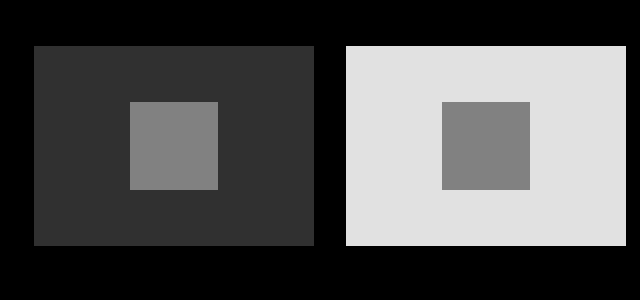
These two patches are identical
It is the most repeated and least checkable sentence in visual perception, because the whole point is that it does not look true. Every instance here is computed, and checked before the figure is drawn.
Constancy is the default
A sheet of paper looks white in daylight and white under a tungsten lamp, although the light reaching the eye differs enormously. The visual system is solving one equation with two unknowns, and it solves it by assumption.
The illuminant is half the answer
An object has a reflectance, not a colour. The colour appears when a specified light falls on it, which is why two surfaces can match in a shop and clash outside, and why every serious matching standard names the light.
The algorithms that guess the light
What reaches a sensor is an illuminant multiplied by a reflectance, and no arithmetic separates a product into its factors. Every white-balance algorithm therefore works by assuming something about the world — and the interesting content of each is not its formula but the assumption, because a scene can violate it.
A shadow has its own illuminant
Outdoors there are two lights, not one. The direct beam is a radiator reddened by the atmosphere; the sky is precisely the power that reddening removed. A shadow is lit by the second alone, so shadowed ground and sunlit ground sit under illuminants 21 units of ΔE apart — before any surface, any eye or any opinion is involved.

The highlight is the lamp
Light reflected at the surface of a glossy material never entered it, so it never met a pigment. Fresnel's reflectance varies by 5.5% across the visible band and the paint underneath varies by a factor of twenty — which makes a highlight the one region of a photograph that reports what the light was rather than what the object is.
A scene has no white point
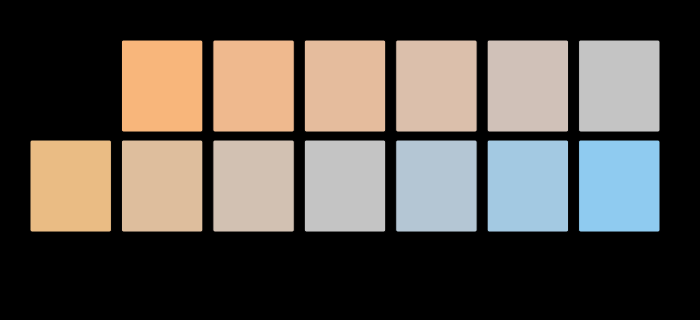
White balance is one transform applied to a whole image, and a scene lit by two lamps has no single answer for that transform to be. The failure is structural rather than a matter of a better estimator — and every colour-managed workflow in existence takes exactly one white point as an input, with no field in which to say there were two.

The paper is the white point
A printed colour is reported against the sheet it sits on rather than against the light in the room, and the choice is a switch in every colour engine. Flipped one way, the same separation on coated stock and on newsprint is a 3.04 colour difference; flipped the other, it is 0.13 — and the two answers are about different questions.

Two lamps do not average
Light adds, band by band, and every number a lamp is sold by is a projection of the sum rather than a sum of the projections. Two radiators sitting exactly on the Planckian locus mix into a light that is measurably pink; two poor lamps mix into a better one than either.
There is no brown light
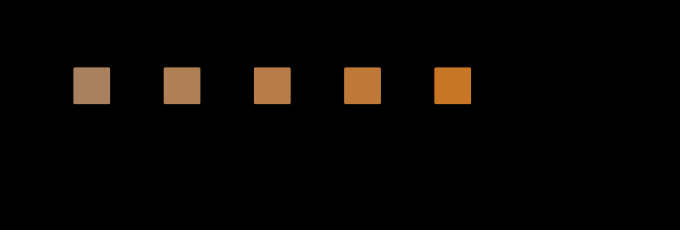
Brown is dark orange, dark is a ratio to a white, and a light in a dark room has no white to be dark against. The same stimulus, unchanged in XYZ, runs from lightness 152 to lightness 16 as the surround is raised — and only the bottom of that range has a name.

The model has no clock
An appearance model takes a stimulus and a situation and returns what it looks like. It does not take a time, and adaptation is not instantaneous — half a second after the light changes a judgement is three and a half CAM16-UCS units from the settled one, and a minute later it is still 1.3.
A gain has a time constant
An afterimage and the clock on chromatic adaptation were built in different files from what the last phase said was one mechanism. Joining them removes a free parameter, reproduces both, and predicts a third thing — that two people in one room, at one moment, looking at one patch, do not agree about its colour.

The eye is never still
A perfectly stabilised retinal image disappears within seconds. What keeps the world there is a drift of about half a degree a second between the microsaccades — fast enough to keep the finest detail modulating and slow enough not to carry it past fusion, in a band whose upper edge is at 0.71 degrees a second.

A lamp has a direction
A white LED is a blue die under a converter, and light leaving at an angle has travelled further through the converter than light leaving straight up. So the mixture is different in every direction, the beam is bluer in the middle than at its edge, and the number on the box is one direction's worth of a device that has no single colour.

The room settles after the eye does
Four clocks run in a room and only three of them are in the observer. The slowest is the lamp, which takes four hundred seconds to reach nine tenths of its colour change — so a minute after the light goes on, when the eye is conventionally said to have settled, most of what is left is the lamp, and three quarters of that could not be adapted away by an observer of any speed.

A viewing condition is a moment
CIECAM16's degree of adaptation is a function of the surround and the adapting luminance and of nothing else, because the model has no time in it. Solving for when an observer who will adapt completely has got that far turns the standard's three surrounds into three clock readings — 107, 50 and 21 seconds — and the two readings are distinguishable by waiting.

A corner moves both terms
The interreflection essays compute what a corner does to a spectrum, which is one of the two things a corner does. It is also a brighter place with a differently coloured background — a viewing condition, not a stimulus — and adaptation removes most of the first and none of the second. At an enclosure of six tenths that is 63 per cent of seven units gone and a further unit arriving from the extra light alone.

What no adaptation can remove
A change of light is exactly a 3×3 matrix on tristimulus values, and adaptation is a diagonal one. Putting every change of illumination this site models through that distinction sorts them by how much of themselves they leave behind, and the smallest residual in the census belongs to a filter inside the eye.

Which lamp changes are free
The changes of light that existed before electricity commute with one another to a couple of parts in a thousand, so one set of axes handles all of them. The lights the lighting industry invented do not, and the worst pair in the census is seventy-six times further from commuting than the best.

The same wall applied twice
A bounce off a painted wall is a change of illumination, and adaptation handles it about as well as it handles a change of colour temperature. A corner applies the same reflectance twice, which sharpens it — and leaves an adapted observer with 1.96 times as much for a change only 1.33 times as large.

An image does not determine the light
A photograph of a scene under one illuminant gives three numbers per surface and asks for the illuminant plus three numbers per surface. The count closes only if reflectances lie in a two-dimensional model, and no number of surfaces helps — at three dimensions the alternative scenes can be written down, and they reproduce every sensor response exactly.

Which changes of light pay for it
A fitted adaptation basis beats the receptors by 0.68 units on average, and an average is a poor description of what it does. On six of fourteen changes of light it is worse, and the whole of its advantage comes from four — a tungsten lamp and three coloured walls.
Everyone is beaten by the same wall
Eight candidate adaptation bases, fourteen changes of light, and seven of the eight have their worst row in the same place — not a lamp, but a green wall reflecting twice. The one that does not is the one that was fitted, and what its fit bought was permission to give up on that row.

The average surface does not look average
Over a population of observers the appearance model is so nearly linear that the mean of its answers is its answer for the mean, to 1.4 per cent of the spread. Over the surfaces in a scene it is not. On 240 smooth reflectances the gap is 21 per cent of the spread, and the mean surface looks 4.2 units lighter than the surfaces look on average. The grey that matches the average light is a 47 per cent reflectance; the grey that matches the average look is a 43 per cent one.

A gloss room looks less colourful than it measures
A gloss finish takes 8.3 per cent of the chroma out of a green room's reflected light, and a viewer adapted to the room should discount a loss that affects everything alike. The appearance model says the opposite. Adaptation removes the colour the whole room shares, leaves the colour that differs from face to face, and the finish takes as large a share of that as of anything — so to a viewer standing in the room the faces lose 13.9 per cent of their chroma, not 8.6.

A room with two lights has no white
An appearance model takes one adapting white. A desk beside a window has two, and the mixture falling on the paper is not the same thing as the white the person reading it has adapted to. Mixing the lights is arithmetic. Choosing the white is not, and the choice is worth sixty units of appearance — most of which is a cast, and not all of which is.
Named alongside it
The objects these essays reach for when they reach for this one.
Chromatic adaptationIlluminantAdaptationReflectanceViewing conditionThe von Kries transformCIECAM16White pointAssertionSpectral power distributionCAT16Colour appearance