White point — where it appears
Named by 35 essays across 8 fields — each of them below, with the objects they name alongside it.

A spectrum is not a colour
What arrives at the eye is a function of wavelength. What the eye reports is three numbers. Keeping the two apart is the single most useful habit in the subject, and almost every confusion in applied colour comes from letting them merge.

Why colour is exactly three-dimensional
Matching every wavelength with three primaries requires, for some wavelengths, a negative amount of one of them. That physical awkwardness is why the colour-matching functions were transformed into XYZ, and why the horseshoe is curved.

A hex code is not a colour
Six hexadecimal digits identify three numbers. Turning three numbers into a colour needs a colour space, a transfer function, a white point and a display, and leaving any of them unstated is the everyday version of every confusion in colour management.

Four ways to move a white point
Every chromatic adaptation transform is the same three lines with a different matrix. The matrices disagree by more than any tolerance a supplier is held to, and the oldest one — still shipping, still called von Kries — is not a cone basis at all.
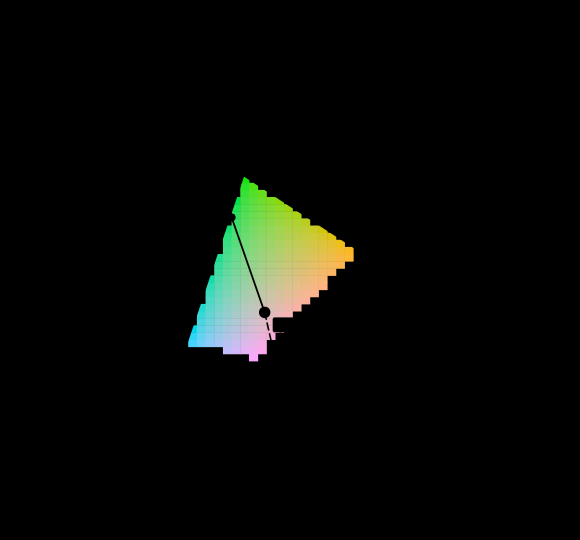
Not every colour has a wavelength
The question every reader arrives with is which wavelength a colour is. For close to a third of the directions on the chromaticity diagram the honest answer is that there is none, and the construction colorimetry offers instead is a statement about a diagram rather than about light.

The triangle is a shadow
A display's gamut is drawn as a triangle on the chromaticity diagram, and coverage is quoted as a percentage of that triangle's area. Chromaticity has luminance divided out, so the triangle is a projection along the axis the eye cares most about — and the ratios computed on the solid are not the ratios computed on its shadow.

Two degrees or ten
This site names the observer on every figure it draws, which was supposed to be the point. Measuring what it had actually done found two hundred and four figures naming the same observer, three naming the other, and sixty-two of sixty-four generators printing a string that had never once varied.
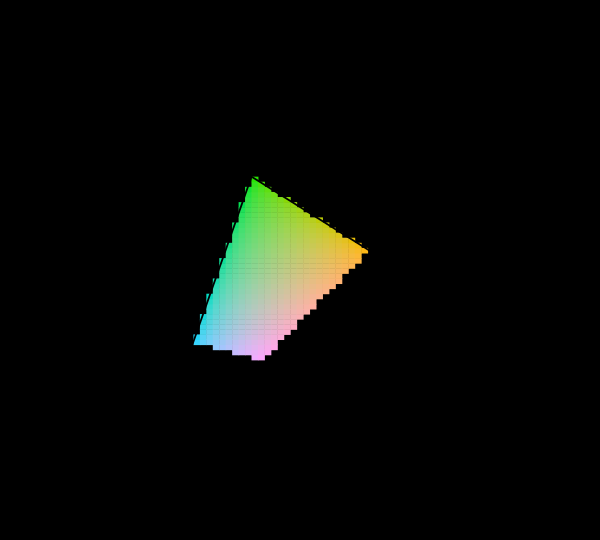
Six numbers make a space
An RGB colour space is eight numbers — three primary chromaticities, a white point, and a transfer function — and everything else about it is derived. Deriving it rather than copying the matrix is the difference between having a colour space and having a table somebody else computed.

The sun is not one illuminant
Daylight is not a blackbody and is not one spectrum. It is a one-parameter family reconstructed from three measured basis functions, its chromaticities lie on a curve that is near the Planckian locus and not on it, and the difference is the reason a colour temperature needs a second number beside it.
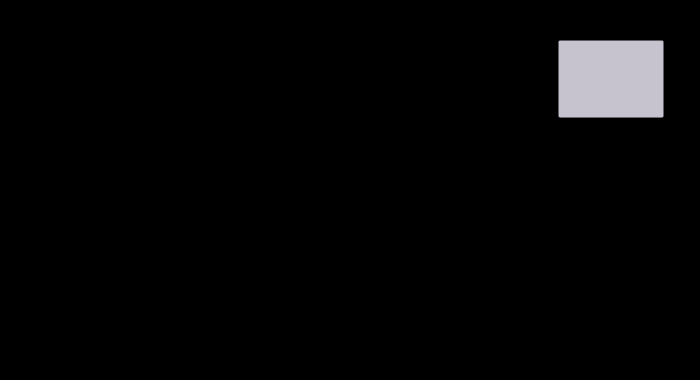
A shadow has its own illuminant
Outdoors there are two lights, not one. The direct beam is a radiator reddened by the atmosphere; the sky is precisely the power that reddening removed. A shadow is lit by the second alone, so shadowed ground and sunlit ground sit under illuminants 21 units of ΔE apart — before any surface, any eye or any opinion is involved.
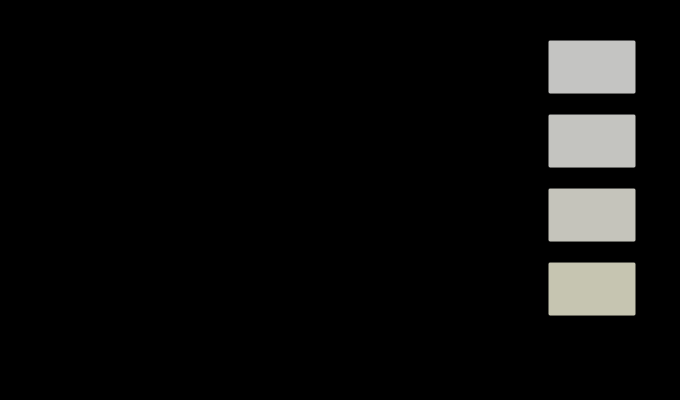
What a white wall costs
A closed room returns 1/(1−ρ) times the light that entered it, computed band by band — so a paint that is five percent off neutral becomes a strongly coloured illuminant once the room has finished bouncing. The gain amplifies the tint along with the brightness, and the last few percent of albedo cost far more than the first.
A scene has no white point
White balance is one transform applied to a whole image, and a scene lit by two lamps has no single answer for that transform to be. The failure is structural rather than a matter of a better estimator — and every colour-managed workflow in existence takes exactly one white point as an input, with no field in which to say there were two.

The paper is the white point
A printed colour is reported against the sheet it sits on rather than against the light in the room, and the choice is a switch in every colour engine. Flipped one way, the same separation on coated stock and on newsprint is a 3.04 colour difference; flipped the other, it is 0.13 — and the two answers are about different questions.

There is no D65 lamp
D65 is standardised by three numbers, and three numbers do not pin a spectrum. A source built to hit them exactly — matched to a part in a billion, with a third of the visible band nearly empty — separates pairs that D65 says are identical by up to eight and a half units of colour difference.

White is a region
A lamp is not sold as a chromaticity. It is sold as 4000 K, and what that means is that its chromaticity fell inside a quadrangle — which two lamps can occupy at opposite corners, eleven ΔE00 apart. In a room with either of them, the same twelve surfaces differ by one unit.

A screen is a poor lamp
A display's white is a light. Shone on a surface it renders colour worse than a fluorescent tube — and the wider the gamut, the worse it gets, because the narrow primaries that buy a large triangle are exactly the ones that leave holes in the spectrum.
A gain has a time constant
An afterimage and the clock on chromatic adaptation were built in different files from what the last phase said was one mechanism. Joining them removes a free parameter, reproduces both, and predicts a third thing — that two people in one room, at one moment, looking at one patch, do not agree about its colour.

A display in a room is a smaller display
Two results here turn the room's light in opposite directions and neither knows about the other. A room has one light level and does both at once — so there is a brightness at which a display delivers the most colour, it is not at either end, and it scales with the panel.

Four primaries have a choice
Three primaries matching three numbers have one answer. Four have a family of them, every member exact to floating point for the observer they were solved for — and the members are not equally good for anybody else, so a display with a fourth primary has a setting that is robust to who is looking at it and a setting that is not.

The room settles after the eye does
Four clocks run in a room and only three of them are in the observer. The slowest is the lamp, which takes four hundred seconds to reach nine tenths of its colour change — so a minute after the light goes on, when the eye is conventionally said to have settled, most of what is left is the lamp, and three quarters of that could not be adapted away by an observer of any speed.

A viewing condition is a moment
CIECAM16's degree of adaptation is a function of the surround and the adapting luminance and of nothing else, because the model has no time in it. Solving for when an observer who will adapt completely has got that far turns the standard's three surrounds into three clock readings — 107, 50 and 21 seconds — and the two readings are distinguishable by waiting.

What no adaptation can remove
A change of light is exactly a 3×3 matrix on tristimulus values, and adaptation is a diagonal one. Putting every change of illumination this site models through that distinction sorts them by how much of themselves they leave behind, and the smallest residual in the census belongs to a filter inside the eye.

A gain needs a basis
Adaptation scales three signals, and which three is a choice. The basis in which a change from D65 to D50 is exactly diagonal can be computed in closed form from the two spectra, it beats every published transform on daylight by a factor of five, and it loses to all of them on a fluorescent tube.

Dividing by the paper
Media-relative colorimetry divides tristimulus values by the substrate's, which is a von Kries adaptation applied in XYZ — the one basis the table here describes as the oldest mistake still shipping. On a paper-mill white it costs a few hundredths of a unit. On a tinted sheet it costs ten times what the same rule costs in a cone basis.

Primaries chosen for their inverse
Moving a display's white point is a gain on its R, G and B, so a display adapts in the inverse of its own primary matrix — a basis chosen by committees for gamut coverage and phosphor availability. Pose the design problem properly and the answer costs one per cent of the gamut argument and reaches within two per cent of the best basis there is.

Best on the average, undefined at the edge
Bradford has the lowest mean residual of any adaptation transform over the census of illumination changes, which is why colour management uses it. Inside the family that census was drawn from, its middle row's reading of the white passes through zero — so the gain is a division by nothing, and the model stops being defined rather than merely doing badly. CAT16, which exists because its predecessor did this, does not.

The surfaces that answer nothing
Five of the hundred and twenty-five test surfaces contribute exactly zero to every number the adaptation census reports — not approximately, exactly — and the reason is the one fact about von Kries adaptation that makes it worth having at all. Counting the set by how much it contributes gives about a hundred members rather than a hundred and twenty-five.

Three numbers the scene supplies
An adaptation model's parameters are not all the same kind of thing. Some are numbers an observer must estimate from the room it is standing in; others could have been settled once by evolution. Counting them separately turns the diagonal gain from a crude approximation into the only model of the set that gets a large answer from information the observer can actually have.

A neutral has no grid
A perfectly flat reflectance computes to exactly the same colour on every wavelength grid, through every slit, at every origin, and for every observer — not nearly, but to the last bit of a floating-point number. The condition is an identity rather than a limit, and what makes it one is the white point.

The normaliser carries the error too
A five-nanometre sum gets a red pigment's tristimulus value wrong by two hundredths of a per cent and its colour wrong by six hundredths of a unit. Those two numbers are not the same size because the grid appears twice in a colour — once in the sample and once in the white — and the two errors are largely the same error.

A neutral is everyone's colour
Two eyes differing by fifty years of lens yellowing, by a factor of three in macular pigment and by six nanometres of long-wavelength peak agree about a grey card to four parts in ten thousand billion. The agreement is an identity rather than a coincidence, and it says exactly what an observer disagreement is a disagreement about.
The conditions are the result
The round measured about twenty departures and established ten conditions. The departures are numbers that depend on a sample, a light and a construction; the conditions are exact, they hold under every substitution tried, and they are what a reader can act on. A size is a measurement and a condition is a mechanism.

A room with two lights has no white
An appearance model takes one adapting white. A desk beside a window has two, and the mixture falling on the paper is not the same thing as the white the person reading it has adapted to. Mixing the lights is arithmetic. Choosing the white is not, and the choice is worth sixty units of appearance — most of which is a cast, and not all of which is.

A finish adds colour only to a daylight meter
Measured against daylight's white, a satin finish under six lamps and six wall colours takes anything from −6 to 42 per cent of a room's colour, and one room reads as more colourful glossy than matt. Measured against the white of the lamp each room is actually lit by, the same thirty-six rooms lose between 7.7 and 12.9 per cent and none gains. The whole spread was the lamp's own colour, and the finish does one simple thing to every room: it pulls the room's colour a tenth of the way towards the lamp's white.

What an adapted viewer loses is set by the wall
A satin finish takes about a tenth of a room's colour, measured on the room's light against its lamp's white. Read through an appearance model by a viewer adapted to the room, the same thirty-six rooms lose between 12.8 and 30.9 per cent — 1.4 to 2.4 times as much — and the wall colour decides the multiplier: a deep red room loses twice what a green one does, under every lamp. A test on the bare wall predicts it. Add a little of the lamp's white to the wall's own colour and ask the model what that costs: the answer orders the thirty-six multipliers at 0.95.
Named alongside it
The objects these essays reach for when they reach for this one.
Chromatic adaptationIlluminantStandard observerThe von Kries transformColour managementAdaptationColour constancyPrimariesReflectanceSpecificationAssertionChromaticity