Primaries chosen for their inverse
Assumes Everyone is beaten by the same wall, Four ways to move a white point and A gain needs a basis.
A display’s white point control is a gain on three channels. That is what the control physically does — it scales the drive to each primary — and a per-channel gain in some basis is exactly a von Kries adaptation. The basis is the inverse of the display’s own primary matrix, so three chromaticities chosen in a standards meeting decide how well every white-point change on that panel behaves, and nobody has ever posed the choice that way.
The claim
Design primaries for the adaptation properties of their inverse, subject to a floor on how much of the diagram they must cover, and the constraint is almost free. Unconstrained, the best display reaches 0.996 ΔE00 against a best-possible-basis figure of 0.974 — within 2.3 per cent — while covering 54 per cent of the diagram, more than Display P3. Required to cover as much as Rec. 2020, it reaches 1.018.
- Six numbers, two constraints. Three chromaticities, each required to be a colour some light can have, and a triangle required to cover a stated share.
- The trade is nearly flat. From 54 per cent coverage to 72 per cent costs eight per cent of the adaptation residual.
- And it is not a trade with discrimination either. Widening the gamut improves the ellipse anisotropy of the display’s own basis, from 7.80 to 3.14.
- The published sets are all above the curve. sRGB by a factor of 2.4, P3 by 1.2, Rec. 2020 by 1.07.
What the design variables are
A display’s primary matrix takes linear R, G and B to tristimulus values, and it is determined by three chromaticities and a white point: the columns are the primaries scaled so that unit RGB gives the white. Its inverse is the basis a per-channel gain acts in.
So the design space is six numbers — the xy coordinates of three primaries — with the white held at D65. That is the same effective dimension as the space of distinguishable adaptation bases, since three of the nine free numbers in a basis are invisible to a gain. The display design problem is therefore not a small corner of the basis problem; it is nearly all of it, restricted to the region where the three rows correspond to realisable colours.
That observation is what makes the result unsurprising in retrospect and worth measuring anyway: the good adaptation bases are all realisable as primaries, and there was no way to know that without asking.

Where a primary is allowed to be
The constraint that a primary be a realisable colour is a real one and it is what makes the problem bounded. Every chromaticity any light can have is a non-negative mixture of monochromatic ones, so the admissible region is the convex hull of the spectral locus, and the corners of that hull are the monochromatic lights themselves.
That detail cost this collection a false result and is worth recording. The first version of the search tested membership against a polygon through the locus sampled every five nanometres, which cuts corners off the true region — and it rejected Rec. 2020’s green and blue as unrealisable. They are not unrealisable; they are on the locus, and the polygon was inside it. Every design at a gamut floor above sixty per cent came back reporting its own starting point.
The hull at one nanometre fixes it, and the largest triangle that fits inside it covers 73.9 per cent of the diagram — the hard ceiling for any three primaries. That number, like every share of a diagram, is a property of the diagram and is quoted for CIE xy.
The trade curve
The interesting property of the curve is how boring it is.
With no coverage requirement at all, the best display leaves 0.996 and happens to cover 54 per cent. Required to cover 60 per cent it leaves 1.007. Required to cover 63.5 per cent — Rec. 2020’s share — it leaves 1.018. Required to cover 72 per cent, close to the geometric ceiling, it leaves 1.075.
So the whole span from more than P3 to nearly the largest triangle possible costs eight per cent of the adaptation residual. There is no wall, no knee, and no region where the two objectives fight.

The second surprise is that the other objective moves the right way. A display’s own basis is also a space, and how nearly it makes discrimination contours circular can be measured: at 54 per cent coverage the designed display leaves an axis ratio of 7.80, and at 72 per cent it leaves 3.14. Widening the gamut improves it by three fifths. The reason is the same mechanism running backwards — a wider triangle needs primaries nearer the locus, which are spectrally narrower, and narrower channels help a gain and hurt discrimination — except that a display’s basis starts so far from cone-like that moving it in almost any direction is an improvement.
The exchange between the two objectives
The gamut floor costs adaptation and buys discrimination, and the rate is worth more than the endpoints.
Sweeping the floor: below 0.5379 it binds nothing at all, because the unconstrained optimum already covers that much, so the first rows of the sweep are identical. Above it:
| coverage floor | achieved | adaptation | anisotropy |
|---|---|---|---|
| unconstrained | 0.5379 | 0.9961 | 7.796 |
| 0.55 | 0.5505 | 0.9955 | 7.561 |
| 0.60 | 0.6000 | 1.0072 | 6.577 |
| 0.635 | 0.6350 | 1.0183 | 5.128 |
| 0.68 | 0.6800 | 1.0639 | 4.036 |
| 0.71 | 0.7188 | 1.0750 | 3.143 |
Across the whole constrained range the adaptation residual worsens by 7.9 per cent while the anisotropy improves by a factor of 2.48. That is less a trade than a purchase: about a third of a per cent of adaptation for each per cent of coverage, against a fall of nearly two thirds in the discrimination geometry.
And the exchange improves as it goes. Between floors of 0.635 and 0.71 — the stretch from Rec. 2020’s own coverage upwards — the adaptation cost is 5.6 per cent and the anisotropy gain is 38.7 per cent, the steepest rate anywhere on the curve.
So describing the constraint as nearly free understates it in one direction. Requiring a display to cover more of the diagram costs almost nothing on the objective it was designed against and improves a second objective it was not designed against at all — and the improvement is steepest exactly where the standards have already arrived, which makes the next widening the best-value one on the curve.
What the designed primaries look like
At Rec. 2020’s coverage, the design puts its red at (0.686, 0.314), its green at (0.137, 0.813) and its blue at (0.139, 0.037). Rec. 2020’s own are (0.708, 0.292), (0.170, 0.797) and (0.131, 0.046).
They are close, and the differences are informative. The design pulls the red in from the locus and pushes the green further towards it, which trades a little of the red corner’s area for a green channel that overlaps its neighbours less. The blue barely moves, because the blue corner is doing almost nothing in either objective — the short-wave channel carries very little luminance and its position is nearly free.
The improvement over Rec. 2020 itself is 6.8 per cent at identical coverage: 1.018 against 1.092. That is small and it is not the point. The point is that a difference of that size exists at all in a quantity nobody has ever computed for a display specification.
Why nobody posed it
Three reasons, and none of them is negligence.
The two properties belong to different documents. A display specification names primaries, a white point, a transfer function and a bit depth, and it names them so that two devices agree about what a code means. Adaptation belongs to colour appearance modelling and to colour management, which take the display as given and adapt around it. There is no document in which both live.
The white point control does not look like an adaptation. It looks like three sliders, or like a menu item called colour temperature, and what it does is described in the manual as changing the white. That it is a von Kries gain in a particular basis is true, obvious once said, and said nowhere.
And the gamut argument was loud. For twenty years the interesting question about primaries has been how much of the diagram they cover, because that is what distinguishes a specification from its predecessor and what can be put on a box. A second criterion arriving in the middle of that argument would have needed a reason, and the reason — that a white point change is a gain — is one line of algebra that nobody had occasion to write down.
What the number means for a panel
The residuals here are for a complete white point change — the display’s white moved from D65 to the second context’s white, with the panel doing what its control does. That is what happens when a user picks a warmer white, when an operating system applies a night-time shift, or when a calibration targets D50 for print proofing.
At sRGB’s primaries that operation leaves 2.36 ΔE00 on average across the census, which is a visible cast on a substantial fraction of colours: greens and cyans shift most because the green primary is the widest channel and the gain that is right for the white is wrong for them.
At Rec. 2020’s primaries the same operation leaves 1.09. So a wide-gamut panel does not merely show more colours; it survives being white-balanced better, and the second property has never appeared in a review.
The practical reading for proofing is direct. Setting a display to D50 to compare against print is a large white point move, and it is the move this arithmetic measures. Doing it on an sRGB panel and on a Rec. 2020 panel gives two different amounts of residual error, differing by more than a factor of two, in a workflow whose whole purpose is matching a screen to a sheet of paper.
What a fourth primary would do
Adding primaries is the other lever on this design space, and this collection has the machinery to ask what a fourth one buys.
The adaptation question changes shape with four channels, because a four-channel display’s white point control is a gain in a four-dimensional space and the map back to tristimulus values is not square. There is no unique basis and no unique inverse; there is a family of ways to drive four primaries to a given colour, and the choice among them is a design decision exactly as it is for inks.
That is a genuinely different problem and it is not attempted here. What can be said is that the three-primary result — that the constraint of realisability costs about two per cent — suggests the four-primary version would find the constraint even cheaper, since the admissible set is larger.

Who could act on it
The answer is narrower than it looks, and worth stating so the result is not oversold.
A panel maker cannot easily move its primaries: they are a phosphor, a quantum dot or a filter set, chosen for efficiency and lifetime as much as for chromaticity, and the design freedom is a few thousandths rather than the tenths this search uses.
A standards committee can, and the moment to do it is when a new specification is written. The measurement here says the cost of adding an adaptation criterion to such a specification is small — the best triangle at any given coverage is not far from the widest one — so the criterion could be met almost for free if anybody asked for it.
And a colour management implementer can do something today that costs nothing: stop assuming a display’s white point control is equivalent to an adaptation transform applied in a good basis. On an sRGB panel it is equivalent to XYZ scaling, which this collection calls the oldest mistake still shipping, and applying a proper transform in software and driving the panel at its native white is measurably better.
What was computed, and how
The objective is the adaptation residual the essays on adaptation bases already used, unchanged and long-standing: for each of fourteen changes of illumination, the exact 3×3 relating tristimulus values under the two contexts, the diagonal an adapted observer applies in the candidate basis, and the mean CIEDE2000 remaining over a hundred and twenty-five constructed surfaces.
The search is Nelder–Mead over the six chromaticity coordinates, started from Rec. 2020’s primaries, with restarts.
Both constraints are soft penalties proportional to the shortfall rather than a large constant, and this is not a detail. The first version returned a large constant outside the feasible set, and every run at a floor above sixty per cent reported the seed unchanged — the simplex was standing on a plateau of infinity with nothing to walk down. The failure does not announce itself: the answer is finite, plausible and is exactly the starting point. It is the classical argument for a barrier method, met in practice.
The budgets are recorded rather than re-derived: the design at Rec. 2020’s coverage returns 1.020 at two hundred steps and three restarts, 1.018 at two hundred and fifty and four, and 1.020 at five hundred and six — a spread of two thousandths, which is the simplex’s own noise rather than a convergence gap.

Asking for only forty-five per cent of the diagram is about what Display P3 reaches, which makes it the comparison a manufacturer would recognise.

The other end of the curve
The trade curve stops at 72 per cent because the largest triangle that fits inside the visible region covers 73.9, and the last point is close enough to the ceiling that the search struggles.
That ceiling deserves a sentence of its own, because it is a fact about three primaries rather than about any particular three. No display with three primaries, of any technology, ever built or ever buildable, can cover more than about three quarters of the CIE xy diagram, and the optimal triangle’s corners are at (0.167, 0.009), (0.737, 0.262) and (0.074, 0.834) — a violet, an orange-red and a green, none of them at the extremes of the locus.
The maximum-area triangle problem is affine-invariant rather than projective-invariant, so unlike most share statements the identity of the optimal triangle is stable under affine changes of the diagram and not under projective ones. The 73.9 belongs to CIE xy; that a ceiling exists does not.
Rec. 2020 is at 63.3 per cent, so it is already at 86 per cent of what three primaries can do, and the remaining headroom is worth much less than the invariant count suggests — a display’s coverage of stimuli people encounter saturates long before its coverage of the diagram does.
Where the model stops
A white point control is not always a diagonal. Some panels apply a full 3×3 in their processing pipeline, which would remove the whole question — and would remove it at a cost in computation and in precision that the panel makers who do not do it have presumably weighed.
Primaries are not free. The search treats any chromaticity inside the hull as available, and a real primary is a phosphor, an emitter or a filtered backlight with an efficiency, a lifetime and a cost. Rec. 2020’s corners are monochromatic by specification precisely because no real emitter is, and a design that asks for a green at 0.813 is asking for a very narrow emitter with the efficiency penalty that implies.
And a gamut share is a share of a chosen diagram. Every percentage in this essay is CIE xy, and the same triangle covers between 8.5 and 38.4 per cent of the visible diagram across twelve published coordinate systems. The trade curve is a real object; the numbers on its horizontal axis belong to one plane.
The generalisation
A parameter chosen for one purpose is a parameter, and the second purpose is usually free to ask what it would have chosen. Nothing about display primaries hides their role as an adaptation basis; the role follows in one line from what a white point control does. It was simply never asked.
The general form is that a specification fixes a quantity for a stated reason, and the quantity then appears in some downstream model as a parameter that model would like to choose. Whether the specification’s choice costs anything is a computation nobody is assigned to do, because it belongs to neither committee.
Here it costs Rec. 2020 seven per cent and sRGB a factor of 2.4, and the second number is large enough to matter.
Where the ladder goes next
The most interesting thing about that factor of 2.4 is that it was produced by an argument about gamut coverage rather than about adaptation, and the gamut race turns out to have chosen a good basis by accident.
Where this goes next
 The gamut race chose the basis
Twenty years of arguing about how much of the diagram a display should cover has produced primaries whose inverse is a better adaptation basis than any transform ever fitted to corresponding-colour data. On the invariant count of what those displays can actually show, the same twenty years produced nothing at all.
The gamut race chose the basis
Twenty years of arguing about how much of the diagram a display should cover has produced primaries whose inverse is a better adaptation basis than any transform ever fitted to corresponding-colour data. On the invariant count of what those displays can actually show, the same twenty years produced nothing at all.
 Four ways to move a white point
Every chromatic adaptation transform is the same three lines with a different matrix. The matrices disagree by more than any tolerance a supplier is held to, and the oldest one — still shipping, still called von Kries — is not a cone basis at all.
Four ways to move a white point
Every chromatic adaptation transform is the same three lines with a different matrix. The matrices disagree by more than any tolerance a supplier is held to, and the oldest one — still shipping, still called von Kries — is not a cone basis at all.
 What a gamut costs
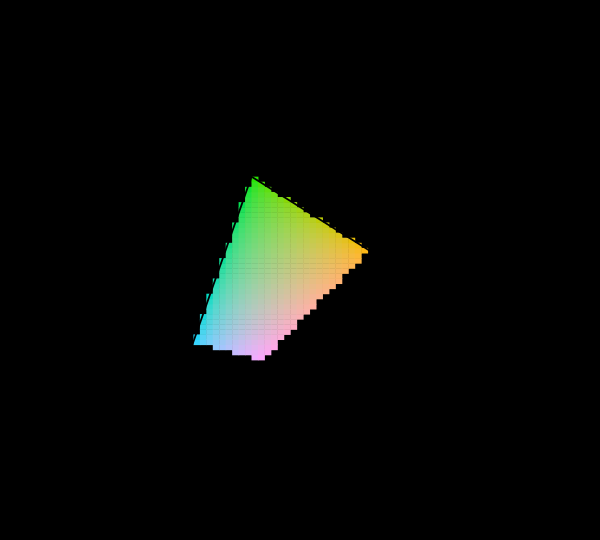
Three primaries reach a triangle and the visible region is not a triangle, so something has to give. Widening the primaries helps, has a price in precision and compatibility, and runs into a limit that is geometric rather than technological.
What a gamut costs
Three primaries reach a triangle and the visible region is not a triangle, so something has to give. Widening the primaries helps, has a price in precision and compatibility, and runs into a limit that is geometric rather than technological.
What this makes readable
Essays that name this one as a prerequisite.
Named alongside this one
Essays reaching for the same objects. Nobody chose these; they are what the index of named objects makes visible.
- A constraint costs what it points at basis · chromatic adaptation · optimisation · specification · trade-off
- One matrix doing two jobs basis · chromatic adaptation · specification · trade-off · the von kries transform
- A narrow primary buys a disagreement display gamut · primaries · specification · trade-off
- A sensor designed for its inverse basis · chromatic adaptation · optimisation · the von kries transform
- Best on the average, undefined at the edge basis · chromatic adaptation · the von kries transform · white point
- Dividing by the paper chromatic adaptation · specification · the von kries transform · white point
What links here
Every essay whose body links to this one.
The objects this essay names
Each one links to every other essay that touches it.
BasisChromatic adaptationChromaticityDisplay gamutOptimisationPrimariesSpecificationTrade-offThe von Kries transformWhite point