A screen is a poor lamp
Assumes A lamp is not a blackbody and What a lamp cannot give back.
A display is treated everywhere on this site as a device that emits colours: three primaries, a white point, a transfer function, a triangle on a chromaticity diagram. That is the right description for the job it is doing.
It is not the only job it does. A screen at three hundred candelas a square metre, filling a good part of somebody’s field of view, is also a light source — it lights the desk, it lights the face on the video call at the other end, and it lights whatever print is being compared against it. And as a light source it is bad.

The claim
A display’s white, judged as an illuminant by the same index a lamp is judged by, scores worse than a fluorescent tube — and the ordering across display technologies is the gamut ordering backwards.
At one chromaticity — every source below is D65 to within thirty kelvin, so nothing here is a white-point difference:
| source | fidelity index | worst surface shift |
|---|---|---|
| D65 itself | 99.9 | — |
| an LCD’s white | 88.1 | 3.89 |
| a triphosphor fluorescent tube | 81.2 | — |
| an OLED’s white | 82.0 | 5.56 |
| a laser projector’s white | 67.6 | 8.33 |
A fluorescent tube is the standing example of a bad lamp. Two of the three displays are worse.
And the ordering is the gamut ordering backwards. The LCD has the broadest primaries and the smallest triangle; the laser has the narrowest and the largest. Every step that buys more gamut costs rendering, for the same reason in both cases: a narrow primary is a spike, a spike has nothing either side of it, and a surface whose reflectance peaks where the spike is not gets no light to reflect.
The mechanism, which is the same one twice
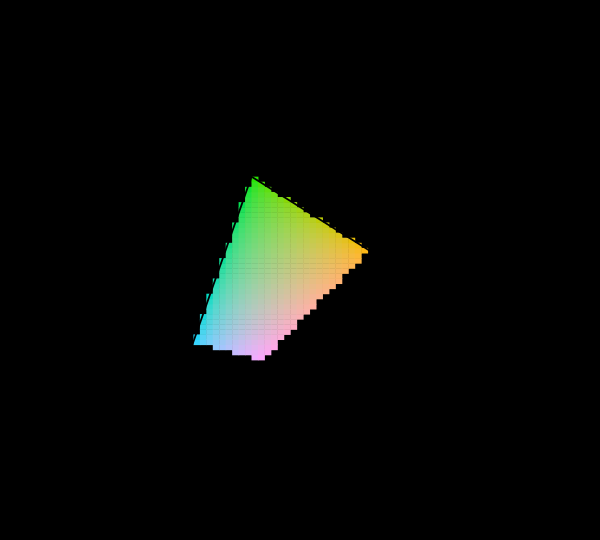
What a gamut costs measured the first half of this: narrower primaries reach further out on the chromaticity diagram, which is why every wide-gamut display has spikier primaries than the one before it. The gamut is a triangle whose corners are the primaries’ chromaticities, and a chromaticity is pushed toward the spectral locus by making the emission narrow.
The rendering half is the same fact read backwards. A source’s ability to render a surface is its ability to sample that surface’s reflectance across the visible band, and three narrow lines sample at three wavelengths. A reflectance that dips between two of them is invisible to the source, and a reflectance that peaks between them reflects nothing.
So one design decision moves two quantities in opposite directions, and no display has ever been sold on the second.
Where this actually bites
Four places, and the first two are ordinary.
Video calls. A face lit mostly by a screen is lit by a source with an index in the eighties or worse, and the failure is concentrated in exactly the reds and warm skin tones a face is made of. The correction applied at the far end is a white balance, which moves the whole picture along one axis and cannot undo a rendering failure — because a rendering failure is not a chromaticity shift.
Softproofing. A print held beside a screen is lit partly by the screen, whose light the paper’s own white point then multiplies. The standards for this specify the room’s illuminance and the booth’s spectrum precisely and say nothing about the display’s own emission falling on the sheet — which at close range is not negligible and is a different light from the booth’s.
Film and television lighting. Large light-emitting-diode panels are used as key lights, and the ones designed for the job carry a rendering specification. Panels built as displays and used as lights — a wall of screens as a backdrop, which is now ordinary practice — do not, and what a camera makes of such a light is a fourth observer’s problem on top of this one.
And the room a screen is in. A display in a room is a two-way exchange: the room’s light falls on the screen and raises its black, and the screen’s light falls on the room and is part of what the observer is adapted to. The second half has a spectrum, and it is this one.

The set can be drawn with different members and under different observers, and the ordering of the three technologies survives both.

Two more sets say that the ordering is not an artefact of which three sources were put on the axis or which observer was used to score them.


The one number that does move, and the one that does not
Two quantities separate the three displays and they behave differently, which is worth saying because only one of them is a rendering statement.
The index falls with the primary width, monotonically: 88.1, 82.0, 67.6, for widths that go roughly 50, 30 and 2 nanometres. That is the rendering claim.
And the worst single surface more than doubles, going 3.89, 5.56, 8.33 across the same span.
That comparison is usually made the wrong way round, including in the first version of this section, and the error is worth naming because it is the commonest one made about indices. An index falls from 88.1 to 67.6 — a 23 per cent fall — while the worst shift rises by 114 per cent, and the two figures invite the conclusion that the extreme is deteriorating far faster than the average. They are not comparable. An index is a score with a ceiling at 100 and a shift is a distance with a floor at zero, so a fixed deterioration shows up as a small proportional change in the first and a large one in the second, whatever is actually happening.
Put both on the same footing by reading the index as a deficit from its own ideal:
| LCD | OLED | laser | ratio across | |
|---|---|---|---|---|
| index | 88.1 | 82.0 | 67.6 | ×0.77 |
| deficit from 100 | 11.9 | 18.0 | 32.4 | ×2.72 |
| worst surface shift | 3.89 | 5.56 | 8.33 | ×2.14 |
The two now move together, and the average moves slightly more than the extreme. So there is no separate finding about the tail here: across these three technologies the mean and the worst case deteriorate at nearly the same rate, and the apparent divergence was the arithmetic of a bounded score against an unbounded distance.
That does not rescue the index. The reason to distrust one number remains the one the replacement measures were built for — a source can score well by rendering nothing badly and nothing well — and the right response is still to report the distribution. What has gone is the specific evidence offered here for it, which was an artefact rather than a measurement.
What does not move is the white. Every one of the three is at D65 to within thirty kelvin, by construction, because that is what the two-by-two solve is for. So the differences in the table are not a calibration failure and cannot be corrected by one: two lights with identical chromaticity and different spectra are a metameric pair, and no white-point transform touches the part of the difference that is not a white-point difference.
Why a display is allowed to be a bad lamp, and a lamp is not
The obvious objection is that a display is not sold as a lamp and should not be judged as one. That is a fair description of the intent and it is not a description of the physics, and the difference between the two is where the trouble is.
A lamp and a display are the same object doing two jobs, and the two jobs have opposite requirements.
A lamp’s job is to be a good basis for surfaces. It has to put energy everywhere a reflectance might have structure, because whatever it leaves out cannot come back. Broad is good, and the best lamp for rendering is a blackbody, which has no structure at all.
A display’s job is to reach far from white. It has to put energy in narrow places, because a primary’s chromaticity is dragged toward the spectral locus by narrowing it. Spiky is good, and the best display primary is a laser.
So the two requirements are not merely different, they are opposed, and a device that does both well does not exist in three channels. Every display is a bad lamp because it is a good display, and the two-hundred-year-old measurement that says so — Planck’s law giving the smoothest possible spectrum from one number — is on this site already.
The way out is not a better trade but a fourth channel, and it is discussed at the end.
What a fourth primary actually buys
The closing suggestion — add an emitter to fill a hole without moving the triangle’s corners — is right, and the reason it works is stronger than “there is now more spectrum”, and worth stating because the same algebra has already been done on this site in absorption.
With three primaries, a stated white is a unique mixture. Two chromaticity constraints and three weights leave one degree of freedom, and that one is the overall scale — which is a brightness, not a colour. So once a display’s primaries and its white point are fixed, its white’s spectrum is fixed too, and the rendering index that follows from it is a property of the panel with no dial on it.
With four primaries there are four weights against the same two constraints, so after the scale there is one free parameter left, and the white becomes a one-parameter family of spectra rather than a single one. Every member of that family has the same chromaticity, the same white point and the same triangle — and a different rendering index.
That is the whole of what the fourth channel buys, and it is not more gamut. It is the conversion of a fixed property into a design choice: the same display, calibrated to the same white, with a knob that trades how much of the white comes from the fourth emitter against how much comes from the other three, and hence how well it lights a room.
The algebra is exactly the separation family’s, one field over and with the sign of everything reversed. Four inks against three numbers leave a one-parameter family of separations that match under the profiling illuminant; four emitters against two chromaticity constraints leave a one-parameter family of whites that match for the standard observer. Both families are metameric by construction, and every consequence follows: the members come apart for a particular observer rather than the standard one, which on narrow primaries is already the worst case, and they come apart most for the observers whose fundamentals differ most.
So a four-primary display’s rendering dial is free in gamut and not free in observer metamerism, and the trade it offers is between two things a datasheet reports neither of. That is a better position than the three-primary one, where the same quantity is fixed by the primaries and cannot be discussed at all.
Two sources are enough to make the point when they are the two furthest apart, and a Planckian radiator against a phosphor-converted LED is that pair.

What was computed, and how
A display’s white is built as a spectrum, not assumed. Three Gaussian primaries at stated centres and widths, mixed to land on a stated chromaticity — a two-by-two solve, because a chromaticity is two constraints and three weights carry one redundant overall scale. If the solve needs a negative weight the function throws rather than returning something that is not a light, which is the case for a white outside the triangle those three primaries span.
The three technologies are stated as primary widths and nothing else:
| red | green | blue | |
|---|---|---|---|
| an LCD — a white diode behind filters | 615 nm, 60 wide | 535, 70 | 450, 25 |
| an OLED — three emitters | 620, 30 | 530, 40 | 460, 22 |
| a laser projector — three lines | 638, 2 | 532, 2 | 465, 2 |
The index is this site’s own and is not CIE Ra. It uses twelve constructed reflectances rather than the CIE’s tabulated samples, CAM16-UCS rather than the 1964 space, and a scale factor stated as a presentational choice. What that costs is comparability with published numbers; what it buys is that every step is visible. The quantity that means something is the worst surface shift, in CAM16-UCS units, and the per-sample detail underneath it.
The control is D65 itself, which scores 99.92 — not 100, because the reference for a source at 6,504 K is the reconstructed daylight at that temperature and the site’s own D65 is a tabulated one. That two-hundredths of a unit is the measurement’s own noise floor and everything above is quoted against it.
And every source is at one chromaticity. All three displays are D65 to within thirty kelvin and a Duv of 0.0032, which is D65’s own distance off the Planckian locus. So none of the differences in the table is a white-point difference, which is the point: the white is identical and the light is not.
Where the model stops
These are not particular products. The primary widths are plausible for their technologies and are stated rather than measured, and a real panel’s primaries have shoulders and secondary bumps that a Gaussian has not. The ordering is robust — it follows from the widths alone — and the individual numbers are not.
A quantum-dot display is missing, and it is the interesting case: narrow emission like an OLED’s but from a phosphor rather than an emitter, and the width is a manufacturing parameter rather than a physical constant. It would sit between the OLED and the laser and would show the trade being made continuously.
Nothing here models the screen’s geometry. How much of a face’s light comes from a screen depends on the screen’s area, the room’s other lighting and the distance, none of which is here. What is computed is the light’s quality, not its quantity.
And the index has the flaw every index has. It is one number about a twelve-dimensional failure, and a source can score well by rendering nothing badly and nothing well.
The generalisation
The sentence worth carrying: a display’s primaries are a spectrum, and a spectrum has more in it than a triangle.
Everything a display is specified by — the primaries’ chromaticities, the white point, the transfer function, eight numbers in all — is a projection of three emission spectra onto a small number of coordinates. Those coordinates are exactly the ones needed to predict what the display can show, and they contain nothing about what it does as a light.
The surprising connection is with metamerism. A display’s white and daylight are a metameric pair by construction — that is what calibrating to D65 means — and every consequence of metamerism follows. They match for the standard observer and not for a particular one, which is why narrow primaries make observer differences worse; and they match as lights and not as illuminants, which is this essay. The two failures have the same cause and are usually discussed as though they were different subjects.
Who found it, and when
The colour rendering index was standardised in 1965, revised in 1974, and has been known to be inadequate for narrowband sources since light-emitting diodes arrived — the failure mode being that a source can score well by having no large error on any of eight moderate samples while failing badly on a saturated one. The replacement measures, from the 2010s, use many more samples and report more than one number.
Displays as light sources is much newer as a question, and it arrived from two directions at once: video conferencing making a screen the main light on most faces at work, and virtual-production stages replacing painted backdrops with walls of panels whose light falls on real actors.
What has not changed is what a display is specified by. A panel’s datasheet carries primaries, white point, transfer function, peak luminance and contrast ratio, and no statement at all about what its light does to a surface.
The two fluorescent sources are the pair a lighting schedule actually chooses between, and the ten-degree observer scores them too.

What the pictures cannot show
They cannot shine on anything. Every figure here is a drawing of a spectrum or of a computed shift, seen on a display that is itself one of the sources being described — so the reader is looking at the subject through the subject.
And the rendering pairs are the misleading ones. They show two versions of a surface side by side, computed under two illuminants and drawn on one. What is being claimed is that a surface lit by the second source looks like the second patch, and the figure delivers both patches under whatever light is actually in the room.
Where the ladder goes next
The nearest unfinished piece is the quantum-dot case, which would make the gamut–rendering trade a continuous curve rather than three points. The width is a single parameter and both quantities are already computable from it: one sweep gives the whole trade, and would say what a display costs in rendering per per-cent of gamut gained.
The second is the four- and five-primary display, which is the way out. Adding a fourth emitter fills a hole in the spectrum without moving the triangle’s corners, so it buys rendering at no gamut cost — the same argument a fifth ink makes on a press, in emission rather than absorption, and with the trade running the other way.
Where this goes next
 What a lamp cannot give back
Six hundred and eighty-three lumens per watt is not a measurement of anything. It is the definition of the candela, it is a ceiling no white light can approach, and the distance between a lamp and that ceiling is mostly the price of being able to see what colour things are.
What a lamp cannot give back
Six hundred and eighty-three lumens per watt is not a measurement of anything. It is the definition of the candela, it is a ceiling no white light can approach, and the distance between a lamp and that ceiling is mostly the price of being able to see what colour things are.
 What a gamut costs
Three primaries reach a triangle and the visible region is not a triangle, so something has to give. Widening the primaries helps, has a price in precision and compatibility, and runs into a limit that is geometric rather than technological.
What a gamut costs
Three primaries reach a triangle and the visible region is not a triangle, so something has to give. Widening the primaries helps, has a price in precision and compatibility, and runs into a limit that is geometric rather than technological.
 The proof is a different object
A soft proof can be made colorimetrically exact and still not match the print, because the print is in a booth at two thousand lux with an average surround and the screen is in a dim room at a fifth of the luminance. The appearance model puts four CAM16-UCS units between them, with no change of stimulus anywhere — larger than the error any rendering intent is arguing about.
The proof is a different object
A soft proof can be made colorimetrically exact and still not match the print, because the print is in a booth at two thousand lux with an average surround and the screen is in a dim room at a fifth of the luminance. The appearance model puts four CAM16-UCS units between them, with no change of stimulus anywhere — larger than the error any rendering intent is arguing about.
What this makes readable
Essays that name this one as a prerequisite.
Named alongside this one
Essays reaching for the same objects. Nobody chose these; they are what the index of named objects makes visible.
- A lamp switched on is not the lamp measured colour management · illuminant · specification · spectral power distribution · viewing condition · white led
- A lamp has a waveform display gamut · primaries · specification · spectral power distribution · white led
- Four primaries have a choice display gamut · metamerism · primaries · specification · white point
- Not every colour has a wavelength display gamut · gamut · illuminant · primaries · white point
- The display is an unknown colour management · display gamut · gamut · primaries · viewing condition
- There is no D65 lamp illuminant · metamerism · specification · spectral power distribution · white point
What links here
Every essay whose body links to this one.
The objects this essay names
Each one links to every other essay that touches it.
Colour managementColour renderingDisplay gamutGamutIlluminantMetamerismPrimariesSpecificationSpectral power distributionViewing conditionWhite LEDWhite point