Viewing condition — where it appears
Named by 54 essays across 8 fields — each of them below, with the objects they name alongside it.
Matching is not appearance
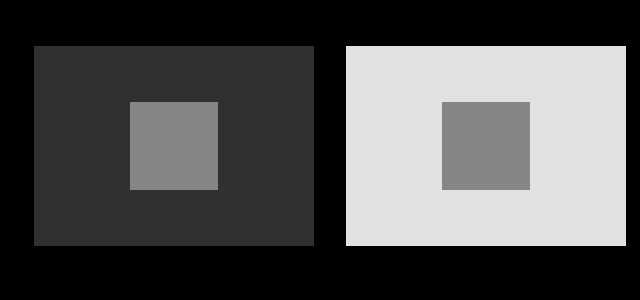
CIE XYZ predicts when two lights will look the same under identical viewing conditions. It was never a model of how anything looks, and most of the confusion in applied colour comes from using it as one.
The display is an unknown
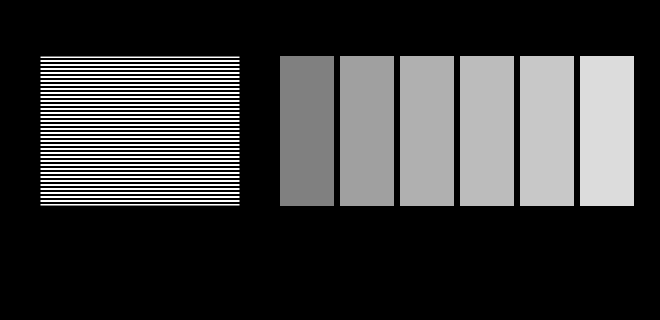
This site is displayed on the very apparatus it is about, and it knows almost nothing about that apparatus. Two figures here stop assuming and ask instead — a probe for the transfer function and a probe for the gamut.
A viewing condition is an argument
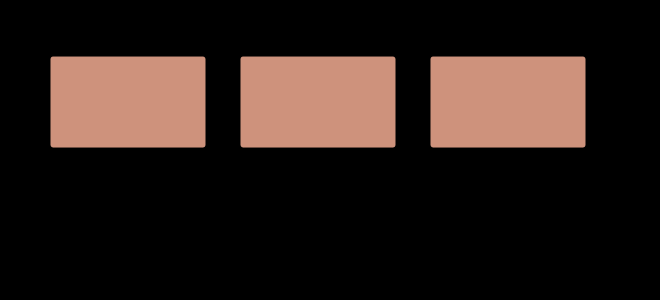
An appearance model takes a stimulus and a situation. The second argument is not a refinement of the first — it is the content of the claim, and a model that returns an appearance from a colour alone has assumed a room without saying which.
Why there are four unique hues
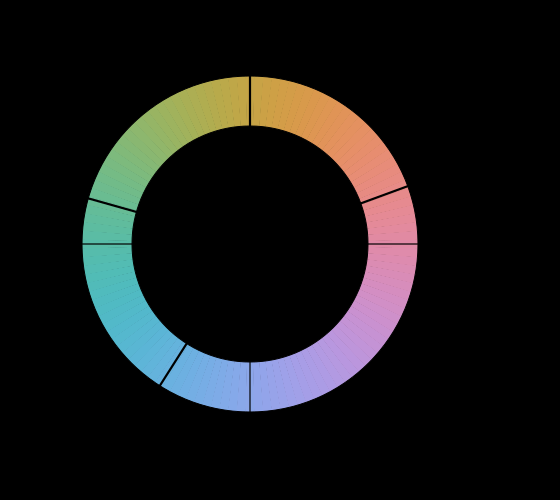
Observers agree that four hues are elementary and that no colour is reddish green. Nothing in the three receptors predicts either fact, and the axes of every standard colour space miss the four by tens of degrees.
A patch is not a scene
A paint chip is the wrong size, on the wrong background, at the wrong luminance, in the wrong surround. Every one of those is a term in an appearance model, and the model says how much each of them moves the answer — which is the difference between a caution and a prediction.
A scene has no white point
White balance is one transform applied to a whole image, and a scene lit by two lamps has no single answer for that transform to be. The failure is structural rather than a matter of a better estimator — and every colour-managed workflow in existence takes exactly one white point as an input, with no field in which to say there were two.
The proof is a different object
A soft proof can be made colorimetrically exact and still not match the print, because the print is in a booth at two thousand lux with an average surround and the screen is in a dim room at a fifth of the luminance. The appearance model puts four CAM16-UCS units between them, with no change of stimulus anywhere — larger than the error any rendering intent is arguing about.

The screen is not the room
A thousand-to-one display in an ordinary office is a hundred-and-thirty-seven-to-one display, and the signal value that means black comes out at the lightness of a dark grey card. Nothing is wrong with the panel. Light falls on the screen and comes back off it, and the two per cent it returns is added to every pixel — most of all to the ones with nothing else in them.
There is no brown light
Brown is dark orange, dark is a ratio to a white, and a light in a dark room has no white to be dark against. The same stimulus, unchanged in XYZ, runs from lightness 152 to lightness 16 as the surround is raised — and only the bottom of that range has a name.

The gamut shrinks in the dark
Every gamut number here is a property of a device and of nothing else, which is why the same display has the same gamut in a studio and in a cinema. It does not. Turn the room down four decades and the solid loses a fifth of its reach and two thirds of its volume, with the signal unchanged.

The model has no clock
An appearance model takes a stimulus and a situation and returns what it looks like. It does not take a time, and adaptation is not instantaneous — half a second after the light changes a judgement is three and a half CAM16-UCS units from the settled one, and a minute later it is still 1.3.

Colour stops at the edge of sight
Cone density falls twenty-one-fold between the centre of gaze and ten degrees out, and the three channels give out at three different rates — so a colour difference in the periphery does not merely shrink, it turns. At the exact point of fixation there are no short-wavelength cones at all.

A screen is a poor lamp
A display's white is a light. Shone on a surface it renders colour worse than a fluorescent tube — and the wider the gamut, the worse it gets, because the narrow primaries that buy a large triangle are exactly the ones that leave holes in the spectrum.
A difference has no place
A colour difference formula answers a question about two patches somebody is looking straight at. Move the same pair ten degrees into the periphery and a third of it is left — and it has turned twenty-four degrees of hue, because the three channels give out at three different rates.
A gain has a time constant
An afterimage and the clock on chromatic adaptation were built in different files from what the last phase said was one mechanism. Joining them removes a free parameter, reproduces both, and predicts a third thing — that two people in one room, at one moment, looking at one patch, do not agree about its colour.

The eye is never still
A perfectly stabilised retinal image disappears within seconds. What keeps the world there is a drift of about half a degree a second between the microsaccades — fast enough to keep the finest detail modulating and slow enough not to carry it past fusion, in a band whose upper edge is at 0.71 degrees a second.

A display in a room is a smaller display
Two results here turn the room's light in opposite directions and neither knows about the other. A room has one light level and does both at once — so there is a brightness at which a display delivers the most colour, it is not at either end, and it scales with the panel.
Nobody here has two eyes
One person's two eyes differ in macular pigment and lens density, so the same light produces two colours — a whole ΔE00 apart for an ordinary pair, seven for one replaced lens. Adaptation hides it exactly, which is why nobody notices and why nothing in colorimetry has a term for it.

Three constants nobody quotes
CIEDE2000 is defined with three parametric factors in it, the CIE leaves them to the industry using the formula, and the two settings in ordinary use differ by a factor of two in one of them. Twenty-nine per cent of acceptance decisions change between the two — a larger disagreement than any between the formulae themselves.

The slowest clock is chemical
An earlier essay here joined the afterimage to the adaptation clock and named what was still missing — a third gain, upstream of both, in the pigment itself. It is twice as slow as anything measured before it, it leaves a coloured after-tint from a white field, and at steady state it cancels exactly, which is why nobody has ever needed to model it.

Three ways to dim a lamp
"Dimmed to ten per cent" names three different colours. Switching the lamp on and off faster than anybody can see changes the chromaticity by nothing at all — exactly, to floating point. Reducing the current moves it a few units. Reducing the power to a filament moves it eighteen hundred kelvin down the Planckian locus, and stays on the locus exactly the whole way.

A lamp switched on is not the lamp measured
A luminaire takes about seven minutes to reach nine tenths of its working temperature, loses a quarter of its output on the way, and moves ΔE00 2.6 while it does. That is slower than every clock in the eye — so for the first minutes after a switch is thrown, both ends of the measurement are moving, and every appearance claim here has assumed one of them was still.

The room settles after the eye does
Four clocks run in a room and only three of them are in the observer. The slowest is the lamp, which takes four hundred seconds to reach nine tenths of its colour change — so a minute after the light goes on, when the eye is conventionally said to have settled, most of what is left is the lamp, and three quarters of that could not be adapted away by an observer of any speed.

A viewing condition is a moment
CIECAM16's degree of adaptation is a function of the surround and the adapting luminance and of nothing else, because the model has no time in it. Solving for when an observer who will adapt completely has got that far turns the standard's three surrounds into three clock readings — 107, 50 and 21 seconds — and the two readings are distinguishable by waiting.

A name moves with the room
Eleven basic colour terms are quoted as centroids in CIELAB and a colour is named by which one it is nearest. Two things nobody records decide the answer — which distance function is used, which renames a fifth of the displayable gamut, and which room the colour is in, which renames more than a quarter of it.

A corner moves both terms
The interreflection essays compute what a corner does to a spectrum, which is one of the two things a corner does. It is also a brighter place with a differently coloured background — a viewing condition, not a stimulus — and adaptation removes most of the first and none of the second. At an enclosure of six tenths that is 63 per cent of seven units gone and a further unit arriving from the extra light alone.

What a second model changed
Thirteen claims here, each computed with one model and recomputed with two. Ten of them move by half again or more. Three of them do not move at all in the ordinary sense — the first model's answer is exactly zero, not because it computed zero but because it has no variable for the quantity — and every one of those three is a join that supplied a state or a device rather than a spread.

A name in the model's own words
The eleven basic colour terms move when the room does, and the obvious objection is that they were being measured in a space with no room in it. Quoting them in an appearance model's own coordinates instead does not shrink the renaming — it grows it by four per cent — and the space alone renames an eighth of the gamut with the room held still.

The window is part of the light
A viewing condition here has always been a spectrum and a geometry. For anything fluorescent it needs a third thing — the transmittance of whatever the daylight came through — because ordinary window glass, a laminated windscreen and a museum filter remove three quite different parts of the band a brightener eats, and the sheet is a different colour behind each.

A brighter white still looks white
Colorimetry says a brightened sheet is nine units of b* from neutral, which sounds like a visible blue. An appearance model with the observer adapted to the room says it carries eleven units of chroma at a hue of 295 degrees — genuinely blue-violet — and that the number falls by nearly half between a bright room and a dark one. What it cannot say is why anybody calls the result white.

The cones an appearance model uses
CIECAM16 adapts in three axes whose rows are labelled L, M and S, and they were fitted to corresponding-colour experiments rather than measured on receptors. Run the dichromat construction backwards on them and they commit to a deuteranope confusion point 1.45 away in chromaticity from the measured one — which is a test the axes were never asked to pass.

The surround is three rows of a table
An appearance model takes the room as three constants, and the standard tabulates three rooms. Every appearance figure in this collection is drawn at one of them. The parameter they are three points of is continuous, and the middle row is not in the middle.

A discount nobody measured
Every adaptation number in this collection assumes an observer who adapts completely. The appearance model's own formula says they do not — it puts the degree at 0.94 in an ordinary room — and the difference is not a rounding. It is a factor of 1.7 on the residual every one of those figures reports.

A delivery tolerance is three tolerances
A colour reaches a reader through a profile, a gamut mapping and a room, and each has a number somebody chose. Each has an essay of its own here, and none of those essays had put the three costs in one column. Put there, the stage nobody controls carries ninety-seven per cent of the total.

A model judged in another model's unit
An appearance shift is a change in what an observer would report, not a change in a stimulus, so measuring one with a matching difference means first asking what stimulus a settled observer would need to be shown to give the same report. That step is not bookkeeping — it is the whole distinction the field rests on, and it costs a factor of 1.7 across the menu.

A dial has a price
Two rounds declined to give the appearance model's surround a continuous control, both times because the frames would be too heavy, and neither time was the weight taken. It is 2.25 kilobytes at the median — the light end of these figures rather than the heavy end — and one figure is already breaking the rule the deferral was made under.

The floor is a different colour from the door
With a lobe on the walls the floor sends chroma 18.76 towards the front of the room and 20.94 towards the side walls, a spread of two colour differences. A radiosity solution assigns the floor one number, so the whole of that spread is a quantity the method has no slot for rather than one it estimates badly.

The booth and the eye disagree
A viewing booth is specified to simulate daylight, and daylight is the light under which observers disagree least. So a booth is the condition in which a specification is least likely to be tested against the thing that breaks it, and the shop it will be judged in roughly doubles the term.

The appearance model takes XYZ
CIECAM16 predicts how a colour looks, and its input is three tristimulus values computed through a standard observer. Everything this round measures happens before the model is called, so an appearance prediction inherits six observer departures and a choice of cone space before it begins.

Where the model's curve does not matter
This round has been about what a nonlinearity does to an average, and CIECAM16 is the most nonlinear thing in the collection. Over the spread a population of observers produces, the average of its predictions is its prediction for the average to within 1.4 per cent — the nonlinearity is there and the excursion is too small to reach it. Over the range of adapting luminance one room covers in a day, the same gap is 59 per cent of the spread, and from indoors to outdoors 74.

The budget adds two units
This collection publishes a three-stage error budget for a colour-management chain and prints its sum. Two of the three stages are colour differences between stimuli and the third is a distance between appearances, and the conversion between those is not a constant. Re-measured in one unit over the same colours the chain has four stages rather than three, its end-to-end error is 5.05 against a sum of 7.66, and the profile's contribution where a job actually lands is 3.2 times its published average.

The appearance model has no straight piece
CIELAB's lightness is a straight line below L* 8, so a deviation near black has a fixed price and a black has a floor under it. CIECAM16 has no such piece. Its lightness near zero goes as the luminance to a power set by the room, the price of a deviation rises without limit as the black deepens — as Y to the power −0.44 in a lit room and −0.58 in a dark one — and on a projected black a lightness unit in the model allows under half the luminance change a unit of L* allows.

A gloss room looks less colourful than it measures
A gloss finish takes 8.3 per cent of the chroma out of a green room's reflected light, and a viewer adapted to the room should discount a loss that affects everything alike. The appearance model says the opposite. Adaptation removes the colour the whole room shares, leaves the colour that differs from face to face, and the finish takes as large a share of that as of anything — so to a viewer standing in the room the faces lose 13.9 per cent of their chroma, not 8.6.

Two filters cancel only in a bright enough room
An older lens and a denser macular pigment cancel each other once an eye has adapted — and that result belongs to the end of a dial nobody stands at. Read at the degree of adaptation CIECAM16 gives an ordinary room, the two barely cancel; in a living room they add, and in a cinema they cost six times what they cost under the sky. The room has to be about as bright as an office before the cancelling begins at all.

A tolerance has no light level
Twenty-three pairs built at exactly one colour difference stay at exactly one in every room, because the formula has no argument for the room. Read in the unit that does have one, the same pairs are 0.72 in a cinema, 1.04 in an office and 1.30 in direct sun — and inside any one room they spread by half again, so no single conversion between the two units exists at all.

A room with two lights has no white
An appearance model takes one adapting white. A desk beside a window has two, and the mixture falling on the paper is not the same thing as the white the person reading it has adapted to. Mixing the lights is arithmetic. Choosing the white is not, and the choice is worth sixty units of appearance — most of which is a cast, and not all of which is.

A dark background moves every difference and no match
CIECAM16's background is one number, and it reaches lightness as one exponent. That is enough to change what a grey looks like and not enough to change which of two greys is lighter — so a match survives the background exactly, a corresponding colour is invariant to it, and a tolerance is not. The effect the background is usually invoked to explain is absent from the model entirely.

The cancellation is exact and cheap to lose
CIECAM16 has no crispening, and adding one was expected to be expensive: the background's exactness in a corresponding colour comes from its being a common exponent, and a function of the sample's own level is not one. It is expensive in kind and not in size. A term that raises a straddling pair's lightness difference by half moves a corresponding colour by five thousandths of a tristimulus unit — a thousandth of what stating the background differently at the two ends already costs.

The reversals have a straight edge
Twenty-one of 276 pairs change places in chroma between a dark background and a light one, and the reason given was that chroma is a product of a term carrying the exponent and a term that does not. That is true and it is not a description of which pairs. Chroma at one background is a single common factor times a power of lightness at another, so a pair reverses exactly when its chroma ratio and its lightness ratio point opposite ways and the first is the smaller — a wedge with two straight edges, which names every reversal and nothing else.

Two rooms with one lightness scale
CIECAM16's surround and its background both reach lightness, and they reach it through one product. So the rooms fall into classes: a television in a lit living room against a mid grey returns exactly the lightness a print on a desk against a background of 2.8 does, for every sample, to the last bit of a double. It returns 0.76 of its chroma and 0.81 of its brightness. Two of the model's four viewing-condition parameters are one parameter, and only colour tells them apart.

Adaptation turns more pairs off than on
One pair of observer departures was followed across the degree of adaptation and found to cancel only in a bright enough room. The same calculation takes any two, and run over all fifteen pairs it says something the single pair does not: adaptation is a rotation rather than a mechanism for making departures oppose each other. Five pairs lose their cancellation as the eye adapts, three gain it, three keep it and four never have it — and the pair everybody quotes is one of the three it turns on.

The room a surface needs is written in its band
Whether two yellow filters cancel on a surface depends on the room, and each surface has its own crossing — the degree of adaptation at which the shared yellowing falls to the size of what is left underneath. Those crossings run from 0.68 to 0.99, and where a surface's absorption band sits accounts for almost all of the spread while how much light it returns accounts for almost none. The reds need a room brighter than a graphic-arts viewing booth, which is brighter than any room a sample is judged in.

The shadows a unit counts are the ones a room removes
ΔEITP's growth with display brightness is largest in the dark greys, and dark greys are where a lit room's light reflected off the screen sits. One candela a square metre of veiling luminance removes 22 per cent of the difference the unit gives a step at the bottom of the scale on a 1,000-candela display and nothing measurable at the top. The same veil raises the growth the unit reports across display levels from a factor of six to a factor of seventeen, because it destroys a dim display's shadows first.

A guessed veil halves the error
A colour difference that takes a display's absolute luminance leaves out the light a room reflects off the screen, and on an ordinary display in an ordinary room that makes it wrong about the darkest greys by a factor of three. Giving the unit the veil as a declared argument fixes that when the veil is known. The worry was that it never would be — that a guessed argument is no better than none. It is better: any declared veil up to about twice the true one beats declaring none, and one middling guess for every room halves the worst error. What a guess cannot do is reach ten per cent; that needs the veil known within a sixth, which is what a luminance meter aimed at a black screen gives.
Named alongside it
The objects these essays reach for when they reach for this one.
CIECAM16AdaptationColour appearanceSpecificationSurroundLightnessChromatic adaptationΔEToleranceColour constancyIndividual variationQuality control