Concept

Surround — where it appears

The field beyond the immediate background of a stimulus, entered into an appearance model as one of three named states. It changes colourfulness and contrast substantially — a chroma can fall by nearly half between an average surround and a dark one.

Named by 25 essays across 5 fields — each of them below, with the objects they name alongside it.
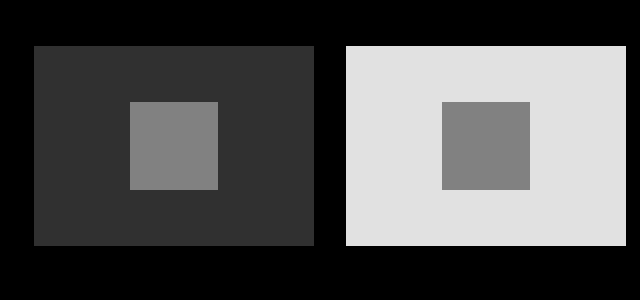
Two identical grey patches on different surrounds. Both inner squares are #818181. The one on the dark field looks lighter. The values are checked to be equal before the figure is drawn, so the claim is a fact about the drawing rather than a promise.

These two patches are identical

It is the most repeated and least checkable sentence in visual perception, because the whole point is that it does not look true. Every instance here is computed, and checked before the figure is drawn.
brain · Appearance
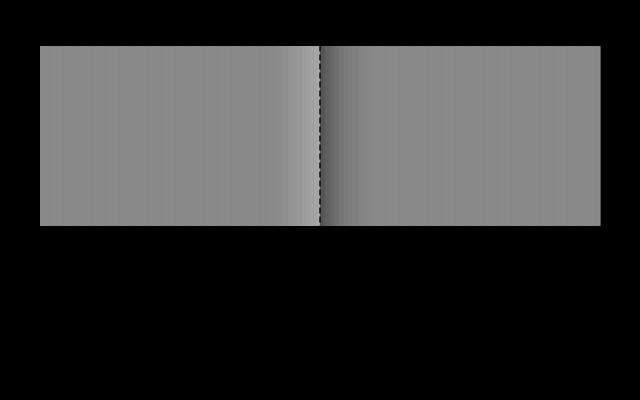
The Cornsweet edge, with its luminance profile. The two plateaux are both #898989 and are flat to exactly — the profile below shows that everything which differs lies within a narrow band at the boundary. Cover the centre line and the two halves become obviously identical.

Brightness is inferred from edges

The Cornsweet effect makes two identical regions look different by altering nothing except a narrow band at the boundary between them. Cover the boundary and the difference vanishes, which says the visual system is reconstructing surfaces rather than reading off intensities.
brain · Appearance
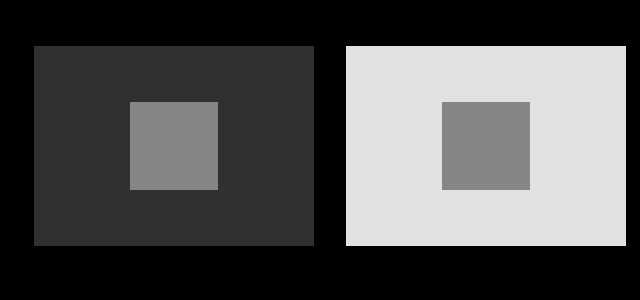
Two identical grey patches on different surrounds. Both inner squares are #868686. The one on the dark field looks lighter. The values are checked to be equal before the figure is drawn, so the claim is a fact about the drawing rather than a promise.

Matching is not appearance

CIE XYZ predicts when two lights will look the same under identical viewing conditions. It was never a model of how anything looks, and most of the confusion in applied colour comes from using it as one.
matching · Gamut
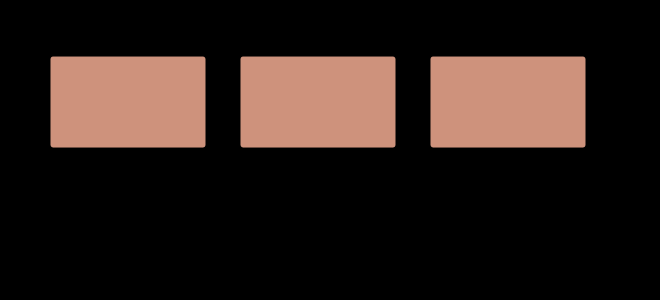
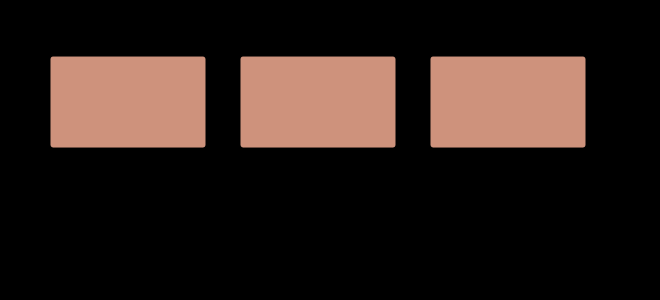
One stimulus, three rooms, three appearances. The same XYZ in a dark, a dim and an average surround. The stimulus does not change and is drawn identically in all three panels; what changes is what CIECAM16 says it looks like. Predicted lightness runs from 65.6 to 57.5 — a spread of 8.1 — with chroma and colourfulness moving too. Colorimetry returns one answer here because it has nowhere to put the room.

A viewing condition is an argument

An appearance model takes a stimulus and a situation. The second argument is not a refinement of the first — it is the content of the claim, and a model that returns an appearance from a colour alone has assumed a room without saying which.

brain · Appearance
Colourfulness rises with light level; apparent contrast does not. Predicted colourfulness M for one stimulus across four decades of adapting luminance, and the exponent of the lightness curve over the same range. M rises by a factor of 2.24 — the Hunt effect, which the model does predict. The lightness exponent changes by -2.2%, and in the wrong direction — the Stevens effect, which it does not.

Brighter looks more colourful

Colourfulness rises with light level and the model predicts it. Apparent contrast is supposed to rise too, and the model does not — which turns out to be right, because the thing that actually carries contrast is the surround.
brain · Appearance
One stimulus, three rooms, three appearances. The same XYZ in a dark, a dim and an average surround. The stimulus does not change and is drawn identically in all three panels; what changes is what CIECAM16 says it looks like. Predicted lightness runs from 65.6 to 57.5 — a spread of 8.1 — with chroma and colourfulness moving too. Colorimetry returns one answer here because it has nowhere to put the room.

A patch is not a scene

A paint chip is the wrong size, on the wrong background, at the wrong luminance, in the wrong surround. Every one of those is a term in an appearance model, and the model says how much each of them moves the answer — which is the difference between a caution and a prediction.
brain · Appearance
Lightness against colourfulness, in a booth and on a screen. Each arrow is one colour, from what the model predicts under a print in a 2000 lux booth to what it predicts under a display in a dim room. Every arrow points the same way, which is the content: a dimmer surround lowers predicted lightness and colourfulness together, so a proof does not merely differ from the print, it differs in a direction — and that is why proofing standards specify the room and not only the numbers.

The proof is a different object

A soft proof can be made colorimetrically exact and still not match the print, because the print is in a booth at two thousand lux with an average surround and the screen is in a dim room at a fifth of the luminance. The appearance model puts four CAM16-UCS units between them, with no change of stimulus anywhere — larger than the error any rendering intent is arguing about.
applied · Delivery
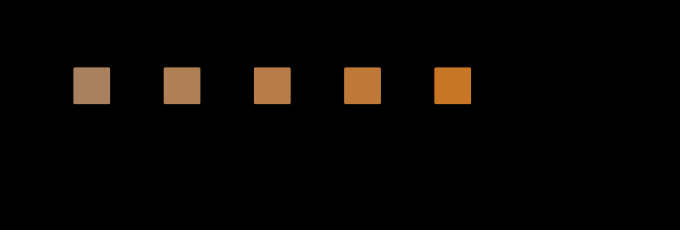
One light, seven rooms. The same stimulus — fixed in XYZ, unchanged throughout — shown against whites from 12 to 800 candelas per square metre. Its lightness falls from 152 to 16 and its brightness rises, because one of those is a ratio to the white and the other is not. Brown is the low-lightness end: a colour that exists only when something brighter is present, which is why no lamp is brown and no star is.

There is no brown light

Brown is dark orange, dark is a ratio to a white, and a light in a dark room has no white to be dark against. The same stimulus, unchanged in XYZ, runs from lightness 152 to lightness 16 as the surround is raised — and only the bottom of that range has a name.

brain · Appearance
The colourfulness the sRGB cube reaches, against the light in the room. The display is the same display throughout and the signal is the same signal. What moves is the adapting luminance, which enters the appearance model and nothing else. The furthest colourfulness the cube reaches falls from 131 to 57, a factor of 2.29. A gamut in CIELAB cannot show this at all, because CIELAB has no light level in it — which is why every gamut percentage in circulation is quoted without one.

The gamut shrinks in the dark

Every gamut number here is a property of a device and of nothing else, which is why the same display has the same gamut in a studio and in a cinema. It does not. Turn the room down four decades and the solid loses a fifth of its reach and two thirds of its volume, with the signal unchanged.
limits · Limits
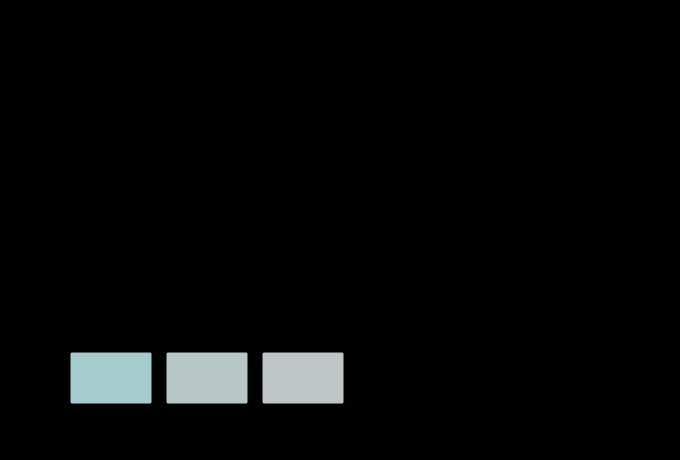
An afterimage, as the local pool coming back to equilibrium. The local pool has adapted to the patch and the global pool has not, so the gain change is exactly the local share of a full von Kries change — which is why afterimage's free strength parameter is not free here. The dwell is 20 seconds. The swatches are the predicted appearance of the test surface at four moments. They are predictions of hue and direction; there is no response compression in this model, so the chroma is a ceiling rather than an estimate.

A gain has a time constant

An afterimage and the clock on chromatic adaptation were built in different files from what the last phase said was one mechanism. Joining them removes a free parameter, reproduces both, and predicts a third thing — that two people in one room, at one moment, looking at one patch, do not agree about its colour.

brain · Appearance
How much colour a display delivers, against how bright the room is. The appearance solid of the whole code cube, with the room's reflected light added to every code value and the surround ratio computed from the room's own white against the display's. A 300 cd/m² panel delivers most at 200 lux, and the curve falls on both sides: darker costs the surround, brighter costs the black. At the 32 lux the softproofing standards specify, the solid is 89 per cent of its best — which is not a criticism of the standard, since it is written for matching a screen to a print viewing booth rather than for delivering the most colour.

A display in a room is a smaller display

Two results here turn the room's light in opposite directions and neither knows about the other. A room has one light level and does both at once — so there is a brightness at which a display delivers the most colour, it is not at either end, and it scales with the panel.

limits · Limits
The appearance model's three rooms, read as three moments. CIECAM16's degree of adaptation is a function of the surround and the adapting luminance and of nothing else — the model has no time in it. Solving for the moment at which an observer who will adapt completely has got that far turns each of the three tabulated surrounds into a reading on a clock. At 100 candelas per square metre they are 106, 49, 21 seconds. They are presented as three rooms. They are also one observer, in one room, at three times in the first two minutes.

A viewing condition is a moment

CIECAM16's degree of adaptation is a function of the surround and the adapting luminance and of nothing else, because the model has no time in it. Solving for when an observer who will adapt completely has got that far turns the standard's three surrounds into three clock readings — 107, 50 and 21 seconds — and the two readings are distinguishable by waiting.

brain · Appearance
How much of the gamut changes name, and what changed it. The eleven basic terms are quoted as centroids in CIELAB, and a colour is named by which one it is nearest. Two things nobody records decide the answer. Changing the distance function renames 20.5 per cent of the displayable gamut. Changing the room — the same colours, the same words, a different surround, through the appearance model — renames up to 26.8 per cent. The centroids were measured in one viewing condition and are applied here in every essay as though a name were a region of a space with no room in it.

A name moves with the room

Eleven basic colour terms are quoted as centroids in CIELAB and a colour is named by which one it is nearest. Two things nobody records decide the answer — which distance function is used, which renames a fifth of the displayable gamut, and which room the colour is in, which renames more than a quarter of it.

brain · Appearance
How much of what a display can show each name owns. Every point on a 5-unit CIELAB lattice inside the sRGB gamut is given to its nearest centroid under ΔE00, and the shares counted. They run from 21.1 per cent for purple to 4.6 for blue, a factor of 4.6. The three terms that carry no chroma at all — black, grey and white — hold 20 per cent between them. A share here is a statement about the names and about the gamut they are counted over, and the gamut is sRGB.

A name in the model's own words

The eleven basic colour terms move when the room does, and the obvious objection is that they were being measured in a space with no room in it. Quoting them in an appearance model's own coordinates instead does not shrink the renaming — it grows it by four per cent — and the space alone renames an eighth of the gamut with the room held still.

brain · Appearance
How blue the sheet reads, and how much of that is the room. Chroma in an appearance model, with the observer adapted to the light the sheet is under. The three markers on each row are an average, a dim and a dark surround; the open marker at the left is the same sheet with the ultraviolet removed. Every stock is close to neutral without the excitation and carries real chroma with it, at a hue of about 295 degrees — blue-violet — so the colour is the fluorescence and not the substrate. And it falls by nearly half between a bright room and a dark one, which makes how blue a sheet looks a property of where it is being looked at.

A brighter white still looks white

Colorimetry says a brightened sheet is nine units of b* from neutral, which sounds like a visible blue. An appearance model with the observer adapted to the room says it carries eleven units of chroma at a hue of 295 degrees — genuinely blue-violet — and that the number falls by nearly half between a bright room and a dark one. What it cannot say is why anybody calls the result white.

brain · Appearance
A mid-grey's lightness across a continuum of rooms. The lightness a mid-grey is predicted to have, plotted along the continuous surround parameter running from an average room to a dark one. The three rooms the standard tabulates are marked on it: average at the left, dark at the right, and dim 61% of the way between them rather than halfway. The whole span is 9.71 units of lightness and the step from average to dim is 5.64 of it — 58% — so choosing one of the three rows is a decision worth most of the range.

The surround is three rows of a table

An appearance model takes the room as three constants, and the standard tabulates three rooms. Every appearance figure in this collection is drawn at one of them. The parameter they are three points of is continuous, and the middle row is not in the middle.

brain · Appearance
Every adaptation number here assumes a complete adaptation. Three curves and their mean: the colour difference an adapted observer is left with after a change of light, against the degree of adaptation from zero — no adaptation at all — to one. Every adaptation figure in this collection is computed at one, the right-hand end. The appearance model's own formula puts the degree at 0.941 for an average surround at a hundred candelas, marked, where the residual is 2.21 ΔE00 rather than 1.27 — larger by a factor of 1.74. The left-hand end is exactly the unadapted change, which is not an approximation but an identity, and is what says the curve interpolates between the two things it claims to.

A discount nobody measured

Every adaptation number in this collection assumes an observer who adapts completely. The appearance model's own formula says they do not — it puts the degree at 0.94 in an ordinary room — and the difference is not a rounding. It is a factor of 1.7 on the residual every one of those figures reports.

brain · Appearance
What six of this collection's published numbers do when the unit changes. Six quantities, from six calculations that share nothing: a change of light after an observer has adapted, a camera profile's error, the gap between the two standard observers, a metameric pair under the lamp that breaks it, the same image on two papers, and an observer two seconds into a new room. Each is recomputed under all six units and every unit is calibrated onto ΔE2000's scale first, so the bar is not a change of units in the ordinary sense. The bar is the ratio of the largest reading to the smallest, and it runs from 1.71 to 2.30. Five of the six are printed in ΔE2000 by the essays that report them; the sixth is printed in CAM16-UCS, because the model it comes out of defines that unit.

A model judged in another model's unit

An appearance shift is a change in what an observer would report, not a change in a stimulus, so measuring one with a matching difference means first asking what stimulus a settled observer would need to be shown to give the same report. That step is not bookkeeping — it is the whole distinction the field rests on, and it costs a factor of 1.7 across the menu.

brain · Appearance
Every figure a surround dial would apply to, weighed. The eleven generators in the appearance family, by the size of the drawing each emits — which is what a dial multiplies, because every frame carries the figure's whole body. The dashed rules are the thresholds the dial policy here is written in: under 3 KB gets thirteen stops, under 6 gets nine, under 10 gets seven, and above about 12 KB nothing gets a dial at all. The median body here is 2.25 KB and 4 of the eleven are inside the most generous tier, against a policy written when the distribution had a median of 4.0 KB. Two phases deferred a surround dial on the grounds that appearance swatches are not small. The exception is unique-hues at 14.1 KB, which is over the ceiling that says it should have no dial — and it has one, on chroma, declared in the same file as the ceiling.

A dial has a price

Two rounds declined to give the appearance model's surround a continuous control, both times because the frames would be too heavy, and neither time was the weight taken. It is 2.25 kilobytes at the median — the light end of these figures rather than the heavy end — and one figure is already breaking the rule the deferral was made under.

applied · Delivery
What a small neutral deviation costs as the grey darkens, in two lightness scales. The price of a fixed fraction of deviation on a neutral — how much lightness it is worth per unit of luminance — from L 40 down to L 0.25, both axes logarithmic. CIELAB's L is a straight line below L 8 and its price there is exactly flat. The appearance model's J′ has no straight piece: its price keeps rising, by a factor of 5.0 across the same range, as the luminance to the power -0.442 — the derived exponent is -0.441 in an average surround.

The appearance model has no straight piece

CIELAB's lightness is a straight line below L* 8, so a deviation near black has a fixed price and a black has a floor under it. CIECAM16 has no such piece. Its lightness near zero goes as the luminance to a power set by the room, the price of a deviation rises without limit as the black deepens — as Y to the power −0.44 in a lit room and −0.58 in a dark one — and on a projected black a lightness unit in the model allows under half the luminance change a unit of L* allows.

matching · Gamut
Four mixtures of display primaries, bowing by different amounts in two units. The half-and-half mixture of each pair of sRGB primaries, measured from the midpoint of the two readings as a share of the pair's own separation. The upper bar is ΔE₀₀ and the lower is the appearance model's J′a′b′. In ΔE₀₀ green and blue bows most, at 25 per cent; in the model it is red and blue, at 20, and blue and yellow falls from 22 to 12. The right-hand column gives the model's distance with its power correction, which is smaller than the Euclidean one for every pair here.

Which mixture bows most depends on the ruler

The physical half-and-half mixture of two lights misses the midpoint of their two readings in any unit a person is shown, and the share it misses by is about the same in ΔE₀₀ and in the appearance model's own space — 12.8 and 14.6 per cent at the median. Which mixtures miss most is not. The rank correlation between the two units is 0.57, a display's blue and yellow is the worst pair in one and the mildest in the other, and the smaller number usually quoted for the appearance model is its power correction rather than a straighter line.

matching · Gamut
The angle between the two filters against how completely the eye has adapted. The angle, in the local metric, between what an older lens does to a reading and what a denser macular pigment does, on 120 smooth reflectances, as the degree of adaptation runs from nought to one. The median angle is 8 degrees unadapted and 156 at complete adaptation, and almost all of the turn happens in the last tenth: it passes a right angle at a degree of 0.928. The marks are the degrees CIECAM16 gives five rooms — an overcast sky 1.00, an office 0.94, a lit living room 0.86, a dim room 0.75, a cinema 0.66 — so only the outdoor one is at the end of the dial.

Two filters cancel only in a bright enough room

An older lens and a denser macular pigment cancel each other once an eye has adapted — and that result belongs to the end of a dial nobody stands at. Read at the degree of adaptation CIECAM16 gives an ordinary room, the two barely cancel; in a living room they add, and in a cinema they cost six times what they cost under the sky. The room has to be about as bright as an office before the cancelling begins at all.

difference · Metric
The same pairs, held at one colour difference, read in a unit that knows the room. 23 pairs of reflectances built to sit at exactly ΔE₀₀ 1.000 under D65, read in CAM16-UCS as the adapting luminance runs from a third of a candela a square metre to ten thousand, in an average surround. ΔE₀₀ has no argument for the room, so in that formula every pair stays at 1.000 all the way across — the flat line. In the model's unit the same pairs rise from a median of 0.76 to 1.30, and they do not rise together: at the bright end they run from 1.11 to 1.65.

A tolerance has no light level

Twenty-three pairs built at exactly one colour difference stay at exactly one in every room, because the formula has no argument for the room. Read in the unit that does have one, the same pairs are 0.72 in a cinema, 1.04 in an office and 1.30 in direct sun — and inside any one room they spread by half again, so no single conversion between the two units exists at all.

difference · Metric
One lightness scale, drawn as a contour across the rooms. Three surrounds up the page and the background's luminance factor across it, on a square-root scale so that the model's own exponent base is linear in the axis. Each curve joins the rooms whose lightness exponent is the same, and every room on one curve returns the same lightness for every sample. The marked curve is the one through a television in a lit living room against a mid grey: it also passes through a print on a desk against a background of 2.8 and a projection in a dark room against 47.0. A curve that leaves the plot has no member in that surround, because each surround multiplies a base that runs only from 1.48 to 2.48.

Two rooms with one lightness scale

CIECAM16's surround and its background both reach lightness, and they reach it through one product. So the rooms fall into classes: a television in a lit living room against a mid grey returns exactly the lightness a print on a desk against a background of 2.8 does, for every sample, to the last bit of a double. It returns 0.76 of its chroma and 0.81 of its brightness. Two of the model's four viewing-condition parameters are one parameter, and only colour tells them apart.

brain · Appearance
The appearance model's lightness-to-chroma balance, as the room takes a share of the adaptation. The median lightness pair's reading over the median chroma pair's, for twelve base colours, against the display's white, in a room of 20 cd/m². Solid: CAM16-UCS, with the viewer taking all, three quarters, half, a quarter and none of the adaptation from the display — darker lines take more from the display. Dashed: ΔEITP, which no room enters. With the display alone the model's balance falls 23 per cent; with half from the room, 13; with none from the display it does not move.

A lit room brings the units' medians together

As a display brightens, CAM16-UCS says chroma differences gain a quarter on lightness differences and ΔEITP says a tenth. All of the appearance model's movement comes from what the viewer is adapted to, and every calculation had the viewer adapted to the display alone. Give the room its share of the adaptation and the model's movement shrinks at every step: with a 20 cd/m² room supplying two thirds of it, the two units' medians fall by the same amount. What does not shrink is their disagreement about direction. The model still moves every colour the same way, ΔEITP still moves violets, reds and cyan-blues the other way, and in a lit room that becomes the whole of what separates them.

difference · Metric

Named alongside it

The objects these essays reach for when they reach for this one.

CIECAM16Viewing conditionColour appearanceAdaptationLightnessSpecificationAbsolute luminanceChromatic adaptationColourfulnessLuminanceAppearance modelChroma

All concepts