Brighter looks more colourful
Assumes A viewing condition is an argument.
Two effects are named after the people who measured them, both concern what happens as the light level rises, and both are quoted in the same sentence in most accounts of colour appearance. One of them an appearance model predicts. The other it does not, and finding that out changed what this essay is about.


Where the samples are taken along the range is the other thing that could have made the pattern, and it does not.


The Hunt effect, computed
Robert Hunt’s observation, published in 1952, is that colours look more colourful at higher light levels. A scene at noon and the same scene at dusk are not merely brighter and dimmer: the colours in the bright one are more vivid, and not by a small amount. The comparison has to be made carefully, because the illuminant has changed as well between those two times of day, and that is a different effect with a different cause. The Hunt effect is what remains when the light level alone is varied.
The model has this, and it has it in a specific place. Colourfulness M and chroma C differ by a factor that depends on the adapting luminance, so raising the light level raises M steeply while C — which is relative to the white — barely moves. Across four decades, from a candela to ten thousand, predicted colourfulness rises by a factor of 2.24, monotonically at every step.
That is a real prediction from a fitted model, and it is worth noticing what kind of fact it is. Nothing was put into the model that says “colours look more colourful when brighter”. What was put in was a compressive nonlinearity whose steepness depends on the adapting level, fitted to matching experiments, and the Hunt effect falls out of it. An effect that emerges is worth more than one that was inserted.
The Stevens effect, measured and absent
S. S. Stevens’ claim, from the same era, is that apparent contrast rises with light level: the dark parts of a scene look darker and the light parts lighter as the overall level goes up. It is quoted alongside the Hunt effect constantly, usually in the same sentence, and the phase that built this site’s appearance model set out to compute both.
Computing it withdrew the claim. Hold the stimuli at fixed fractions of the adapting white, raise the adapting luminance through the same four decades, and fit a power law to predicted lightness against relative luminance. The exponent moves from 0.554 to 0.542 — a change of 2%, and in the direction that reduces contrast.
Whatever CIECAM16 is doing with the adapting luminance, and it is doing a great deal with it for colourfulness, it is not this.
The honest response to that was not to look for a way to make the number come out. It was to record the finding, write the assertion in the direction the finding points — the effect must stay absent, and if a future revision of the model started predicting it the essay resting on this would be wrong — and then ask what does carry apparent contrast, since something plainly does.
What actually carries contrast
The surround, and by an order of magnitude.
The surround enters the model as an exponent. That is the structural reason it does so much: an exponent on lightness reshapes the whole tone curve, while the adapting luminance enters through a factor that mostly rescales.
So the dark-surround effect is what the Stevens effect gets credited with. In a darkened room the shadows lift, the picture flattens, and the image needs more contrast put back into it to look the way it did in a lit one. That is not a subtle prediction, it is not new, and it has been engineering practice for most of a century.
The engineering that was already doing this
Three system gammas, three surrounds, and the ordering matches.
A computer display in an office is viewed in an average surround, and its system gamma — the end-to-end power law from scene to display, encoding and decoding combined — is close to 1.0 or slightly above. A television in a living room is a dim surround, and broadcast practice puts the system gamma near 1.2. Cinema projection is a dark surround, and the standard is 1.5.
Nobody derived those from an appearance model. They were arrived at empirically, decades before there was a model that produced them, by people adjusting until the picture looked right in the room it was shown in. What the model contributes is not the numbers but the explanation of why there have to be three of them, and why they run in that order.
This is a good case of what an appearance model is worth. It did not discover the practice. It made the practice a consequence of something rather than a convention, and it means the next viewing environment — a phone in sunlight, a headset — can be reasoned about rather than tuned into existence.
What “more colourful” is not
The Hunt effect is about colourfulness, and colourfulness is not chroma, and the distinction is the one most often lost when the effect is quoted.
Chroma is relative to the white. It answers: how colourful is this, compared with a white in the same scene? Raise the light level and both rise together, so the ratio barely changes.
Colourfulness is absolute. It answers: how much colour is there? Raise the light level and there is straightforwardly more.
Both are correct descriptions of what happens, and they lead to opposite-sounding statements about the same event. A red flag at noon and the same flag at dusk have nearly the same chroma and very different colourfulness. Whether “the colour changed” depends entirely on which question was asked, and ordinary language has one word for both.
The practical version turns up in image reproduction. An image captured outdoors at 20,000 cd/m² and displayed indoors at 200 will have the same relative colorimetry and much lower colourfulness, so it looks flat and washed out, and no amount of gamut width fixes it. The correction is to raise the chroma in the reproduction — which is not a distortion but a compensation, and one that has been standard practice in photographic printing since long before anybody could compute it.
The four correlates that go together
Reading the model’s output as a set of four independent numbers is another way of missing the structure. Lightness and brightness move together, chroma and colourfulness move together, and the two pairs move differently as the light level changes.
Hue is the odd one out, and helpfully so — though where its zero sits is a separate argument: it is close to stable across all of this. A stimulus does not change hue much as the light level rises or the surround darkens, which is why hue is the correlate most safely quoted without its viewing condition — and even that is only close to true rather than true.
The background does it too, and separately
The surround is the field beyond the immediate neighbourhood. The background is the immediate neighbourhood, it is a separate argument to the model, and it moves lightness by its own route — through the exponent again, but via a different term.
So there are three ways to change apparent lightness without touching the stimulus, and the model separates them: the light level, the immediate background, and the wider surround. Of the three, the light level does least — which is the finding above, arrived at from the third direction.
A practical consequence follows for anyone laying out a page. The background is a parameter of the layout, not of the room, and it is the one a designer controls completely. Whatever the reader’s lighting and whatever their surround, the immediate background of a swatch is whatever it was placed on. That is why this site’s page chrome is exactly neutral and why the neutrality is checked mechanically rather than left to discipline: it is the one term in the model that the author owns.
Absolute luminance, and the format that finally states it
The Hunt effect is a function of an absolute quantity, and almost nothing in colour reproduction carries one. An sRGB image says a pixel is 60% of white; it does not say 60% of what, in candelas, and it cannot, because the standard does not bind a display’s brightness.
That is a real obstacle to using the model. Predicting appearance requires the adapting luminance, and a conventional image file does not contain it — so every appearance calculation on ordinary content begins by assuming one, usually 100 cd/m² and usually silently.
An absolute encoding closes that gap in principle. If a code value denotes a luminance, an appearance calculation on the content has the argument it needs without assuming anything — and the Hunt effect stops being a correction applied by judgement and becomes computable from the file. Whether that is what HDR formats are actually used for is another matter, and the essay on them is not optimistic. But the missing quantity is the same missing quantity, and it is worth seeing that a problem in appearance modelling and a change in delivery formats are the same problem from two ends.
What was computed, and how
The Hunt effect is measured as the ratio of predicted colourfulness at 10,000 cd/m² to that at 1 cd/m², for a fixed stimulus with the background held at a fixed fraction of the white. The stimulus does not change and the relative background does not change; only the absolute level does. The ratio is 2.24 and the sequence is monotonic, which is checked step by step rather than only at the ends — a non-monotonic rise with the right endpoints would be an artefact rather than an effect.
The Stevens effect is measured by fitting a power law to predicted lightness against relative luminance over seven samples spanning 2% to 100% of the white, at each adapting luminance, and comparing the exponents. The assertion requires the change across four decades to stay under 5%; measured it is 2.2%, negative.
The surround effect uses the same fit at fixed adapting luminance across the three surrounds. The assertion requires the ordering dark < dim < average and a spread above 20%; measured it is 31%.
All three run in the site’s gate, and the second is the unusual one: it asserts an absence. Assertions of absence are worth writing precisely when a claim has been withdrawn, because they are what notices if the withdrawal was wrong.
Starting the sweep a decade lower puts the bottom of it at a light level a room is actually dimmed to, which is where the two effects would be easiest to tell apart.

Where the model stops
Two limits, and they bound the argument above rather than undermining it.
The surround is three words. Between a dim room and a dark one there is no defined position, and the exponent is not interpolated because nothing was measured in between. A great many real viewing situations — a phone at dusk, a laptop in a train — sit there, and the model has nothing to say about them beyond which of the three they most resemble.
The absolute luminance is a single number for the whole field. Real viewing has a bright window and a dark corner and an observer whose adaptation state is somewhere between, changing as the eyes move. The model takes one adapting luminance and applies it to everything.
There is also a limit on the Stevens finding itself, and it should be stated. What has been established is that this model does not predict this effect in this correlate. Stevens measured something, and the measurement is not in question here; what the computation shows is that CIECAM16 does not reproduce it, which is a fact about the model. A reader is entitled to conclude that the model is incomplete rather than that the effect is not real, and the evidence on this page does not choose between those.
Starting the sweep near the bottom of photopic vision is where the two effects have most room to separate.

What the pictures cannot show
Everything on this page is the model’s arithmetic, and none of it is a demonstration.
The most obvious missing figure would be the Hunt effect shown rather than plotted: the same scene at two light levels, side by side, with the brighter one visibly more colourful. That figure cannot be drawn. Both panels would be displayed at the same luminance, on the reader’s screen, in the reader’s room — so the second panel would have to be drawn more colourful, which would be presenting the model’s prediction as evidence for the model.
The same objection applies to the surround effect and with more force, because the reader’s surround is the page. A figure demonstrating that a dark surround flattens the tone curve would need two surrounds, and the page has one.
So the figures plot numbers. The Hunt effect here is a curve rising, not a pair of pictures, and a reader who wants the demonstration has to find a room with a dimmer switch.
Why an effect that emerges is worth more than one fitted
There is a distinction running underneath this whole essay that is worth making explicit, because it decides how much any of these predictions is worth.
An appearance model has a great many free parameters, and a model with enough of them can be made to reproduce any list of effects it is shown. If the Hunt effect had been built in — a term whose only job was to raise colourfulness with luminance — its appearance in the output would be no evidence of anything. It would be a restatement.
It was not built in. What was built in is a compressive response whose steepness depends on the adapting level, fitted to matching data, and the rise in colourfulness is a consequence of that. The effect emerges from machinery installed for another purpose, which is the only circumstance in which a model predicting an effect counts as support for the model.
The same standard, applied to the Stevens effect, is what makes its absence informative rather than embarrassing. Nothing was removed to produce the absence. The model was built, the quantity was measured, and the effect was not there — which is a result about the model, obtained the same way the positive result was.
This is the site’s habit stated in a new field. A generator asserts what is true of its own arguments; a model earns credit for predictions it was not shown; and a claim that has never risked being false has not been tested. The Stevens finding is the first thing on this site to be withdrawn by the machinery built to demonstrate it, and it is recorded as a withdrawal rather than smoothed away.
Who found it, and when
Hunt published the effect in 1952, from experiments on colour appearance at different adaptation levels, and spent the following decades assembling the set of phenomena an appearance model would need to predict — a list that became the specification every subsequent model was judged against.
Stevens’ power law for sensory magnitude, published in 1957, is a far broader claim than the colour case: perceived magnitude grows as a power of stimulus intensity across many senses, with an exponent characteristic of each. The contrast effect that carries his name in colour appearance is one consequence among many.
Bartleson and Breneman measured the surround effect in the 1960s, and their work is the direct ancestor of the surround parameter in every appearance model since — including the three-category structure, which is three categories because they ran three arrangements.
Where this goes next
The model itself, and what its second argument contains, is a viewing condition is an argument. The absolute luminance the Hunt effect depends on is exactly what an HDR encoding makes explicit, in how bright is white. And the mechanism behind the surround’s effect on lightness, at the level below the model, is brightness is inferred from edges.
Where this goes next
 A viewing condition is an argument
An appearance model takes a stimulus and a situation. The second argument is not a refinement of the first — it is the content of the claim, and a model that returns an appearance from a colour alone has assumed a room without saying which.
A viewing condition is an argument
An appearance model takes a stimulus and a situation. The second argument is not a refinement of the first — it is the content of the claim, and a model that returns an appearance from a colour alone has assumed a room without saying which.
 How bright is white
An sRGB value says a pixel is some fraction of whatever the display can manage. A PQ value says it is two hundred candelas. The change is the largest in display encoding since gamma, and what it removed was the honest admission that nobody knew.
How bright is white
An sRGB value says a pixel is some fraction of whatever the display can manage. A PQ value says it is two hundred candelas. The change is the largest in display encoding since gamma, and what it removed was the honest admission that nobody knew.
 Brightness is inferred from edges
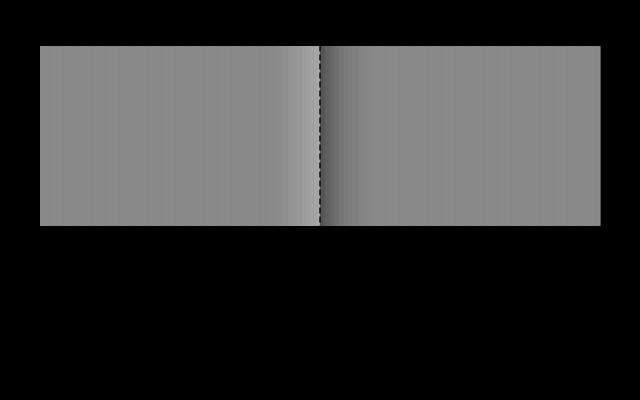
The Cornsweet effect makes two identical regions look different by altering nothing except a narrow band at the boundary between them. Cover the boundary and the difference vanishes, which says the visual system is reconstructing surfaces rather than reading off intensities.
Brightness is inferred from edges
The Cornsweet effect makes two identical regions look different by altering nothing except a narrow band at the boundary between them. Cover the boundary and the difference vanishes, which says the visual system is reconstructing surfaces rather than reading off intensities.
What this makes readable
Essays that name this one as a prerequisite.
Named alongside this one
Essays reaching for the same objects. Nobody chose these; they are what the index of named objects makes visible.
- A display in a room is a smaller display adaptation · colour appearance · surround · tone reproduction
- A viewing condition is a moment absolute luminance · adaptation · colour appearance · surround
- A gain has a time constant adaptation · colour appearance · surround
- There is no brown light colour appearance · colourfulness · surround
- Two filters cancel only in a bright enough room absolute luminance · adaptation · surround
- Where the model's curve does not matter adaptation · colour appearance · luminance
What links here
The 8 essays that link to this one and share the most of its objects, of 22 that link here.
The objects this essay names
Each one links to every other essay that touches it.
Absolute luminanceAdaptationApparent contrastColour appearanceColourfulnessThe Hunt effectLuminanceThe Stevens effectSurroundTone reproduction