The gamut shrinks in the dark
Assumes The triangle is a shadow and Brighter looks more colourful.
Every gamut figure on this site so far has been a property of a device. The triangle on the chromaticity diagram is three primaries; the solid in CIELAB is those primaries and a white point; the percentages quoted in display specifications are ratios of those objects. None of them contains a light level, because CIELAB does not have one.
So the same panel showing the same signal has the same gamut in a bright studio and in a dark cinema. That is plainly not what happens.

The claim
A colorimetric gamut is a property of a device. An appearance gamut is a property of a device and a room, and the second shrinks as the room darkens while the first does not move at all.
Measured on the sRGB cube in CAM16-UCS:
| adapting luminance | greatest colourfulness | UCS volume |
|---|---|---|
| 1000 cd/m² | 130.7 | 379,374 |
| 100 | 107.4 | 293,416 |
| 10 | 87.8 | 224,024 |
| 1 | 72.0 | 168,028 |
| 0.1 | 57.0 | 117,999 |
The reach falls 2.29× and the volume 3.22× over four decades. Meanwhile the same cube’s volume in CIELAB is 820,067 at every one of those light levels, because there is nothing in CIELAB for the light level to enter.
And the lightness range does not move
The second half of the table is as interesting as the first: the lightness span is 0 to 100 at every light level, exactly.
That is not a defect of the model. It is the relative-versus-absolute division showing up in a gamut: lightness and chroma are ratios to the white in the field, and the display’s own white is the white in the field, so the relative attributes are pinned by construction. Brightness and colourfulness are absolute, and they are the ones that fall.
So “the gamut shrinks in the dark” is precise about which gamut. The set of relative appearances is unchanged — a dark room does not stop the display from producing something that looks like a full-strength red relative to its own white. The set of absolute appearances collapses, and that is what a viewer in a dark cinema is actually reporting when the picture looks flat.

One column is a power law and the other is not
Two summaries were computed because neither is trustworthy alone, and putting them side by side turns out to say something neither says on its own.
The reach is very nearly a power law in the light level. Dividing each row by the one below it gives 1.217, 1.223, 1.219 and then 1.263, so over the top three decades the fall is a constant factor and the exponent is steady to about one per cent:
The volume is not. The same division gives 1.293, 1.310, 1.333, 1.424 — an exponent that climbs monotonically from 0.112 to 0.153, a drift of thirty-eight per cent across the table. A quantity whose exponent moves is not obeying a power law over that range, and the two columns therefore cannot both be describing a solid that simply scales.
The bottom row is where both of them bend, and it is the row to distrust. The reach’s exponent jumps eighteen per cent in the last decade and the volume’s jumps twenty-three. That is the model leaving the conditions it was fitted in: 0.1 cd/m² is below the level at which cone vision has the field to itself, and CIECAM16 has no rod term at all. The arithmetic does not know that, and it continues to return a number.
The solid does not merely shrink
The two columns are also in different units, which is easy to miss and is what makes the comparison worth making. The reach is a colourfulness ; the volume is measured after CAM16-UCS has compressed that colourfulness logarithmically. So the reach cannot be squared and compared with the volume until it has been through the same compression:
which takes the top and bottom of the reach column from 130.7 and 57.0 to 60.58 and 36.52 — a fall of 1.66 rather than 2.29, because the compression is steepest where the colourfulness is largest.
Now the two are comparable, and the comparison is a test with a stated null. The essay has already established that the lightness span is pinned at 0 to 100 in every room. So if the solid kept its shape and only its chromatic radius shrank, its volume would fall as the square of that radius: . The measured fall is 3.22.
| predicted by uniform scaling | measured | excess | |
|---|---|---|---|
| 1000 → 100 | 1.245 | 1.293 | +3.9% |
| 100 → 10 | 1.268 | 1.310 | +3.3% |
| 10 → 1 | 1.281 | 1.333 | +4.1% |
| 1 → 0.1 | 1.361 | 1.424 | +4.7% |
| over four decades | 2.751 | 3.215 | +17% |
The excess is in the same direction on all four decades and of nearly the same size on each, which is what rules out a rounding artefact in any one row. A dark room does not scale the appearance solid down; it also makes it less full. The gamut loses about a sixth more volume than the shrinking of its own outer boundary accounts for, so the colours going missing are not only the extreme ones — the solid is deflating from the inside as well as pulling in at the edge.
That is a claim about a shape, drawn from two summary numbers rather than from the solid itself, so it is a bound on how much reshaping there is rather than a description of where. Measuring where would mean keeping the tetrahedra rather than their total, which the machinery could do and does not.
The surround does it too
Adapting luminance is not the only viewing argument, and the second one is easier to control and more often got wrong. Holding the light level at 100 cd/m² and changing only the surround:
| surround | greatest colourfulness | UCS volume |
|---|---|---|
| average — a lit room | 107.4 | 293,416 |
| dim — a living room in the evening | 102.7 | 272,232 |
| dark — a cinema | 95.2 | 243,411 |
A tenth of the reach and a sixth of the volume, from nothing but what is around the screen. This is why cinema masters and home video masters are graded differently, and why the same file looks flat in a bright room and garish in a dark one: the surround is a term in the model, worth more than most people’s calibration budget.
What this does to a gamut percentage
Display specifications quote coverage as a percentage of a standard’s gamut: ninety-eight per cent of DCI-P3, seventy-five per cent of Rec. 2020. Those numbers are computed on chromaticity or in CIELAB, and are therefore statements about primaries.
They are perfectly good statements about primaries. What they are not is a prediction about what a viewer will see, for three reasons this site has now measured separately:
- The projection. A chromaticity triangle has luminance divided out, so its area is not the solid’s volume — sRGB and P3 differ by 1.36 in area and 1.50 in CIELAB volume.
- The room. Everything above: a factor of up to three in what the same solid reaches.
- And the eye’s own limits. The chromatic channels give out at a few cycles per degree, so a gamut is a statement about large patches; the colours a display cannot reach at small sizes are a smaller set.
A percentage that folded all three in would need to name a room, a size and a distance. No specification does, which is not a scandal — it is the ordinary consequence of quoting a device property and calling it a viewer property.
Why a colorimetric gamut has no light level in it
This is worth spelling out, because it is a design decision rather than an omission.
CIELAB was built as a difference metric for surface colours under normal viewing. Its inputs are a stimulus and a white, both in tristimulus units, and the white is used to normalise — which is why the space is scale-free: multiply the stimulus and the white by the same factor and every coordinate is unchanged. That invariance is precisely what makes it usable for surface colours, where the illuminant’s level varies constantly and nobody wants a tolerance to move with it.
The invariance is also what makes it silent about a dark room. A property that is unchanged by scaling everything cannot report what scaling everything does.
An appearance model breaks the invariance deliberately, by taking the adapting luminance as a separate argument. That is the entire structural difference between the two, and every result in this essay is a consequence of it — as is the Hunt effect, which is the same fact measured on one stimulus instead of a solid.
What was computed, and how
The solid is the sRGB cube, decomposed into tetrahedra — Kuhn’s six per cell, which tile the cube exactly with no gaps or overlaps, so the sum is a volume rather than an estimate of one. That decomposition was already here for the CIELAB volumes; what this phase added was making the map an argument, so the same code measures the same cube in a space that has a room in it.
The map is CIECAM16 at the stated viewing conditions, then CAM16-UCS. The white is D65, the background is twenty per cent, and the surround is average unless stated.
The reach is the largest colourfulness over a lattice of the cube, which is a cruder summary than the volume and a legible one — a reader can be told what a colourfulness of 130 means far more easily than what a UCS volume of 380,000 means.
And the assertions are monotone rather than pairwise. A single ratio between two light levels could come out of a sign error; a fall at every one of five successive decades could not. The volume is required to agree with the reach about the direction, which is the two-routes check this site uses everywhere.
Where the model stops
The display is assumed to deliver the same light in every room. It does not: ambient light reflected off the screen lifts the black and reduces the contrast ratio, which is a second and larger effect in a bright room. Modelling both at once would need the screen’s reflectance, which is a property of a panel this site does not have.
The white is the display’s white at every level. In a real dark room the eye is adapted to something between the screen and the surround, and CIECAM16’s own degree-of-adaptation term handles part of that and not all of it.
The lattice is coarse. Volumes are computed at twelve to twenty cells per axis, which converges from below; the ratios between light levels are far more stable than the absolute figures, and the ratios are what is quoted.
And 0.1 cd/m² is outside the model. CIECAM16 is a photopic model and the bottom row of every table here is at a level where rods contribute; the exponent’s jump in that last decade is the first visible symptom of it, and it is the model failing gracefully rather than reporting a fact about vision. Every ratio quoted over the top three decades is inside the model’s range and every ratio quoted over four is not.
And appearance is not discrimination. A smaller appearance gamut does not directly say how many colours can be told apart — that is a count of just-noticeable differences, and it falls faster in the dark than the volume does, because the thresholds themselves rise.
The generalisation
The pattern is one this site keeps arriving at: a quantity that leaves out an argument is not wrong, it is conditional on a value of that argument that nobody wrote down.
CIELAB has no light level because it was built to be a difference metric for surface colours under normal viewing, and for that job the omission is a simplification rather than an error. Using it to describe what a display does in a cinema imports the assumption without importing the caveat.
The same shape, three times over on this site:
- A colour temperature with no Duv is conditional on the source being on the locus.
- A gamut percentage with no luminance is conditional on chromaticity being the whole story.
- A ΔE with no size is conditional on the patches being large.
The practical rule for anybody quoting a gamut: say the room, or say that the number is a property of the panel. Both are honest; only the first is a prediction.


What the shrinkage costs at one hue rather than over the whole solid is the reading a designer would actually use, and it is available from the same machinery.
Who found it, and when
That colourfulness rises with luminance is the Hunt effect, measured in the 1950s and computed on this site during the expansion phase, where it fell out of CIECAM16 at 2.24× over four decades of adapting luminance. The gamut result here is that effect applied to a whole solid rather than to a stimulus, and the factors are of the same order because it is the same mechanism.
The practical version has been standard in film and television for much longer than the model has: cinema is graded at a low light level in a dark surround, television at a higher one in a dim surround, and the transfer between them has always involved more than a matrix. The system gamma applied when converting between the two — the reason a cinema master looks washed out on a television — is the industry’s empirical version of the surround term.
What is newer is being able to compute it. An appearance model with a viewing-condition argument turns “graded for a dark room” from a workflow convention into a number, and the number is a factor of three in volume across the range of rooms people actually watch in.
What the pictures cannot show
Any of it. This is the essay whose subject the medium is least able to display: the claim is about what a display looks like in rooms other than the one the reader is in, and the reader is in exactly one room. Every figure here is a plot of numbers rather than a demonstration, and the demonstration is available to any reader with a dimmer switch and thirty seconds.
And the swatches are drawn under one condition. Every colour patch elsewhere on this site is computed for a stated observer and verified reachable in sRGB. None of them is computed for a stated room, because the room is not a rendering parameter — which means the site’s own figures inherit exactly the omission this essay is about.
What it costs a particular colour
The volume is the summary and a single colour is the thing a reader can hold on to.
Take the most saturated red the display can produce. At 1000 cd/m² of adapting luminance the model puts its colourfulness at the top of the range; at 0.1 it is 57 per cent of that. Nothing about the light leaving the screen has changed — the same photons, the same spectrum, the same three code values — and the model says the colour is a little over half as colourful.
That is a bigger change than the difference between two display standards. sRGB and Display P3 differ by 1.36 in chromaticity area and 1.50 in CIELAB volume; the room, across the range of rooms people watch in, is worth 2.29 in reach and 3.22 in volume. The room is a bigger gamut decision than the panel, and it is the one nobody is sold.
Where the ladder goes next
The obvious next piece is the join with the room’s other effect. This essay turns the light level down and leaves the display alone; the screen-in-a-room essay turns the light level up and measures what reflected light does to the black. Both are computed here, from different libraries, and the combination — a display’s delivered appearance gamut in a stated room — is a single function that neither file currently exposes.
The second is the discrimination count. A volume in a uniform appearance space divided by the size of a just-noticeable difference is a count of distinguishable colours, and both halves move with the light level: the volume shrinks and the differences grow. The count at daylight levels is already on this site and disagrees by a factor of 4.68 between two metrics; the same count in the dark would be a genuinely new number and would need the photon arithmetic as well as this one.
Where this goes next
 The triangle is a shadow
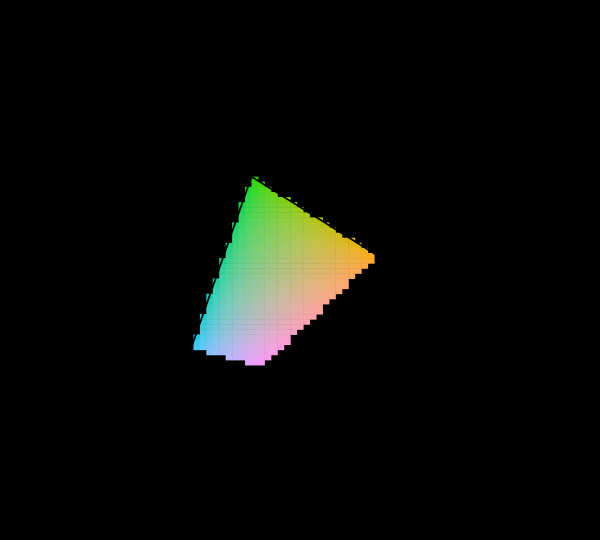
A display's gamut is drawn as a triangle on the chromaticity diagram, and coverage is quoted as a percentage of that triangle's area. Chromaticity has luminance divided out, so the triangle is a projection along the axis the eye cares most about — and the ratios computed on the solid are not the ratios computed on its shadow.
The triangle is a shadow
A display's gamut is drawn as a triangle on the chromaticity diagram, and coverage is quoted as a percentage of that triangle's area. Chromaticity has luminance divided out, so the triangle is a projection along the axis the eye cares most about — and the ratios computed on the solid are not the ratios computed on its shadow.
 Brighter looks more colourful
Colourfulness rises with light level and the model predicts it. Apparent contrast is supposed to rise too, and the model does not — which turns out to be right, because the thing that actually carries contrast is the surround.
Brighter looks more colourful
Colourfulness rises with light level and the model predicts it. Apparent contrast is supposed to rise too, and the model does not — which turns out to be right, because the thing that actually carries contrast is the surround.
 The screen is not the room
A thousand-to-one display in an ordinary office is a hundred-and-thirty-seven-to-one display, and the signal value that means black comes out at the lightness of a dark grey card. Nothing is wrong with the panel. Light falls on the screen and comes back off it, and the two per cent it returns is added to every pixel — most of all to the ones with nothing else in them.
The screen is not the room
A thousand-to-one display in an ordinary office is a hundred-and-thirty-seven-to-one display, and the signal value that means black comes out at the lightness of a dark grey card. Nothing is wrong with the panel. Light falls on the screen and comes back off it, and the two per cent it returns is added to every pixel — most of all to the ones with nothing else in them.
What this makes readable
Essays that name this one as a prerequisite.
Named alongside this one
Essays reaching for the same objects. Nobody chose these; they are what the index of named objects makes visible.
- A third of the appearance box is no surface ciecam16 · colour appearance · display gamut · gamut · object-colour solid · specification
- The proof is a different object ciecam16 · colour appearance · colourfulness · specification · surround · viewing condition
- A gain has a time constant adaptation · ciecam16 · colour appearance · surround · viewing condition
- A patch is not a scene adaptation · ciecam16 · colour appearance · surround · viewing condition
- A viewing condition is a moment adaptation · ciecam16 · colour appearance · surround · viewing condition
- Matching is not appearance adaptation · ciecam16 · colour appearance · surround · viewing condition
What links here
Every essay whose body links to this one.
The objects this essay names
Each one links to every other essay that touches it.
AdaptationCIECAM16Colour appearanceColourfulnessDisplay gamutGamutObject-colour solidPhoton noiseSpecificationSurroundViewing condition