Colour appearance — where it appears
Named by 39 essays across 7 fields — each of them below, with the objects they name alongside it.
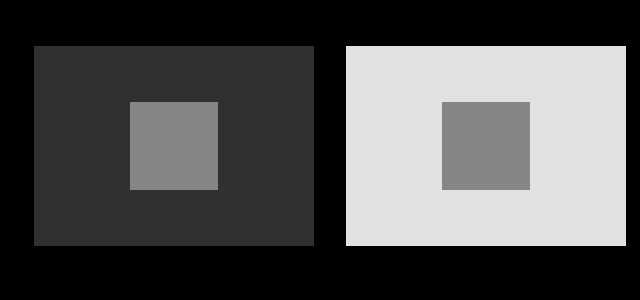
Matching is not appearance
CIE XYZ predicts when two lights will look the same under identical viewing conditions. It was never a model of how anything looks, and most of the confusion in applied colour comes from using it as one.
A viewing condition is an argument
An appearance model takes a stimulus and a situation. The second argument is not a refinement of the first — it is the content of the claim, and a model that returns an appearance from a colour alone has assumed a room without saying which.

Brighter looks more colourful
Colourfulness rises with light level and the model predicts it. Apparent contrast is supposed to rise too, and the model does not — which turns out to be right, because the thing that actually carries contrast is the surround.
A patch is not a scene
A paint chip is the wrong size, on the wrong background, at the wrong luminance, in the wrong surround. Every one of those is a term in an appearance model, and the model says how much each of them moves the answer — which is the difference between a caution and a prediction.
The proof is a different object
A soft proof can be made colorimetrically exact and still not match the print, because the print is in a booth at two thousand lux with an average surround and the screen is in a dim room at a fifth of the luminance. The appearance model puts four CAM16-UCS units between them, with no change of stimulus anywhere — larger than the error any rendering intent is arguing about.
Brightness is not luminance
Photometry is additive because the CIE defined it that way. Brightness is not, and a saturated colour looks as bright as a neutral of one and a half times its luminance — an effect this site's appearance model moves by two per cent, in a direction that depends on the hue.
There is no brown light
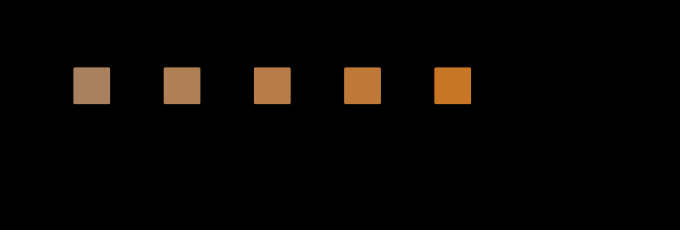
Brown is dark orange, dark is a ratio to a white, and a light in a dark room has no white to be dark against. The same stimulus, unchanged in XYZ, runs from lightness 152 to lightness 16 as the surround is raised — and only the bottom of that range has a name.
An afterimage is an adaptation
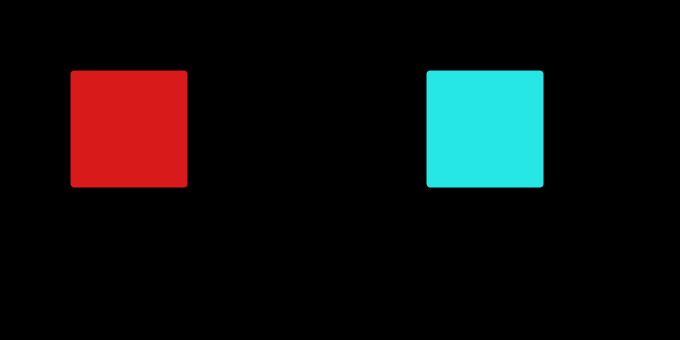
The demonstration everybody gives is an inverted image, which is a statement about a file format. Running the receptoral arithmetic instead puts the afterimage of a saturated red sixty degrees of hue away from the inverse — and outside what any display can show.

The gamut shrinks in the dark
Every gamut number here is a property of a device and of nothing else, which is why the same display has the same gamut in a studio and in a cinema. It does not. Turn the room down four decades and the solid loses a fifth of its reach and two thirds of its volume, with the signal unchanged.

The model has no clock
An appearance model takes a stimulus and a situation and returns what it looks like. It does not take a time, and adaptation is not instantaneous — half a second after the light changes a judgement is three and a half CAM16-UCS units from the settled one, and a minute later it is still 1.3.

White is a region
A lamp is not sold as a chromaticity. It is sold as 4000 K, and what that means is that its chromaticity fell inside a quadrangle — which two lamps can occupy at opposite corners, eleven ΔE00 apart. In a room with either of them, the same twelve surfaces differ by one unit.
A gain has a time constant
An afterimage and the clock on chromatic adaptation were built in different files from what the last phase said was one mechanism. Joining them removes a free parameter, reproduces both, and predicts a third thing — that two people in one room, at one moment, looking at one patch, do not agree about its colour.

A display in a room is a smaller display
Two results here turn the room's light in opposite directions and neither knows about the other. A room has one light level and does both at once — so there is a brightness at which a display delivers the most colour, it is not at either end, and it scales with the panel.

A viewing condition is a moment
CIECAM16's degree of adaptation is a function of the surround and the adapting luminance and of nothing else, because the model has no time in it. Solving for when an observer who will adapt completely has got that far turns the standard's three surrounds into three clock readings — 107, 50 and 21 seconds — and the two readings are distinguishable by waiting.

A name moves with the room
Eleven basic colour terms are quoted as centroids in CIELAB and a colour is named by which one it is nearest. Two things nobody records decide the answer — which distance function is used, which renames a fifth of the displayable gamut, and which room the colour is in, which renames more than a quarter of it.

What a second model changed
Thirteen claims here, each computed with one model and recomputed with two. Ten of them move by half again or more. Three of them do not move at all in the ordinary sense — the first model's answer is exactly zero, not because it computed zero but because it has no variable for the quantity — and every one of those three is a join that supplied a state or a device rather than a spread.

A name in the model's own words
The eleven basic colour terms move when the room does, and the obvious objection is that they were being measured in a space with no room in it. Quoting them in an appearance model's own coordinates instead does not shrink the renaming — it grows it by four per cent — and the space alone renames an eighth of the gamut with the room held still.

The cones an appearance model uses
CIECAM16 adapts in three axes whose rows are labelled L, M and S, and they were fitted to corresponding-colour experiments rather than measured on receptors. Run the dichromat construction backwards on them and they commit to a deuteranope confusion point 1.45 away in chromaticity from the measured one — which is a test the axes were never asked to pass.

One matrix doing two jobs
CIECAM16 adapts in CAT16 and then applies its response compression in the same axes, so a single matrix decides both how well the model handles a change of light and how uniform the space it produces is. The two jobs have different best answers, and the matrix was chosen against only one of them.
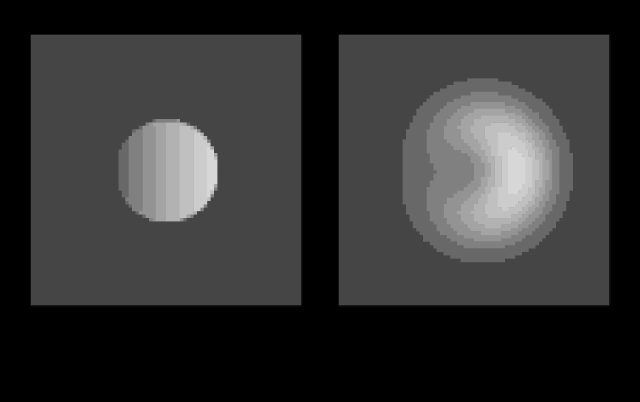
A pool with an edge
A Gaussian pool says how much of a stabilised image survives and can say nothing about what the remainder looks like, because a Gaussian has no edge. Give the pool a boundary and the interior of a faded region takes the average of its own border — exactly, by the mean value theorem, arriving as a prediction about appearance.

The appearance model has no slot for it
Two slabs with identical reflectance and different kernels come out of CIECAM16 with identical lightness, chroma and hue — to six decimal places, because the model's input is a stimulus and their stimuli are the same. Translucency is a recognised appearance attribute with no correlate in any appearance model, and the reason is structural rather than an oversight.

The appearance model takes XYZ
CIECAM16 predicts how a colour looks, and its input is three tristimulus values computed through a standard observer. Everything this round measures happens before the model is called, so an appearance prediction inherits six observer departures and a choice of cone space before it begins.
A contrast control is three controls
A tone curve is a function of one number at a time and knows nothing about hue. Applied to each channel separately it rotates a hue circle by up to seventeen degrees, raises chroma by a factor of 1.27 at ordinary strength, and lifts lightness — so a photographer who moves a contrast slider has moved three things and the interface names one of them. All three scale with the curve's strength, monotonically, and the hue rotation depends on which hue it is.

An appearance is not always a stimulus
CIECAM16's inverse is a closed form that returns three numbers for every lightness, chroma and hue it is handed. Whether those three numbers are a light it does not ask, and over a lattice spanning the space a specification is written in, 10.8 per cent of them are not — one tristimulus value negative, or a relative luminance above the white's. Only 43.8 per cent are colours a display could show at all.

The hue scale has four corners
CIECAM16 reports hue twice — as an angle in its own opponent plane, and as a quadrature interpolated through four unique hues with four fitted weights. The second is the one hue tolerances and hue-preserving mappings are written in, and it is piecewise — its slope jumps at each of the four anchors, by a factor of 1.74 at green and by 0.41 at blue, and it runs 4.1 times faster near yellow than near blue.

Where the model's curve does not matter
This round has been about what a nonlinearity does to an average, and CIECAM16 is the most nonlinear thing in the collection. Over the spread a population of observers produces, the average of its predictions is its prediction for the average to within 1.4 per cent — the nonlinearity is there and the excursion is too small to reach it. Over the range of adapting luminance one room covers in a day, the same gap is 59 per cent of the spread, and from indoors to outdoors 74.

The audit, read as appearances
The previous round priced six observer departures in a matching unit and left them there. Read in the appearance unit an appearance prediction would actually be judged by, they are not the same six numbers scaled by a constant — the model amplifies the smallest by 1.58 and the largest by 1.03, so the range between the largest and smallest term narrows from 3.34 to 2.17. The published ranking survives in the mean and changes on fourteen of the forty-two surfaces it was averaged over.

A stated lightness is two requirements
A specification quotes an appearance to a stated precision — a lightness to a tenth of a unit, say — and the same precision everywhere. Inverted, a twentieth of a unit of lightness fixes the luminance to nine tenths of one per cent at the bottom of the scale and to a tenth of one per cent at the top, a factor of 9.3. Read in absolute luminance it is the other way round by a factor of 6.5, and both readings are true.

A third of the appearance box is no surface
An appearance specification is written as a lightness, a chroma and a hue, and the model's inverse turns any such triple into three numbers. A tenth of the space turns into something that is not a light at all. A further quarter turns into a light no reflecting surface can return, because a surface cannot give back more than all the light at any wavelength. So a third of the space a paint, a print or a dye is specified in cannot be made from paint, print or dye, and at lightness 90 nearly two thirds cannot.

The model has a hue shift it was never given
A monochromatic light changes hue as it is brightened, except at three wavelengths that do not move — an effect measured since the nineteenth century and not among the things CIECAM16 was fitted to. The model has it anyway: brightening a stimulus thirtyfold moves its hue angle, and the places where the movement crosses zero land at 459, 495, 502 and 570 nanometres against the reported 474, 506 and 571. The sizes are another matter.

A room with two lights has no white
An appearance model takes one adapting white. A desk beside a window has two, and the mixture falling on the paper is not the same thing as the white the person reading it has adapted to. Mixing the lights is arithmetic. Choosing the white is not, and the choice is worth sixty units of appearance — most of which is a cast, and not all of which is.

A dark background moves every difference and no match
CIECAM16's background is one number, and it reaches lightness as one exponent. That is enough to change what a grey looks like and not enough to change which of two greys is lighter — so a match survives the background exactly, a corresponding colour is invariant to it, and a tolerance is not. The effect the background is usually invoked to explain is absent from the model entirely.

The cancellation is exact and cheap to lose
CIECAM16 has no crispening, and adding one was expected to be expensive: the background's exactness in a corresponding colour comes from its being a common exponent, and a function of the sample's own level is not one. It is expensive in kind and not in size. A term that raises a straddling pair's lightness difference by half moves a corresponding colour by five thousandths of a tristimulus unit — a thousandth of what stating the background differently at the two ends already costs.

The reversals have a straight edge
Twenty-one of 276 pairs change places in chroma between a dark background and a light one, and the reason given was that chroma is a product of a term carrying the exponent and a term that does not. That is true and it is not a description of which pairs. Chroma at one background is a single common factor times a power of lightness at another, so a pair reverses exactly when its chroma ratio and its lightness ratio point opposite ways and the first is the smaller — a wedge with two straight edges, which names every reversal and nothing else.

Two rooms with one lightness scale
CIECAM16's surround and its background both reach lightness, and they reach it through one product. So the rooms fall into classes: a television in a lit living room against a mid grey returns exactly the lightness a print on a desk against a background of 2.8 does, for every sample, to the last bit of a double. It returns 0.76 of its chroma and 0.81 of its brightness. Two of the model's four viewing-condition parameters are one parameter, and only colour tells them apart.

Two uniform spaces disagree about between
ΔE₀₀'s own local behaviour says which colours lie between two colours, and so does CAM16-UCS's. They do not agree. On cyan to magenta the two shortest paths run fifteen CIELAB units apart — more than either runs from the straight line — and on that gradient ΔE₀₀ would rather have the straight line than CAM16-UCS's answer. Getting the comparison at all takes noticing that one of the two has no local metric: its published difference is a Euclidean distance raised to the power 0.63, and a power below one has an infinite derivative at zero.

What an adapted viewer loses is set by the wall
A satin finish takes about a tenth of a room's colour, measured on the room's light against its lamp's white. Read through an appearance model by a viewer adapted to the room, the same thirty-six rooms lose between 12.8 and 30.9 per cent — 1.4 to 2.4 times as much — and the wall colour decides the multiplier: a deep red room loses twice what a green one does, under every lamp. A test on the bare wall predicts it. Add a little of the lamp's white to the wall's own colour and ask the model what that costs: the answer orders the thirty-six multipliers at 0.95.

White turns a hue, and the models part at blue
Mix a saturated light with white and its hue changes as well as its saturation — the Abney effect, and the reason lines of constant perceived hue curve in a chromaticity diagram. Asked what adding white does to the twenty-four most saturated colours a display makes, CIECAM16, CIELAB and Oklab all turn the hue. About reds they agree: CIECAM16 turns within a degree of Oklab, whose hue was fitted to observers' constant-hue judgements. About the display's blue they do not: Oklab turns sixteen degrees, CIECAM16 four, and CIELAB nine the other way.

A third space breaks the tie only once
ΔE₀₀ and CAM16-UCS disagree about which colours lie between two colours. Oklab was the obvious tie-breaker, and it breaks the tie on one gradient of five: on red to blue its path runs within six CIELAB units of CAM16-UCS's and twenty-nine from ΔE₀₀'s. On red to green and cyan to magenta it keeps to CIELAB's straight line while both others bow, and on blue to yellow it bows further than either. Each of the three spaces is the odd one out somewhere. Asking also exposed a CAM16-UCS path that had never converged.
Named alongside it
The objects these essays reach for when they reach for this one.
CIECAM16Viewing conditionSpecificationAdaptationSurroundLightnessChromatic adaptationCIELABModelling assumptionAssertionColourfulnessLuminance