Specification — where it appears
Named by 131 essays across 9 fields — each of them below, with the objects they name alongside it.

A tolerance is a shape
A total colour difference below one, or every component within one — the two sound like the same requirement stated twice. They are different shapes, they disagree about most of what either accepts, and which one a supplier is held to is worth money.

Where the formula is not smooth
A colour difference formula is a distance, and a distance ought to vary gently. CIEDE2000's does not everywhere — it carries a hue-rotation term with a hard edge in it, and the discontinuity sits where a great many industrial samples live.

Neither gamut contains the other
Converting a picture to CMYK is described everywhere as a reduction, as though the press were a smaller version of the screen. Measured as solids, the press reaches eleven per cent of its volume outside sRGB while sRGB reaches fifty-four per cent of its volume outside the press — and in the cyans the press wins by seventy per cent of chroma.

A profile is a table
An ICC profile does not contain a model of the device it describes. It contains a lattice of patches that were printed and measured, and everything between them is interpolation — which is exactly zero at every patch, so a profile checked against its own target reports perfection for ever.

The paper is the white point
A printed colour is reported against the sheet it sits on rather than against the light in the room, and the choice is a switch in every colour engine. Flipped one way, the same separation on coated stock and on newsprint is a 3.04 colour difference; flipped the other, it is 0.13 — and the two answers are about different questions.

The fourth ink is not for colour
Black is in every process set and it extends the gamut by more than a third — and at every lightness above about forty it extends the chroma boundary by exactly nothing. What it buys is depth at the bottom, a neutral that holds its hue when the press drifts, and a way to put a full-strength dark on a sheet that could not carry three inks' worth of it.

A black that is not black
The deepest colour a four-colour press can make is L* 2.4, and against its own paper that is a contrast of about 320 to 1 — less than a cheap display manages in a dark room. Everything a printed picture does in the shadows is done inside that range, and the two ways of fitting a picture into it destroy different things.
The separation is not unique
A four-ink press has one more control than a colour has numbers, so most colours can be printed several ways. The alternatives agree to a hundredth of a colour difference under the light the match was made in — and they are metamers of one another, so under a tungsten lamp the same eleven separations of one colour spread by nearly seven.
No mapping preserves everything
More than half the sRGB solid is outside a press's gamut, so something has to be done with it, and there are two things that can be done. One leaves every reproducible colour exactly where it was and delivers a gradient as a flat area. The other keeps the gradient and moves every colour that needed no help by about three.
The lamp in the shop decides
Two packages printed to the same specification, verified under the same standard illuminant and passed, can differ by nearly seven colour differences on a shelf under a tungsten lamp. Nothing went wrong at either press. The specification named one light, the separations that satisfy it are metamers of one another, and the shop chose the second light.
A brand colour is an ink
A named colour is a jar of pigment with a spectrum, and a four-colour build of it is three inks arranged to integrate to the same three numbers. Of 156 constructed single-pigment inks, 15 can be matched at all — and those fifteen drift by a median of 3.8 colour differences under a tungsten lamp, because the match was never a match.

The fifth ink buys a corner
Orange, green and violet are sold as the answer to a four-colour press's gamut, and each one adds seven to nine per cent of volume. All three together add 23 per cent — almost exactly the sum, with no interaction — and every bit of it lands in the region of the ink that was added, at lightnesses where that ink is dark.
The proof is a different object
A soft proof can be made colorimetrically exact and still not match the print, because the print is in a booth at two thousand lux with an average surround and the screen is in a dim room at a fifth of the luminance. The appearance model puts four CAM16-UCS units between them, with no change of stimulus anywhere — larger than the error any rendering intent is arguing about.

The screen is not the room
A thousand-to-one display in an ordinary office is a hundred-and-thirty-seven-to-one display, and the signal value that means black comes out at the lightness of a dark grey card. Nothing is wrong with the panel. Light falls on the screen and comes back off it, and the two per cent it returns is added to every pixel — most of all to the ones with nothing else in them.
Colour thrown away on purpose
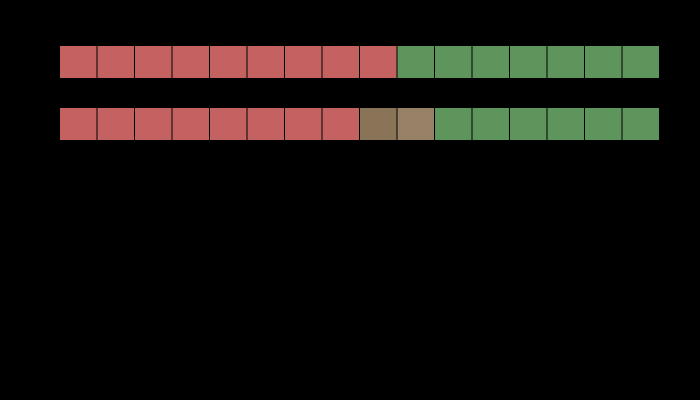
Every video format in use discards three quarters of its colour information and keeps all of its luminance, because the eye resolves fine colour detail badly. On an edge that carries luminance the loss is exactly zero. On an edge of nearly equal luminance it is a colour difference of forty-three, and the two edges are the same edge to the codec.

Two lamps do not average
Light adds, band by band, and every number a lamp is sold by is a projection of the sum rather than a sum of the projections. Two radiators sitting exactly on the Planckian locus mix into a light that is measurably pink; two poor lamps mix into a better one than either.

There is no D65 lamp
D65 is standardised by three numbers, and three numbers do not pin a spectrum. A source built to hit them exactly — matched to a part in a billion, with a third of the visible band nearly empty — separates pairs that D65 says are identical by up to eight and a half units of colour difference.

Five nanometres is a choice
Every integral here is taken in five-nanometre steps, and the interval has never had to be defended. Coarsening it to twenty costs daylight two hundredths of a colour difference and a fluorescent tube six and a half — and which way of coarsening is used decides a further factor of six.
A gradient is a path
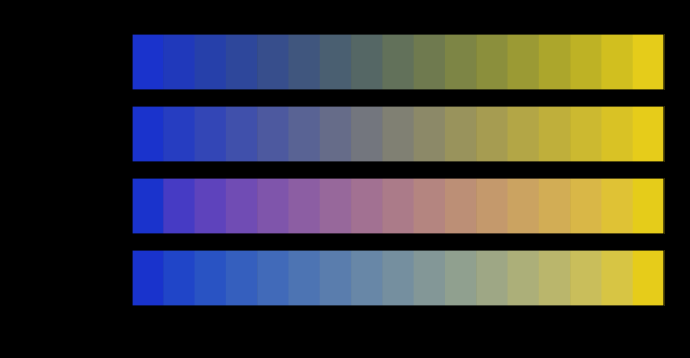
Two colours fix the ends of a blend and nothing else. The middle is decided by the space the interpolation happens in, and four spaces in daily use put the halfway point of one ordinary gradient as much as thirty-seven units of colour difference apart.
A difference is not a distance
Two earlier essays here said that CIEDE2000 violates the triangle inequality and left it at that. Searching for the violation finds a detour half the length of the direct route, a smaller one inside a five-unit ball, and a second defect nobody mentions — ΔE94 is not even symmetric.

The gamut shrinks in the dark
Every gamut number here is a property of a device and of nothing else, which is why the same display has the same gamut in a studio and in a cinema. It does not. Turn the room down four decades and the solid loses a fifth of its reach and two thirds of its volume, with the signal unchanged.

The model has no clock
An appearance model takes a stimulus and a situation and returns what it looks like. It does not take a time, and adaptation is not instantaneous — half a second after the light changes a judgement is three and a half CAM16-UCS units from the settled one, and a minute later it is still 1.3.

A lamp has a waveform
A lamp modulating a thousand times a second is a hundred times past the frequency at which flicker fuses, and it is plainly visible — as a dotted trail, during any glance across the room. The reason is not a new measurement; it is the spatial contrast sensitivity function, arriving from an unfamiliar direction.

White is a region
A lamp is not sold as a chromaticity. It is sold as 4000 K, and what that means is that its chromaticity fell inside a quadrangle — which two lamps can occupy at opposite corners, eleven ΔE00 apart. In a room with either of them, the same twelve surfaces differ by one unit.

A screen is a poor lamp
A display's white is a light. Shone on a surface it renders colour worse than a fluorescent tube — and the wider the gamut, the worse it gets, because the narrow primaries that buy a large triangle are exactly the ones that leave holes in the spectrum.

Which of two is worse
Two colour-difference formulae disagree about which of two pairs is the larger difference in thirteen per cent of comparisons overall — and in forty-three per cent of comparisons among pairs sitting near a tolerance of one unit, which is where every acceptance decision is actually made.
A difference has no place
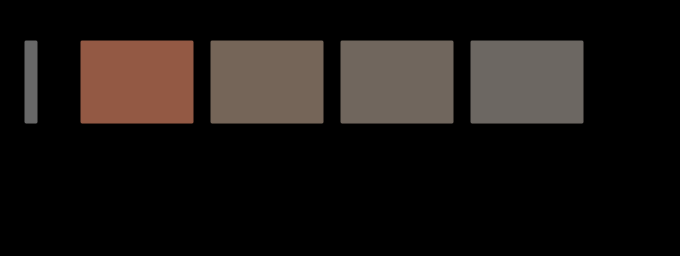
A colour difference formula answers a question about two patches somebody is looking straight at. Move the same pair ten degrees into the periphery and a third of it is left — and it has turned twenty-four degrees of hue, because the three channels give out at three different rates.

The laws that make colour add up
Colorimetry is an integral, and an integral assumes matching is linear. Grassmann's four laws are exact for a linear observer, to floating point — and they fail at both ends of the light range, by two different mechanisms, leaving colorimetry an operating band of three and a bit decades that no standard states.

One match names the observer
A yellow at 589 nanometres set against a mixture of 545 and 670 is two equations in two unknowns. It has one solution for a normal observer, a solution somewhere else for an anomalous one, and no unique solution at all for a dichromat — whose two equations are one equation twice.

A display in a room is a smaller display
Two results here turn the room's light in opposite directions and neither knows about the other. A room has one light level and does both at once — so there is a brightness at which a display delivers the most colour, it is not at either end, and it scales with the panel.

Nobody here has two eyes
One person's two eyes differ in macular pigment and lens density, so the same light produces two colours — a whole ΔE00 apart for an ordinary pair, seven for one replaced lens. Adaptation hides it exactly, which is why nobody notices and why nothing in colorimetry has a term for it.

Every threshold was measured with a grating
An earlier essay here claimed that the model cannot explain why dither works, and named two missing pieces. One of them was real and worth thirteen times the guess; the other was not needed. The piece nobody named was the detector — and reading the same model two ways changes the answer by a factor of fifty.

A colour has a name
Every quantity here is a number, and the question a reader arrives with is what colour something is called. The eleven basic terms of English divide the space into territories that differ by a factor of five, the metric accounts for fifteen per cent of that, and one of the eleven focal colours cannot be shown on this page at all.

A name is not a threshold
Two colours have to move about ten times a just-noticeable difference apart before people stop calling them the same thing, and how far varies threefold across one plane of the space. A tolerance and a word are answering different questions, and nothing in colorimetry converts between them.

A catalogue is not a vocabulary
A colour order system is a regular lattice, because a person has to be able to find a page. Sorted by what its chips would be called, that lattice comes apart into piles differing by a factor of three — and a fifth of all one-step moves in it change the name.

Four primaries have a choice
Three primaries matching three numbers have one answer. Four have a family of them, every member exact to floating point for the observer they were solved for — and the members are not equally good for anybody else, so a display with a fourth primary has a setting that is robust to who is looking at it and a setting that is not.

A tolerance is a probability
A colorimeter reports one number and a specification compares it with another, and both are computed for an observer who does not exist. Handed to two hundred people, the same pair at ΔE00 1.0 is read from 0.8 to 3.7 — and which of those two ranges applies depends on something no specification records.

Three constants nobody quotes
CIEDE2000 is defined with three parametric factors in it, the CIE leaves them to the industry using the formula, and the two settings in ordinary use differ by a factor of two in one of them. Twenty-nine per cent of acceptance decisions change between the two — a larger disagreement than any between the formulae themselves.

A mean is not a difference
A specification for a proof, a profile or a print run is written against a set of colours and has to reduce that set to one number. The mean and the ninety-fifth percentile disagree about which of two reproductions is better in thirty per cent of cases, and both numbers are honest.
There is no word for that colour
The naming model built this phase gives a saturated cyan the name green, calls part of a chromatic ring grey, and puts one of the eleven focal colours outside what a display can show. Each failure is a measurement rather than a disclaimer, and together they say what a vocabulary is that eleven points and a distance are not.

A lamp has a direction
A white LED is a blue die under a converter, and light leaving at an angle has travelled further through the converter than light leaving straight up. So the mixture is different in every direction, the beam is bluer in the middle than at its edge, and the number on the box is one direction's worth of a device that has no single colour.

Three ways to dim a lamp
"Dimmed to ten per cent" names three different colours. Switching the lamp on and off faster than anybody can see changes the chromaticity by nothing at all — exactly, to floating point. Reducing the current moves it a few units. Reducing the power to a filament moves it eighteen hundred kelvin down the Planckian locus, and stays on the locus exactly the whole way.

A lamp switched on is not the lamp measured
A luminaire takes about seven minutes to reach nine tenths of its working temperature, loses a quarter of its output on the way, and moves ΔE00 2.6 while it does. That is slower than every clock in the eye — so for the first minutes after a switch is thrown, both ends of the measurement are moving, and every appearance claim here has assumed one of them was still.

The index is one observer's opinion
A colour rendering index is printed to a tenth of a point and computed for a single set of colour-matching functions that no standard names as a choice. Scored by two hundred eyes instead, one lamp's spread is wider than the whole range the standard observer puts five lamps in — and two lamps the standard separates by four tenths of a point come out the other way round for every member of the population.

A fourth primary is a design
A display's fourth emitter is sold as more colour. Optimised instead against how far apart two hundred eyes are about its white — with the gamut held fixed so it cannot cheat — it buys agreement, and two and a half times closer together than three primaries reaching the same area, and the wavelengths it chooses are not the ones anybody would pick.

A tolerance needs a second number
Two samples one colour difference apart can be read almost identically by everybody or two units apart by the worst-off twentieth, and which of those it is depends on how far apart their spectra are — a quantity every spectrophotometer has already measured and none of them prints. Adding it as a second field predicts the population three times better, and at the tolerances where it matters it is right about a third of the decisions the difference alone gets wrong.

Fitted to an eye nobody has
A camera profile's residual against the observer it was fitted to is under a unit, and that is the number everybody quotes. Against a person drawn from a population it is 3.35 at the ninety-fifth percentile — and a camera with no spectral error whatever, reporting the standard observer's tristimulus values exactly, would carry 3.47. The camera is not the problem.

The booth is a luminaire
A standard viewing booth is specified by its light's chromaticity, its rendering and the uniformity of its illuminance across the sample plane. Illuminance is a photometric integral, so two positions can be inside the uniformity tolerance and lit by two different spectra — and a sample at the far corner of a compliant booth is ΔE00 2.4 from one in the middle, against a tolerance of one.

What a second model changed
Thirteen claims here, each computed with one model and recomputed with two. Ten of them move by half again or more. Three of them do not move at all in the ordinary sense — the first model's answer is exactly zero, not because it computed zero but because it has no variable for the quantity — and every one of those three is a join that supplied a state or a device rather than a spread.

Dividing by the paper
Media-relative colorimetry divides tristimulus values by the substrate's, which is a von Kries adaptation applied in XYZ — the one basis the table here describes as the oldest mistake still shipping. On a paper-mill white it costs a few hundredths of a unit. On a tinted sheet it costs ten times what the same rule costs in a cone basis.

One unit in another room
Twenty-three pairs built at exactly ΔE00 1.000 under D65, re-measured under every change of light this site models with the observer adapted to each, come out anywhere between 0.64 and 1.57. A tolerance is written as a property of a pair and it is a property of a pair and a room.

A surface that is not a multiplication
Every argument here about what light does to a surface begins by multiplying two spectra together. A surface with a brightener in it takes light at one wavelength and returns it at another, so it is a full operator rather than a diagonal one — and it does not have a reflectance at all.

Only one dimmer is invisible
An earlier essay separated the three ways to dim a lamp by the chromaticity each arrives at. Asked instead what an adapted observer is left with, the ordering is different and one method comes out at exactly zero — a duty cycle is a scaling, a scaling is a gain in every basis, and adaptation removes all of it at every depth.

Only one of these devices adapts
An eye, a camera, a display and a press all meet the same changes of light, and each has at most one thing it can do about them. The press has nothing at all, so its column is the whole change; and this collection's sensor built to satisfy the Luther condition exactly is the one that adapts worst.

The window is part of the light
A viewing condition here has always been a spectrum and a geometry. For anything fluorescent it needs a third thing — the transmittance of whatever the daylight came through — because ordinary window glass, a laminated windscreen and a museum filter remove three quite different parts of the band a brightener eats, and the sheet is a different colour behind each.

An instrument brings its own light
ISO 13655 names four measurement conditions and they are usually read as four degrees of care. They are not. They are four different quantities — on an unbrightened sheet all four agree to a rounding, and on a brightened one they are up to seven and a half units apart, with every instrument in calibration and every answer correct.

Whiteness is mostly the lamp
The CIE whiteness formula ranks white samples the way people do, which is what it was built for and is not in question. What is in question is what it is a measurement of — take the ultraviolet out of the instrument and 82 per cent of the scale collapses, because the part that separates a premium sheet from an ordinary one was contributed by the lamp.

The brightener is being used up
The molecule that absorbs an ultraviolet photon occasionally does something other than re-emit it, and what it does is break. So a sheet's whiteness has a half-life, the fall is steepest at the start, and a specification quoting a whiteness figure without a date is quoting a property of a sheet that no longer exists.

Which of these is a convention
Nine ordinary sentences from this collection, put through one test — do they mean the same thing after the observer's three curves are replaced by a nonsingular combination of themselves? Five survive and four do not, and none of the four is wrong, because each is a statement about a set of coordinates being read as a statement about an eye.

One matrix doing two jobs
CIECAM16 adapts in CAT16 and then applies its response compression in the same axes, so a single matrix decides both how well the model handles a change of light and how uniform the space it produces is. The two jobs have different best answers, and the matrix was chosen against only one of them.

The exponent was never the argument
A century of colour science has argued about whether the eye's response is a cube root, a square root or a logarithm. Minimise the anisotropy of MacAdam's ellipses over every basis, at each of eight exponents, and the floor moves by under three per cent between a cube root and a tenth root — while the basis moves it by a factor of two.

Primaries chosen for their inverse
Moving a display's white point is a gain on its R, G and B, so a display adapts in the inverse of its own primary matrix — a basis chosen by committees for gamut coverage and phosphor availability. Pose the design problem properly and the answer costs one per cent of the gamut argument and reaches within two per cent of the best basis there is.

The gamut race chose the basis
Twenty years of arguing about how much of the diagram a display should cover has produced primaries whose inverse is a better adaptation basis than any transform ever fitted to corresponding-colour data. On the invariant count of what those displays can actually show, the same twenty years produced nothing at all.

A constraint costs what it points at
Three primary chromaticities remove three of the nine numbers in an adaptation basis and cost one per cent. Three dichromat confusion points remove six and cost seventy. Counting what a constraint removes predicts neither, because an optimum is a long bowl and what matters is which way the constraint points.

A tolerance is a region
How far a display's red primary can move before its adaptation behaviour costs anything is not a distance. It is a closed region on the chromaticity diagram, fifteen times longer one way than another, and about half of it lies outside the area a real primary can occupy — where the objective does not rise and the primary cannot go.

The input nobody declared
An audit that swept every declared width in this collection found the largest elasticity anywhere to be about a half. The most elastic input turns out to be one that was never declared, never quoted with a range and never varied — and being undeclared is exactly why it escaped the audit that was looking for it.

Every worst surface sits on a declaration
Bounding the wall in a painted room produced a real worst case — the residual turns over at a band six nanometres wide because a narrower band returns too little light. Bounding the surfaces the residual is averaged over produces nothing of the kind, because all fourteen answers sit exactly on two numbers somebody typed and the one constraint that comes from the world never binds at all.

The claim, in nanometres
For four rounds the claim here has been that every published adaptation transform puts the protanope's confusion point outside any real population of eyes, stated in standard deviations of a population whose widths were declared rather than measured. Restated as a pigment displacement it needs no population at all — and the nearest transform asks the medium-wave cone to move thirty per cent of the way to the long-wave one.
Five transforms and the space between them
Every appearance prediction here chooses one of five published adaptation transforms, and the five disagree about where a protanope's confusion lines meet by more than the distance between the two pigments the disagreement is about. That spread is itself a scale, and using it needs no population model at all.
A chart decides what a camera scores
A camera profile's reported error changes by a factor of five when the test chart's saturation changes, with the camera and its matrix untouched. The elasticity is 0.67 — the same figure, to two per cent, that an entirely unrelated measurement over an entirely unrelated set of surfaces gives.
A budget drawn through one hue
The three-stage error budget this collection publishes for a colour-management chain is computed over twenty-four colours of a single hue at a single lightness. The quantity that actually varies with hue — how many distinguishable colours a rendering intent destroys — runs from nothing at all to more than a third, and the hue the budget uses is near the bottom of that range.

What the audit still cannot reach
Two rounds have now swept every declared width in this collection and one of its structural choices. Three structural choices remain, none of them has a multiplier to sweep, and the reason each resists is different — which makes the list a description of where this kind of audit ends rather than a queue of work.

A tolerance is a boundary through pairs
Twenty-four pairs of surfaces built to sit exactly on a ΔE2000 tolerance of one read from 0.69 to 1.93 in the other five units. A contract quoting "one unit" without naming the formula does not become slightly wrong in another; it accepts and rejects a different set of deliveries, and in one case rejects every single one.

A dial has a price
Two rounds declined to give the appearance model's surround a continuous control, both times because the frames would be too heavy, and neither time was the weight taken. It is 2.25 kilobytes at the median — the light end of these figures rather than the heavy end — and one figure is already breaking the rule the deferral was made under.

An aperture is a filter
A measuring aperture throws away the light that came back outside it, and the light that comes back furthest is the light at the wavelengths the sample absorbs least. So an aperture does not attenuate a translucent sample evenly — it attenuates its peaks more than its troughs, which is a filter whose transmission curve the sample itself decides.

Either disc can be the wide one
Every standard on translucent samples says to illuminate a larger area than is measured, and explains it by saying that light leaks out of the lit spot. That is true and it is not the reason, because the instruction works equally well the other way round — measuring a larger area than is lit gives a reading just as exact. The error is a product of two apertures and either one being wide kills it.

Which index to buy an instrument for
Four departures from the colour integral, ranked by what they cost and by what it would take to remove each one. The ranking by cost and the ranking by price are almost exactly reversed — the two largest are removed by specifying a lamp and by widening a table, and the two that need new hardware are the two smallest.
The departures are larger than the tolerance
A delivery tolerance is written around one ΔE₀₀ and every one of this round's four departures is above it on ordinary material. A specification that names an illuminant, an observer and a tolerance, and does not name a measurement condition, an aperture and a field, has written a number that two honest laboratories can miss each other on by more than the number itself.

Which end to buy
Refining a five-nanometre grid to one buys a daylight calculation 0.05 ΔE₀₀ and widening its range buys 0.54. Under a fluorescent tube the same two purchases are worth 0.83 and 0.0001. The ranking reverses completely, and what decides it is one length compared against one other length.

The endpoint term has a name
The five-nanometre error on a smooth light falls linearly with the step, which is not what a sampling error does. It is the half-cell at each end of a truncated range, it is first order where the sampling is second, and halving two weights removes fourteen fifteenths of it for nothing.

A grid is not a resolution
Ten essays into this collection there is one sentence about wavelength sampling, and it is that five nanometres is enough. Ten measurements later there are three decisions, three mechanisms, three repairs and two rankings, and the word resolution names none of them.

The lens is worst under tungsten
An ageing lens costs 4.38 ΔE₀₀ under a tungsten lamp and 2.20 under a fluorescent tube. The pigment peaks cost 2.84 under a three-emitter LED and 1.87 under the same tube. Six departures across six lights do not form a single ordering, which is what a pairing looks like and what a dominant term would not.

The ranking is not stable
On a red pigment under daylight the six observer departures run from 2.38 down to 1.20 ΔE₀₀. Over forty-two surfaces two of them change places, the top two separate, and every one spans between a factor of ten and a factor of thirty-five. A chart of six bars is a chart of one example.

A field size is two changes
The CIE publishes two standard observers and the difference between them is usually described as a field size. What actually differs is a macular pigment the light no longer passes through and a cone outer segment the light no longer travels the length of — two changes, in two places, with different signs and different sample dependence.

The observer has no age
Five of the six arguments in this round are spreads — a population differs about them and the mean is a reasonable summary. The lens is not. Everybody's lens yellows in the same direction at about the same rate, so a standard observer with no age is not an average over a population; it is a snapshot of one moment in every reader's life.

An observer is a contract
Six departures, all above a delivery tolerance, none dominant, and no reader matching the standard on any of them. That would be a demolition if the standard observer were a description of an eye. It is not — it is an agreement about what a number means, and an agreement is not falsified by being unlike anybody.

Every scene in this collection was matt
The green wall, the corner, the bounce series and the metamer separation are all computed on Lambertian surfaces, because the solver that produced them requires it. Each would move by between one and five colour differences on an ordinary satin finish, and none of those essays says what finish it means.
A tolerance with an observer in it
A delivery tolerance is written in ΔE₀₀ against the 1931 observer, and six departures of that observer combine to about three of the same units on an ordinary saturated sample. A one-unit tolerance is being asked to contain a three-unit uncertainty that nothing in its budget mentions.

The instrument is one observer exactly
A spectrophotometer has no observer uncertainty. It computes through the 1931 tables to the last bit, reproducibly, forever — which is its whole value and is also why it cannot report the three colour differences of observer spread between itself and whoever is looking at the sample.

A narrow primary buys a disagreement
The observer audit decomposes what a display costs a population. Narrowing the primaries raises the pigment-peak departure monotonically, moving one raises or lowers the macular departure, and the two respond to different design variables — so a wide gamut and an observer-robust display are bought with the same money.
The booth and the eye disagree
A viewing booth is specified to simulate daylight, and daylight is the light under which observers disagree least. So a booth is the condition in which a specification is least likely to be tested against the thing that breaks it, and the shop it will be judged in roughly doubles the term.
A brand colour for a population
A brand colour is chosen once, specified in a number, and seen by everybody. The observer audit says two candidate colours with identical specifications can carry observer spreads differing by an order of magnitude, and that the spread is computable from an ink's spectrum at the moment the ink is chosen.
Two observers and one metamer
An observer departure is invisible on a single sample compared with nothing. It becomes a disagreement the moment two spectra are being asked to match, because a match is an identity between three integrals and a different observer takes different integrals. Everything in this round is a statement about pairs wearing a single sample's clothes.

A lamp is two audits at once
A lamp's ultraviolet content decides what its tabulation costs and its blue content decides what its observer costs, and the two run in opposite directions with colour temperature. So no lamp is good for both audits and no lamp is bad for both, and a single figure of merit for either is a figure of merit for one property of a spectrum.

Three audits and one shape
The tabulation, the observer and the scene solver have nothing in common as subjects. Each turned out to hold a departure that is a pairing of two deviations, vanishes exactly when either is empty, and had been invisible because its parameter had no call site. Three subjects, one shape, and the shape is the round's result.

What this round could not reach
Three audits, about twenty departures and ten conditions, and a longer list of things that were named and not measured. Every item on it is specific, most of them are an afternoon's work, and the reason none was done is the same in every case — the round ran out of round.

The straight piece under the cube root
CIELAB's lightness is described everywhere as a cube root and below a stated luminance it is a straight line, spliced on with two constants chosen so the join is exact in value and in slope. Every black a delivery chain reaches is inside that straight piece — a press black at L* 2.4, a projected black at 1.1 — where the compression does not compress, the price of a deviation is flat to two parts in a thousand, and the second derivative the composition of two departures needs does not exist.

What one number accepts
A delivery tolerance is written as a single colour difference and it acts on three tristimulus values, so what it actually accepts is a closed surface. Measured over sixty-four colours in the sRGB cube, the volume inside that surface varies by a factor of a hundred thousand and its longest axis is between three and thirty times its shortest. The same contract, applied to a dark colour and a light one, is two different requirements.

A lattice has no derivative
Every departure priced here was priced by perturbing something and reading the answer, which requires the thing being perturbed to have a derivative. A file written on a code lattice does not have one — its output is flat almost everywhere and jumps on a set of measure zero — so quantisation can be bounded and never propagated. The bound is 1.15 colour differences at eight bits per channel against a mean of 0.19, and it is worst where the encoding spends fewest codes.

The order is not in the documentation
A raw converter performs a white balance, a colour matrix, a tone curve and a clip, and every account of the process lists them in that order without saying the order decides anything. Exchanging the first two moves the picture by nine colour differences at the mean and thirteen at the worst patch. The twenty-four arrangements collapse into five outcomes running out to sixty-five, and nothing a converter ships says which of them it is.

One step has no choice
Four of a raw converter's operations can be arranged twenty-four ways. The reconstruction cannot be arranged at all — a colour matrix needs three numbers and a mosaic site has one, so filling in the mosaic is forced to the front by arithmetic rather than by convention. What is not forced is whether it happens in linear light or after the curve, and that decision costs 5.8 colour differences at an ordinary edge and nothing at all four sites away from it.

A contrast control is three controls
A tone curve is a function of one number at a time and knows nothing about hue. Applied to each channel separately it rotates a hue circle by up to seventeen degrees, raises chroma by a factor of 1.27 at ordinary strength, and lifts lightness — so a photographer who moves a contrast slider has moved three things and the interface names one of them. All three scale with the curve's strength, monotonically, and the hue rotation depends on which hue it is.

A stop is not a stop afterwards
Doubling the light is exactly a factor of two in raw values and in tristimulus values, which is the one thing about exposure everybody is sure of. A stop taken after the tone curve is a factor of something else, and matching the two on an eighteen per cent grey leaves the rest of the frame between three and four colour differences apart at the mean and up to eleven at the worst patch. The gain that matches one stop is 2.47 rather than 2.

Two converters and one highlight
The clip is the only step in a raw pipeline that destroys information rather than moving it, and it is the step whose position varies most between converters. Below the sensor's ceiling its position changes nothing at all, exactly. Above it, clipping at the sensor and clipping after the matrix land twenty-one colour differences and seventy-eight degrees of hue apart, and which hues are affected is a property of the camera's own dyes.

An appearance is not always a stimulus
CIECAM16's inverse is a closed form that returns three numbers for every lightness, chroma and hue it is handed. Whether those three numbers are a light it does not ask, and over a lattice spanning the space a specification is written in, 10.8 per cent of them are not — one tristimulus value negative, or a relative luminance above the white's. Only 43.8 per cent are colours a display could show at all.

The hue scale has four corners
CIECAM16 reports hue twice — as an angle in its own opponent plane, and as a quadrature interpolated through four unique hues with four fitted weights. The second is the one hue tolerances and hue-preserving mappings are written in, and it is piecewise — its slope jumps at each of the four anchors, by a factor of 1.74 at green and by 0.41 at blue, and it runs 4.1 times faster near yellow than near blue.

The audit, read as appearances
The previous round priced six observer departures in a matching unit and left them there. Read in the appearance unit an appearance prediction would actually be judged by, they are not the same six numbers scaled by a constant — the model amplifies the smallest by 1.58 and the largest by 1.03, so the range between the largest and smallest term narrows from 3.34 to 2.17. The published ranking survives in the mean and changes on fourteen of the forty-two surfaces it was averaged over.

A stated lightness is two requirements
A specification quotes an appearance to a stated precision — a lightness to a tenth of a unit, say — and the same precision everywhere. Inverted, a twentieth of a unit of lightness fixes the luminance to nine tenths of one per cent at the bottom of the scale and to a tenth of one per cent at the top, a factor of 9.3. Read in absolute luminance it is the other way round by a factor of 6.5, and both readings are true.

The budget adds two units
This collection publishes a three-stage error budget for a colour-management chain and prints its sum. Two of the three stages are colour differences between stimuli and the third is a distance between appearances, and the conversion between those is not a constant. Re-measured in one unit over the same colours the chain has four stages rather than three, its end-to-end error is 5.05 against a sum of 7.66, and the profile's contribution where a job actually lands is 3.2 times its published average.

An average on the stored values
A resize, an antialiased edge, a transparency composite and a chroma subsample are all averages, and in almost every pipeline they are taken on the numbers as stored. The numbers as stored are encoded, the encoding is a compression, and a half-and-half blend of black and white taken that way lands 18.7 colour differences from the half-and-half blend of the light — 22.7 units of lightness darker, on every pair, always in the same direction.

An intent is not a function of the colour
A rendering intent is chosen per job and applied per pixel, which suggests it is a function of the colour. The colorimetric ones are, exactly — the same colour from two documents comes out identical to the floating-point floor. The perceptual one is not — it compresses the whole source solid into the destination, so the same colour delivered from a wide document and from a muted one lands 2.6 colour differences apart, on colours the destination could hold either way.

A second conversion is not a repeat
A colour converted to a device and back is described as lossy where the device cannot hold it and exact where it can, which suggests that a colour surviving one round trip survives any number. One of the four intents is idempotent to the floating-point floor. The other two are not — a perceptual conversion moves a ramp 3.70 colour differences on its first pass and another 2.73 on its second, and after three passes it is still moving by 2.42.

A tolerance has a grain
A colour tolerance pulled back into tristimulus values is a long thin shape, and across the whole sRGB cube its shortest axis points the same way, fifteen degrees off at the median — the direction in which X rises as Y falls, which is the direction of a*. So what one colour difference allows depends on which way a delivery drifts. An instrument's X filter may age 1.4 per cent before the tolerance is used up, its Z filter 5.1, and the light on the sample 9.3.

The appearance model has no straight piece
CIELAB's lightness is a straight line below L* 8, so a deviation near black has a fixed price and a black has a floor under it. CIECAM16 has no such piece. Its lightness near zero goes as the luminance to a power set by the room, the price of a deviation rises without limit as the black deepens — as Y to the power −0.44 in a lit room and −0.58 in a dark one — and on a projected black a lightness unit in the model allows under half the luminance change a unit of L* allows.

A distance raised to a power has no length
CAM16-UCS's colour difference is its Euclidean distance raised to the power 0.63 and multiplied by 1.41. That is still a metric — the triangle inequality holds on every one of four thousand random triples — and it has no length. A grey ramp from black to white measures 25 units in one step, 137 in a hundred and 755 in ten thousand, growing as the number of steps to the power 0.37, and halving the size of a step triples the number of steps that fit.

A third of the appearance box is no surface
An appearance specification is written as a lightness, a chroma and a hue, and the model's inverse turns any such triple into three numbers. A tenth of the space turns into something that is not a light at all. A further quarter turns into a light no reflecting surface can return, because a surface cannot give back more than all the light at any wavelength. So a third of the space a paint, a print or a dye is specified in cannot be made from paint, print or dye, and at lightness 90 nearly two thirds cannot.

A soft proof is exact for one reader
A display can be driven to match a printed patch exactly for the standard observer — three equations, three unknowns, agreement to fourteen decimal places. Two hundred observers drawn from a realistic population see the same screen and print a median of 2.1 colour differences apart on an OLED panel and 5.4 apart at the ninety-fifth percentile. On a laser projector the ninety-fifth percentile is 7.5. The patch that fails worst is unprinted paper, and in the chain's own unit the ninety-fifth percentile reader's stage is larger than every one of the four stages a delivery chain is budgeted for.

A chain measured in a unit that cannot add
A delivery chain's four stages, measured in the power-corrected appearance difference, sum to 7.66 while the chain end to end measures 5.05, and the shortfall was read as the stages partly cancelling. A chain whose four stages lay in a straight line and added exactly would still read 0.74 of its sum in that unit, because a distance raised to the power 0.63 cannot add. Measured in the model's own Euclidean space the same chain reaches 0.84 of its sum. Three quarters of the published shortfall was the exponent.

The line can be in the sample
The rule for which tabulation defect to fix compares the light's narrowest feature with the grid's step, and it named its own failure case — a sample with structure narrower than the step. Given one, a two-nanometre notch under a thermal source with no feature at all costs 2.1 colour differences at five nanometres and moves 2.0 when the grid slides, which is what a fluorescent tube costs on a smooth pigment. Under that tube a notch twelve nanometres wide, more than twice the step, moves 8.1 when it sits on the mercury line.

The cost of a steep notch repeats every step
A Gaussian notch is safe on a five-nanometre grid once it is a couple of steps wide. A flat-bottomed notch with steep sides never is. Its cost on the grid rises and falls with its width, with the step as its period — 0.02 colour differences at ten nanometres, 1.99 at twelve and a half, 0.03 at twenty — and it does not die away as the notch widens. What sets its size is how fast the edges rise, and an interference filter's edges rise in under a nanometre.

A press is charged for the direction it barely moves
A press run varies almost entirely along the direction a colour tolerance forgives. Split along the tolerance's own axes under four stated mixes of press variation, its tightest axis holds about one per cent of the sheet-to-sheet variation and pays a quarter to a third of the price — and on a blue overprint four fifths, for the balance between two inking units rather than the level of either.

A tolerance has no light level
Twenty-three pairs built at exactly one colour difference stay at exactly one in every room, because the formula has no argument for the room. Read in the unit that does have one, the same pairs are 0.72 in a cinema, 1.04 in an office and 1.30 in direct sun — and inside any one room they spread by half again, so no single conversion between the two units exists at all.

The metamerism index has two corrections
The index for a metameric pair is defined for a pair that matches exactly under the reference light, and no real pair does. The standard's remedy is to correct the sample first, and it names two corrections — scale the tristimulus values, or add the difference. On six pairs matched to one colour difference, the two answers differ by a tenth to four tenths of an index unit; at two, by a whole one.

The reversals have a straight edge
Twenty-one of 276 pairs change places in chroma between a dark background and a light one, and the reason given was that chroma is a product of a term carrying the exponent and a term that does not. That is true and it is not a description of which pairs. Chroma at one background is a single common factor times a power of lightness at another, so a pair reverses exactly when its chroma ratio and its lightness ratio point opposite ways and the first is the smaller — a wedge with two straight edges, which names every reversal and nothing else.

Two rooms with one lightness scale
CIECAM16's surround and its background both reach lightness, and they reach it through one product. So the rooms fall into classes: a television in a lit living room against a mid grey returns exactly the lightness a print on a desk against a background of 2.8 does, for every sample, to the last bit of a double. It returns 0.76 of its chroma and 0.81 of its brightness. Two of the model's four viewing-condition parameters are one parameter, and only colour tells them apart.

Quadrature is exact in one room
An observer allowance is built by adding the departures in quadrature, which assumes they are mutually perpendicular. Over fifteen pairs their angles run from 18 degrees to 179 and hardly any are perpendicular. Measured against the real combination, quadrature is too small in a cinema by eight per cent and too large under the sky by fourteen, crossing at an adapting luminance of 22 candelas a square metre — and on individual surfaces it is out by a third in both directions in every room.

The room a surface needs is written in its band
Whether two yellow filters cancel on a surface depends on the room, and each surface has its own crossing — the degree of adaptation at which the shared yellowing falls to the size of what is left underneath. Those crossings run from 0.68 to 0.99, and where a surface's absorption band sits accounts for almost all of the spread while how much light it returns accounts for almost none. The reds need a room brighter than a graphic-arts viewing booth, which is brighter than any room a sample is judged in.

A profile interpolates light
A profile is exact at its patches and wrong between them, and how wrong has been measured twice. Which way it is wrong has not. At a nine-step lattice the mean signed lightness error between the nodes is +0.136 against a mean colour difference of 0.133 — the error is not a scatter but a bias, and it lightens. The repair costs nothing measured and is forbidden by how a profile is checked: let the table be wrong at its own patches.

The scale hangs from one measurement
Black point compensation is a straight line between two blacks, and the destination's is a measurement of one patch at the darkest place a spectrophotometer is ever asked to read. The lightness scale's slope is 903 units per unit of luminance factor there and 43 at the paper, so a thousandth of a reflectance is worth nine tenths of a lightness unit at the black and four hundredths at the white. That one number moves a mid grey by nearly a quarter of a delivery tolerance, and no specification names it.

The ambiguity is largest where the index is used
The metamerism index is defined for a pair that matches exactly under the reference light, no real pair does, and the two corrections the standard allows for the residual give different answers. Over eighteen pairs at eleven match qualities the gap is nearly a function of the mismatch alone — its middle half spans a factor of 1.4 at the mismatches a dyehouse reaches — so it could be tabulated. And it is largest exactly there: zero at a laboratory's match, and re-grading eight pairs in eighteen at a trade's.

The inverse table errs dark
A profile's forward table predicts a print lighter than the press makes, and refitting its nodes removes the bias. The table a colour engine actually uses to separate an image is the other one — the inverse, from colour to ink — and it errs the opposite way: filled exactly from the press it asks for too much ink and prints dark, and built by inverting the ordinary forward table it prints darker still. Inverting the refitted forward table removes the inherited part and leaves the inverse's own. The round trip through both tables improves only when each is refitted against its own error, and then the two are no longer each other's inverse.
Named alongside it
The objects these essays reach for when they reach for this one.
Quality controlToleranceColour managementMeasurement errorIndividual variationΔEStandard observerObserver metamerismViewing conditionChromatic adaptationCIEDE2000Gamut