A dark background moves every difference and no match
Assumes A viewing condition is an argument, Brightness is not luminance and A stated lightness is two requirements.
A patch on black does not look like a patch on white, and every appearance model has a place to put that. In CIECAM16 the place is Yb, the luminance factor of the background — a single number, usually left at 20 because that is roughly a mid grey and because every published table was computed there.
The number does real work. Move it and the answers move.

But the three curves are not three shapes. They are one shape raised to three powers, and everything worth saying about the background follows from that.
The background is one exponent, and the exponent can be checked
The background enters the model through a single ratio, n = Yb / Yw, from which four constants are derived before any sample is looked at: the base exponent z, the two induction factors Nbb and Ncb, and the achromatic response of the white, Aw. Lightness is then J / 100 = (A / Aw) ^ (c z), and the crucial detail is that Nbb multiplies both A and Aw, so it divides out. What is left is a ratio that does not depend on the background at all, raised to a power that does. The background changes the exponent and nothing else.
Two of the four constants are therefore doing nothing to lightness whatsoever. Ncb never enters the achromatic path at all — it belongs to chroma — and Nbb enters twice and cancels. Aw carries it once as a scale factor on the white, and A carries it once as the same scale factor on the sample, so the ratio the exponent is applied to is a pure property of the sample and the white. Only z survives, and z = 1.48 + √n is about as simple as a derived constant gets.
That is an algebraic claim, and algebraic claims about a model as tangled as this one are worth computing rather than reading off the page. The standard’s text and an implementation can disagree, a reordering of two lines can break a cancellation that the algebra says must hold, and the whole argument below rests on this one step. If it is right, lightness at any background is lightness at the reference background raised to the ratio of the two exponents, exactly — and undoing that power should collapse the three curves onto one.

So the figure is empty, deliberately. The residual is 2 × 10⁻¹⁶ against values of order one, which is a few units in the last place of a double — the identity is not approximately true, it is true. The exponent runs from 1.62 on a near-black background to 2.37 on a near-white one, and that range is the entire contribution the background makes to CIECAM16’s lightness.
What an exponent cannot do to an order
A monotone increasing function applied to every value in a list cannot change which value is larger. Raising to a positive power is such a function on the positive reals, so the moment the background is known to be an exponent, several things follow without any further computation — and the point of computing them anyway is that “the background is an exponent” was itself a claim about code.
Twenty-four surfaces read at a near-black background and again at a near-white one produce no inversions in lightness and none in hue, in all 276 pairs. If one sample is lighter than another on black, it is lighter on white, by the model, always. The same holds for hue, which never touched the background’s constants in the first place.
This is stronger than it sounds, because it says that the model’s answer to does this match does not depend on the background, while its answer to what does this look like plainly does. A stated lightness is two requirements separated a target’s value from its tolerance for a different reason; here the same seam opens along the background instead.
A tolerance is not a match, and only one of them survives
The natural next question is what happens to a difference, and the answer is that differences are exactly where an exponent does its damage. Two samples a fixed distance apart in luminance are not a fixed distance apart in lightness, and how far apart they are depends on the power.

The pairs did not change, the light did not change, and the observer did not change. A tolerance stated in the appearance model’s own unit therefore carries an unstated background with it, and the same pairs are inside or outside a stated limit depending on what colour the wall behind them is. A tolerance has no light level found the same shape one argument over, with the adapting luminance in place of the background; the two are independent and they multiply.
The spread matters as much as the median. On a near-black background the twenty-three pairs run from 0.328 to 0.773 — a factor of 2.4 between the narrowest and the widest — and on a near-white one from 0.203 to 0.451. So the background does not simply rescale a tolerance by a known factor that could be absorbed into the limit; it rescales it by an amount that depends on where the pair sits, which is the same objection a room with two lights has no white raises against correcting away an adopted white’s effect. A single multiplier fitted to the median would leave the ends further out than they started.
Note also what the ratio is not. It is not that a dark background makes everything harder to distinguish, or easier. The sensitivity curves cross: somewhere between a luminance factor of 5 and 20 the ordering reverses, and above it a light background separates samples further while below it a dark one does. A single sentence about which background is more forgiving is wrong at one end of the scale whatever it says.
Chroma is the exception, and it is the exception for a reason
The monotone argument covers lightness and hue. It does not cover chroma, and chroma does not behave.

Chroma in CIECAM16 is built from a temporary quantity t, and the formula is C = t^0.9 × (J/100)^0.5 × k. The lightness term carries the exponent at half strength; the t term carries the background too, through Ncb, but as a plain multiplier that is the same for every sample. A common multiplier preserves order and a common exponent preserves order — but a product of a term with one and a term with the other does not, because the two act on different sample-dependent quantities and their relative weight shifts as the exponent moves.
So the reversals are not noise or an edge case. They are the model saying that which of two surfaces is more colourful depends on the wall, which is a substantive prediction — one that nothing in the background’s derivation was designed to produce, and that no experiment cited in the model’s own documentation was run to test.
The effect the background is usually invoked for is not in the model
There is a measured phenomenon that the background is routinely brought in to explain. Crispening is the observation that differences between samples are seen most sharply when the samples straddle the background’s own luminance: two greys a little lighter and a little darker than the surround are easy to tell apart, and the same physical pair against a much lighter or much darker surround is not. It is not a subtle effect, and it is the reason a mid-grey surround is standard in the first place.

It cannot be there, and the reason is structural rather than a matter of fit. The background’s four constants are computed from Yb alone, before the sample exists; nothing downstream ever compares the sample’s level to the background’s. A model in which the background is a coefficient cannot produce an effect defined by a relation between the sample and the background, and this one does not: at every background the sensitivity peak sits at the darkest sample tested, not at Yb.
What the background does instead is tilt the whole curve about a point. A 2% sample gains 3.60 units of lightness per unit of luminance factor on a near-black background and 2.33 on a near-white one; a 96% sample gains 0.46 against 0.68 the other way round. That is the exponent, seen as a slope: the darker the background, the more of the scale is spent near black. It is a real prediction and it is a different prediction from crispening — brightness is inferred from edges is where the mechanism crispening belongs to actually lives, and it is a mechanism about spatial comparison that a per-patch model has nowhere to put. The appearance model has no slot for it makes the general form of this argument; the background is a particularly clean instance, because the slot exists, is filled, and is filled with the wrong kind of thing.
Where the background does reach a match
One place is left, and it is the place that matters in practice. A corresponding colour — the tristimulus values that will look the same under a second light as the original does under the first — is computed by running the model forward under one viewing condition and backward under another. If the background is the same at both ends, the exponent is applied going in and undone coming out.

The cancellation is exact, and it is worth being precise about what it licenses. A studio computing corresponding colours can use whatever background it likes, and get the same answer, provided it uses the same one at both ends. It almost never does: the original is judged against a mid-grey card and the reproduction is seen on a page, or on a screen in a dark room, and those are different backgrounds at the two ends of the same computation. That asymmetry is the entire remaining effect — a median of 5.1 tristimulus units on a hundred-unit scale, which is not small.
Nothing about that exactness is an accident of the sample set, and it is worth seeing why. Going forward, lightness is the ratio raised to c z; going back, the inverse raises it to 1 / (c z) with the same z, because the same background was stated. The two powers compose to one and the ratio comes back untouched, so the background cannot influence the result no matter what value it takes. The same cancellation runs through the chroma path, which is why hue and chroma come back unchanged too. It is the one place in the model where a parameter is guaranteed to have no effect, and it is guaranteed rather than approximate — which is also why the mismatched case is not a small correction to it but a different computation. A brighter white still looks white is the neighbouring case of a parameter whose effect survives the round trip, and the contrast between the two is the useful part.
So the background’s practical significance in a colour-management pipeline is almost exactly inverted from how it is usually presented. It is not that getting Yb right matters; it is that getting it consistent matters, and that an inconsistency nobody thinks to record is the one thing that moves the answer.
What was computed, and how
The samples are the audit’s widened surface family under D65, thinned by taking every seventh, which gives twenty-four surfaces spanning seven band centres and four reflectance levels. All comparisons hold the adapting luminance at 100 candelas a square metre and the surround at average, so only Yb moves; the surround’s own contribution is c, which multiplies the same exponent and is the subject of the surround is three rows of a table.
The exponent identity is checked sample by sample as the absolute difference between lightness computed directly at a background and lightness at the reference background raised to the ratio of exponents. The one-unit pairs are the same set used for every question of this shape: pairs constructed to sit at exactly 1.000 ΔE₀₀ under D65, then read in CAM16-UCS, whose unit is the subject of a model judged in another model’s unit. Corresponding colours run D65 to illuminant A through the model’s own inverse.
Where the measurement stops
Twenty-four samples give 276 pairs, which is enough to say that chroma reversals happen and not enough to say how common they are across the whole object-colour solid. The count of 21 is a property of this sample set; the existence of reversals is a property of the model.
The crispening test is a test of the model’s lightness sensitivity to a small change in the sample, which is the standard way the effect is stated but not the only one. An experiment measuring crispening in chroma, where the background’s contribution is not a pure exponent, might find something — and the algebra above does not rule it out the way it rules out a lightness peak.
The backgrounds run from 2 to 80 per cent, which brackets anything practical, and the model accepts values outside that. Nothing here says the exponent identity holds where the derived constants stop being sensible; it says it holds wherever the model is being used.
And “no crispening” is a statement about CIECAM16 as specified, not about appearance models generally. Several spatial models compute a local adaptation per region, and a background whose effect depends on the sample is exactly what they add. The claim is that the model in the standard does not have one, which is a different and narrower thing than the claim that it could not.
Still open: a crispening term that does not break the cancellation
The interesting design question this leaves is whether crispening can be added to a model of this shape without losing what the exponent structure buys. The two properties are in tension by construction: crispening is a function of the sample’s level relative to the background, and any such function is not a common exponent, so it cannot cancel in a corresponding colour the way the current background does.
That suggests a testable prediction rather than a hope. If a crispening term is added and the corresponding-colour cancellation is measured before and after, the size of the loss is a number, and it can be compared against the size of the crispening effect being bought. A term worth a few units of lightness near the background, at the cost of a few tristimulus units of drift in every corresponding colour, is a bad trade for a colour-management pipeline and a good one for a model of what a person sees — which is a sign that the two uses want different models rather than one model with a better background.
The experiment that would set the price is direct: a lightness-difference scaling run at several surround levels with samples on both sides of each, which produces the peak’s height and width empirically. The model’s current answer is that the peak’s height is zero, and that is a prediction sharp enough to be refuted by a single session in a booth.
A parameter that only rescales
The habit is about telling apart a parameter that changes what a model says from one that changes only what its numbers are worth.
The background is the second kind. It moves every reported value substantially — fourteen units of lightness on a mid grey — while leaving every comparison between values intact, and a reader who sees only the magnitude of the first will conclude that it matters more than it does. A reader who notices the second, and asks what algebraic form produces it, gets the whole of the parameter’s behaviour in one line and can then say precisely which questions it can affect: differences yes, orders no, matches no, mismatched pairs of conditions yes.
The way to tell which kind a parameter is, is to look for the invariant rather than at the change. Plotting the answers at three settings shows three curves and invites the conclusion that the setting is important. Undoing the suspected transform and finding that the three curves are one curve says what the setting actually is, and takes about as long.
The failure mode is to measure a parameter’s influence by how much it moves the output. That number is large here and mostly uninformative, and the informative number — how much it moves an ordering — is zero.
Where this goes next
 A viewing condition is an argument
An appearance model takes a stimulus and a situation. The second argument is not a refinement of the first — it is the content of the claim, and a model that returns an appearance from a colour alone has assumed a room without saying which.
A viewing condition is an argument
An appearance model takes a stimulus and a situation. The second argument is not a refinement of the first — it is the content of the claim, and a model that returns an appearance from a colour alone has assumed a room without saying which.
 A stated lightness is two requirements
A specification quotes an appearance to a stated precision — a lightness to a tenth of a unit, say — and the same precision everywhere. Inverted, a twentieth of a unit of lightness fixes the luminance to nine tenths of one per cent at the bottom of the scale and to a tenth of one per cent at the top, a factor of 9.3. Read in absolute luminance it is the other way round by a factor of 6.5, and both readings are true.
A stated lightness is two requirements
A specification quotes an appearance to a stated precision — a lightness to a tenth of a unit, say — and the same precision everywhere. Inverted, a twentieth of a unit of lightness fixes the luminance to nine tenths of one per cent at the bottom of the scale and to a tenth of one per cent at the top, a factor of 9.3. Read in absolute luminance it is the other way round by a factor of 6.5, and both readings are true.
 Brightness is inferred from edges
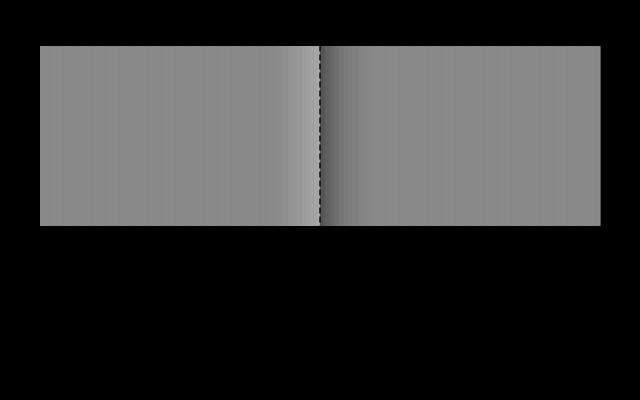
The Cornsweet effect makes two identical regions look different by altering nothing except a narrow band at the boundary between them. Cover the boundary and the difference vanishes, which says the visual system is reconstructing surfaces rather than reading off intensities.
Brightness is inferred from edges
The Cornsweet effect makes two identical regions look different by altering nothing except a narrow band at the boundary between them. Cover the boundary and the difference vanishes, which says the visual system is reconstructing surfaces rather than reading off intensities.
What this makes readable
Essays that name this one as a prerequisite.
Named alongside this one
Essays reaching for the same objects. Nobody chose these; they are what the index of named objects makes visible.
- A patch is not a scene ciecam16 · colour appearance · lightness · simultaneous contrast · viewing condition
- The cones an appearance model uses chromatic adaptation · ciecam16 · colour appearance · corresponding colours · viewing condition
- There is no brown light ciecam16 · colour appearance · lightness · simultaneous contrast · viewing condition
- A delivery tolerance is three tolerances ciecam16 · colour difference · tolerance · viewing condition
- A gain has a time constant chromatic adaptation · ciecam16 · colour appearance · viewing condition
- A name moves with the room chromatic adaptation · ciecam16 · colour appearance · viewing condition
What links here
Every essay whose body links to this one.
The objects this essay names
Each one links to every other essay that touches it.
Chromatic adaptationCIECAM16Colour appearanceColour differenceCorresponding coloursCrispeningLightnessModelling assumptionSimultaneous contrastToleranceViewing condition