Simultaneous contrast — where it appears
Named by 6 essays across 2 fields — each of them below, with the objects they name alongside it.

These two patches are identical
It is the most repeated and least checkable sentence in visual perception, because the whole point is that it does not look true. Every instance here is computed, and checked before the figure is drawn.
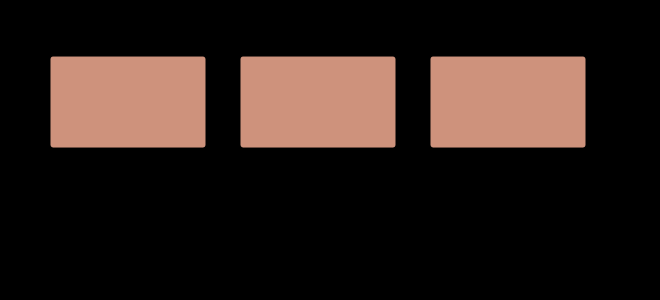
A patch is not a scene
A paint chip is the wrong size, on the wrong background, at the wrong luminance, in the wrong surround. Every one of those is a term in an appearance model, and the model says how much each of them moves the answer — which is the difference between a caution and a prediction.
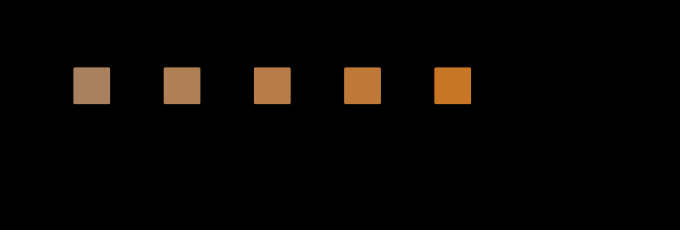
There is no brown light
Brown is dark orange, dark is a ratio to a white, and a light in a dark room has no white to be dark against. The same stimulus, unchanged in XYZ, runs from lightness 152 to lightness 16 as the surround is raised — and only the bottom of that range has a name.
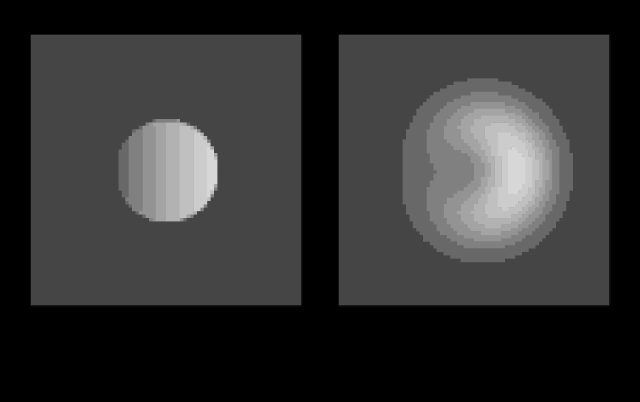
A pool with an edge
A Gaussian pool says how much of a stabilised image survives and can say nothing about what the remainder looks like, because a Gaussian has no edge. Give the pool a boundary and the interior of a faded region takes the average of its own border — exactly, by the mean value theorem, arriving as a prediction about appearance.

A dark background moves every difference and no match
CIECAM16's background is one number, and it reaches lightness as one exponent. That is enough to change what a grey looks like and not enough to change which of two greys is lighter — so a match survives the background exactly, a corresponding colour is invariant to it, and a tolerance is not. The effect the background is usually invoked to explain is absent from the model entirely.

The cancellation is exact and cheap to lose
CIECAM16 has no crispening, and adding one was expected to be expensive: the background's exactness in a corresponding colour comes from its being a common exponent, and a function of the sample's own level is not one. It is expensive in kind and not in size. A term that raises a straddling pair's lightness difference by half moves a corresponding colour by five thousandths of a tristimulus unit — a thousandth of what stating the background differently at the two ends already costs.
Named alongside it
The objects these essays reach for when they reach for this one.
Colour appearanceLightnessCIECAM16Viewing conditionSurroundAssertionColour constancyColour differenceCorresponding coloursCrispeningLuminanceModelling assumption