A gain has a time constant
Assumes An afterimage is an adaptation and The model has no clock.
The phase before this one built two things and left them in different files. One changes three receptor gains and has no time in it; the other has a time course and no place in it. Its own closing note said they came from one mechanism, and did not join them.
Joining them is worth more than tidiness. It removes a parameter that was free, it reproduces both halves exactly, and it predicts an effect neither half could state.
The model, in three sentences
Each cone class carries a running average of what it has been receiving, and its gain is the reciprocal of that average — von Kries, one of the four ways this site computes a white-point move and the one it has used since its foundation.
The average has a time constant. It relaxes toward whatever is arriving as a two-exponential: about one second for the fast component and about a minute for the slow, split roughly two-thirds to the fast. Those constants are the clock essay’s, imported rather than restated, so a revision there moves every number here.
There are two averages, not one. A local pool is driven by the light falling on that piece of retina; a global pool by the average over the whole field. The gain a point applies is a weighted combination of the two.
That is the whole of it. Everything below is arithmetic on those three sentences.
What it removes
afterimage takes a strength argument, with a docstring saying plainly that it is a parameter rather than a prediction: how completely a receptor adapts depends on how long the fixation was and how bright the patch was, and neither was in the model.
In this model it is not free. An afterimage is the state in which the local pool has adapted to the patch and the global pool has not, so the gain change is exactly the local share of a full von Kries change — one quoted number, doing two jobs.
assertTheAfterimageIsTheLocalPool requires the two files to agree at the moment the patch is removed, to ten decimal places, with the local share standing in for the strength. They do.
And a second thing that was not free either: how long the afterimage lasts. Tracking the two exponential components separately makes the dwell — how long the observer stared — a real argument, because a pool driven for one second has its fast component loaded and its slow one barely started. What is left afterwards is not a scaled copy of the fully-loaded case; it is a different mixture, weighted toward the component that goes quickly.
| stare | at the instant | after 5 s | after 30 s |
|---|---|---|---|
| 1 s | 11.60 | 1.47 | 0.88 |
| 5 s | 13.98 | 3.16 | 2.27 |
| 20 s | 14.57 | 5.90 | 4.63 |
| 60 s | 15.52 | 8.60 | 6.99 |
| 5 min | 16.73 | 10.46 | 8.66 |
A glance and a long stare produce afterimages of nearly the same strength — 11.6 against 16.7 CAM16-UCS units — and of very different durations: after thirty seconds the glance has left 0.88 units and the stare has left 8.66, a factor of ten. That is the ordinary observation, and it is a consequence here rather than an input.
Reading the table by ratio rather than by row makes the mechanism explicit, and gives the sentence the effect is worth remembering by.
| stare | strength, as a share of the longest | what survives 30 s, as a share of its own strength |
|---|---|---|
| 1 s | 69.3% | 7.6% |
| 5 s | 83.6% | 16.2% |
| 20 s | 87.1% | 31.8% |
| 60 s | 92.8% | 45.0% |
| 5 min | 100% | 51.8% |
Dwell buys duration, not depth. Across a three-hundred-fold range of staring the strength at the instant of looking away moves by a factor of 1.44 and the residue at thirty seconds by a factor of 9.8. The left-hand column is nearly flat because the fast component is fully loaded within a second or two and it carries two thirds of the change; the right-hand column runs from a fourteenth to a half because the slow component is what is still there half a minute later, and only a long stare loads it.
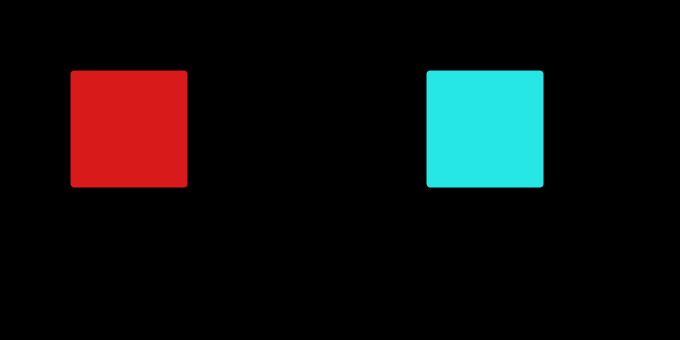
That is worth knowing before running the demonstration everybody runs. Stare at this red square for thirty seconds, then look at the wall is an instruction calibrated for persistence — long enough for the afterimage to still be there while the observer reorients and reports. A two-second glance produces most of the same event and it is gone before anybody has described it, which is why the effect has a reputation for needing patience it does not actually need.
It also says which experiments can be trusted about which quantity. A study reporting afterimage strength is measuring something nearly independent of its own fixation protocol, so a discrepancy in dwell between two laboratories costs it little. A study reporting duration is measuring the slow pool’s loading almost directly, and there the protocol is the measurement — two laboratories differing between a five-second and a sixty-second adapting period are reporting numbers a factor of three apart about the same eye.

The control, and it is an exact one
A change that moves the whole field moves both pools together. Every piece of retina is then in the same state, and a model with two pools must give the same answer as a model with one.
assertTheLightChangeIsNotLocal requires exactly that: an illuminant change computed with the local share at zero and at one gives identical shifts, to 10⁻⁹, at every time. So the second pool has been added without disturbing anything the site already said.
And the second control is between two constructions that share nothing but the time constants. The clock essay interpolates the white point a partly-adapted observer works from and hands it to CIECAM16. This file interpolates three receptor gains and hands the result to the same model with the settled white. They are not the same computation, and they agree:
| time | gains construction | white-point construction |
|---|---|---|
| 0.5 s | 3.70 | 3.58 |
| 1 | 3.26 | 3.15 |
| 2 | 2.74 | 2.65 |
| 5 | 2.35 | 2.28 |
| 10 | 2.22 | 2.15 |
| 60 | 1.35 | 1.31 |
Three and a third per cent apart at every point, which is a real check rather than a tautology. A factor’s worth of disagreement would mean one of the two is wrong.
And the three per cent is a scale rather than a drift, which is what makes it informative instead of merely small. Taking the ratio row by row: 1.0335, 1.0349, 1.0340, 1.0307, 1.0326, 1.0305 — a mean of 1.0327 with a spread of 0.42 per cent across a transient in which the quantity itself falls by a factor of nearly three.
A disagreement that grew with time would implicate the clock, which the two constructions share and which would then be being applied differently. A disagreement that is the same multiple at half a second and at a minute cannot be about the clock at all; it is about the path. One construction moves three receptor gains from the old state to the new and the other moves the white the gains are computed from, and interpolating a quantity is not the same as interpolating its reciprocal — the two routes leave from the same point, arrive at the same point, and take slightly different lines between, by a factor that does not depend on how far along either has got.
Which also says what would close it. The two would agree exactly, rather than to three per cent, if both interpolated the same object; the choice of which is the right one is a question about receptors rather than about arithmetic, and neither file makes a case for its own. The gains construction is the one with a mechanism behind it — a receptor pool has a running average and a white point does not — so the three per cent is the white-point route’s error, on the argument that the site has for preferring one and not on any measurement.
The prediction
Two observers stand in one room. One has been looking at a saturated red poster and one at the wall beside it. The light changes for both of them at the same instant, and both look at the same test patch.
Their global pools are identical — same room, same change. Their local pools are not, because they were driven by different things. So for the first seconds the same patch has two appearances:
| time since the change | difference between the two observers |
|---|---|
| 0 s | 14.75 CAM16-UCS units |
| 0.5 | 12.21 |
| 2 | 7.72 |
| 10 | 5.17 |
| 60 | 3.27 |
| 300 | 0.27 |
Fourteen and a half units is enormous — a viewing condition is an argument, and this is a difference with the argument held fixed — — three times the gap between a print in a booth and a proof on a screen, which is a difference somebody pays money to remove. And after a minute there are still three units of it left.
No appearance model in use has an argument for this. The stimulus is the same, the viewing conditions are the same, the illuminant is the same, and the two observers disagree — because of where each of them happened to be looking a moment earlier.

And one with no change of light at all
The same machinery produces a smaller and more familiar effect with nothing changing but the direction of gaze.
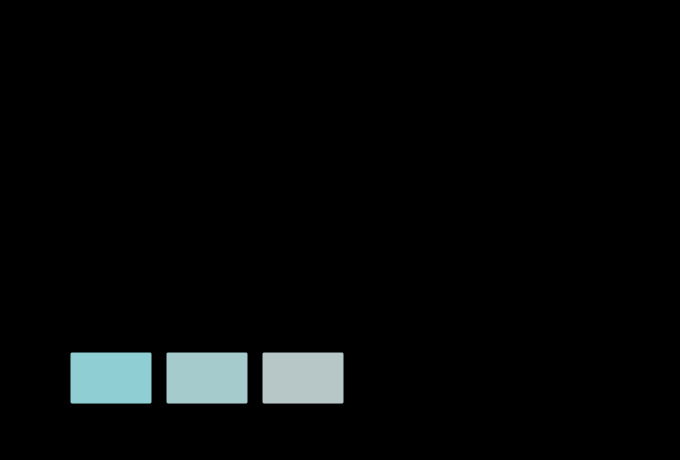
Look at a saturated blue poster for twenty seconds, then look at the wall. Nothing about the light, the room or the stimulus has changed. The wall is 8.79 CAM16-UCS units from where it settles, it is still 5.04 units away after five seconds, and 3.36 after a minute.
CIECAM16 has no argument for this either, and for a sharper reason than the last one: its inputs are a stimulus and a viewing condition, both of which are constant throughout. A model whose inputs do not change cannot produce an output that does.
The everyday version is unremarkable and is usually filed under afterimages — but it is not an afterimage in the demonstration sense. There is no shape, no negative copy of anything, and nothing to see except that a white wall is briefly the wrong colour.
What was computed, and how
The two pools relax identically and are driven differently. Both carry the same two-exponential; what differs is what each is relaxing toward. That one asymmetry produces everything: a change that moves both drives together is an ordinary illuminant adaptation, and a change that moves only the local drive is an afterimage.
The gains are pooled, not the pools. Each pool computes a gain and the gains are combined. That is not the same arithmetic as averaging the two pools and taking one gain of the average, and the difference is not cosmetic — only this one reduces to afterimage with its strength set to the local share, which is what makes that function’s free parameter a consequence here rather than a second thing to choose. The first version pooled the averages instead and disagreed with the existing file by a fifth.
Both drives are put at a common luminance before the ratio is taken, for the reason afterimage’s docstring records: a gain is a statement about the balance of what a class has been receiving, and leaving the two at their own luminances makes it a statement about the exposure as well — which produced gains in the hundreds the first time the afterimage was written.
And the local share is one quoted number with a range. Reported between 0.3 and 0.7 by experiments that adapt one eye and test the other, or one part of the field and test another. The afterimage’s strength and the two-observer gap are both proportional to it; the settled state after a light change does not depend on it at all.
Where the model stops
No response compression. The gains are ratios, and a large ratio predicts a chroma no display can show, exactly as afterimage does. Every claim made from this file is about direction, time course and relative size.
The pools have no shape. Local means at this point of the retina and global means over the field, with nothing in between and no falloff — a real adaptation pool has an extent, and the boundary between local and global is a distance rather than a switch. The visual field has a geometry and none of it is here.
And nothing is bounded. A pool driven by a very dark or very saturated patch produces a gain the model applies without limit, and a real receptor saturates — which is the compression brightness is not luminance is about, in a place this file has none of it.
The relaxation is assumed to be the drive’s own two-exponential run backwards. A pool that has been loaded for a second and one that has been loaded for five minutes are both let go with the same pair of constants, which is what makes the surviving-fraction column above a statement about loading rather than about decay. Whether recovery is symmetric with adaptation is a measurement, it is reported not to be in the extreme cases, and nothing here would notice.
The dwell is a single number. It stands for a steady fixation of a stated duration, and a real observer’s eye is never still: the local drive during twenty seconds of looking at a poster is an average over microsaccades and drift, not a constant.
The generalisation
The sentence worth carrying: an appearance model’s inputs are a stimulus and a room, and an observer is neither.
Every quantity CIECAM16 takes is a property of the scene. What this file adds is a state — three numbers that depend on the observer’s own recent history and on nothing in the scene at all — and once a state exists, two observers in identical conditions can disagree, which is a possibility the model’s signature excludes.
The surprising connection is with colour constancy. Constancy is usually described as the visual system discounting the illuminant, and the discount is computed from the scene: a grey world, a bright patch, an estimate. The mechanism here discounts something else — what this piece of retina has been receiving — and it produces constancy for a global change and an error for a local one. The same machinery that makes a room’s illuminant invisible makes a poster’s colour contaminate the wall beside it, and neither behaviour is chosen.
Who found it, and when
Von Kries proposed independent receptor gains in 1902, and every chromatic adaptation transform in use is a variant of it. That the gain has a time constant is not in the proposal and has never been added to a standard.
The two-component time course has been measured repeatedly since the 1960s, in both psychophysics and single-cell recording, and the fast component is receptoral while the slow one is at least partly cortical — which is where the local–global split comes from.
And the local–global distinction is measured by dichoptic experiments: adapt one eye, test the other, and the fraction that transfers is the global share. Reported between a third and two thirds, which is the range this file’s single quoted number carries.
What has not changed is the standard. CIECAM16 takes an adapting white and a luminance; there is no field for how long the observer has been there and no field at all for where they were looking.
What the pictures cannot show
They cannot run. Every trace on this page is a curve and every swatch is a moment, and the claim is about something that changes over seconds. A reader can stage the gaze-shift experiment with any saturated object in the room; the two-observer prediction needs a light change and a second person and cannot be staged from a page at all.
And the swatches are ceilings. With no response compression, the predicted chroma of an afterimage is larger than anybody reports. The swatches are drawn at the field’s own luminance and marked where they leave the display’s gamut, which is the honest form of a prediction the model overshoots.
Where the ladder goes next
The nearest unfinished piece is the pool’s extent. Local and global are a switch, and the real quantity is a falloff with distance across the retina — which would turn the two-observer prediction into a map, saying how the disagreement depends on how far the test patch is from where each observer had been looking.
The second is the join to bleaching. The pigment density itself changes with light level on a timescale of tens of seconds, which is a third gain with a third time constant, sitting upstream of both pools here. Three mechanisms, three clocks, and this file has one of them.
Where this goes next
 An afterimage is an adaptation
The demonstration everybody gives is an inverted image, which is a statement about a file format. Running the receptoral arithmetic instead puts the afterimage of a saturated red sixty degrees of hue away from the inverse — and outside what any display can show.
An afterimage is an adaptation
The demonstration everybody gives is an inverted image, which is a statement about a file format. Running the receptoral arithmetic instead puts the afterimage of a saturated red sixty degrees of hue away from the inverse — and outside what any display can show.
 The model has no clock
An appearance model takes a stimulus and a situation and returns what it looks like. It does not take a time, and adaptation is not instantaneous — half a second after the light changes a judgement is three and a half CAM16-UCS units from the settled one, and a minute later it is still 1.3.
The model has no clock
An appearance model takes a stimulus and a situation and returns what it looks like. It does not take a time, and adaptation is not instantaneous — half a second after the light changes a judgement is three and a half CAM16-UCS units from the settled one, and a minute later it is still 1.3.
 Four ways to move a white point
Every chromatic adaptation transform is the same three lines with a different matrix. The matrices disagree by more than any tolerance a supplier is held to, and the oldest one — still shipping, still called von Kries — is not a cone basis at all.
Four ways to move a white point
Every chromatic adaptation transform is the same three lines with a different matrix. The matrices disagree by more than any tolerance a supplier is held to, and the oldest one — still shipping, still called von Kries — is not a cone basis at all.
What this makes readable
Essays that name this one as a prerequisite.
Named alongside this one
Essays reaching for the same objects. Nobody chose these; they are what the index of named objects makes visible.
- A room with two lights has no white adaptation · chromatic adaptation · ciecam16 · colour appearance · colour constancy · viewing condition · white point
- A display in a room is a smaller display adaptation · ciecam16 · colour appearance · surround · viewing condition · white point
- The cones an appearance model uses cat16 · chromatic adaptation · ciecam16 · colour appearance · viewing condition · the von kries transform
- What no adaptation can remove adaptation · cat16 · chromatic adaptation · colour constancy · the von kries transform · white point
- A corner moves both terms chromatic adaptation · ciecam16 · colour constancy · viewing condition · the von kries transform
- A gain needs a basis adaptation · cat16 · chromatic adaptation · the von kries transform · white point
What links here
The 8 essays that link to this one and share the most of its objects, of 15 that link here.
The objects this essay names
Each one links to every other essay that touches it.
AdaptationAfterimageCAT16Chromatic adaptationCIECAM16Colour appearanceColour constancyOpponent processingSurroundViewing conditionThe von Kries transformWhite point