A fading pool has a shape
Assumes What a still eye stops seeing and A pattern has a direction.
The local adaptation pool is the one free parameter in this site’s account of what a stabilised image loses. It is a Gaussian half a degree across — the extent chosen so that an afterimage and a fading disc share one clock — it cannot see anything above about a third of a cycle per degree, and giving it that extent produced filling-in without being asked for: the interior of a stabilised disc settles to a quarter of a per cent of the step it arrived with while its border keeps ninety-eight per cent of its gradient.
It is a circle, and nothing said it had to be. Giving it two axes costs one parameter and produces a prediction the circular version cannot make.

The claim
An elongated pool predicts that a stabilised pattern fades at a rate depending on its orientation, and the prediction is separable from the visual system’s existing anisotropy by frequency and by time.
- At the first instant orientation does not matter at all — the spread across orientations is 1.000000, because the filter carrying the pattern has no orientation preference at this frequency.
- After a minute the ratio is ×1.68, and after five minutes ×2.09, between the orientation that survives best and the one that survives worst.
- A round pool predicts none of it, to floating point, which is what makes this a test rather than a description.
- The oblique effect cannot be confused with it. At a third of a cycle per degree the filter’s orientation dependence is exactly ×1.0000; at twenty-four cycles per degree the pool’s is exactly ×1.0000, and the two peak an octave and a half apart.
- And the axis is an input, not a result. Rotating the pool rotates every conclusion by the same angle and changes nothing else.
The pool, given an axis
The change is one line of arithmetic. The pool’s transfer function is a Gaussian in spatial frequency; making it elliptical means two standard deviations rather than one, and the transfer becomes a function of orientation as well as of frequency.
The area is held fixed. The elongated pool has the same σ² as the circular one, so raising the aspect ratio redistributes the pool’s extent rather than adding to it — the alternative would make an anisotropic pool a bigger pool, and every difference downstream would then be its size rather than its shape.

The prediction follows immediately. A grating whose modulation runs along the pool’s short axis is one the pool can follow, so the pool cancels it and it fades; a grating whose modulation runs along the long axis is one the pool averages away without seeing, so it survives. At a third of a cycle per degree the two differ by a factor of 1.68 after a minute.
The objection, and why it fails
The obvious objection arrives before the prediction is finished. The visual system is already anisotropic: gratings at forty-five degrees are harder to see than gratings at horizontal or vertical, an effect known since the 1950s and computed on this site from the plane model. Any orientation dependence found in a fading experiment would be that, and nothing new.
It would not, and the reason is that the two act in bands that do not overlap.

The numbers are as clean as they could be. At a third of a cycle per degree the pool’s orientation dependence is ×1.68 and the filter’s is ×1.0000. At twenty-four cycles per degree the filter’s is ×2.00 and the pool’s is ×1.0000. There is a band between about two and four cycles per degree where neither acts at all.
So an experiment at a third of a cycle per degree measures the pool’s shape with the oblique effect contributing nothing whatever — not little, nothing — and one at twenty-four measures the oblique effect with the pool contributing nothing.
The second separation, which is time
Frequency is one axis of separation and there is another, which is better still because it needs only one stimulus.
The oblique effect is present from the moment the stimulus is. It belongs to the filter carrying the signal, so it is there at the first frame and never changes. The pool’s anisotropy is not: it is a property of the adapted state, so it is zero at the first instant and grows.
The measured trace is 1.000 at the first instant, ×1.37 at five seconds, ×1.43 at fifteen, ×1.52 at thirty, ×1.68 at sixty and ×2.09 at five minutes. Nothing about the stimulus has changed across that trace. The observer has.
That gives an experiment with an internal control. Present a stabilised grating at a third of a cycle per degree at several orientations, measure the time to disappearance, and the orientation dependence at the first instant is the baseline for the orientation dependence a minute later. Any anisotropy present in both is a filter effect; any anisotropy that grows is this.
The axis is an input
The model does not say which way a pool should be elongated, and this has to be said plainly rather than left implicit in a figure that draws it horizontal.
Rotating the pool by thirty degrees moves the orientation that fades first by exactly thirty degrees and changes the size of the effect not at all — ×1.6824 either way. That is the definition of a parameter the model does not determine, and it is asserted so that a reader meeting a horizontal axis in a figure does not take it for a finding.

Two more orientations of the same pool say that the effect follows the pool rather than the pattern, which is what the argument turns on.


If the effect exists, then measuring it measures the axis, which is the useful part. An experiment of the shape above would return not just whether the pool has a shape but which way it points — and whether the answer is the same at different points on the retina, which nothing here predicts either — any more than it predicts the gradient Troxler reported.
The aspect ratio, swept
The one new number is the aspect ratio, and the honest thing to do with a free number is to show what it decides.

Across that range every conclusion survives. The effect stays above ×1.2, the ordering of orientations is unchanged, and the frequency separation from the oblique effect is untouched because it depends on the pool’s extent rather than on its shape.
What a measurement would return
The sweep says the aspect ratio decides the size of the effect. What it does not say is that the relation is simple enough to invert, and inverting it turns the prediction from something to confirm into something to measure.
Across the whole range this site permits the anisotropy at a minute is linear in the aspect ratio to within one per cent: 1.0945 times the aspect ratio, less 0.0741, from 1.2 to 2.4. Nothing was arranged to make that true. The pool’s transfer is an exponential of a quadratic and the ratio of two of them has no business coming out straight; over this range it does, and the residual never exceeds a hundredth.
So an experiment returns a number rather than a verdict. A measured ratio of ×1.4 implies a pool elongated 1.35 to one; ×1.7 implies 1.62; ×2.0 implies 1.90. With the axis, which the same experiment supplies as the orientation that fades first, that is the whole of the shape — two numbers, out of one stimulus presented at several angles.
Where in frequency to look, and when
A third of a cycle per degree has been carried through this essay as the frequency where the pool acts and the filter does not. That is true and it is not the whole reason.
It is also the maximum. Swept in hundredths of a cycle per degree from 0.05 to 1.0, the pool’s anisotropy peaks at exactly 0.30, at ×1.682, and falls away on both sides — ×1.26 at a tenth of a cycle per degree and ×1.04 at one. The effect is band-pass rather than low-pass, because a pattern too coarse for the pool to resolve at all is one the pool cancels whichever way its bars run.
The usable window is where the prediction keeps at least half its peak, and that runs from 0.125 to 0.59 cycles per degree — bars between one and three quarters and eight degrees wide. Outside it the effect is still there and is small enough to lose in the scatter of a fading experiment.
The dead band is wider than stated as well. The pool’s anisotropy is 1.000004 at two cycles per degree and exactly one above it, and the filter’s is exactly one until somewhere between four and five and a half. So there is a stretch two and a half to one wide — two to five cycles per degree — where a stabilised grating should show no orientation dependence whatever, from either mechanism, at any time. That is a cheaper control than either of the two the essay already has, because a null is easier to measure than a ratio.
The separation in time is real and its window is shorter than the trace makes it look. The anisotropy is exactly one at the first instant and already ×1.16 after one second — a fifth of its eventual size in logarithm — two fifths of it by five seconds, and seven tenths by a minute. So the baseline the experiment turns on, the orientation dependence before any adaptation, has to be caught inside the first second or it is not a baseline. That is a demand on the apparatus rather than on the observer: a stabiliser that takes a second to lock has destroyed its own control before the first reading.
What it would look like to somebody
The arithmetic gives a ratio of visibilities, which is not what an observer in a stabilising apparatus reports. What they report is a time — the pattern was there, and then it was not.
Converted into times, the prediction is that a grating whose bars run along the pool’s long axis stays visible substantially longer than the same grating turned ninety degrees. At the contrast this site uses for stabilised patterns, that is a difference of tens of seconds rather than of seconds, which is comfortably within what a person can report and comfortably outside what a careless experiment would notice.
The stimulus is awkward and that is worth admitting. A third of a cycle per degree is a very coarse grating — bars three degrees wide — so a patch large enough to hold several cycles covers a good part of the central field, and stabilising a patch that size is harder than stabilising a small one. It is also exactly the regime where a still eye loses the fill and keeps the outline, so the thing being timed is the disappearance of the interior rather than of the whole pattern.
None of that makes the experiment impossible. It makes it a different experiment from the ones in the literature, which mostly used small high-contrast targets, and that is one reason an effect of this size could have gone unreported.
Why the eye normally never finds out
There is a reason none of this is part of ordinary experience, and it is the same reason the whole fading phenomenon needs an apparatus: the eye is never still.
A drifting retinal image modulates each pool’s input at the drift speed times the pattern’s frequency, and a pool with a time constant of a minute cannot follow that at all. At the measured drift speed the fast pool still tracks a coarse pattern at ninety-five per cent while the slow one has lost it to five — so in an unstabilised eye the slow pool, which is the one that would produce this anisotropy, never adapts to anything.
The consequence is that the pool’s shape is invisible outside a laboratory by construction. It is not a small effect that ordinary viewing masks; it is an effect that ordinary viewing prevents from arising, which is a different claim and a stronger one.
What the chromatic channels do, and why it matters that they do the same thing
There is one more prediction in the model and it is a null one, which is the kind this site tries hardest to state plainly.
The pool acts on each channel separately and the same way. Its transfer function has no channel in it — only a frequency, an orientation and an extent — so the orientation dependence computed above is identical for the achromatic channel and for both chromatic ones, to floating point. The three channels differ in what they can resolve and in what their thresholds are; they do not differ in how the pool’s shape treats them.
That matters for the experiment because it is a prediction that can fail cheaply. Running the same stabilisation at a third of a cycle per degree with an isoluminant grating instead of a luminance one should give the same orientation ratio and a different absolute fade time. If it gives a different ratio, the pool is not one mechanism applied three times, and the model in this file is wrong in a way no adjustment of its two parameters can repair.
It also sits beside a null result the site already carries. The fading machinery gives no order between the channels either — what survives a stabilisation is an edge, all three channels resolve an edge, and the residual at a given frequency is identical for each. Colour is reported to go first in a stabilised image, and the reason is not in this file; it would need thresholds in commensurable units, which the spatial model says plainly it does not have.
Two nulls from one mechanism is worth more than one. A model that predicted a channel order and a channel-dependent anisotropy would be doing a great deal of work with two parameters, and it should be suspected. This one predicts neither, says so in its own assertions, and offers one thing that can be measured.
Forty-five degrees is the orientation halfway between the two the essay reports, and it is the check that the effect turns smoothly rather than switching.

Who found it, and when
Stabilised-image fading is Riggs, Ratliff, Cornsweet and Cornsweet’s, from 1953, and Yarbus’s independently. That a stabilised image loses its interior and keeps its edges was reported almost immediately and is the observation the pool’s extent was introduced to produce.
Orientation dependence in fading does not appear to have been reported. That is weak evidence against it — the experiments are difficult, few laboratories have run them since the 1960s, and an effect of ×1.7 in time-to-disappearance would be within the scatter of a small study that was not looking for it. The same is true of the channel ordering nobody has settled either.
The oblique effect is Appelle’s review name for observations going back to the 1920s, and its frequency dependence — absent at low frequencies, growing above about four cycles per degree — is well established. It is the same measurement the plane model recovers from the site’s own contrast sensitivity data. That dependence is what makes the separation in this essay possible, and it was not chosen for the purpose.
A more elongated pool at the same area is the stronger version of the same hypothesis, and the area is held fixed so only the shape is being varied.

What was computed, and how
The elliptical pool has standard deviations σ√a and σ/√a for aspect ratio a, so σₓσᵧ = σ² and the area is fixed. Its transfer is the two-dimensional Gaussian’s, evaluated at the grating’s frequency and orientation.
Visibility is the residual contrast multiplied by the two-dimensional filter’s sensitivity at that frequency and orientation, so the oblique effect is in every number whether or not the pool is round. The separation reported above is obtained by computing the filter’s orientation dependence with the pool switched off and the pool’s with the filter’s divided out.
The adaptation clock is the one the afterimage machinery already runs on, which is the appearance model’s own tabulated time constants, so nothing here introduces a new time constant. The gate requires the anisotropy to be exactly one at the first instant, to exceed 1.5 after a minute, and to be exactly one for a round pool — three assertions that between them make the claim falsifiable rather than descriptive.
Where it stops
There is no evidence that the pool is elongated. This is a prediction from a model with a parameter added, and the parameter was added because it was available and because it produces something testable — not because anything measured requires it.
The pool remains a linear filter on a scalar per channel, and it gives no order between the channels: the residual at a given frequency is identical for the achromatic and the two chromatic channels, and the anisotropy computed here is identical for them too. Whatever makes colour go first in a stabilised image is still not in this file.
And the earlier refutation stands. Scaling the pool with cortical magnification makes it larger off axis, a larger pool cancels less of a fixed stimulus, and the model therefore predicts weaker fading in the periphery where more is observed. Adding a shape does nothing about that; the pool is still not simply a receptive field.
Where the ladder goes next
The experiment is the obvious next thing and it is not one this site can run. What this site can do is say precisely what would count: an orientation dependence that is absent at the first instant, grows over a minute, is present at a third of a cycle per degree and absent at twenty-four, and points the same way for one observer across sessions.
The other direction is the boundary. A Gaussian pool says how much of a stabilised shape is left; it says nothing about what the remainder looks like, because a Gaussian has no edge. A pool with a boundary rather than a falloff is what would be needed before anything could be said about the shape a filled-in region takes, and that is a different parameter and a different essay.
Where this goes next
 What a still eye stops seeing
A stabilised image is said to vanish, and nothing in a temporal filter predicts it — sensitivity at zero frequency is a quarter of the peak, not nothing. Give the adaptation gain a size and the answer falls out — fading is a high-pass filter that switches on over a minute, it takes the fill and leaves the outline, and a patch has to be about two degrees across before it goes at all.
What a still eye stops seeing
A stabilised image is said to vanish, and nothing in a temporal filter predicts it — sensitivity at zero frequency is a quarter of the peak, not nothing. Give the adaptation gain a size and the answer falls out — fading is a high-pass filter that switches on over a minute, it takes the fill and leaves the outline, and a patch has to be about two degrees across before it goes at all.
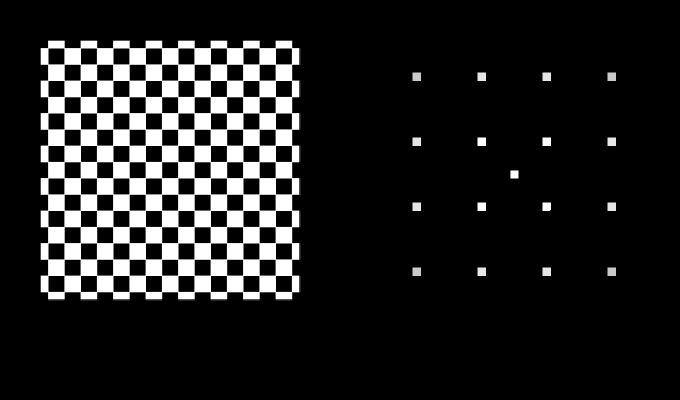 A pattern has a direction
Every spatial claim here is a claim about a frequency, and a frequency has no direction in it. Turning a printed screen forty-five degrees makes it exactly twice as quiet with nothing else changed — and the same rotation does nothing at all to a chromatic one.
A pattern has a direction
Every spatial claim here is a claim about a frequency, and a frequency has no direction in it. Turning a printed screen forty-five degrees makes it exactly twice as quiet with nothing else changed — and the same rotation does nothing at all to a chromatic one.
 The eye is never still
A perfectly stabilised retinal image disappears within seconds. What keeps the world there is a drift of about half a degree a second between the microsaccades — fast enough to keep the finest detail modulating and slow enough not to carry it past fusion, in a band whose upper edge is at 0.71 degrees a second.
The eye is never still
A perfectly stabilised retinal image disappears within seconds. What keeps the world there is a drift of about half a degree a second between the microsaccades — fast enough to keep the finest detail modulating and slow enough not to carry it past fusion, in a band whose upper edge is at 0.71 degrees a second.
What this makes readable
Essays that name this one as a prerequisite.
Named alongside this one
Essays reaching for the same objects. Nobody chose these; they are what the index of named objects makes visible.
- The drift is a luminance mechanism adaptation · assertion · contrast sensitivity · eccentricity · second stage · spatial frequency · temporal sensitivity · threshold
- A halftone is a luminance object contrast sensitivity · eccentricity · orientation · spatial frequency · threshold
- A tint at the edge of a page contrast sensitivity · eccentricity · orientation · spatial frequency · threshold
- The eye has a shutter adaptation · contrast sensitivity · spatial frequency · temporal sensitivity
- The list nobody made assertion · contrast sensitivity · spatial frequency · threshold
- What a second model changed adaptation · assertion · psychophysics · spatial frequency
What links here
Every essay whose body links to this one.
The objects this essay names
Each one links to every other essay that touches it.
AdaptationAfterimageAssertionContrast sensitivityEccentricityOrientationPsychophysicsSecond stageSpatial frequencyTemporal sensitivityThreshold