Concept

Second stage — where it appears

The recombination of cone responses into one achromatic and two chromatic channels, which is where colour vision's resolution is set. Decorrelating the three cone responses gives one broad channel and two narrow ones, which is why fine detail is carried in luminance and colour is not.

Named by 5 essays across 2 fields — each of them below, with the objects they name alongside it.
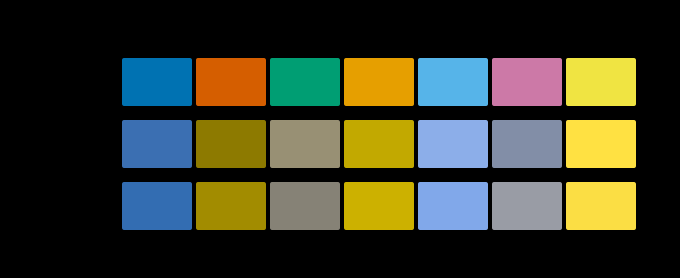
One palette under normal vision and two dichromacies. The same 7 colours simulated by the Brettel–Viénot–Mollon construction at severity 1.0. protanopia and deuteranopia collapse the red-green distinctions. This shows which discriminations survive, not what anybody sees.

Three cones, two axes

The retina does not send three receptor signals down the optic nerve. It sends a sum and two differences, and the reason falls out of the statistics of natural light rather than out of anything the eye intended.
eye · Cones
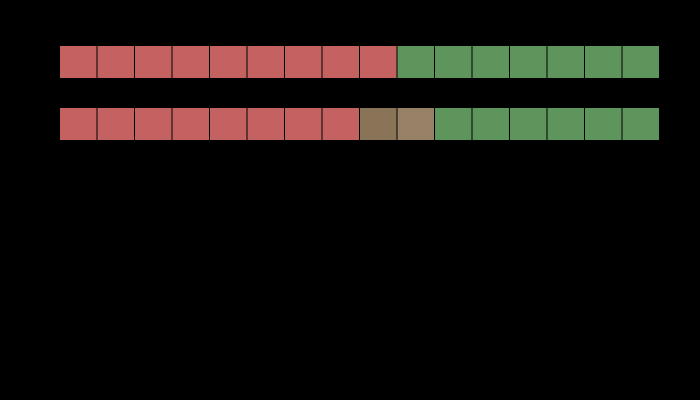
An edge at 4:2:2, and the colour it arrives as. Above, the row as it was sent and as it arrives after the two chroma planes are averaged 2 samples at a time. Below, the colour difference at each sample. The worst is ΔE00 = 25.88, at a luma step of 0.058 across the edge — an edge of nearly equal luminance. Nothing is wrong with the codec: it discards the differences the eye resolves worst, and this edge is made of nothing else.

Colour thrown away on purpose

Every video format in use discards three quarters of its colour information and keeps all of its luminance, because the eye resolves fine colour detail badly. On an edge that carries luminance the loss is exactly zero. On an edge of nearly equal luminance it is a colour difference of forty-three, and the two edges are the same edge to the codec.

applied · Delivery
Contrast sensitivity, three channels, normalised to each channel's peak. Spatial frequency in cycles per degree against relative sensitivity. The luminance channel runs to 50 cycles per degree, red–green to 12 and blue–yellow to 8, each by the same criterion of 5 per cent of that channel's own peak. Only the luminance channel dips at low frequency; the two chromatic ones are low-pass, so a chromatic edge of any size at all is seen at its full contrast.

How fine a colour edge can be

The eye resolves a lightness pattern to about fifty cycles per degree and a red–green one to twelve. Every colour difference here is quoted as though a patch had no size, and the same difference is plainly visible at one scale and gone at another.

eye · Cones
The drift window, asked about each channel in turn. Every spatial frequency a channel can resolve, drifting at v degrees a second, arrives at f × v hertz; the bar is the range of v over which all of them stay above a quarter of that channel's temporal peak. The luminance band is closed at both ends — 0.018 to 0.71 degrees a second — because its temporal sensitivity has a dip at zero to fall into. The chromatic bands have no slow edge at all, because chromatic temporal sensitivity is low-pass: a stationary chromatic pattern sits at the top of its own sensitivity. The mark is the measured drift, and it is inside all three.

The drift is a luminance mechanism

The eye's own drift was shown to sit inside a band of speeds that keeps every spatial frequency modulating, and the band was quoted as though it were about vision. Asked about colour, it has no slow edge at all — a stationary chromatic pattern needs no eye movement whatever. And a stabilised chromatic pattern is the first thing to fade.

eye · Cones
A stabilised grating fades at a rate that depends on which way its bars run. What is left of a 0.3 cycle-per-degree grating, in multiples of its own threshold, as a function of its orientation, at four moments after the image was stabilised on the retina. The first curve is flat to floating point: at the instant the pattern arrives, orientation does not matter, because the filter that carries it has no orientation preference at this frequency. The anisotropy arrives with the fading, reaching ×2.09 after five minutes, and a pool with no axis predicts none of it.

A fading pool has a shape

Giving the local adaptation pool two axes instead of one costs a single parameter and produces a prediction the circular version cannot make — a stabilised grating fades at a rate that depends on which way its bars run. The obvious objection is the oblique effect, and the two act in bands that do not overlap.

eye · Cones

Named alongside it

The objects these essays reach for when they reach for this one.

Opponent processingSpatial frequencyContrast sensitivityAdaptationAssertionEccentricityIndividual variationLuminanceSamplingTemporal sensitivityThresholdAcuity

All concepts