Orientation — where it appears
Named by 7 essays across 4 fields — each of them below, with the objects they name alongside it.
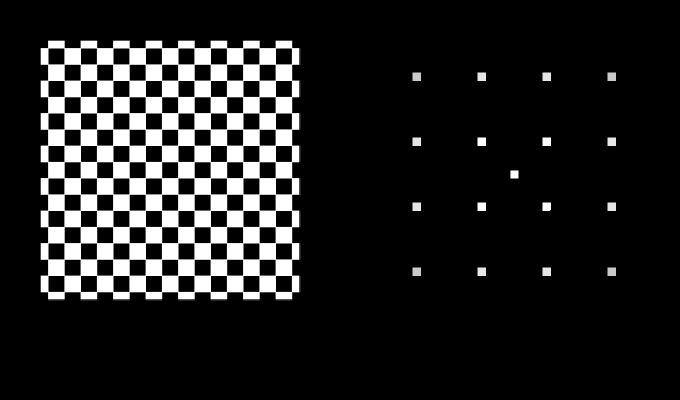
A pattern has a direction
Every spatial claim here is a claim about a frequency, and a frequency has no direction in it. Turning a printed screen forty-five degrees makes it exactly twice as quiet with nothing else changed — and the same rotation does nothing at all to a chromatic one.

The eye is never still
A perfectly stabilised retinal image disappears within seconds. What keeps the world there is a drift of about half a degree a second between the microsaccades — fast enough to keep the finest detail modulating and slow enough not to carry it past fusion, in a band whose upper edge is at 0.71 degrees a second.

A tint at the edge of a page
The last phase left this join open and guessed at its answer — how visible a halftone tint is away from the centre of gaze should be the product of two effects it had measured separately. It is not the product. At five degrees the guess is fifty-three times too generous, and by twenty it is out by eight orders of magnitude.

A halftone is a luminance object
The eye's three spatial channels resolve a screen at 55, 15 and 10 cycles per degree, so at any ruling a press actually runs only one of them can see it at all. The corollary corrects a guess already published here — rotating a screen matters more to the chromatic channels, not less — but only at rulings so coarse that nobody prints there.

A fading pool has a shape
Giving the local adaptation pool two axes instead of one costs a single parameter and produces a prediction the circular version cannot make — a stabilised grating fades at a rate that depends on which way its bars run. The obvious objection is the oblique effect, and the two act in bands that do not overlap.

A tolerance has a grain
A colour tolerance pulled back into tristimulus values is a long thin shape, and across the whole sRGB cube its shortest axis points the same way, fifteen degrees off at the median — the direction in which X rises as Y falls, which is the direction of a*. So what one colour difference allows depends on which way a delivery drifts. An instrument's X filter may age 1.4 per cent before the tolerance is used up, its Z filter 5.1, and the light on the sample 9.3.

A press is charged for the direction it barely moves
A press run varies almost entirely along the direction a colour tolerance forgives. Split along the tolerance's own axes under four stated mixes of press variation, its tightest axis holds about one per cent of the sheet-to-sheet variation and pays a quarter to a third of the price — and on a blue overprint four fifths, for the balance between two inking units rather than the level of either.
Named alongside it
The objects these essays reach for when they reach for this one.
Contrast sensitivitySpatial frequencyEccentricityThresholdHalftoneOpponent processingProcess inksScreen angleViewing distanceAdaptationAfterimageAnisotropy