Concept

Viewing distance — where it appears

How far the reader is from the page, which turns a size in pixels into an angle and decides what any spatial claim means. Every spatial claim on this site is stated in cycles per degree for that reason, since pixels per inch means nothing without it.

Named by 13 essays across 5 fields — each of them below, with the objects they name alongside it.

Contrast sensitivity, three channels, normalised to each channel's peak. Spatial frequency in cycles per degree against relative sensitivity. The luminance channel runs to 50 cycles per degree, red–green to 12 and blue–yellow to 8, each by the same criterion of 5 per cent of that channel's own peak. Only the luminance channel dips at low frequency; the two chromatic ones are low-pass, so a chromatic edge of any size at all is seen at its full contrast.

How fine a colour edge can be

The eye resolves a lightness pattern to about fifty cycles per degree and a red–green one to twelve. Every colour difference here is quoted as though a patch had no size, and the same difference is plainly visible at one scale and gone at another.
eye · Cones
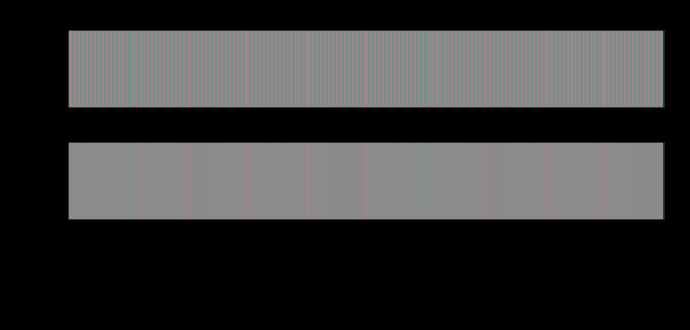
A chromatic line screen at 10.0 cycles per degree. The upper strip is the pattern as delivered and the lower one is the same pattern after each opponent channel has been low-passed at its own cutoff. Against a flat field of the same mean, the delivered pattern differs by up to ΔE00 14.22 and the filtered one by 7.77 — a ratio of 1.8. Every number quoted elsewhere for a difference of this kind is the first one.

A difference has no size

A colour difference formula answers a question about two large patches seen side by side. Applied to a pattern, it reports fourteen units where the eye is left with less than one — and the ratio depends on nothing but how finely the difference is spread.

difference · Metric
A 8-bit ramp from 0.0008 to 0.006 of white, 12° wide. The top strip is the ramp as delivered: 16 distinct levels, each a step of one code value. Below it is the quantisation error as a Weber contrast against the local luminance, filtered by the luminance sensitivity function. The largest response is 8.51 per cent contrast against a threshold of 0.3, which is 28.4 times over — and it occurs at 0.09 per cent of white, at the dark end, because a code step is a Weber contrast and the same step is a larger fraction of less light.

Banding is not a bit depth

Eight bits bands at thirty times threshold in the shadows and at under three at mid grey, on the same ramp with the same encoding. What decides is where in the tone scale the gradient sits, how sharp each step's edge is, and how far away the reader is — and a bit count contains none of the three.
limits · Limits
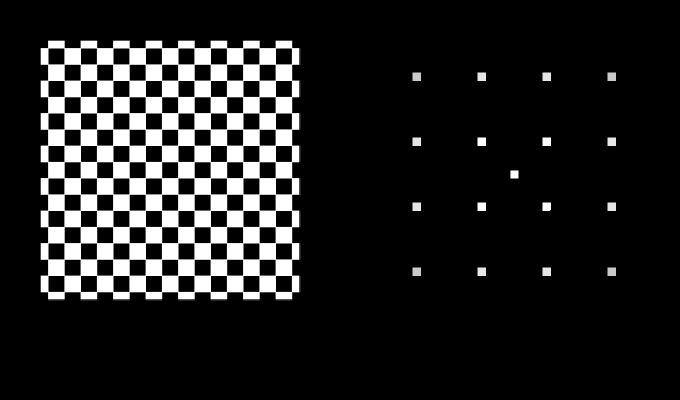
A screen at 45°, 8 c/°, and where its energy sits. Left, the pattern. Right, its power in the frequency plane with the zero frequency at the centre and the edges at the sampling limit of 23 cycles per degree, on a logarithmic scale over five decades. The closed curves are the visual system's own sensitivity at 5, 25, 60 per cent of its peak; they are not circles, because sensitivity is lower on the diagonals than on the cardinal axes by a factor of 2.0 at high frequency. Energy inside a curve is seen; energy outside it is not, whatever its size.

A pattern has a direction

Every spatial claim here is a claim about a frequency, and a frequency has no direction in it. Turning a printed screen forty-five degrees makes it exactly twice as quiet with nothing else changed — and the same rotation does nothing at all to a chromatic one.

eye · Cones
A halftone tint away from the centre of gaze, two ways. The upper curve raises the threshold by the E2 rule and leaves the filter alone, which is the multiplication the last phase guessed at. The lower one also moves the cutoff, because eccentricity magnifies the whole spatial scale — implemented as the substitution that makes it exact, a screen of ruling r seen through a filter whose cutoff has been divided by s being a screen of ruling r·s seen at the fovea. The horizontal line is threshold. The screen is visible where you are looking and gone by 3°, while the product prediction has it visible across the whole page.

A tint at the edge of a page

The last phase left this join open and guessed at its answer — how visible a halftone tint is away from the centre of gaze should be the product of two effects it had measured separately. It is not the product. At five degrees the guess is fifty-three times too generous, and by twenty it is out by eight orders of magnitude.

difference · Metric
Where a pooled gain gives out, against where the eye does. The falling curve is how much of a pattern of each spatial frequency a local adaptation pool of 0.5° can see — and therefore how much of it a settled eye can cancel. It is half gone by 0.37 cycles per degree, which is a feature about 2.7° across. The three marks are the acuity limits of the luminance channel and the two chromatic ones. Every one of them is more than an order of magnitude finer than the pool, which is why a stabilised eye loses the fill of a picture and keeps its outline rather than losing the picture.

What a still eye stops seeing

A stabilised image is said to vanish, and nothing in a temporal filter predicts it — sensitivity at zero frequency is a quarter of the peak, not nothing. Give the adaptation gain a size and the answer falls out — fading is a high-pass filter that switches on over a minute, it takes the fill and leaves the outline, and a patch has to be about two degrees across before it goes at all.

eye · Cones
How fine a screen each channel can see. A halftone screen at 35 per cent coverage, 45 degrees, seen by each of the eye's three spatial channels. The bar is the ruling at which it drops below that channel's own threshold. The luminance channel is still seeing it at 55 cycles per degree; the two chromatic ones have lost it by 15 and 10. The dashed line is an ordinary press ruling at reading distance, and only one channel is above it. A halftone is a luminance object, which is why the ink whose dots are nearly the lightness of the paper is the one nobody worries about.

A halftone is a luminance object

The eye's three spatial channels resolve a screen at 55, 15 and 10 cycles per degree, so at any ruling a press actually runs only one of them can see it at all. The corollary corrects a guess already published here — rotating a screen matters more to the chromatic channels, not less — but only at rulings so coarse that nobody prints there.

difference · Metric
What a halftone measures, against what it looks like. A 50 per cent screen, measured by an aperture that averages the patch and seen by an eye that blurs it first and compresses afterwards. At a coarse ruling the two disagree by ΔE00 11.1, and the patch looks 14.3 lightness units darker than it measures — the average of a concave function is below the function of the average, which is Jensen's inequality and not an illusion. The gap falls under a unit above 30 cycles per degree. That is a viewing distance, and the correction a press applies for dot gain has no distance in it anywhere.

Measured with an aperture, seen with an eye

A spectrophotometer averages a halftone patch and reports one reflectance. An eye blurs it first and compresses afterwards, and the average of a concave function is below the function of the average — so a resolvable screen looks darker than it measures, by fourteen lightness units at a coarse ruling and by nothing at a fine one. The correction a press applies is the same size and has no viewing distance in it.

applied · Delivery
What is read at each distance from the edge of a lit region. Three materials under a half-plane of light, with the boundary at the centre of the horizontal axis and the lit side on the right. The vertical axis is the radiance leaving the surface as a share of what it leaves far inside the lit region. On the unlit side the sample is emitting light while receiving none, so the ratio the model calls a reflectance has a zero denominator there. The distance over which the curve runs from a tenth to nine tenths is 0.21 millimetres on coated paper and 5.1 on pale marble — which is the width of the neighbourhood a point's colour is decided by.

A pixel has an aperture too

A camera photographing a translucent object has the same two discs a spectrophotometer has — one lit, one looked at — and gets them the other way round. Its illumination covers the whole scene, so the flat colour of a translucent surface comes out exactly right at any magnification, and the error moves entirely into the edges.

imaging · Capture
What is read at each distance from the edge of a lit region. Three materials under a half-plane of light, with the boundary at the centre of the horizontal axis and the lit side on the right. The vertical axis is the radiance leaving the surface as a share of what it leaves far inside the lit region. On the unlit side the sample is emitting light while receiving none, so the ratio the model calls a reflectance has a zero denominator there. The distance over which the curve runs from a tenth to nine tenths is 0.21 millimetres on coated paper and 5.1 on pale marble — which is the width of the neighbourhood a point's colour is decided by.

Two blurs before the eye's own

A translucent object arrives at the eye already blurred, by a kernel that is a property of the material rather than of the optics. On every material in this collection's table that blur is coarser at ordinary reading distance than the finest detail the eye can resolve — so the softness of marble or skin or wax is not a failure of vision, it is the object.

eye · Cones
Three stored-value defects, before the eye and after it, a print at 40 cm. Each defect's largest colour difference between the version computed on stored values and the version computed on light, read twice: as a pixel carries it, and after both images have been through the visual system's three channels at 83 pixels a degree. The two rankings are not the same. The unsharp mask has the largest error per pixel — 16.62 — and keeps only 38 per cent of it; the corner has the smallest at 7.14 and comes out at 9.87. The filter is not a blur applied to a difference: it is applied to each image, and the difference is taken after.

The eye keeps the lightness errors

Four essays have priced what a resize taken on stored values costs, in colour differences between pixels. A reader does not see a pixel. Put the two versions of each image through the visual system's own three channels and the ranking reverses: the unsharp mask, the largest error per pixel at 16.6, is seen at 6.3 on a printed page, while the corner's 7.1 is seen at 9.9. What decides it is not the size of an error but how much of it is colour.

applied · Delivery
Where an unsharp mask errs, per pixel and as seen: print, 40 cm. The upper-left corner of a patch of skin against its shadow after an unsharp mask, as two maps of the colour difference between the result taken on stored values and taken on light. Left, pixel by pixel: the corner peaks at 16.8 and the middle of the edge at 16.6. Right, after the eye's three spatial channels at a print at 40 cm: the corner is seen at 17.1 and the edge at 7.1, a ratio of 2.40. Darker is larger, on one scale for both maps.

The eye counts a corner's error, not its peak

A Lanczos-magnified patch errs a fifth more at its corner than along its edges, pixel by pixel, and an unsharp mask errs almost exactly as much at its corner as along its edges. Filtered by the eye over the plane rather than along a line, the two swap: the magnified corner is seen exactly as its edge is, and on a printed page the sharpened corner is seen at 2.4 times its edge. What decides it is whether the error changes sign. Ringing averages away and a one-sided halo does not, and a corner is where two edges' halos land on the same patch of retina.

applied · Delivery
Where a sharpened E errs, per pixel and as seen: black type on paper, 10 point. The letter E at 10 point on a 300-dot-an-inch page, black type on paper, sharpened by an unsharp mask on stored values and on light; the two maps show the colour difference between the results, pixel by pixel on the left and after the eye's three spatial channels at 40 centimetres on the right, on one scale. The thin line is the letter's outline and the dashed circles mark two pixels round each corner — 8 outer corners and stroke ends, 4 inside angles. The circled zones are 31% of the outline and hold 28% of the per-pixel error and 25% of the seen error.

Sharpened type errs on its dark side

A sharpened square hides its halo along its edges and shows it at its corners, so a sharpened page of type was predicted to show its error at the corners of its letters, several times out of proportion to their length. Black type does the opposite: its outer corners and stroke ends hold between two thirds and nine tenths of their share. As the eye leaves it, the error lies on the dark side of every edge, and a corner holds as much of it as it has dark ground around it — a quarter of a disc where a black corner points out into paper, three quarters where black wraps round a pale one.

applied · Delivery

Named alongside it

The objects these essays reach for when they reach for this one.

Contrast sensitivitySpatial frequencyOpponent processingImage differenceHalftoneSamplingΔEProcess inksThresholdDitherEccentricityLightness

All concepts