Process inks — where it appears
Named by 19 essays across 5 fields — each of them below, with the objects they name alongside it.
A halftone is not a mixture
Forty per cent cyan and thirty per cent magenta are not stirred together anywhere. They are laid down as dots, and the sheet is a mosaic of four fully-inked regions in proportions the two coverages fix — which is why the colour is an area average of four spectra rather than a blend of two, and why it lands nowhere near where mixing would put it.

A dot is larger than it was asked to be
Two quite different things make a printed midtone darker than its coverage says — ink spreading under pressure, and light scattering sideways inside the paper. Both bend the tone curve the same way and neither touches its ends, so the measurement every press is characterised by cannot say which happened. A patch that nobody measures can.

Neither gamut contains the other
Converting a picture to CMYK is described everywhere as a reduction, as though the press were a smaller version of the screen. Measured as solids, the press reaches eleven per cent of its volume outside sRGB while sRGB reaches fifty-four per cent of its volume outside the press — and in the cyans the press wins by seventy per cent of chroma.

The fourth ink is not for colour
Black is in every process set and it extends the gamut by more than a third — and at every lightness above about forty it extends the chroma boundary by exactly nothing. What it buys is depth at the bottom, a neutral that holds its hue when the press drifts, and a way to put a full-strength dark on a sheet that could not carry three inks' worth of it.

A brand colour is an ink
A named colour is a jar of pigment with a spectrum, and a four-colour build of it is three inks arranged to integrate to the same three numbers. Of 156 constructed single-pigment inks, 15 can be matched at all — and those fifteen drift by a median of 3.8 colour differences under a tungsten lamp, because the match was never a match.

The fifth ink buys a corner
Orange, green and violet are sold as the answer to a four-colour press's gamut, and each one adds seven to nine per cent of volume. All three together add 23 per cent — almost exactly the sum, with no interaction — and every bit of it lands in the region of the ink that was added, at lightnesses where that ink is dark.
A pattern has a direction
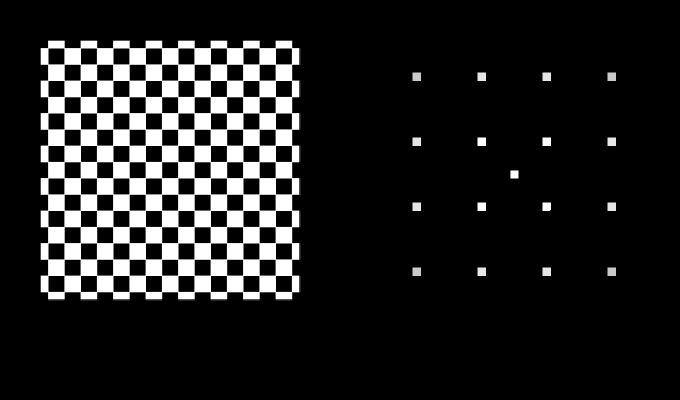
Every spatial claim here is a claim about a frequency, and a frequency has no direction in it. Turning a printed screen forty-five degrees makes it exactly twice as quiet with nothing else changed — and the same rotation does nothing at all to a chromatic one.

A tint at the edge of a page
The last phase left this join open and guessed at its answer — how visible a halftone tint is away from the centre of gaze should be the product of two effects it had measured separately. It is not the product. At five degrees the guess is fifty-three times too generous, and by twenty it is out by eight orders of magnitude.

A halftone is a luminance object
The eye's three spatial channels resolve a screen at 55, 15 and 10 cycles per degree, so at any ruling a press actually runs only one of them can see it at all. The corollary corrects a guess already published here — rotating a screen matters more to the chromatic channels, not less — but only at rulings so coarse that nobody prints there.

Measured with an aperture, seen with an eye
A spectrophotometer averages a halftone patch and reports one reflectance. An eye blurs it first and compresses afterwards, and the average of a concave function is below the function of the average — so a resolvable screen looks darker than it measures, by fourteen lightness units at a coarse ruling and by nothing at a fine one. The correction a press applies is the same size and has no viewing distance in it.

Dividing by the paper
Media-relative colorimetry divides tristimulus values by the substrate's, which is a von Kries adaptation applied in XYZ — the one basis the table here describes as the oldest mistake still shipping. On a paper-mill white it costs a few hundredths of a unit. On a tinted sheet it costs ten times what the same rule costs in a cone basis.

Only one of these devices adapts
An eye, a camera, a display and a press all meet the same changes of light, and each has at most one thing it can do about them. The press has nothing at all, so its column is the whole change; and this collection's sensor built to satisfy the Luther condition exactly is the one that adapts worst.

A profile is a fit between its nodes
A printer profile is a table, exact at every patch that was printed and interpolated everywhere else — and everywhere else is where every job lives. Going from a hundred and thirty-five patches to three and a half thousand is twenty-seven times the work for eight times the accuracy, and the exponents say that is as good as it gets.

A brand colour for a population
A brand colour is chosen once, specified in a number, and seen by everybody. The observer audit says two candidate colours with identical specifications can carry observer spreads differing by an order of magnitude, and that the spread is computable from an ink's spectrum at the moment the ink is chosen.

A profile interpolates light
A profile is exact at its patches and wrong between them, and how wrong has been measured twice. Which way it is wrong has not. At a nine-step lattice the mean signed lightness error between the nodes is +0.136 against a mean colour difference of 0.133 — the error is not a scatter but a bias, and it lightens. The repair costs nothing measured and is forbidden by how a profile is checked: let the table be wrong at its own patches.

The inverse table errs dark
A profile's forward table predicts a print lighter than the press makes, and refitting its nodes removes the bias. The table a colour engine actually uses to separate an image is the other one — the inverse, from colour to ink — and it errs the opposite way: filled exactly from the press it asks for too much ink and prints dark, and built by inverting the ordinary forward table it prints darker still. Inverting the refitted forward table removes the inherited part and leaves the inverse's own. The round trip through both tables improves only when each is refitted against its own error, and then the two are no longer each other's inverse.

A projection has no reason to detour
Holding a gradient inside a press by penalising the excursion turned the gamut's price from a number into a search: on five of ten crossing gradients some starting point leaves the relaxation trapped at more than twice the free length, and the spread across six starts runs to 271 per cent of the free path. Replacing the penalty with a projection — take the free step, then move each point to the nearest printable colour — leaves no trap on any gradient and a spread of 0.06 to 2.4 per cent.

A strategy keeps the refit only where black prints
Refitting an inverse table's nodes against their own error halves it, and in a four-ink table the refit has to leave the separation strategy's choice of black alone. Held to the strategy, it keeps the whole of its gain wherever the strategy prints black and almost none of it where the strategy does not — and the share it keeps equals the share of the grey ramp printed with black, to within three hundredths. The start of black generation, predicted to be where the refit would fail, is where the table needs it least.

A margin costs a press its corners
A gradient held inside a coated press by projection was predicted to tear if the press were first shrunk by a safety margin, at any pinch narrow enough for the shrinking to cut. The press has no such pinch: shrunk by any margin up to thirty CIELAB units it stays in one piece, and projected routes on it are neither trapped nor torn. What a margin costs is concentrated at the corners — the solid yellow moves nearly four times the margin to get inside, like the tip of a 31-degree spike.
Named alongside it
The objects these essays reach for when they reach for this one.
HalftoneSpecificationQuality controlColour managementGamutSeparationSubstrateContrast sensitivityThe ICC profileInterpolationSpatial frequencyTolerance