Series

Delivery — the series

52 essays on one idea, from the one that introduces it to the one that assumes the rest.
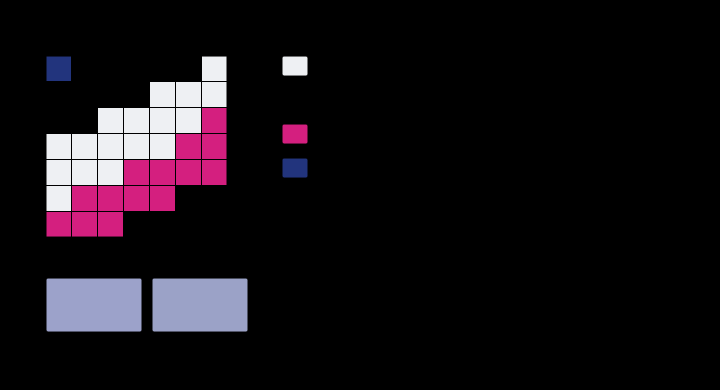
  1. A halftone tint, its four regions, and what they average to. At 40% and 30% coverage the sheet is a mosaic of 4 fully-inked regions, not a mixture of anything. Their areas are the product of the coverages — Demichel's rule, which holds because the screens are rotated to make it hold — and the patch's reflectance is the area-weighted average of theirs, raised to the Yule–Nielsen exponent n = 1.8. Averaging the regions' CIELAB coordinates instead, which is what mixing means to almost everybody, lands ΔE00 = 0.76 away.

    A halftone is not a mixture

    Forty per cent cyan and thirty per cent magenta are not stirred together anywhere. They are laid down as dots, and the sheet is a mosaic of four fully-inked regions in proportions the two coverages fix — which is why the colour is an area average of four spectra rather than a blend of two, and why it lands nowhere near where mixing would put it.

    part 1 · applied
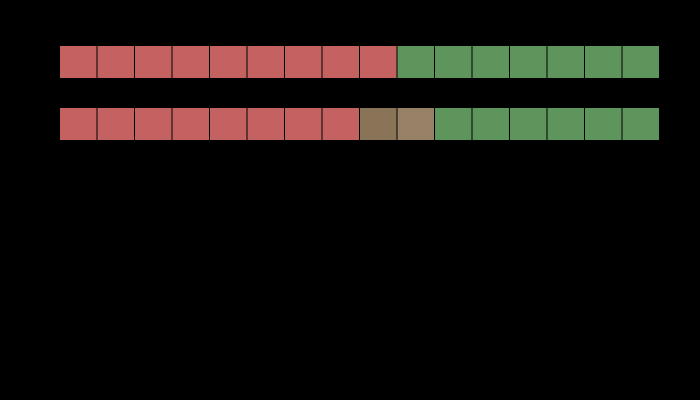
  2. How wrong a profile is between its entries. A device profile is a lattice of measured patches and an interpolation. At every node of every grid drawn here the error is exactly zero, which is why a profile checked at its own patches always looks perfect. Sampled between the nodes, a 3-step grid is worst by ΔE00 = 2.93 and a 17-step grid by 0.30. Both are honest tables of the same press.

    A profile is a table

    An ICC profile does not contain a model of the device it describes. It contains a lattice of patches that were printed and measured, and everything between them is interpolation — which is exactly zero at every patch, so a profile checked against its own target reports perfection for ever.

    part 1 · applied
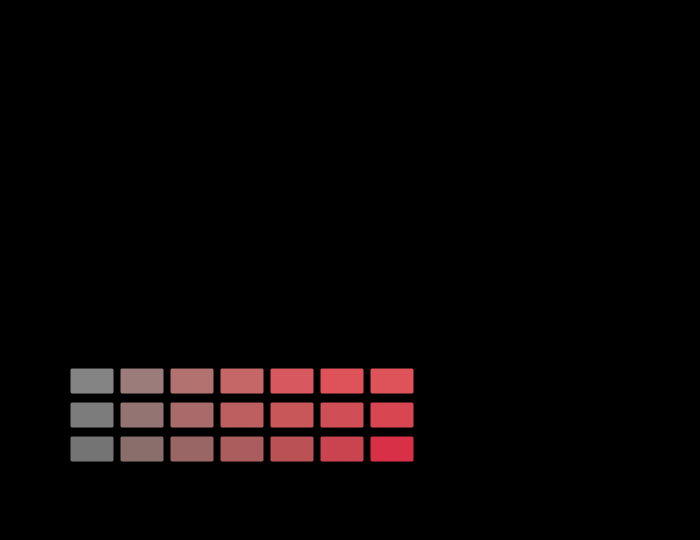
  3. Two mechanisms, one ramp, and the patch that separates them. A cyan ramp printed by a press with 10 per cent mechanical gain and a Yule–Nielsen exponent of 2.4. Fitting a mechanical gain at n = 1.0 gives 23 per cent and fitting one at n = 2.4 gives 10 per cent; both reproduce the ramp to under 0.66 of a lightness unit, and the curves lie on top of one another. The two-ink overprint below was in neither fit, and there they are ΔE00 = 3.20 apart.

    A dot is larger than it was asked to be

    Two quite different things make a printed midtone darker than its coverage says — ink spreading under pressure, and light scattering sideways inside the paper. Both bend the tone curve the same way and neither touches its ends, so the measurement every press is characterised by cannot say which happened. A patch that nobody measures can.

    part 2 · applied
  4. What a press and a display can reach at L* = 50. A slice through both solids at lightness 50, with the press dashed and the display solid. The boundaries cross: the press reaches past sRGB in 15 of 48 directions and falls inside it in 31. That is the shape of every conversion between them — colours are lost in one direction and gained in the other, and the picture cannot show the gained ones, because it is being displayed on the gamut that cannot reach them. Those are hatched.

    Neither gamut contains the other

    Converting a picture to CMYK is described everywhere as a reduction, as though the press were a smaller version of the screen. Measured as solids, the press reaches eleven per cent of its volume outside sRGB while sRGB reaches fifty-four per cent of its volume outside the press — and in the cyans the press wins by seventy per cent of chroma.

    part 2 · applied
  5. The process inks as reflectance. Each ink is a sum of Gaussian absorbance bands with stated centres, widths and peak densities, and the reflectance shown is the substrate's times the square of the ink's transmittance, because light crosses the film going down and coming back. The first band of each ink is what it is for; the rest are what is wrong with it. Magenta's unwanted absorption in the blue-violet reaches an optical density of 0.46 against 0.95 for the band it exists to have — 48 per cent of its own strength, absorbing exactly where a saturated blue needs light to survive.

    The paper is the white point

    A printed colour is reported against the sheet it sits on rather than against the light in the room, and the choice is a switch in every colour engine. Flipped one way, the same separation on coated stock and on newsprint is a 3.04 colour difference; flipped the other, it is 0.13 — and the two answers are about different questions.

    part 2 · applied
  6. The solids, by volume. CIELAB volume, all measured by the same cell count with the same extrapolation, and quoted against sRGB because that is the comparison the estimator supports. The four-colour press reaches 49 per cent of the sRGB solid's volume — and contains colours sRGB does not, which is why "half the gamut" is the wrong summary of a ratio of one half.

    The fourth ink is not for colour

    Black is in every process set and it extends the gamut by more than a third — and at every lightness above about forty it extends the chroma boundary by exactly nothing. What it buys is depth at the bottom, a neutral that holds its hue when the press drifts, and a way to put a full-strength dark on a sheet that could not carry three inks' worth of it.

    part 2 · applied
  7. What happens to a tone the destination cannot print. Source lightness along the bottom, destination lightness up the side, for a print whose black is L* = 8. Clipping is the flat segment on the left — 4 of 10 levels in the bottom twenty points of the scale arrive as the same number, and nothing downstream can recover them. Black point compensation is the straight line: all 10 levels survive as different numbers, and every tone in the picture has moved to pay for it.

    A black that is not black

    The deepest colour a four-colour press can make is L* 2.4, and against its own paper that is a contrast of about 320 to 1 — less than a cheap display manages in a dark room. Everything a printed picture does in the shadows is done inside that range, and the two ways of fitting a picture into it destroy different things.

    part 2 · applied
  8. What separates the separations, and under which light. 11 separations of a single colour, differing only in how much of it is carried by black rather than by the three chromatic inks. Under D50 they agree to ΔE00 = 0.00 — the solver was asked for that and delivered it. Under illuminant A they spread to 6.75. They are metamers of one another, and the whole family is invisible to any instrument reading a single illuminant.

    The separation is not unique

    A four-ink press has one more control than a colour has numbers, so most colours can be printed several ways. The alternatives agree to a hundredth of a colour difference under the light the match was made in — and they are metamers of one another, so under a tungsten lamp the same eleven separations of one colour spread by nearly seven.

    part 3 · applied
  9. A gradient of one hue, mapped into a press's gamut 2 ways. Chroma asked for along the bottom, chroma delivered up the side, for a ramp at lightness 55 and hue angle 25°. A colorimetric intent follows the diagonal until the press runs out and is flat afterwards — the flat part is a gradient arriving as a single colour. The perceptual intent is under the diagonal from the start, which is the price of never going flat.

    No mapping preserves everything

    More than half the sRGB solid is outside a press's gamut, so something has to be done with it, and there are two things that can be done. One leaves every reproducible colour exactly where it was and delivers a gradient as a flat area. The other keeps the gradient and moves every colour that needed no help by about three.

    part 3 · applied
  10. What separates the separations, and under which light. 11 separations of a single colour, differing only in how much of it is carried by black rather than by the three chromatic inks. Under D50 they agree to ΔE00 = 0.00 — the solver was asked for that and delivered it. Under illuminant A they spread to 6.75. They are metamers of one another, and the whole family is invisible to any instrument reading a single illuminant.

    The lamp in the shop decides

    Two packages printed to the same specification, verified under the same standard illuminant and passed, can differ by nearly seven colour differences on a shelf under a tungsten lamp. Nothing went wrong at either press. The specification named one light, the separations that satisfy it are metamers of one another, and the shop chose the second light.

    part 3 · applied
  11. A named ink, and the closest four-colour build of it. The ink is one pigment chosen for its own spectrum; the four-colour build is three chosen for everything. The four-colour build reaches it to ΔE00 = 0.37 under D50 and drifts to 4.46 under a tungsten lamp, because the match is metameric — the two curves cross 4 times rather than coinciding anywhere.

    A brand colour is an ink

    A named colour is a jar of pigment with a spectrum, and a four-colour build of it is three inks arranged to integrate to the same three numbers. Of 156 constructed single-pigment inks, 15 can be matched at all — and those fifteen drift by a median of 3.8 colour differences under a tungsten lamp, because the match was never a match.

    part 3 · applied
  12. The solids, by volume. CIELAB volume, all measured by the same cell count with the same extrapolation, and quoted against sRGB because that is the comparison the estimator supports. The four-colour press reaches 49 per cent of the sRGB solid's volume — and contains colours sRGB does not, which is why "half the gamut" is the wrong summary of a ratio of one half.

    The fifth ink buys a corner

    Orange, green and violet are sold as the answer to a four-colour press's gamut, and each one adds seven to nine per cent of volume. All three together add 23 per cent — almost exactly the sum, with no interaction — and every bit of it lands in the region of the ink that was added, at lightnesses where that ink is dark.

    part 4 · applied
  13. Lightness against colourfulness, in a booth and on a screen. Each arrow is one colour, from what the model predicts under a print in a 2000 lux booth to what it predicts under a display in a dim room. Every arrow points the same way, which is the content: a dimmer surround lowers predicted lightness and colourfulness together, so a proof does not merely differ from the print, it differs in a direction — and that is why proofing standards specify the room and not only the numbers.

    The proof is a different object

    A soft proof can be made colorimetrically exact and still not match the print, because the print is in a booth at two thousand lux with an average surround and the screen is in a dim room at a fifth of the luminance. The appearance model puts four CAM16-UCS units between them, with no change of stimulus anywhere — larger than the error any rendering intent is arguing about.

    part 4 · applied
  14. The tone scale of one display, in four rooms. Code value along the bottom, the lightness it comes out at up the side. The curves are the same display: what changes is the light falling on the screen, which adds a fixed luminance to every pixel. The signal value that means black arrives at L* = 11.7 at 600 lux, against 0.9 in the dark — the lightness of a dark grey card, from a pixel that is switched off.

    The screen is not the room

    A thousand-to-one display in an ordinary office is a hundred-and-thirty-seven-to-one display, and the signal value that means black comes out at the lightness of a dark grey card. Nothing is wrong with the panel. Light falls on the screen and comes back off it, and the two per cent it returns is added to every pixel — most of all to the ones with nothing else in them.

    part 4 · applied
  15. An edge at 4:2:2, and the colour it arrives as. Above, the row as it was sent and as it arrives after the two chroma planes are averaged 2 samples at a time. Below, the colour difference at each sample. The worst is ΔE00 = 25.88, at a luma step of 0.058 across the edge — an edge of nearly equal luminance. Nothing is wrong with the codec: it discards the differences the eye resolves worst, and this edge is made of nothing else.

    Colour thrown away on purpose

    Every video format in use discards three quarters of its colour information and keeps all of its luminance, because the eye resolves fine colour detail badly. On an edge that carries luminance the loss is exactly zero. On an edge of nearly equal luminance it is a colour difference of forty-three, and the two edges are the same edge to the codec.

    part 5 · applied
  16. A viewing booth is a lamp, and a lamp has an angle. The same sample at five positions across a booth's plane, with the lamp 55 centimetres above it. The curve is how far each position is from the middle, in the units the judgement is made in. It reaches ΔE00 2.40 against a tolerance of 1, while the illuminance uniformity — the quantity the standard actually bounds — never falls below 73 per cent and stays comfortably inside it. The flat trace is the same booth with a source whose converter is the same thickness in every direction: ΔE00 0e+0, exactly, by construction.

    The booth is a luminaire

    A standard viewing booth is specified by its light's chromaticity, its rendering and the uniformity of its illuminance across the sample plane. Illuminance is a photometric integral, so two positions can be inside the uniformity tolerance and lit by two different spectra — and a sample at the far corner of a compliant booth is ΔE00 2.4 from one in the middle, against a tolerance of one.

    part 6 · applied
  17. What a halftone measures, against what it looks like. A 50 per cent screen, measured by an aperture that averages the patch and seen by an eye that blurs it first and compresses afterwards. At a coarse ruling the two disagree by ΔE00 11.1, and the patch looks 14.3 lightness units darker than it measures — the average of a concave function is below the function of the average, which is Jensen's inequality and not an illusion. The gap falls under a unit above 30 cycles per degree. That is a viewing distance, and the correction a press applies for dot gain has no distance in it anywhere.

    Measured with an aperture, seen with an eye

    A spectrophotometer averages a halftone patch and reports one reflectance. An eye blurs it first and compresses afterwards, and the average of a concave function is below the function of the average — so a resolvable screen looks darker than it measures, by fourteen lightness units at a coarse ruling and by nothing at a fine one. The correction a press applies is the same size and has no viewing distance in it.

    part 6 · applied
  18. Media-relative colorimetry is a von Kries adaptation in the worst basis there is. Changing the paper is a change of the light reaching the reader, and the rule colour management uses for it — divide the tristimulus values by the substrate's — is a gain applied in XYZ. That is the one transform the table here describes as the oldest mistake still shipping. On the three stocks a press actually uses the penalty is real and small, because a sheet of paper-mill white is the smoothest change of light in the census. On blue it is 10.2 times the residual the same rule would leave in a cone basis.

    Dividing by the paper

    Media-relative colorimetry divides tristimulus values by the substrate's, which is a von Kries adaptation applied in XYZ — the one basis the table here describes as the oldest mistake still shipping. On a paper-mill white it costs a few hundredths of a unit. On a tinted sheet it costs ten times what the same rule costs in a cone basis.

    part 7 · applied
  19. What a proof on an unbrightened sheet cannot reach. The paper white of a heavily brightened stock beside the paper white of an unbrightened one, both under an ultraviolet-included instrument. They are ΔE00 9.8 apart and 10.3 of that is in the blue-yellow axis. A proofing system on the unbrightened sheet can print towards the brightened one only by adding ink, which makes the paper darker rather than bluer; it cannot add light at 435 nanometres because it has no brightener and its own lamp is the one in the room. This is why a soft proof and a hard proof of the same job disagree about the white, and why the disagreement is in one direction.

    A proof cannot glow

    A proof is a different sheet of paper pretending to be the production one, and the pretence works by adding ink until the two agree. It cannot work for a brightened stock, because the direction the proof has to travel is towards more blue at the same lightness and every ink a proofer owns moves it towards less light instead.

    part 7 · applied
  20. Six sheets, four standard measurement conditions, and every pair of them. How far apart two measurement conditions put the same sample. Darker is further. The top row has no brightener in it and every pair agrees to within a unit except the ones involving M₃, whose difference is cross-polarisation removing the interface reflection and is a change of geometry rather than of spectrum. Every row below it disagrees, and the M₁ against M₂ column reaches ΔE00 7.7 — several times any tolerance a printer would accept, on one sheet measured twice by two instruments that are both working correctly. The numbers under the columns are the means.

    An instrument brings its own light

    ISO 13655 names four measurement conditions and they are usually read as four degrees of care. They are not. They are four different quantities — on an unbrightened sheet all four agree to a rounding, and on a brightened one they are up to seven and a half units apart, with every instrument in calibration and every answer correct.

    part 8 · applied
  21. What the next thousand patches buy a printer profile. A profile is a table, exact at its nodes and interpolated everywhere else. Each mark is a grid: the horizontal axis is how many patches somebody had to print and measure, the vertical is the worst error found between the nodes. Going from 135 patches to 3645 — 27.0× the work — buys 8.4× the accuracy. The error falls with the square of the spacing and the count rises with its cube.

    A profile is a fit between its nodes

    A printer profile is a table, exact at every patch that was printed and interpolated everywhere else — and everywhere else is where every job lives. Going from a hundred and thirty-five patches to three and a half thousand is twenty-seven times the work for eight times the accuracy, and the exponents say that is as good as it gets.

    part 9 · applied
  22. Three published primary sets, and a fourth chosen for how it adapts. The spectral locus with four triangles inside it. sRGB covers 33.5% of the diagram and leaves an adapted observer 2.36 ΔE00; Display P3 covers 45.4% at 1.22; Rec. 2020 covers 63.3% at 1.09. The fourth triangle is the best adaptation basis available to a display asked to cover 63.5% of the diagram, at 1.02 — and it is a different triangle from Rec. 2020's rather than a smaller one. The largest triangle that fits at all covers 73.9%, which is where the axis of this argument ends.

    Primaries chosen for their inverse

    Moving a display's white point is a gain on its R, G and B, so a display adapts in the inverse of its own primary matrix — a basis chosen by committees for gamut coverage and phosphor availability. Pose the design problem properly and the answer costs one per cent of the gamut argument and reaches within two per cent of the best basis there is.

    part 10 · applied
  23. At a published matrix the slope arrives long before the bowl. One row per basis in this collection's table. Each row is a logarithmic axis of distance in the nine coefficients, with two markers: the radius at which the objective's curvature becomes as large as its slope, and the distance from that basis to the optimum. The first is between 3.2 and 108 per cent of the second. So over almost the whole journey from a published matrix to the best one, the surface is a slope and not a bowl — and a table of eigenvalues taken there describes a neighbourhood the optimum is nowhere near. XYZ scaling is the exception, at 1.08 of the distance, because its slope is the steepest in the table.

    The slope arrives before the bowl

    The adaptation transforms colour management actually uses are not optima of anything. At every one of them the objective has a slope, and the slope is the larger term over almost the whole distance to the best matrix — so a table of curvatures taken there describes a bowl nobody meets on the way anywhere.

    part 10 · applied
  24. Where a delivered colour's error actually comes from. Three bars and two totals. The profile's interpolation between its nodes contributes 0.13 ΔE00; the rendering intent, at the colorimetric setting, moves nothing that was already printable and contributes 0.00; and looking at the result in a dim room rather than the booth it was proofed in contributes 4.30, which is 97 per cent of the total. The two totals are the three added — 4.43 — and combined in quadrature — 4.30. The gap between those two rules is 0.127, about the size of the entire profile stage, and no standard says which rule to use.

    A delivery tolerance is three tolerances

    A colour reaches a reader through a profile, a gamut mapping and a room, and each has a number somebody chose. Each has an essay of its own here, and none of those essays had put the three costs in one column. Put there, the stage nobody controls carries ninety-seven per cent of the total.

    part 10 · applied
  25. Best on the average, undefined at the edge. Two rows of bars sharing one set of labels. On the left, each adaptation basis's mean residual over the fourteen changes of light the census lists — Bradford is the shortest bar at 1.14 ΔE00 and is what colour management uses. On the right, the same bases against the worst change the same family of painted rooms can produce. Three of the five have no bar there at all, marked instead with the gain that replaced it: under a deep narrow notch their reading of the white passes through zero, so the diagonal is a division by nothing and the model stops being defined rather than merely doing badly. Bradford's middle gain reaches -1.0e+19. CAT16, which exists because CAT02 was withdrawn for going negative in practice, is one of the two that survives.

    Best on the average, undefined at the edge

    Bradford has the lowest mean residual of any adaptation transform over the census of illumination changes, which is why colour management uses it. Inside the family that census was drawn from, its middle row's reading of the white passes through zero — so the gain is a division by nothing, and the model stops being defined rather than merely doing badly. CAT16, which exists because its predecessor did this, does not.

    part 11 · applied
  26. A primary's tolerance is a shape, and part of it is unreachable. The CIE chromaticity diagram with the spectral locus drawn, and three closed regions marking where each primary of a display designed for its own inverse can sit while the adaptation cost stays within 1 per cent of its best. None of them is round: the widest runs 15.1 times further one way than another, so a single tolerance figure for a primary is the average of a shape the shape never takes. 47 of the 144 boundary directions leave the region a real primary can occupy, which is a second constraint the objective knows nothing about — the cost does not rise there, and the primary cannot go there.

    A tolerance is a region

    How far a display's red primary can move before its adaptation behaviour costs anything is not a distance. It is a closed region on the chromaticity diagram, fifteen times longer one way than another, and about half of it lies outside the area a real primary can occupy — where the objective does not rise and the primary cannot go.

    part 11 · applied
  27. Downhill from every published matrix, one step at a time. Each curve is a steepest-descent walk from one of this collection's published bases, plotted as the objective against the distance walked in the nine coefficients. The horizontal line is the optimum. The first step of each walk is the long one — XYZ scaling closes 41 per cent of its whole gap in one — and every walk then flattens without reaching the line, because the valley floor is nearly flat and the steepest direction is nearly across it. Bradford starts closest and closes least: it is already in the flat part.

    Downhill from a published matrix

    Walking steepest descent from each adaptation transform in use closes between a quarter and nine tenths of its distance to the best one, and most of that in the first step. The direction it sets off in is eighty to eighty-seven degrees away from the answer, and that turns out not to be an artefact of the three directions nothing can see.

    part 11 · applied
  28. A gradient of one hue, mapped into a press's gamut 3 ways. Chroma asked for along the bottom, chroma delivered up the side, for a ramp at lightness 55 and hue angle 25°. A colorimetric intent follows the diagonal until the press runs out and is flat afterwards — the flat part is a gradient arriving as a single colour. The perceptual intent is under the diagonal from the start, which is the price of never going flat.

    A budget drawn through one hue

    The three-stage error budget this collection publishes for a colour-management chain is computed over twenty-four colours of a single hue at a single lightness. The quantity that actually varies with hue — how many distinguishable colours a rendering intent destroys — runs from nothing at all to more than a third, and the hue the budget uses is near the bottom of that range.

    part 11 · applied
  29. Pairs built to sit exactly on a ΔE2000 tolerance, read in every other unit. Twenty-four pairs of surfaces, each constructed by walking one member along a fixed direction until the difference is exactly 1.0 ΔE2000 under D65. The bar spans what those same pairs read in each unit, after calibration, with the tick at the mean. ΔE2000's own row is a point at 1.0 by construction. Every other unit spreads them: ΔE*uv reads them from 0.69 to 1.75, so a contract written at "one unit" accepts and rejects a different set of deliveries depending on which unit it means. CAM16-UCS rejects all twenty-four: it reads the closest of them at 1.43.

    A tolerance is a boundary through pairs

    Twenty-four pairs of surfaces built to sit exactly on a ΔE2000 tolerance of one read from 0.69 to 1.93 in the other five units. A contract quoting "one unit" without naming the formula does not become slightly wrong in another; it accepts and rejects a different set of deliveries, and in one case rejects every single one.

    part 12 · applied
  30. The share of a sample's reflectance an aperture recovers, by how wide it is. Six materials, and the fraction of each one's true reflectance that a measurement recovers through an aperture of the stated radius. The horizontal axis is logarithmic in millimetres; the vertical is a share, so 1.0 is the whole of it. The dashed line is a 4-millimetre radius, which is about what a hand-held spectrophotometer has. At that aperture coated paper reads 98 per cent of its own reflectance and candle wax reads 48. Every curve approaches one from below and none of them reaches it: the kernel's tail is what is being cut, and it falls as one over the aperture rather than exponentially.

    An aperture is a filter

    A measuring aperture throws away the light that came back outside it, and the light that comes back furthest is the light at the wavelengths the sample absorbs least. So an aperture does not attenuate a translucent sample evenly — it attenuates its peaks more than its troughs, which is a filter whose transmission curve the sample itself decides.

    part 12 · applied
  31. The share of a sample's reflectance an aperture recovers, by how wide it is. Six materials, and the fraction of each one's true reflectance that a measurement recovers through an aperture of the stated radius. The horizontal axis is logarithmic in millimetres; the vertical is a share, so 1.0 is the whole of it. The dashed line is a 8-millimetre radius, which is about what a hand-held spectrophotometer has. At that aperture coated paper reads 99 per cent of its own reflectance and candle wax reads 66. Every curve approaches one from below and none of them reaches it: the kernel's tail is what is being cut, and it falls as one over the aperture rather than exponentially.

    Either disc can be the wide one

    Every standard on translucent samples says to illuminate a larger area than is measured, and explains it by saying that light leaks out of the lit spot. That is true and it is not the reason, because the instruction works equally well the other way round — measuring a larger area than is lit gives a reading just as exact. The error is a product of two apertures and either one being wide kills it.

    part 12 · applied
  32. Every figure a surround dial would apply to, weighed. The eleven generators in the appearance family, by the size of the drawing each emits — which is what a dial multiplies, because every frame carries the figure's whole body. The dashed rules are the thresholds the dial policy here is written in: under 3 KB gets thirteen stops, under 6 gets nine, under 10 gets seven, and above about 12 KB nothing gets a dial at all. The median body here is 2.25 KB and 4 of the eleven are inside the most generous tier, against a policy written when the distribution had a median of 4.0 KB. Two phases deferred a surround dial on the grounds that appearance swatches are not small. The exception is unique-hues at 14.1 KB, which is over the ceiling that says it should have no dial — and it has one, on chroma, declared in the same file as the ceiling.

    A dial has a price

    Two rounds declined to give the appearance model's surround a continuous control, both times because the frames would be too heavy, and neither time was the weight taken. It is 2.25 kilobytes at the median — the light end of these figures rather than the heavy end — and one figure is already breaking the rule the deferral was made under.

    part 13 · applied
  33. Four departures from the model equation, each at an ordinary strength. What each of the four assumptions inside a colour integral costs, in ΔE₀₀, on a stated sample under a stated light. The wavelength index is a coated printing paper measured with and without the ultraviolet of D50; the range is the same paper integrated from 300 nanometres and from 380; the place index is a pigmented plastic through a four-millimetre radius; the direction index is an eggshell paint beside a window. The spread is a factor of 7.0. This is a ranking of four examples rather than of four departures — each of them can be made larger by choosing a more extreme sample, and the marble in the same collection of materials reaches 12.7 on the index that comes third here.

    Which index to buy an instrument for

    Four departures from the colour integral, ranked by what they cost and by what it would take to remove each one. The ranking by cost and the ranking by price are almost exactly reversed — the two largest are removed by specifying a lamp and by widening a table, and the two that need new hardware are the two smallest.

    part 13 · applied
  34. The conditions under which an observer's departure is exactly zero. A departure of the observer is the pairing of something belonging to the observer with something belonging to the stimulus, so emptying either factor empties the product. The axis is logarithmic in what is left when the condition is imposed. Six rows empty the stimulus's factor — a perfectly neutral sample is the same colour for every observer, at any age and any field size — and two empty the observer's, since a gain on each cone and a change of basis are both absorbed exactly. All eight are identities rather than small numbers. The last two are the same two conditions imposed in a published cone space rather than in the observer's own, and they are worth eight and thirteen units: the identity is about the eye, and the arithmetic everybody uses is in somebody else's coordinates.

    The instrument is one observer exactly

    A spectrophotometer has no observer uncertainty. It computes through the 1931 tables to the last bit, reproducibly, forever — which is its whole value and is also why it cannot report the three colour differences of observer spread between itself and whoever is looking at the sample.

    part 14 · applied
  35. Every departure under every light. Six departures across six lights, each cell the difference between two observers in ΔE₀₀, drawn as a bar whose length is the number. The rows are not multiples of one another: the lens is worst under tungsten and the pigment peaks are worst under a three-emitter LED, because a departure is a pairing and which light is being paired with decides it. The laser projector's row is empty, and that is not a fact about lasers — on this collection's five-nanometre grid a three-line spectrum is a one-line spectrum, and a single wavelength is a stimulus every observer agrees about exactly.

    The booth and the eye disagree

    A viewing booth is specified to simulate daylight, and daylight is the light under which observers disagree least. So a booth is the condition in which a specification is least likely to be tested against the thing that breaks it, and the shop it will be judged in roughly doubles the term.

    part 14 · applied
  36. Each departure over forty-two surfaces rather than one. The same six departures measured over a family of forty-two analytic reflectances — an absorption band of stated centre, width and depth — with the smallest, the median, the ninety-fifth percentile and the largest marked. Every one of them spans more than a factor of three, and the ranking between them is not stable across the family: what decides a departure's size is which sample it is asked about, because a departure is a pairing and the sample is one of the two factors. Quoting any single number for what an observer's age is worth is quoting a choice of example.

    A brand colour for a population

    A brand colour is chosen once, specified in a number, and seen by everybody. The observer audit says two candidate colours with identical specifications can carry observer spreads differing by an order of magnitude, and that the spread is computable from an ink's spectrum at the moment the ink is chosen.

    part 15 · applied
  37. The budget's three numbers, and the units they are in. The published three-stage budget's own figures, with each one's unit named, beside the same stage re-measured in a single unit over the same colours. Two of the three are colour differences between stimuli and the third is a distance between appearances, and the budget adds them. The fourth row is a stage the budget has no entry for: the colours the separation cannot reach even after the mapping has moved them, which comes to 1.45.

    The budget adds two units

    This collection publishes a three-stage error budget for a colour-management chain and prints its sum. Two of the three stages are colour differences between stimuli and the third is a distance between appearances, and the conversion between those is not a constant. Re-measured in one unit over the same colours the chain has four stages rather than three, its end-to-end error is 5.05 against a sum of 7.66, and the profile's contribution where a job actually lands is 3.2 times its published average.

    part 16 · applied
  38. The same blend, taken on the stored values and on the light. Six pairs blended at 50 per cent, once by averaging the values as they are stored and once by averaging the light they stand for. Every resize, every antialiased edge and every transparency composite in an ordinary pipeline does the first. The two land 15.8 colour differences apart at the mean and 19.3 on a red against a green, and the stored-value blend is the darker on all six, by up to 23 units of lightness.

    An average on the stored values

    A resize, an antialiased edge, a transparency composite and a chroma subsample are all averages, and in almost every pipeline they are taken on the numbers as stored. The numbers as stored are encoded, the encoding is a compression, and a half-and-half blend of black and white taken that way lands 18.7 colour differences from the half-and-half blend of the light — 22.7 units of lightness darker, on every pair, always in the same direction.

    part 17 · applied
  39. The same colour, delivered from two documents. A ramp of chroma, mapped into a press's gamut under the perceptual intent from two source solids: the whole of sRGB, and the same solid with its chroma limited, which is what a document containing only muted colours amounts to. Under a colorimetric intent the two answers are identical to the floating-point floor. Under the perceptual one they are 0.69 apart at the mean and 2.64 at the worst, on colours the destination could hold either way.

    An intent is not a function of the colour

    A rendering intent is chosen per job and applied per pixel, which suggests it is a function of the colour. The colorimetric ones are, exactly — the same colour from two documents comes out identical to the floating-point floor. The perceptual one is not — it compresses the whole source solid into the destination, so the same colour delivered from a wide document and from a muted one lands 2.6 colour differences apart, on colours the destination could hold either way.

    part 17 · applied
  40. How far the chain falls short of its sum, and how much of that is the unit. For each rendering intent, three ratios of the chain's end-to-end error to the sum of its four stages. The lowest bar is the published one, in the power-corrected unit. The middle bar is what that unit reports for a chain whose stages point the same way and add exactly — the exponent on its own. The top bar is the same chain measured in the model's own Euclidean space. Under the colorimetric intent the published ratio is 0.66, the exponent alone gives 0.74 and the chain in a space that can add 0.84: 77 per cent of the shortfall is the unit.

    A chain measured in a unit that cannot add

    A delivery chain's four stages, measured in the power-corrected appearance difference, sum to 7.66 while the chain end to end measures 5.05, and the shortfall was read as the stages partly cancelling. A chain whose four stages lay in a straight line and added exactly would still read 0.74 of its sum in that unit, because a distance raised to the power 0.63 cannot add. Measured in the model's own Euclidean space the same chain reaches 0.84 of its sum. Three quarters of the published shortfall was the exponent.

    part 17 · applied
  41. Out to the device and back, once and again. Each intent applied 3 times in succession to the same ramp. The upper bar is what the first pass moves and the lower is what the second moves. relative-colorimetric is idempotent — the second pass moves nothing, to the floating-point floor — and the other two are not: perceptual moves another 2.73 and saturation moves another 3.09. A file converted twice is not a file converted once.

    A second conversion is not a repeat

    A colour converted to a device and back is described as lossy where the device cannot hold it and exact where it can, which suggests that a colour surviving one round trip survives any number. One of the four intents is idempotent to the floating-point floor. The other two are not — a perceptual conversion moves a ramp 3.70 colour differences on its first pass and another 2.73 on its second, and after three passes it is still moving by 2.42.

    part 18 · applied
  42. One edge magnified four times, three ways: text on a page. A step between the two colours of text on a page, magnified four times by linear interpolation, by bicubic and by a three-lobe Lanczos kernel, once on the stored values and once on the light. The curves are the stored-value result's lightness minus the light's, sample by sample across the edge; below the line the stored-value resize is darker. Linear interpolation is darker everywhere it differs. The two kernels with negative lobes swing above the line beside the edge, where their negative weights fall — bicubic by up to 1.8 colour differences and Lanczos by 3.7.

    A resize with a negative weight in it

    A blend taken on stored values is always darker than the blend of the light, because the encoding is concave and a convex combination of a concave function's values lies below the function of the combination. A bicubic or Lanczos resize is not a convex combination. Beside an edge its negative weights make the stored-value result lighter than the light's own — by up to 6.1 colour differences with bicubic and 12.2 with Lanczos on skin against its shadow — and on edges between full-scale values the clip hides the overshoot and the old guarantee appears to hold.

    part 18 · applied
  43. A soft proof exact for one observer, as two hundred others see it. Each display is driven to match each of thirty printed patches exactly for the reference observer, so for that observer screen and print are the same colour to fourteen decimal places. The bars are what two hundred observers drawn from the population make of the same pairs: the median observer's difference, median over the patches, and the ninety-fifth percentile observer's: 1.8 and 4.8 on the wide-gamut LCD, 2.0 and 5.4 on the OLED, 3.1 and 7.5 on the laser projector. The narrower a display's primaries, the larger both become.

    A soft proof is exact for one reader

    A display can be driven to match a printed patch exactly for the standard observer — three equations, three unknowns, agreement to fourteen decimal places. Two hundred observers drawn from a realistic population see the same screen and print a median of 2.1 colour differences apart on an OLED panel and 5.4 apart at the ninety-fifth percentile. On a laser projector the ninety-fifth percentile is 7.5. The patch that fails worst is unprinted paper, and in the chain's own unit the ninety-fifth percentile reader's stage is larger than every one of the four stages a delivery chain is budgeted for.

    part 19 · applied
  44. The corner of a patch of skin against its own shadow, magnified four times by Lanczos, three lobes. A map of the neighbourhood of one corner of a square patch — the patch fills the lower right, the field the rest — once it has been magnified four times by Lanczos, three lobes. Each cell is shaded by how much lighter (warm) or darker (cool) the stored-value result is than the light's, the deepest shade 18.2 units of lightness. Within three source pixels of the corner the stored-value result is up to 14.5 colour differences lighter, 14.5 outside the patch against 3.1 inside it, and up to 7.3 darker.

    The corner of a resized patch is lighter than its edges

    A resize taken on stored values is darker than the resize of the light wherever its weights are positive, and lighter beside an edge where a kernel's negative lobes fall. In two dimensions the kernel is a product, and just outside a patch's corner a Lanczos magnification of skin against its shadow comes out 14.5 colour differences lighter — more than along either edge. A reduction to a quarter is mostly an average and errs lighter by at most two. And an unsharp mask, whose negative weights are its whole purpose, is lighter on the stored values at every amount on every pair, and never darker.

    part 20 · applied
  45. A soft proof exact for one observer, and three proofs tuned for readers. For each display, the median over printed patches of the 95th percentile reader's mismatch between screen and print, for four ways of choosing the display's three drive levels: exact for the reference observer; least squares over a population of a hundred; tuned on that population's 95th percentile; and tuned on the two hundred readers it is scored on, which no workflow could do. On a wide-gamut LCD the four give 4.57, 4.99, 4.74, 4.39, and the three tuned proofs cost the reference observer 0.70, 0.82, 0.69. On an OLED panel the four give 5.12, 5.72, 4.99, 4.86, and the three tuned proofs cost the reference observer 1.35, 0.95, 0.67. On a laser projector the four give 7.54, 7.00, 6.81, 6.50, and the three tuned proofs cost the reference observer 1.88, 1.23, 1.14.

    A proof cannot be tuned for readers who disagree

    A soft proof matched exactly for the standard observer is five colour differences wrong for one reader in twenty. Giving up that exactness to tune the display's three drives for a population instead moves the ninety-fifth percentile reader by 4 to 14 per cent even when the tuning is done on the very readers it is scored against — because what readers see is mostly each other's disagreement, and three drives act on every reader at once.

    part 20 · applied
  46. Three stored-value defects, before the eye and after it, a print at 40 cm. Each defect's largest colour difference between the version computed on stored values and the version computed on light, read twice: as a pixel carries it, and after both images have been through the visual system's three channels at 83 pixels a degree. The two rankings are not the same. The unsharp mask has the largest error per pixel — 16.62 — and keeps only 38 per cent of it; the corner has the smallest at 7.14 and comes out at 9.87. The filter is not a blur applied to a difference: it is applied to each image, and the difference is taken after.

    The eye keeps the lightness errors

    Four essays have priced what a resize taken on stored values costs, in colour differences between pixels. A reader does not see a pixel. Put the two versions of each image through the visual system's own three channels and the ranking reverses: the unsharp mask, the largest error per pixel at 16.6, is seen at 6.3 on a printed page, while the corner's 7.1 is seen at 9.9. What decides it is not the size of an error but how much of it is colour.

    part 21 · applied
  47. The error between a profile's nodes is a bias, not a scatter. Two quantities against the lattice size: the mean colour difference between the nodes, and the mean signed lightness error. If the interpolation erred in both directions the second would be near zero while the first was not. They lie on each other — 0.136 against 0.133 at a nine-step lattice — so the whole of what a profile does between its patches is to lighten. It errs light because a press's response is convex in ink coverage: the first drop of ink removes more light than the last, and a straight line between two points on a convex curve lies above it. At three steps 400 of 400 samples err light.

    A profile interpolates light

    A profile is exact at its patches and wrong between them, and how wrong has been measured twice. Which way it is wrong has not. At a nine-step lattice the mean signed lightness error between the nodes is +0.136 against a mean colour difference of 0.133 — the error is not a scatter but a bias, and it lightens. The repair costs nothing measured and is forbidden by how a profile is checked: let the table be wrong at its own patches.

    part 21 · applied
  48. One instrument, one uncertainty, six places on the scale. What an absolute uncertainty of 0.001 in measured reflectance is worth in lightness, at six levels from a four-colour solid to the paper. Nothing about the instrument changes between the rows: what changes is the slope of the lightness function, which is a straight line of 903 units per unit of luminance factor below a luminance of 0.0089 and a cube root above it. At the solid the uncertainty is 0.903 lightness units and at the paper 0.043 — 21 times as much, for the same measurement.

    The scale hangs from one measurement

    Black point compensation is a straight line between two blacks, and the destination's is a measurement of one patch at the darkest place a spectrophotometer is ever asked to read. The lightness scale's slope is 903 units per unit of luminance factor there and 43 at the paper, so a thousandth of a reflectance is worth nine tenths of a lightness unit at the black and four hundredths at the white. That one number moves a mid grey by nearly a quarter of a delivery tolerance, and no specification names it.

    part 21 · applied
  49. Two tables, two directions of error: 5-node ramps of four inks. For each ink, the mean signed lightness error between the nodes: of the ordinary forward table, which errs light, and of four ways to fill the inverse table, all of which err dark except the one refitted against its own objective. On cyan the forward table errs by +0.206; an inverse filled from the press by -0.317; one inverted from the ordinary table by -0.554, because it inherits the forward table's error on top of its own; one inverted from the refitted table by -0.367; and one refitted in its own right by -0.002.

    The inverse table errs dark

    A profile's forward table predicts a print lighter than the press makes, and refitting its nodes removes the bias. The table a colour engine actually uses to separate an image is the other one — the inverse, from colour to ink — and it errs the opposite way: filled exactly from the press it asks for too much ink and prints dark, and built by inverting the ordinary forward table it prints darker still. Inverting the refitted forward table removes the inherited part and leaves the inverse's own. The round trip through both tables improves only when each is refitted against its own error, and then the two are no longer each other's inverse.

    part 22 · applied
  50. Where an unsharp mask errs, per pixel and as seen: print, 40 cm. The upper-left corner of a patch of skin against its shadow after an unsharp mask, as two maps of the colour difference between the result taken on stored values and taken on light. Left, pixel by pixel: the corner peaks at 16.8 and the middle of the edge at 16.6. Right, after the eye's three spatial channels at a print at 40 cm: the corner is seen at 17.1 and the edge at 7.1, a ratio of 2.40. Darker is larger, on one scale for both maps.

    The eye counts a corner's error, not its peak

    A Lanczos-magnified patch errs a fifth more at its corner than along its edges, pixel by pixel, and an unsharp mask errs almost exactly as much at its corner as along its edges. Filtered by the eye over the plane rather than along a line, the two swap: the magnified corner is seen exactly as its edge is, and on a printed page the sharpened corner is seen at 2.4 times its edge. What decides it is whether the error changes sign. Ringing averages away and a one-sided halo does not, and a corner is where two edges' halos land on the same patch of retina.

    part 22 · applied
  51. Where a sharpened E errs, per pixel and as seen: black type on paper, 10 point. The letter E at 10 point on a 300-dot-an-inch page, black type on paper, sharpened by an unsharp mask on stored values and on light; the two maps show the colour difference between the results, pixel by pixel on the left and after the eye's three spatial channels at 40 centimetres on the right, on one scale. The thin line is the letter's outline and the dashed circles mark two pixels round each corner — 8 outer corners and stroke ends, 4 inside angles. The circled zones are 31% of the outline and hold 28% of the per-pixel error and 25% of the seen error.

    Sharpened type errs on its dark side

    A sharpened square hides its halo along its edges and shows it at its corners, so a sharpened page of type was predicted to show its error at the corners of its letters, several times out of proportion to their length. Black type does the opposite: its outer corners and stroke ends hold between two thirds and nine tenths of their share. As the eye leaves it, the error lies on the dark side of every edge, and a corner holds as much of it as it has dark ground around it — a quarter of a disc where a black corner points out into paper, three quarters where black wraps round a pale one.

    part 23 · applied
  52. A four-ink inverse table's error along the grey axis, 9 nodes, black from L* 60. The colour difference between a grey asked for and the grey printed, from L 92 to 14, for a 9-node inverse table whose separation strategy begins black generation at L 60 (dashed line). Three tables: filled exactly from the strategy, mean 0.073; refitted with each node sliding along the strategy, 0.050; refitted freely, 0.036. To the left of the dashed line the strategy-bound refit lies close to the filled table; to the right it lies close to the free refit. Every table is exact at its nodes, marked on the axis.

    A strategy keeps the refit only where black prints

    Refitting an inverse table's nodes against their own error halves it, and in a four-ink table the refit has to leave the separation strategy's choice of black alone. Held to the strategy, it keeps the whole of its gain wherever the strategy prints black and almost none of it where the strategy does not — and the share it keeps equals the share of the grey ramp printed with black, to within three hundredths. The start of black generation, predicted to be where the refit would fail, is where the table needs it least.

    part 23 · applied

All series