Concept

Albedo — where it appears

The fraction of light a surface returns overall, integrated rather than per wavelength. It is what decides how much a wall contributes to the light in a room, and it is a single number where a reflectance is a curve.

Named by 10 essays across one field — each of them below, with the objects they name alongside it.
The interreflection gain of a room, band by band. A closed cavity of reflectance ρ returns 1/(1 − ρ) times the light that entered it, and because that is computed per band it amplifies the wall's colour along with its brightness. The wall here is only 5% off neutral — a paint anybody would call white — and at albedo 0.9 the room's white point has moved by ΔE00 = 50.7 against the lamp it was lit with. The gain is a geometric series, so the last few percent of albedo cost far more than the first: 1.64× at ρ = 0.4 against 8.41× at ρ = 0.9.

What a white wall costs

A closed room returns 1/(1−ρ) times the light that entered it, computed band by band — so a paint that is five percent off neutral becomes a strongly coloured illuminant once the room has finished bouncing. The gain amplifies the tint along with the brightness, and the last few percent of albedo cost far more than the first.

scene · Scene
The form-factor matrix of the box. F_ij is the fraction of everything leaving face i that arrives at face j. The diagonal is zero because a flat face sees none of itself; each row sums to exactly 1 because the cavity is closed; and A_i F_ij = A_j F_ji, which is reciprocity and is checked to 10⁻⁹. For a cube the opposite face takes 19.98% and each of the four adjacent faces 20.00%, and the near-equality of those two numbers is a coincidence of the cube rather than a rule.

A corner is not a wall

A form factor is the fraction of everything leaving one surface that arrives at another, and it is the only place geometry enters the colour of a room. It is also the one number here with a published closed form to check against — and the check turned out to converge at two different rates for two cases that look identical.
scene · Scene
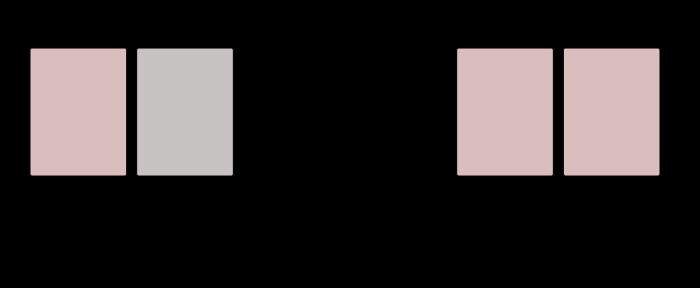
Every face of the solved room. The red room after the transport is solved in all 81 bands. Only the ceiling emits; the other five faces are lit entirely by what the ceiling and each other send them, so their colour is the lamp multiplied by every reflectance along every path that reached them. The ceiling itself comes out 1.05× brighter than it emits, because a closed room returns light to its own source. The two chromaticities under each swatch are the spectral solve and the three-channel one, and the faces furthest from the lamp — the ones the light reached by the most bounces — are where they disagree most.

The room is the illuminant

Colour bleeding is usually described as an aesthetic phenomenon of rendered images. It is better described as a measurement. In a room with one lamp, five of six surfaces emit nothing at all, so their light is entirely a product of other surfaces' reflectances — and the bleeding saturates rather than running away, for a reason worth deriving.

scene · Scene
The same wall, applied once and applied twice. A room lit by light that has bounced off its own walls is a change of illumination like any other, and a corner is the same change applied twice. Squaring a reflectance sharpens it, a sharper change of light is further from being a gain, and the residual an adapted observer is left with therefore grows faster than the change does: the second bounce is 1.33 times the change and 1.96 times the residual. This is the adaptation half of what a corner does to a metameric match.

The same wall applied twice

A bounce off a painted wall is a change of illumination, and adaptation handles it about as well as it handles a change of colour temperature. A corner applies the same reflectance twice, which sharpens it — and leaves an adapted observer with 1.96 times as much for a change only 1.33 times as large.

scene · Scene
What the Lambertian assumption costs a room, against how rough its walls are. The horizontal axis is the roughness of the two coloured walls; the right-hand end is nearly matt, which is what a radiosity calculation assumes. One line is the distance in ΔE₀₀ between the floor's colour and what radiosity gives for the same room — 4.89 at an eggshell finish, falling to 0.97 at the matt end. The other is the chroma of the bounce, which falls as the walls get glossier: what an interface returns is a Fresnel reflection and carries no pigment, so the fraction of the return that goes into the lobe is a fraction that arrives at the floor white. The lobe is taken out of the body term rather than added beside it, which is what a real finish does.

The solver had no slot for gloss

Every scene result in this collection is computed by radiosity, and radiosity is not an approximation that could be made more accurate. Its unknown is one number per surface, and a surface that returns light differently in different directions does not have one. A missing slot cannot be wrong by a small amount.

scene · Scene
What the floor receives, matt walls against walls of roughness 0.2. The spectral radiance leaving the floor towards the front of the room, computed twice. The matt curve peaks at 530 nanometres, where the walls' pigment is. The glossy curve is higher everywhere and higher by relatively more away from that peak, because the extra light is a Fresnel return and a Fresnel return has the lamp's spectrum rather than the paint's. That difference in shape is the desaturation, drawn before it is reduced to a number, and it is the reason the two lines cannot be brought together by any exposure change.

A lobe takes colour out of a bounce

A gloss wall sends more light to the floor and less colour. The extra light is a Fresnel reflection at the interface, it carries the lamp's spectrum rather than the paint's, and it arrives at the next surface white — so a green room in satin paint is less green than the same room in flat paint by nearly a colour difference of chroma.

scene · Scene
Where the viewer stands, at a wall roughness of 0.2. The chroma of the light the floor sends towards each of the five other faces of the room, at one roughness. The spread is 2.00 ΔE₀₀ between the extremes. A radiosity solution assigns one radiosity to the floor and therefore cannot have a spread at all — the whole width of this chart is a quantity the method has no slot for, rather than one it approximates badly. The two side walls see the most because they are where the coloured light comes from, and the direction the lobe favours is the direction it came from.

The floor is a different colour from the door

With a lobe on the walls the floor sends chroma 18.76 towards the front of the room and 20.94 towards the side walls, a spread of two colour differences. A radiosity solution assigns the floor one number, so the whole of that spread is a quantity the method has no slot for rather than one it estimates badly.

scene · Scene
Two ways of putting a lobe on a wall, and the sign they disagree about. The chroma of the floor's return against the wall's roughness, computed twice. In one the interface's return is taken out of the body term — light reflected at the boundary never reaches the pigment, which is what a real finish does. In the other it is added beside the body term, which is what a microfacet model does if nobody couples the two. The first says a gloss wall makes the room less coloured and the second says more, and the gap at the glossiest end is 2.87 units of chroma. Neither is a numerical error; the difference is a modelling decision that is usually made by omission.

Two ways to put a lobe on a wall

Take the interface's return out of the body term and a gloss wall makes the room less colourful. Add it beside the body term and the same wall makes the room more colourful. Same solver, same room, one line of energy accounting, and the two answers differ by nearly three units of chroma at the glossy end.

scene · Scene
The lobe's share of what leaves a surface of body reflectance 0.5. For light arriving at 45°, the fraction of what leaves the surface that is the interface's Fresnel return rather than the pigment's. It runs from about 9.1 per cent at an eggshell finish down to 4.2 at a matt one. That is a small share, and it is the whole of the effect: a tenth of the return arriving white is enough to move the room's colour by units of ΔE₀₀, because the bounce is what a room's colour is made of and every bounce is multiplied by the next.

A tenth of the return arriving white

Nine per cent of what leaves a satin wall is a Fresnel reflection carrying no pigment. That nine per cent moves the room's colour by 4.89 ΔE₀₀ and its chroma by five per cent, because an interreflection multiplies and a small contribution with a different spectrum compounds into a large one.

scene · Scene
The room's reflected light and its colour, against how glossy the walls are. Four changes against the matt room as the coloured walls are made glossier, from roughness 0.8 on the left to 0.15 on the right. The room's reflected light rises by up to 19 per cent and its chroma falls by up to 9.1 per cent. The walls' own outgoing chroma falls fastest, by 14.6 per cent, and the floor's follows the room's. A lobe does not move colour from one face to another: the room as a whole has less of it.

A gloss finish takes colour out of the whole room

A gloss wall makes the floor's return less colourful seen from the front of a room and more colourful seen from the coloured walls, which leaves open whether the lobe removes colour or only moves it. A ledger of every flux between the room's faces answers it. At an eggshell finish the room's reflected light gains 16 per cent in quantity and loses 8.3 per cent of its chroma, and the loss is nearly the same for blue, green and orange walls while the walls' own losses range from 13 to 25 per cent. Only the painted walls receive light as colourful as before.

scene · Scene

Named alongside it

The objects these essays reach for when they reach for this one.

InterreflectionRadiosityColour bleedingSpecularBidirectional reflectanceForm factorModelling assumptionReflectanceChromaFresnelIlluminantStandard observer

All concepts