Concept

Macular pigment — where it appears

A yellow filter over the fovea that absorbs around 460 nanometres and is absent a few degrees away. It is the reason the CIE's two standard observers are two observers rather than one, and its density varies by a factor of several between people.

Named by 26 essays across 5 fields — each of them below, with the objects they name alongside it.

The CIE 1931 colour-matching functions. The three functions that turn a spectrum into three numbers. They are all positive, which is why XYZ exists — the RGB functions they were derived from are not. ȳ is by construction the luminous efficiency function, which is why luminance comes out of Y.

Seventeen observers in 1931

The standard observer that governs every colour specification in industrial use is an average over seventeen young British men, measured with equipment from the 1920s. It is known to be wrong in the blue, the correction has existed since 1951, and it has never been adopted.

limits · Limits
How far a match comes apart when the observer changes. A broad source and a three-primary source, solved at each primary width so the pair is an exact tristimulus match for the CIE 1931 observer. The pair is then handed to the 1964 observer, and the gap between them is plotted. For the observer they were built for the gap is arithmetic noise at every width. For the other it grows as the primaries narrow, reaching 0.012 at 10 nm — and displays have been getting narrower for twenty years.

Whose eyes

The standard observer is an average over seventeen people, and no reader is it. What that costs was small when displays were broad and grows every time the primaries get narrower.

limits · Limits
Longitudinal chromatic aberration of the eye, focused at 555 nm. Thibos's chromatic eye, plotted as defocus in dioptres relative to 555 nm. The curve crosses zero exactly once, at the wavelength the eye is accommodating on, and everything else is out of focus — by -1.22 D at 420 nm and 0.50 D at 680 nm. Through a 3 mm pupil that first figure is a blur circle of 12.6 minutes of arc, against a foveal acuity limit of about one. The eye is never in focus across the spectrum and never can be.

Nothing is in focus at both ends

The eye carries about two dioptres of chromatic aberration across the visible band, which is a strong reading prescription. Whatever it is focused on, most of the spectrum is landing somewhere other than the retina — and the cone class that gets the worst of it is the one the retina bothered least to sample.

eye · Cones
How far a match comes apart when the observer changes. A broad source and a three-primary source, solved at each primary width so the pair is an exact tristimulus match for the CIE 1931 observer. The pair is then handed to the 1964 observer, and the gap between them is plotted. For the observer they were built for the gap is arithmetic noise at every width. For the other it grows as the primaries narrow, reaching 0.012 at 10 nm — and displays have been getting narrower for twenty years.

Two degrees or ten

This site names the observer on every figure it draws, which was supposed to be the point. Measuring what it had actually done found two hundred and four figures naming the same observer, three naming the other, and sixty-two of sixty-four generators printing a string that had never once varied.
limits · Limits
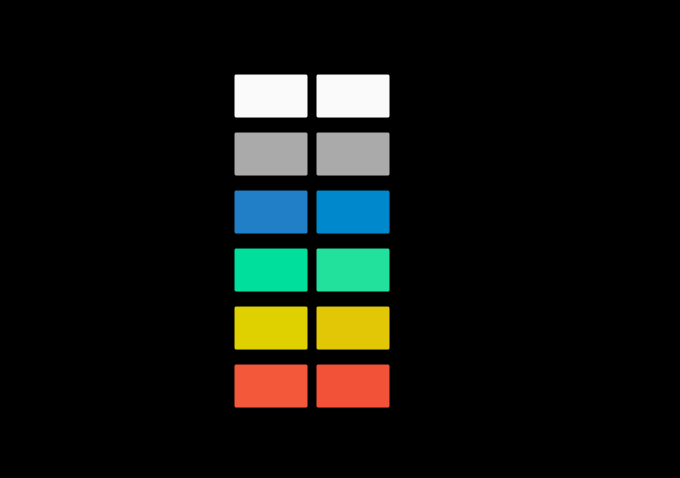
What the same eye reports about one field, in the middle and at the edge. Each row is a uniform field, drawn at the most saturated version of itself this page can show — the percentage is how much of the full stimulus survived, the rest being the adapting light added to bring it inside the gamut. The left patch is what the centre of gaze reports and the right one what 10 degrees out reports, each adapted to the same light as that position sees it. The adapting white comes out identical to 5e-13, because an adapted eye cancels its own filter exactly. Nothing else does, and the largest difference is in the blue. tungsten light is not drawn: it cannot be shown at any useful saturation, and at full strength it differs by ΔE00 1.87.

One person is two observers

The macular pigment is a yellow screen over the fovea and nowhere else, so a cone at the centre of gaze and a cone ten degrees away have different colour-matching functions in the same eye. A match made in the middle comes apart at the edge by six units — and fitting one filter to the gap between the CIE's two standard observers gives a density of 0.40 against a measured 0.35.

eye · Cones
The share of itself each change leaves behind, and the smallest is inside the eye. The residual as a fraction of the change rather than as a colour difference, which sorts the census differently. At the top is the macular pigment — the filter in front of the central few degrees of one's own retina — leaving 2.4 per cent of itself. It is a fixed transmittance multiplying the light and the white together, which is as close to a pure gain as anything here gets, and it is why nobody notices they have one.

The filters inside the eye

The macular pigment leaves 2.4 per cent of itself after adaptation — the smallest share of anything in this site's census of light changes, and less than half the next smallest. Fifty years of lens yellowing leaves 7.9 per cent, and the difference between the two says what a gain is actually good at.

eye · Cones
What reaches the retina, and why the observer's table stops at 360 nanometres. The transmittance of the eye's own optics across the short-wave band, at three ages, with the brightener's absorption shaded underneath. The upper curve is an eye whose lens has been removed — the cornea alone, opaque below about 295 nanometres and transparent above it. The photopigments absorb perfectly well in this band; what stops the light is a piece of optics in front of them, which is why the short-wave limit of colour vision moves with age and can be removed surgically. A twenty-year-old receives 21 times as much of the band a brightener works in as a seventy-year-old does.

The eye stops at the lens

Neither standard observer is tabulated below 360 nanometres, and the reason is not that the photopigments stop absorbing there. It is that the light never arrives — the cornea and the crystalline lens take it — so the short-wave limit of human colour vision is a piece of optics, it moves by a factor of twenty across a lifetime, and it can be surgically removed.

eye · Cones
A template that cannot place a point, fitted three ways. Three rows, one per set of stimuli the pigment template's cone matrix can be fitted over, each listing the three confusion points that matrix implies. The protanope's point wanders from (0.99, 0.20) to (0.76, 0.13) against a measured (0.75, 0.25), and the deuteranope's moves by 22.5 in chromaticity — further than the whole diagram is wide. A copunctal point is where two nearly parallel planes meet, so a template good to a few per cent, which is far more than enough to place a spectrum, is nowhere near enough to place this. It is why the population is built by moving the measured points rather than by deriving them.

A template cannot place a point

This collection's model of an eye is good to a few tenths of a per cent at predicting what a cone catches, which is far more than enough to place a spectrum. Asked where that eye's confusion points are, it puts the protanope's at (0.99, 0.20) against a measured (0.75, 0.25) and the deuteranope's anywhere from (1.1, −0.5) to (−18, 11) depending on which stimuli the fit was made over.

eye · Cones
How far a fitted transform is from anybody's eyes. Five groups of three bars: for each published adaptation transform, the distance from the population's own cloud to the confusion point that transform is committed to, measured in the population's standard deviations on that point. On the protanope's point every one of them is between 2.2 and 14.4 out, and on the deuteranope's between 3.7 and 11.8. On the tritanope's, 5 of the five are within three standard deviations — indistinguishable from a member of the population. The claim that these matrices are not cone responses is safe, and the evidence for it is two points out of three.

Two points out of three

Every published adaptation transform implies three dichromat confusion points, whether or not it was fitted to any. Measured in the population's own standard deviations they are two to fourteen out on the protanope's point and four to twelve on the deuteranope's — and between half a standard deviation and two and a half on the tritanope's, which is inside the population. The claim that these matrices are not cone responses is safe. The evidence for it is two points.

matching · Gamut
A population of receptor bases, in the plane the published ones live in. The two axes this collection scores an adaptation basis on — the residual across the illumination census on the horizontal, ellipse anisotropy on the vertical, lower better on both — with 200 extra points on it. Each is the basis a member of the population's own confusion points determine. The cloud is not a point: it runs from 1.22 to 2.24 ΔE00 horizontally, which is wider than the whole spread of the published transforms marked on it. The observer this site quotes sits inside the cloud and near one edge of it, and the sentence "the receptor basis costs seventy per cent" is a sentence about that one point rather than about the construction.

A trade between matrices, not people

Across the space of possible bases, adapting well and discriminating well pull in opposite directions — the two optima sit at the ends of an empty diagonal. Across a population of actual observers the same two costs move weakly together, at a correlation of +0.29. The trade-off is a property of the set of matrices somebody could choose, not of the eyes anybody has. One measurement inside the population does trade, and it is the macular pigment.

brain · Appearance
Every width at the wide end of its span, and at the narrow end. One line per published quantity, each spanning the value it takes when all four declared widths are read at the narrow end of their reported ranges to the value at the wide end, with a marker at the value as declared. The largest span is the deutan margin at a factor of 2.62; the smallest is 1.22. This is the reading the population model's own documentation promised for four phases and nothing ever took. It is not a confidence interval — the four ends are not quantiles and the widths are not independent draws — it is what a reader who distrusts all four at once sees.

A width nobody varied

Five numbers say how much people differ from one another, and every conclusion drawn here about a population rests on them. Each was written down with the range the literature reports beside it, so that a result could be re-read at the pessimistic end. Nothing ever was.

eye · Cones
Which width carries the answer, and which carries the doubt. Two columns of bars over the four things that differ between two pairs of eyes. On the left, the share of the population's disagreement each one accounts for — the attribution quoted here since the population was built, which puts the lens first at 81%. On the right, how much of the doubt each one puts on everything published here, which is its elasticity multiplied by how badly the width itself is known. The macular pigment comes first there, at 0.65 against the lens's 0.60 — a lead of 8%. The two lists agree exactly below the top.

Which measurement is worth making

Four things about an eye differ between people, and they have been ranked here by how much of the answers they carry since the population was built. Ranking them by how much doubt they carry gives a different order, and ranking them by which one takes a published claim closest to failing gives a third.

eye · Cones
What six of this collection's published numbers do when the unit changes. Six quantities, from six calculations that share nothing: a change of light after an observer has adapted, a camera profile's error, the gap between the two standard observers, a metameric pair under the lamp that breaks it, the same image on two papers, and an observer two seconds into a new room. Each is recomputed under all six units and every unit is calibrated onto ΔE2000's scale first, so the bar is not a change of units in the ordinary sense. The bar is the ratio of the largest reading to the smallest, and it runs from 1.71 to 2.30. Five of the six are printed in ΔE2000 by the essays that report them; the sixth is printed in CAM16-UCS, because the model it comes out of defines that unit.

The observers differ by a unit's worth

The gap between the 1931 and 1964 standard observers is the one quantity in this collection's audit with no published number under it — nothing here reports it as a single figure over a stated set. It also has the second-largest dependence on which colour-difference formula is used, running from 1.60 to 3.55 across the menu.

matching · Gamut
How far this site's median observer sits from the 1931 standard, by template. Twenty-four natural reflectances under D65, each given a tristimulus value twice: once by the 1931 colour-matching functions and once by this site's median member, with each judged against its own white. The bar is the mean difference, which is the residual this collection bounds and calls inescapable. It is inescapable, and it is smallest for the simpler template: Lamb's 1995 nomogram gives 0.9006 against Govardovskii's 0.9522, and removing Govardovskii's secondary band brings it down again to 0.9354. Neither is an argument for changing template — a nomogram is fitted to measurements of individual receptors, not to colour matches, so agreement with the standard observer is not what either was trying to achieve. What it says is that the residual is a mismatch between two kinds of observer rather than a shortfall a better pigment model would close. The number after each bar is the template's tail ratio: how far the L cone's half-maximum reaches below its peak against how far it reaches above.

The population rests on a template

Two hundred observers here are built from one formula fitted to microspectrophotometry in 2000. The obvious alternative — the tabulated cone fundamentals — is not available, and the reason is the finding. A tabulated fundamental has no peak wavelength to move, so the moment it is used the population collapses to a single observer.

eye · Cones
The secondary band, dialled from nothing to twice what Govardovskii published. Govardovskii's template has a second, smaller absorption band below 400 nm, published at 0.26 of the α-band's peak. It is the one coefficient in the whole template whose contribution is somewhere else in the spectrum than the peak, and it is the part of the template a reader is least likely to have heard of. Sweeping it from nothing to twice the published value moves the median observer's distance from the 1931 standard from 0.9354 to 0.9790 ΔE₀₀, monotonically upwards. That is a small effect — about a fiftieth of the residual — and its being monotone is the interesting part: there is no interior optimum, so nothing here recommends the published value over any other, and a coefficient whose measured value is not the one that best fits an unrelated agreement is a coefficient to leave where the measurement put it.

The band below four hundred

The pigment template every observer here is built from carries a second, smaller absorption band in the ultraviolet, published at 0.26 of the main one. Dialling it from nothing to twice that moves the median observer monotonically away from the standard one, with no interior optimum — which is what a physical constant looks like when nothing downstream is pulling it anywhere.

eye · Cones
The arguments a standard observer does not have. Seven choices inside a set of colour-matching functions, each with the shape it takes and what it is worth in ΔE₀₀ on a red pigment under a 6500 K radiator. Six are measurements: a field size, an age, a macular density, a cone optical density, three peak wavelengths and a rod contribution. The seventh is not — a change of basis is a change of curves and not a change of observer, and its entry is exactly zero because the space an experiment measures is what an observer is. Printing that zero beside the others is the clearest statement of what the other six are measurements of.

The third factor is a construction

Every figure in this collection names its observer, which was the whole point. None of them says what an observer is made of. Three curves are not a measurement of the eye; they are a projection of one, with a field size, an age, a macular density, three peak wavelengths and a luminance constraint inside them.

eye · Cones
Every departure under every light. Six departures across six lights, each cell the difference between two observers in ΔE₀₀, drawn as a bar whose length is the number. The rows are not multiples of one another: the lens is worst under tungsten and the pigment peaks are worst under a three-emitter LED, because a departure is a pairing and which light is being paired with decides it. The laser projector's row is empty, and that is not a fact about lasers — on this collection's five-nanometre grid a three-line spectrum is a one-line spectrum, and a single wavelength is a stimulus every observer agrees about exactly.

The lens is worst under tungsten

An ageing lens costs 4.38 ΔE₀₀ under a tungsten lamp and 2.20 under a fluorescent tube. The pigment peaks cost 2.84 under a three-emitter LED and 1.87 under the same tube. Six departures across six lights do not form a single ordering, which is what a pairing looks like and what a dominant term would not.

eye · Cones
Each departure over forty-two surfaces rather than one. The same six departures measured over a family of forty-two analytic reflectances — an absorption band of stated centre, width and depth — with the smallest, the median, the ninety-fifth percentile and the largest marked. Every one of them spans more than a factor of three, and the ranking between them is not stable across the family: what decides a departure's size is which sample it is asked about, because a departure is a pairing and the sample is one of the two factors. Quoting any single number for what an observer's age is worth is quoting a choice of example.

The ranking is not stable

On a red pigment under daylight the six observer departures run from 2.38 down to 1.20 ΔE₀₀. Over forty-two surfaces two of them change places, the top two separate, and every one spans between a factor of ten and a factor of thirty-five. A chart of six bars is a chart of one example.

eye · Cones
The three cone absorptances at two settings of the field size. Solid and dashed are the same construction at the two ends of the CIE's own second observer. The curves are built from one pigment template through its ocular media, which is the same model its population of two hundred eyes is drawn from. The largest difference between the two sets is 16.0 per cent of the peak, and where it sits along the wavelength axis is what decides which stimuli the two observers disagree about — a departure concentrated in the blue is invisible on a sample with no blue in it.

A field size is two changes

The CIE publishes two standard observers and the difference between them is usually described as a field size. What actually differs is a macular pigment the light no longer passes through and a cone outer segment the light no longer travels the length of — two changes, in two places, with different signs and different sample dependence.

eye · Cones
The three cone absorptances at two settings of the age of the lens. Solid and dashed are the same construction at the two ends of twenty years old against seventy. The curves are built from one pigment template through its ocular media, which is the same model its population of two hundred eyes is drawn from. The largest difference between the two sets is 25.5 per cent of the peak, and where it sits along the wavelength axis is what decides which stimuli the two observers disagree about — a departure concentrated in the blue is invisible on a sample with no blue in it.

The observer has no age

Five of the six arguments in this round are spreads — a population differs about them and the mean is a reasonable summary. The lens is not. Everybody's lens yellows in the same direction at about the same rate, so a standard observer with no age is not an average over a population; it is a snapshot of one moment in every reader's life.

eye · Cones
The three cone absorptances at two settings of the macular pigment. Solid and dashed are the same construction at the two ends of two standard deviations of the reported spread. The curves are built from one pigment template through its ocular media, which is the same model its population of two hundred eyes is drawn from. The largest difference between the two sets is 31.5 per cent of the peak, and where it sits along the wavelength axis is what decides which stimuli the two observers disagree about — a departure concentrated in the blue is invisible on a sample with no blue in it.

The macular is a band, not a filter

The lens absorbs everything below 500 nanometres with a long tail; the macular pigment absorbs forty nanometres either side of 460 and nothing else. The two have similar sizes and completely different distributions, and the reason is that one is broad and one is narrow — which is what decides whether a sample is affected at all.

eye · Cones
The same white, matched at six primary widths. At every width the three primaries are solved to match D65 exactly for the reference member; the bands are what the population sees. A broad primary integrates the observer differences over a band and averages them away; a narrow one samples them at a point and passes them straight through. From 40 nm to 2 the ninety-fifth percentile rises from 11.3 to 17.9 ΔE00, monotonically, and the technology has been moving from left to right for thirty years.

A narrow primary buys a disagreement

The observer audit decomposes what a display costs a population. Narrowing the primaries raises the pigment-peak departure monotonically, moving one raises or lowers the macular departure, and the two respond to different design variables — so a wide gamut and an observer-robust display are bought with the same money.

matching · Gamut
The angle between the lens and the macular pigment, before and after adaptation. On each of 120 surfaces the angle, in the local metric, between what an older lens does to the reading and what a denser macular pigment does, binned in ten-degree steps. Read without adaptation, where both filters yellow the observer's white along with everything else, the two point nearly the same way: a median of 8 degrees. Read after each observer has adapted to its own white, the median is 156, and the two together cost less than the larger alone on 115 of the 120.

Two yellow filters cancel on a slope

An older lens and a denser macular pigment both take blue out of the light, and read before adaptation they move a colour in nearly the same direction, eight degrees apart. Once each eye has adapted to its own white they point a median 156 degrees apart on smooth reflectances and together cost less than the lens alone. On surfaces with a narrow absorption band they still sit 26 degrees apart and add. What decides it is the width of the surface's own features.

difference · Metric
The angle between the two filters against how completely the eye has adapted. The angle, in the local metric, between what an older lens does to a reading and what a denser macular pigment does, on 120 smooth reflectances, as the degree of adaptation runs from nought to one. The median angle is 8 degrees unadapted and 156 at complete adaptation, and almost all of the turn happens in the last tenth: it passes a right angle at a degree of 0.928. The marks are the degrees CIECAM16 gives five rooms — an overcast sky 1.00, an office 0.94, a lit living room 0.86, a dim room 0.75, a cinema 0.66 — so only the outdoor one is at the end of the dial.

Two filters cancel only in a bright enough room

An older lens and a denser macular pigment cancel each other once an eye has adapted — and that result belongs to the end of a dial nobody stands at. Read at the degree of adaptation CIECAM16 gives an ordinary room, the two barely cancel; in a living room they add, and in a cinema they cost six times what they cost under the sky. The room has to be about as bright as an office before the cancelling begins at all.

difference · Metric
Every pair of departures, before adaptation and after it. The fifteen pairs of the six audited observer departures. Each row runs from the angle between that pair's two deviations with no adaptation to the angle with complete adaptation; an angle past ninety degrees is a pair pointing apart, which is where a pair can cost less together than the larger of the two costs alone. 3 pairs gain that behaviour as the eye adapts, 3 keep it, 5 lose it and 4 never have it. The pair followed here — the lens against the macular pigment — is in the smallest group that is not empty, and every result quoted from it generalises in the wrong direction.

Adaptation turns more pairs off than on

One pair of observer departures was followed across the degree of adaptation and found to cancel only in a bright enough room. The same calculation takes any two, and run over all fifteen pairs it says something the single pair does not: adaptation is a rotation rather than a mechanism for making departures oppose each other. Five pairs lose their cancellation as the eye adapts, three gain it, three keep it and four never have it — and the pair everybody quotes is one of the three it turns on.

difference · Metric
Where a surface's band sits decides the room it needs. Each of 168 surfaces at its own crossing — the degree of adaptation at which the part adaptation has yet to remove falls to the size of the part it will leave — against where that surface's absorption band sits. The line joins the median at each band centre and the rooms are marked across. A surface absorbing at 470 nm crosses at 0.883 and one absorbing at 670 nm at 0.972. Both of the filters this is about absorb in the blue, so a surface with a blue band is where the two differ in shape and has a large residual, while a surface with a red band is nearly invisible to both and its whole deviation is the shared yellowing of the observer's white.

The room a surface needs is written in its band

Whether two yellow filters cancel on a surface depends on the room, and each surface has its own crossing — the degree of adaptation at which the shared yellowing falls to the size of what is left underneath. Those crossings run from 0.68 to 0.99, and where a surface's absorption band sits accounts for almost all of the spread while how much light it returns accounts for almost none. The reds need a room brighter than a graphic-arts viewing booth, which is brighter than any room a sample is judged in.

difference · Metric

Named alongside it

The objects these essays reach for when they reach for this one.

Standard observerIndividual variationObserver metamerismCone fundamentalsLens yellowingColour-matching functionsSpecificationChromatic adaptationPopulationTest setAdaptationBasis

All concepts