Concept

Hue quadrature — where it appears

A scale that spaces the hues by their appearance rather than by an angle in a space, anchored on four unique hues. It exists because equal angular steps in an opponent space are not equal hue steps, and the discrepancy is largest in the blues.

Named by 6 essays across 3 fields — each of them below, with the objects they name alongside it.

Three lightness scales, seventy years apart. Munsell value, CIELAB's L* and CIECAM16's J against luminance, all rescaled to run 0 to 100. Each is somebody's answer to how evenly spaced lightness steps map onto light. They put the midpoint of the scale at 19.8%, 18.4% and 28.0% of the white's luminance respectively — close enough to be three measurements of one thing, far enough apart to be three measurements rather than one restated twice.

Colour by catalogue

A colour order system arranges physical samples on a regular lattice so a person can find one and name it. The space it samples is not regular, and everything interesting about such systems is what happens at that mismatch.
matching · Gamut
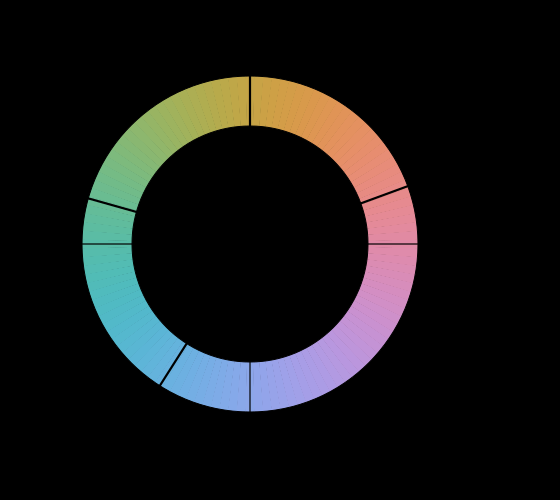
The four unique hues, and the axes they are said to define. A constant-lightness, constant-chroma ring in CIECAM16, with the four unique hue anchors marked and CIELAB's a and b axes drawn through the same circle. If a* really were the red-green axis the anchors would fall on the crosshairs. Unique red sits 25° off, and the four are not 90° apart in any case. Hatched sectors are hues this display cannot reach at this chroma.

Why there are four unique hues

Observers agree that four hues are elementary and that no colour is reddish green. Nothing in the three receptors predicts either fact, and the axes of every standard colour space miss the four by tens of degrees.

brain · Appearance
A hue circle through a per-channel curve. 28 colours on a circle of constant lightness 55 and chroma 38, each put through the tone curve one channel at a time and read back. The curve is a function of a single number and has no idea what hue is, and it rotates the circle by up to 4.4 degrees — largest at hue 260 — while raising chroma by a factor of 1.27 and lightness by about 1 units.

A contrast control is three controls

A tone curve is a function of one number at a time and knows nothing about hue. Applied to each channel separately it rotates a hue circle by up to seventeen degrees, raises chroma by a factor of 1.27 at ordinary strength, and lifts lightness — so a photographer who moves a contrast slider has moved three things and the interface names one of them. All three scale with the curve's strength, monotonically, and the hue rotation depends on which hue it is.

imaging · Capture
The same highlight, clipped in two places. A ramp running from inside the sensor's range to 1.6 times over it, clipped at the sensor and clipped after the matrix. Below the ceiling the two are identical to the floating-point floor. Above it they part, reaching 21.0 colour differences and 78 degrees of hue. Clipping late keeps a highlight neutral and clipping early keeps its hue, and converters do both.

Two converters and one highlight

The clip is the only step in a raw pipeline that destroys information rather than moving it, and it is the step whose position varies most between converters. Below the sensor's ceiling its position changes nothing at all, exactly. Above it, clipping at the sensor and clipping after the matrix land twenty-one colour differences and seventy-eight degrees of hue apart, and which hues are affected is a property of the camera's own dyes.

imaging · Capture
The model's hue scale, and the four numbers it is built from. Hue quadrature against hue angle. The four anchors are the unique hues, each with its own weight, and between them the scale is a hyperbolic interpolation rather than a straight line. The quadrant from blue back to red spans 143 degrees of hue angle for its hundred units of quadrature, against 70 for red to yellow.

The hue scale has four corners

CIECAM16 reports hue twice — as an angle in its own opponent plane, and as a quadrature interpolated through four unique hues with four fitted weights. The second is the one hue tolerances and hue-preserving mappings are written in, and it is piecewise — its slope jumps at each of the four anchors, by a factor of 1.74 at green and by 0.41 at blue, and it runs 4.1 times faster near yellow than near blue.

brain · Appearance
How far CIECAM16 moves a monochromatic hue when the light is brightened thirtyfold. A monochromatic stimulus at a relative luminance of 2 and of 60, read through CIECAM16 in one room, and the difference between its two hue angles. The model was never fitted to this effect and has it anyway: the shift is positive at the short end, negative through the greens, positive again in the yellows and reds, and crosses zero at 459, 495, 502, 570 nanometres. The marks are the invariant wavelengths the literature reports — 474, 506, 571.

The model has a hue shift it was never given

A monochromatic light changes hue as it is brightened, except at three wavelengths that do not move — an effect measured since the nineteenth century and not among the things CIECAM16 was fitted to. The model has it anyway: brightening a stimulus thirtyfold moves its hue angle, and the places where the movement crosses zero land at 459, 495, 502 and 570 nanometres against the reported 474, 506 and 571. The sizes are another matter.

brain · Appearance

Named alongside it

The objects these essays reach for when they reach for this one.

CIECAM16CIELABColour appearanceLightnessNamingSpecificationStructural choiceDeclared inputLuminanceTransfer functionUnique huesAbsolute luminance

All concepts