Concept

Subtractive mixture — where it appears

Colourants filtering the same light in succession, so that transmittances multiply and absorbances add. It is why mixing blue and yellow paint gives green and mixing blue and yellow light does not — two different arithmetics sharing one word.

Named by 9 essays across 3 fields — each of them below, with the objects they name alongside it.

Mixing two paints and stacking two filters are different operations. The same two reflectances combined two ways. Stacking them as filters multiplies the transmittances, which is right for gels in front of a lamp and wrong for pigment stirred into pigment: a stirred mixture is one scattering layer, not two in series, and light meets whichever particle is nearest rather than passing through both. Kubelka–Munk handles it by moving to K/S = (1 − R)²/2R, in which absorption and scattering add by concentration, and inverting afterwards. The two answers differ by ΔE00 = 15.0, and the filter model is the darker of the two because it charges every photon for both pigments.

Paint is not a filter

Stacking two filters multiplies their transmittances. Stirring two pigments together does not multiply their reflectances, because a mixture is one scattering layer rather than two in series — light meets whichever particle is nearest. Treating the two as the same operation is a 15-unit error, and which way it errs turns out to depend on whether the comparison holds the amount of pigment fixed.

scene · Scene
Why blue and yellow make green. 7 mixtures between a blue and a yellow pigment, mixed in Kubelka–Munk — K/S summed by concentration and inverted back to reflectance — and plotted against the straight line joining the two endpoints. The path bows towards green by 0.099 in chromaticity, and the reason is in the spectra rather than in the eye: the blue reflects below about 520 nm and the yellow above about 500, so the only band both return is the overlap between them. Mixing lights adds spectra and lands on the chord; mixing pigments intersects them and does not.

Why blue and yellow make green

The oldest fact in colour, and the usual explanations are wrong. It is not because green sits between blue and yellow, and it is not a fact about the eye at all — it is that the only band both pigments return is their overlap, and the overlap of a blue and a yellow reflectance is green. Computed, the mixing path bows away from the straight line by a measurable amount.
scene · Scene
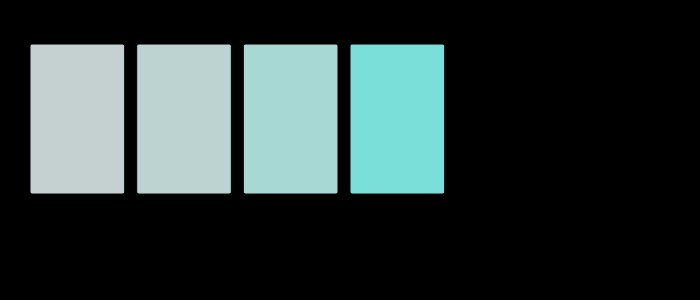
The same medium at six path lengths. Beer's law at 6 depths of one absorbing medium. The absorption coefficient is a single spectrum and the only thing changing is how far the light travelled, yet the patches differ in hue by 7.8° as well as in lightness — because absorption is exponential in depth and the observer is linear, so the bands that survive at d = 8 are not a scaled copy of the ones that survive at d = 0.25. Path length belongs to the geometry, not to the substance, which is why this sits in a field about scenes.

The colour is in the thickness

Transmittance is exponential in path length and the observer is linear, so doubling the depth of an absorbing medium squares the transmittance rather than halving the colour. A translucent object therefore has no one colour — its thin edge and its thick middle are different spectra of the same substance, and the hue moves between them.
scene · Scene
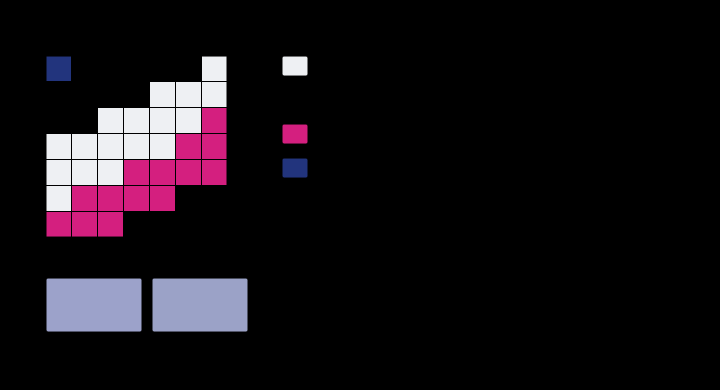
A halftone tint, its four regions, and what they average to. At 40% and 30% coverage the sheet is a mosaic of 4 fully-inked regions, not a mixture of anything. Their areas are the product of the coverages — Demichel's rule, which holds because the screens are rotated to make it hold — and the patch's reflectance is the area-weighted average of theirs, raised to the Yule–Nielsen exponent n = 1.8. Averaging the regions' CIELAB coordinates instead, which is what mixing means to almost everybody, lands ΔE00 = 0.76 away.

A halftone is not a mixture

Forty per cent cyan and thirty per cent magenta are not stirred together anywhere. They are laid down as dots, and the sheet is a mosaic of four fully-inked regions in proportions the two coverages fix — which is why the colour is an area average of four spectra rather than a blend of two, and why it lands nowhere near where mixing would put it.

applied · Delivery
The solids, by volume. CIELAB volume, all measured by the same cell count with the same extrapolation, and quoted against sRGB because that is the comparison the estimator supports. The four-colour press reaches 49 per cent of the sRGB solid's volume — and contains colours sRGB does not, which is why "half the gamut" is the wrong summary of a ratio of one half.

The fourth ink is not for colour

Black is in every process set and it extends the gamut by more than a third — and at every lightness above about forty it extends the chroma boundary by exactly nothing. What it buys is depth at the bottom, a neutral that holds its hue when the press drifts, and a way to put a full-strength dark on a sheet that could not carry three inks' worth of it.

applied · Delivery
The solids, by volume. CIELAB volume, all measured by the same cell count with the same extrapolation, and quoted against sRGB because that is the comparison the estimator supports. The four-colour press reaches 49 per cent of the sRGB solid's volume — and contains colours sRGB does not, which is why "half the gamut" is the wrong summary of a ratio of one half.

The fifth ink buys a corner

Orange, green and violet are sold as the answer to a four-colour press's gamut, and each one adds seven to nine per cent of volume. All three together add 23 per cent — almost exactly the sum, with no interaction — and every bit of it lands in the region of the ink that was added, at lightnesses where that ink is dark.

applied · Delivery
What the interface does to a reflectance, and the straight line it is taken for. The Saunderson relation between the reflectance inside a pigment layer and the reflectance an instrument reads off it, for a boundary of refractive index 1.50. The curve is the real map; the dashed line joins its two endpoints, which is the straight relation an additive pedestal assumes. They are 0.216 of a reflectance unit apart at their widest, which is 5 times the pedestal itself. The curvature comes from the k₂ term — light reflected back down into the layer from underneath the boundary — which is 0.60 where the outward reflection is 0.04.

A mixture in the variable nobody named

Kubelka–Munk works because absorption and scattering add over a mixture and reflectance does not. What adds is the absorption of the pigment layer, and what an instrument reports is that layer seen through an interface — related by a Möbius function rather than by a constant. Mixing in the reported variable instead of the internal one costs between three and eight ΔE₀₀, and no source this collection quotes says which variable its curves are in.

scene · Scene
Which way a tint turns a pigment's hue, made in paint and made in light. For eight pigments tinted nineteen parts white to one of colour, the Oklab hue turn from the pure pigment: of the tint made in paint (upper bar) and of the additive mixture with white at the same luminance (lower bar). For seven of the eight the two point in opposite directions. The orange turns +13.5° in paint and −13.9° in light.

A tint in paint turns the other way

A pale colour can be made two ways: by stirring white pigment into a coloured one, or by adding white light to it — which is what a halftone on white paper and a display both do. At the same luminance the two tints are not the same colour. For seven of eight pigments they turn the hue in opposite directions, an orange by +13.5 degrees in paint and −13.9 in light, and the paint tint is the more colourful of the two every time. The cause is in the reflectance: diluting a pigment moves its absorption edge, and adding light does not.

brain · Appearance
A halftone tint, between the two ideals and nearer one of them. For each pigment, how far the hue turns when it is tinted to the same lightness three ways: mixed with white pigment, mixed with white light, and printed as a halftone at a Yule–Nielsen factor of two. Right is towards a longer wavelength. 7 of the eight pigments' two ideals turn the hue opposite ways. The halftone mark sits between them at every pigment and between 26 and 44 per cent of the way from the light ideal to the paint one — so it keeps the additive tint's direction and loses about a third of its size.

Printing does not change the sign

A tint mixed in paint and a tint mixed in light turn seven of eight pigments' hues opposite ways. A halftone sits between the two because light entering the paper between dots emerges under a dot, and the question was where. At the optical gain a coated sheet is fitted at, a halftone has travelled between 26 and 44 per cent of the way from the light ideal to the paint one — the same fraction for every ink — and only one pigment in eight changes direction.

brain · Appearance

Named alongside it

The objects these essays reach for when they reach for this one.

ReflectanceHalftoneKubelka munkPigmentAbsorptionAdditive mixtureChromaticityProcess inksStandard observerColour managementGamutHue

All concepts