The thread: Computed, not quoted — page 5
 What the brain does
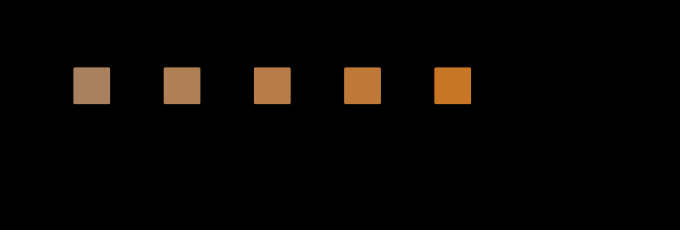
There is no brown light
Brown is dark orange, dark is a ratio to a white, and a light in a dark room has no white to be dark against. The same stimulus, unchanged in XYZ, runs from lightness 152 to lightness 16 as the surround is raised — and only the bottom of that range has a name.
 What the brain does
An afterimage is an adaptation
The demonstration everybody gives is an inverted image, which is a statement about a file format. Running the receptoral arithmetic instead puts the afterimage of a saturated red sixty degrees of hue away from the inverse — and outside what any display can show.
 Where the model breaks
Banding is not a bit depth
Eight bits bands at thirty times threshold in the shadows and at under three at mid grey, on the same ramp with the same encoding. What decides is where in the tone scale the gradient sits, how sharp each step's edge is, and how far away the reader is — and a bit count contains none of the three.
 Where the model breaks
The gamut shrinks in the dark
Every gamut number here is a property of a device and of nothing else, which is why the same display has the same gamut in a studio and in a cinema. It does not. Turn the room down four decades and the solid loses a fifth of its reach and two thirds of its volume, with the signal unchanged.
 Where the model breaks
The model has no clock
An appearance model takes a stimulus and a situation and returns what it looks like. It does not take a time, and adaptation is not instantaneous — half a second after the light changes a judgement is three and a half CAM16-UCS units from the settled one, and a minute later it is still 1.3.
 What the eye does
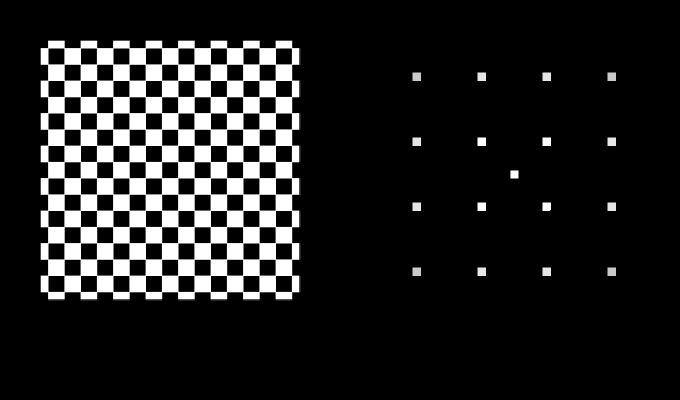
A pattern has a direction
Every spatial claim here is a claim about a frequency, and a frequency has no direction in it. Turning a printed screen forty-five degrees makes it exactly twice as quiet with nothing else changed — and the same rotation does nothing at all to a chromatic one.
 What the eye does
Colour stops at the edge of sight
Cone density falls twenty-one-fold between the centre of gaze and ten degrees out, and the three channels give out at three different rates — so a colour difference in the periphery does not merely shrink, it turns. At the exact point of fixation there are no short-wavelength cones at all.
 What the eye does
The eye has a shutter
An isoluminant flicker fuses at fifteen hertz and a luminance one at sixty, so a light whose colour changes forty times a second is a steady light of a colour it never emits. And the frequency at which flicker stops being visible is not a property of the eye — it moves twelve and a half hertz for every decade of light.
 What light is
A lamp has a waveform
A lamp modulating a thousand times a second is a hundred times past the frequency at which flicker fuses, and it is plainly visible — as a dotted trail, during any glance across the room. The reason is not a new measurement; it is the spatial contrast sensitivity function, arriving from an unfamiliar direction.
 What light is
White is a region
A lamp is not sold as a chromaticity. It is sold as 4000 K, and what that means is that its chromaticity fell inside a quadrangle — which two lamps can occupy at opposite corners, eleven ΔE00 apart. In a room with either of them, the same twelve surfaces differ by one unit.
 What light is
A screen is a poor lamp
A display's white is a light. Shone on a surface it renders colour worse than a fluorescent tube — and the wider the gamut, the worse it gets, because the narrow primaries that buy a large triangle are exactly the ones that leave holes in the spectrum.
 Difference and uniformity
Which of two is worse
Two colour-difference formulae disagree about which of two pairs is the larger difference in thirteen per cent of comparisons overall — and in forty-three per cent of comparisons among pairs sitting near a tolerance of one unit, which is where every acceptance decision is actually made.
 Difference and uniformity
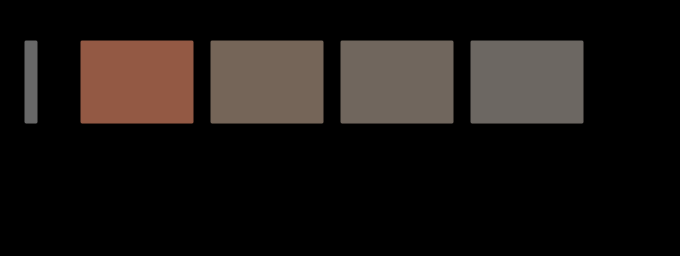
A difference has no place
A colour difference formula answers a question about two patches somebody is looking straight at. Move the same pair ten degrees into the periphery and a third of it is left — and it has turned twenty-four degrees of hue, because the three channels give out at three different rates.
 Matching and measuring
The laws that make colour add up
Colorimetry is an integral, and an integral assumes matching is linear. Grassmann's four laws are exact for a linear observer, to floating point — and they fail at both ends of the light range, by two different mechanisms, leaving colorimetry an operating band of three and a bit decades that no standard states.
 Matching and measuring
One match names the observer
A yellow at 589 nanometres set against a mixture of 545 and 670 is two equations in two unknowns. It has one solution for a normal observer, a solution somewhere else for an anomalous one, and no unique solution at all for a dichromat — whose two equations are one equation twice.
 What the brain does
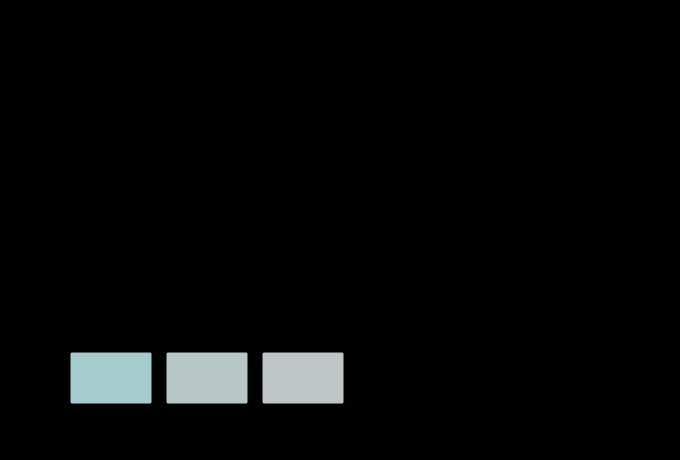
A gain has a time constant
An afterimage and the clock on chromatic adaptation were built in different files from what the last phase said was one mechanism. Joining them removes a free parameter, reproduces both, and predicts a third thing — that two people in one room, at one moment, looking at one patch, do not agree about its colour.
 What the brain does
The eye is never still
A perfectly stabilised retinal image disappears within seconds. What keeps the world there is a drift of about half a degree a second between the microsaccades — fast enough to keep the finest detail modulating and slow enough not to carry it past fusion, in a band whose upper edge is at 0.71 degrees a second.
 Where the model breaks
A display in a room is a smaller display
Two results here turn the room's light in opposite directions and neither knows about the other. A room has one light level and does both at once — so there is a brightness at which a display delivers the most colour, it is not at either end, and it scales with the panel.
 Where the model breaks
Nobody here has two eyes
One person's two eyes differ in macular pigment and lens density, so the same light produces two colours — a whole ΔE00 apart for an ordinary pair, seven for one replaced lens. Adaptation hides it exactly, which is why nobody notices and why nothing in colorimetry has a term for it.
 Where the model breaks
Every threshold was measured with a grating
An earlier essay here claimed that the model cannot explain why dither works, and named two missing pieces. One of them was real and worth thirteen times the guess; the other was not needed. The piece nobody named was the detector — and reading the same model two ways changes the answer by a factor of fifty.
 What the brain does
A colour has a name
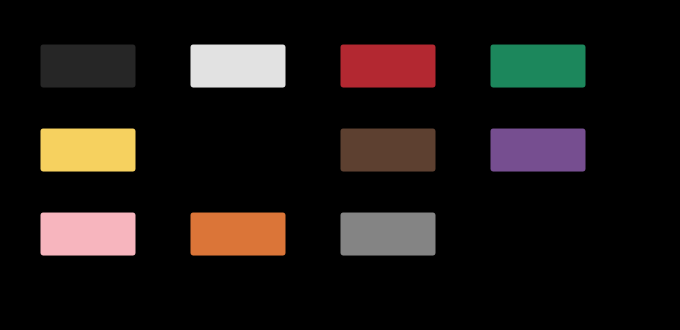
Every quantity here is a number, and the question a reader arrives with is what colour something is called. The eleven basic terms of English divide the space into territories that differ by a factor of five, the metric accounts for fifteen per cent of that, and one of the eleven focal colours cannot be shown on this page at all.
 What the brain does
A name is not a threshold
Two colours have to move about ten times a just-noticeable difference apart before people stop calling them the same thing, and how far varies threefold across one plane of the space. A tolerance and a word are answering different questions, and nothing in colorimetry converts between them.
 Matching and measuring
A catalogue is not a vocabulary
A colour order system is a regular lattice, because a person has to be able to find a page. Sorted by what its chips would be called, that lattice comes apart into piles differing by a factor of three — and a fifth of all one-step moves in it change the name.
 Matching and measuring
Four primaries have a choice
Three primaries matching three numbers have one answer. Four have a family of them, every member exact to floating point for the observer they were solved for — and the members are not equally good for anybody else, so a display with a fourth primary has a setting that is robust to who is looking at it and a setting that is not.
463 essays on this thread, page 5 of 20 · all threads · all essays